I'm sure you've noticed how Spanish or French versions of things often come out longer. A case in point: my computer speaker has a big round button, which underneath says
PUSH TO MUTE
and also
APPLIYER POUR ACTIVER LA SOURDINE
Hee.
Saturday, March 28, 2009


Thursday, March 26, 2009
Wednesday, March 25, 2009
Notes

Lately I've noticed how very helpful notes are - not just notes I've already taken, but the writing of notes itself. Here are situations, some more common than others, in which writing notes helps me:
- To-do lists. I don't write large or ongoing to-do lists and keep them for weeks, but I find them helpful for a few tasks I need to do within a couple of days.
- Breaking down a task. Sometimes when I'm not sure how to tackle something, or just can't quite get myself started, I can write it down in tiny steps and get kick-started that way.
- Handling confusion. When I get confused about a problem - at school or work - writing out my questions and concerns (neatly, in complete sentences, slowly) is often surprisingly helpful. I will either get an answer to my problems or great insights about how to approach them. (The picture with this post is an example of some of this type of note-taking; I took these notes a few minutes ago and they have jump-started a task I had completely stalled at.)
- Reading difficult material. Recently, I've been trying to read some math journal articles. I decided that since I write down things like axioms and theorems when I take notes in class, I might as well directly copy them from journal articles as well. And guess what? It helps! A lot! I think the process of slowing down and being methodical makes me a lot more likely to understand material. I have also found this works wonders for reading math textbooks. It feels silly to copy out the exact lines of an example worked in the book, but it aids understanding immensely.
Wednesday, March 18, 2009
Cooking Experiment
 For the past few months, Ed and I have been trying to make and eat dinner together more. We've stuck pretty well to our original goal of having me cook for us twice a week and him once a week. A meal is typically weekday dinner or weekend brunch, and we try (and have so far managed) to include protein, vegetables (and/or fruits), and some kind of starch. I often include a whole grain when it is my turn. (I did not make the meal in this picture, but it looks like my type of thing.)
Last night, for instance, I made boneless pork chops (broiled in the oven), brown basmati rice (plain, but cooked with salt and butter), and asparagus (sauteed in a pan with olive oil, crushed red pepper, and garlic). It made a very pretty meal, actually, and the asparagus was pleasingly spicy.
Here is what I have learned so far:
- I much prefer cooking for the two of us to making my own dinner, even though when I cook for just myself it is much easier (because I don't make such elaborate things).
- I actually really enjoy making dinner for us.
- I prefer cooking several things to making a one-pot dish. I am especially fond of the protein/starch/vegetable trio, often with a very plain vegetable.
- Any kind of fish can be cooked with oil and butter in a pan and come out delicious.
- Excluding (bizarrely) restaurant food, I view food cooked by other people with suspicion and distrust.
- I like to control what we have for dinner.
Tuesday, March 17, 2009
Once He Was
I've owned this album for years, but lately (perhaps because Pandora has been playing it for me) I've gotten obsessed with "King of Spain" by Moxy Früvous. I think the whole thing is quite clever, but I especially like the policy details mixed in with the silliness, as here:
Royalty, lord it looked good on meHere is the song (along with a video someone made up to go with it):
Buried in silk in the royal boudoir or going nuclear free
Or playing Crokinole with the Princess of Monaco
Telling my jokes to the OPEC leaders, getting it all on video.
Sunday, March 15, 2009
Passive-Aggressive Tendencies
It's important to me to keep getting better in whatever ways I can. Of course, I start out with a basic package of assets and flaws, and my relative strengths and weaknesses may not change all that much over time. But I do work on many of the things about me that are troublesome.
Something I've worked on a lot in my relationship with Ed is passive aggressiveness. I've never thought of myself as particularly passive-aggressive, and I don't think most people would characterize me that way (in the spectrum of humanity), but I definitely have tendencies. Ed is particularly sensitive to it, and that has...helped.
When I get angry with someone, my first impulse is to be silent at them. Once I reject that option, the next few that come up on the list are also passive-aggressive. I could make a snide remark to let them know I'm angry. I could say something sarcastic. Or I could just go somewhere else and wait for them to figure out that I'm avoiding them on purpose.
These days, I try to first think and determine whether the anger seems justified or not. If it isn't, or if I can't tell, I'll say something like, "This may not be fair. But I'm feeling kind of angry [about X]." Otherwise I'll just say the angry part.
Even at this point (and Ed is amazing supportive of this type of communication), it's hard for me not to follow up with passive-aggressive remarks like, "I guess I just thought you would have known how that would make me feel," or, "I guess I just trusted that you knew how to cook a steak," or, "Never mind - I shouldn't have thought you'd get it."
It's not that being passive-aggressive is generally so very awful. There are definitely worse ways to handle anger. But I think my tendency to be this way comes from feeling essentially powerless whenever I am angry. I see no hope of remediation, and that's what makes me want to just snub the other person. I feel contemptuous or fundamentally angry towards them, as though whatever has happened changes the underlying reality of the whole relationship.
I am actually getting a lot better at this through practice, this thing of just saying, "I am angry. Here is why," and listening to the response and working through it. For me, right now, in this relationship, even when it turns out that my anger is unfair I seem to be better off expressing it.
Something I've worked on a lot in my relationship with Ed is passive aggressiveness. I've never thought of myself as particularly passive-aggressive, and I don't think most people would characterize me that way (in the spectrum of humanity), but I definitely have tendencies. Ed is particularly sensitive to it, and that has...helped.
When I get angry with someone, my first impulse is to be silent at them. Once I reject that option, the next few that come up on the list are also passive-aggressive. I could make a snide remark to let them know I'm angry. I could say something sarcastic. Or I could just go somewhere else and wait for them to figure out that I'm avoiding them on purpose.
These days, I try to first think and determine whether the anger seems justified or not. If it isn't, or if I can't tell, I'll say something like, "This may not be fair. But I'm feeling kind of angry [about X]." Otherwise I'll just say the angry part.
Even at this point (and Ed is amazing supportive of this type of communication), it's hard for me not to follow up with passive-aggressive remarks like, "I guess I just thought you would have known how that would make me feel," or, "I guess I just trusted that you knew how to cook a steak," or, "Never mind - I shouldn't have thought you'd get it."
It's not that being passive-aggressive is generally so very awful. There are definitely worse ways to handle anger. But I think my tendency to be this way comes from feeling essentially powerless whenever I am angry. I see no hope of remediation, and that's what makes me want to just snub the other person. I feel contemptuous or fundamentally angry towards them, as though whatever has happened changes the underlying reality of the whole relationship.
I am actually getting a lot better at this through practice, this thing of just saying, "I am angry. Here is why," and listening to the response and working through it. For me, right now, in this relationship, even when it turns out that my anger is unfair I seem to be better off expressing it.
Friday, March 13, 2009
Spoiler-Free Review of Watchmen
 Ed and I saw Watchmen tonight, in IMAX glory. And I promise this (brief) review will be completely spoiler-free, so read without fear.
I either read or started to read Watchmen years ago while dating Robin. At any rate, I didn't remember anything about the plot at all, though the opening sequence of the film was very familiar and I think it was shot a lot like you'd expect from the beginning of the book. I was glad not to know the plot going in.
I should preface this by saying that I have a hard time getting into any kind of plot-based action movies, especially superhero movies. I saw Iron Man. Watched The Dark Knight. They didn't really do anything for me even when I could recognize the artistry. I wasn't really drawn in at all, and they felt tedious to watch and I waited for the plots to resolve. Honestly, I feel similarly about the more recent three Star Wars movies and about The Lord of the Rings and the Harry Potter movies. I can modestly enjoy them but I wouldn't go see them if they weren't blockbuster spectaculars that one should see. (And I saw a lot of those with Mosch, who always wants to have seen those movies.) Oh, and Pirates of the Caribbean and the sequels. Same deal.
But Watchmen I liked. I mean, I really, really liked it. I was aware while I was watching it that I was just having a fantastic time.
I'm trying to think why that was. I think that, unlike with most other action movies, I was actually into the characters. Other than perhaps the romantic female lead (if you can call her that), any time a character was on screen I was watching in a mesmerized fashion. I found every one of the men attractive in some unusual way. I just wanted to look at them all day. And somehow that really helps.
The movie is gory in parts - more gory than I prefer. It is probably what Robin would call "cartoon-like violence," but for me it was mostly just violence. But I was willing to tolerate it in order to see the rest of the movie, and only one part really disturbed me.
It has a lot of fighting, but as best I can recall no high-speed chasing types of sequences, which was good since those usually bore me. There was interesting machinery and structures. And beauty.
So, if you're at all inclined to see it, go. You'll probably like it.

Wednesday, March 11, 2009
Ed's New Job
 Ed starts his first post-college job next week - a regular corporate office job. It will actually be a 3-month internship, at the close of which he will hopefully be hired as a permanent employee.
It's kind of an exciting time. He's never had a corporate job before and I'm looking forward to him having a working experience similar to mine. I feel like he doesn't really understand what working in this type of job is like, though all types of work have their ups and downs, and I certainly don't know what trying to write a thesis is like (though I think I would suck at it).
It'll also be challenging for us. Our relationship goes more smoothly when I'm not in school, when Ed is not stressed, when things are...easy. And having your first full-time office job is not easy. Being unemployed is stressful but also easy in terms of having plenty of time for rest and recreation.
But overall it's exciting. I hope Ed has a great time doing a kind of work where, when you come home at night, you're done. I don't think he's ever had that luxury. And just...all the various aspects of working life. (Oh. And they pay you. That's good too.)
Bring it on!
Tuesday, March 10, 2009
The One We Left Blank
Last week, I had a test in Principles of Programming Languages. I knew I wasn't fully prepared, but I had gone through my notes and looked for ways to review the things I would have to do on the test. (The whole test was "do this" types of questions - no factual questions at all. It was nice, actually. And it was open notes.)
 The last question on the test was about recursive descent parsing. We were supposed to write some code to go with some existing code to do a little piece of it, and I just...couldn't. I couldn't figure out how to access the variables I would have needed from the code block I was to write, and I wasn't sure how it was supposed to work anyway. I wrote a couple of lines and then gave up, essentially leaving it blank. Time was up anyway - I had spent most of the two-hour class period doing the first 7 problems.
So I was expecting a B.
Last night, when I got the test back, I had scored 55/56, or 98%.
"I didn't grade Question 8," the professor said. "By the time I got there I was just like ... eh. This is enough. No, not really. It's just, I looked, and most of the answers were blank. And the rest were...varying degrees of pseudocode that...yeah. So I decided not to grade it."
It seems fair. Our class has no textbook or any other kind of outside material. If basically nobody can make a decent attempt at answering a test question, it seems likely that you didn't actually teach the material.
And, of course, I was personally pleased to be one of many fuck-ups rather than an individual unique fuck-up.
The last question on the test was about recursive descent parsing. We were supposed to write some code to go with some existing code to do a little piece of it, and I just...couldn't. I couldn't figure out how to access the variables I would have needed from the code block I was to write, and I wasn't sure how it was supposed to work anyway. I wrote a couple of lines and then gave up, essentially leaving it blank. Time was up anyway - I had spent most of the two-hour class period doing the first 7 problems.So I was expecting a B.
Last night, when I got the test back, I had scored 55/56, or 98%.
"I didn't grade Question 8," the professor said. "By the time I got there I was just like ... eh. This is enough. No, not really. It's just, I looked, and most of the answers were blank. And the rest were...varying degrees of pseudocode that...yeah. So I decided not to grade it."
It seems fair. Our class has no textbook or any other kind of outside material. If basically nobody can make a decent attempt at answering a test question, it seems likely that you didn't actually teach the material.
And, of course, I was personally pleased to be one of many fuck-ups rather than an individual unique fuck-up.
Thursday, March 05, 2009
Desargues' Theorem
My geometry class this semester seems to revolve around Desargues' Theorem (pronounced dezargs), which is a slightly complicated theorem that doesn't hold in the Euclidean plane, but holds in a lot of projective spaces. It took me a long time to be really comfortable with it, but it now seems quite simple to me, probably because of the dozens of times that I have drawn and explained it.
Desargues' says, simply, that if two triangles are perspective from a point, they are also perspective from a line.
"Perspective from a point" is relatively simple, though it took me a while to learn what motivated calling it that.
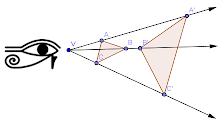
 In this picture, the two triangles ABC and A'B'C' are perspective from V because if you were looking from V (hint: like the giant eye), the corresponding points of the triangles would be on the same lines. (Here, "triangle" actually refers to the points, not the line segments or the interior, though it's not very important in this case.)
"Perspective from a line," alas, doesn't allow quite such a simple explanation. What it means is that the intersections of the corresponding sides (e.g., where AB crosses A'B', if you extend the line segments) are collinear, or all on the same line. Let's expand the drawing above to include those points and their (possible) line of perspective. (Note: I've also moved the points around slightly to make the intersections show up.)

Here, I've colored the corresponding sides the same color, so AB and A'B' are blue, AC and A'C' are red, and BC and B'C' are green. Where each pair intersects, you get the purple points L, M, and N, and the big purple line goes through all of them. So, in this case, Desargues' Theorem does hold: ABC and A'B'C' are perspective from both V and the the purple line.
The only reason Desargues' doesn't always hold in a Euclidean plane (the kind of geometry we're used to) is that some of the lines might be parallel. For instance, if AC and A'C' were parallel, N (their intersection) wouldn't exist. Projective geometry basically does away with parallel lines, so it doesn't have that limitation.
Desargues' says, simply, that if two triangles are perspective from a point, they are also perspective from a line.
"Perspective from a point" is relatively simple, though it took me a while to learn what motivated calling it that.
 In this picture, the two triangles ABC and A'B'C' are perspective from V because if you were looking from V (hint: like the giant eye), the corresponding points of the triangles would be on the same lines. (Here, "triangle" actually refers to the points, not the line segments or the interior, though it's not very important in this case.)
"Perspective from a line," alas, doesn't allow quite such a simple explanation. What it means is that the intersections of the corresponding sides (e.g., where AB crosses A'B', if you extend the line segments) are collinear, or all on the same line. Let's expand the drawing above to include those points and their (possible) line of perspective. (Note: I've also moved the points around slightly to make the intersections show up.)

Here, I've colored the corresponding sides the same color, so AB and A'B' are blue, AC and A'C' are red, and BC and B'C' are green. Where each pair intersects, you get the purple points L, M, and N, and the big purple line goes through all of them. So, in this case, Desargues' Theorem does hold: ABC and A'B'C' are perspective from both V and the the purple line.
The only reason Desargues' doesn't always hold in a Euclidean plane (the kind of geometry we're used to) is that some of the lines might be parallel. For instance, if AC and A'C' were parallel, N (their intersection) wouldn't exist. Projective geometry basically does away with parallel lines, so it doesn't have that limitation.
Tuesday, February 24, 2009
Enjoyment Can Regress
 Mosch and I used to go on a lot of hikes, bicycle rides, etc., and over time I noticed a very strong pattern: experiences that were difficult in the moment often magically transformed into enjoyable after they were done. I could be miserable, sweaty, and working way too hard, and later on say, "Man, that hike was awesome!"
Once I realized this, the point of enjoyment moved backwards in time. I would start thinking the hike was great immediately after we got done. And then eventually I started really enjoying the hike while still hiking. I don't know for sure, but I think there was a causal relationship - the knowledge that I would later feel that I had enjoyed the outing led me to enjoy it in the moment.
I'm finding the same thing with math these days. I keep saying that Ed and I talk about math a lot and implying that it's fun, but in the moment, it's often actually difficult and frustrating. He raises a lot of questions that I don't want to go into because, damn it, I want to get where I'm trying to go, not take a lot of painful side trips. I don't want to work "uphill" all the time. I want to only talk about the parts I understand. I certainly don't want to learn anything new.
But later, I invariably retrospectively enjoy the conversations. It's not just that I enjoy having had them; I actually feel as though, in retrospect, I enjoyed them at the time. The memories are pleasurable. And I now feel that enjoyment regressing, happening earlier and earlier. Sometimes I am even aware of enjoying the math conversations in the moment.
Does this happen to other people?
Monday, February 23, 2009
Oral Exam
I had my oral exam in geometry today. I spent almost the entire weekend (with some breaks for meals, roleplaying, and Diablo) preparing myself for it. The prof had given us a list of examples, theorems, definitions, and problems from the book that he might ask us about during the exam, and I wrote up and/or reviewed all of them for myself. Today at lunch, I went over a couple of the more complicated ones again, just to be sure I could do them. (There was one I still never could do properly, but the rest I was fine on.)
I had envisioned that he might ask me a couple of questions. I was worried that he might ask me the one I couldn't quite get. The grading scheme for these oral exams (and for presentations in this class) is good/fair/poor (95/75/35), with a possible 100 if you are magically perfect, or a 0 if you totally don't do it. I knew I would get at least the 75, but I would have been very disappointed; I wanted the 95 and thought that was realistic.
Instead of a couple of questions, he had me do problems (at a chalkboard) for the full half hour, and actually a little bit beyond. He gave me my choice of the first problem, and I chose a nice hard one that I did understand, and when he asked me if there was another one I liked, I said that there was only one I could not do, and so we discussed it a bit. (It was one of the homework problems, and he said that my proof was actually better than his except that I did have that one minor thing I wasn't able to do. So that was cool. He had copied my proof - with corrections - on the answer key after his own, saying, "Here is a better way to prove this, courtesy of one of your fellow students." This is the homework that I got the C on.)
He didn't make me do the one I couldn't do - we just talked about it - but we did a ton of other ones. I was able to handle all of them. He said, at one point, "These problems are too easy for you," and, for the first time in my life, I wanted to assure him that I had actually worked quite hard to develop the mastery I was displaying and was not finding the class to be a cakewalk at all.
 In the end, he gave me the 100, which wasn't even on my radar of possible scores. I left feeling like a Brilliant Math Genius. He also asked me if I was planning to go to grad school in math, and said that I should.
Afterwards, we talked a bit about the course, and I told him that the homework that I got the C on was extremely long, conceptually. He said he is just starting to figure out where everyone is. And apparently my 14 out of 18 points was the highest grade on that assignment. So...yeah. He might need to adjust his thinking a bit.
I had envisioned that he might ask me a couple of questions. I was worried that he might ask me the one I couldn't quite get. The grading scheme for these oral exams (and for presentations in this class) is good/fair/poor (95/75/35), with a possible 100 if you are magically perfect, or a 0 if you totally don't do it. I knew I would get at least the 75, but I would have been very disappointed; I wanted the 95 and thought that was realistic.
Instead of a couple of questions, he had me do problems (at a chalkboard) for the full half hour, and actually a little bit beyond. He gave me my choice of the first problem, and I chose a nice hard one that I did understand, and when he asked me if there was another one I liked, I said that there was only one I could not do, and so we discussed it a bit. (It was one of the homework problems, and he said that my proof was actually better than his except that I did have that one minor thing I wasn't able to do. So that was cool. He had copied my proof - with corrections - on the answer key after his own, saying, "Here is a better way to prove this, courtesy of one of your fellow students." This is the homework that I got the C on.)
He didn't make me do the one I couldn't do - we just talked about it - but we did a ton of other ones. I was able to handle all of them. He said, at one point, "These problems are too easy for you," and, for the first time in my life, I wanted to assure him that I had actually worked quite hard to develop the mastery I was displaying and was not finding the class to be a cakewalk at all.
In the end, he gave me the 100, which wasn't even on my radar of possible scores. I left feeling like a Brilliant Math Genius. He also asked me if I was planning to go to grad school in math, and said that I should.Afterwards, we talked a bit about the course, and I told him that the homework that I got the C on was extremely long, conceptually. He said he is just starting to figure out where everyone is. And apparently my 14 out of 18 points was the highest grade on that assignment. So...yeah. He might need to adjust his thinking a bit.
Sunday, February 22, 2009
A Bad Grade
Last week, in my Geometry course, we had a homework assignment consisting of 5 problems, 4 of which were proofs. I spent many, many hours on it. I probably spent at least 10 hours writing the proofs up, plus numerous other hours thinking about them, discussing them with Ed, working on them in my head, scribbling notes on pieces of paper, drawing diagrams, and so on. There were mornings when I woke up with a clear sense of having worked on a proof all night in my head. (And indeed, in one case I was able to wake up and quickly resolve my remaining issues and then write the proof. All before the alarm went off.)
I got 78% credit on the assignment.
I'll grant you that the class median was 64%, and the average grade was even lower. Most of the class did worse than I did, which comports with my experience of generally being an above average student in my classes.
But I worked fantastically hard on that assignment. What I turned in was six very neat pages of proofs, handwritten, with diagrams. All but one of the proofs was, as best I can determine (I haven't gotten the homework back yet, just seen the grade online), correct, and the incorrect proof had only a trivial section that I wasn't able to complete. The professor's solutions take up 3 pages of single-spaced type, so it was a long assignment, and not just for me.
It's not that I think I should get high grades just because I worked hard. (I certainly don't want other people who work hard to get the same grades as me if I outperform them. That may be uncharitable but I also think it's not good for grades to work that way.) But it's disheartening to have spent so very many hours producing so very much good work and get a C.
What I have to remind myself of is that this class is an elective. I signed up for it because I thought it would be fun, interesting, a challenge, and good on my transcript (assuming, you know, I don't get a C in the class, which I most likely won't). And right up until I got that stupid grade, I was enjoying the whole thing immensely. I had a wonderful time doing that homework. I was fantastically engaged. I talk about this stuff with Ed all the time for pure fun, and my understanding of it is pretty strong (relative to what I think is reasonable for being at this point in the course). The geometry is beautiful, clean, and thrilling.
I need to use the grade(s) only as motivation to keep stretching because I love the stretching itself. I can't let myself be demotivated by some sense of futility when I'm only doing this for the joy of it anyway.
I got 78% credit on the assignment.
I'll grant you that the class median was 64%, and the average grade was even lower. Most of the class did worse than I did, which comports with my experience of generally being an above average student in my classes.
But I worked fantastically hard on that assignment. What I turned in was six very neat pages of proofs, handwritten, with diagrams. All but one of the proofs was, as best I can determine (I haven't gotten the homework back yet, just seen the grade online), correct, and the incorrect proof had only a trivial section that I wasn't able to complete. The professor's solutions take up 3 pages of single-spaced type, so it was a long assignment, and not just for me.
It's not that I think I should get high grades just because I worked hard. (I certainly don't want other people who work hard to get the same grades as me if I outperform them. That may be uncharitable but I also think it's not good for grades to work that way.) But it's disheartening to have spent so very many hours producing so very much good work and get a C.
What I have to remind myself of is that this class is an elective. I signed up for it because I thought it would be fun, interesting, a challenge, and good on my transcript (assuming, you know, I don't get a C in the class, which I most likely won't). And right up until I got that stupid grade, I was enjoying the whole thing immensely. I had a wonderful time doing that homework. I was fantastically engaged. I talk about this stuff with Ed all the time for pure fun, and my understanding of it is pretty strong (relative to what I think is reasonable for being at this point in the course). The geometry is beautiful, clean, and thrilling.
I need to use the grade(s) only as motivation to keep stretching because I love the stretching itself. I can't let myself be demotivated by some sense of futility when I'm only doing this for the joy of it anyway.
Tuesday, February 17, 2009
The Whiteboard
 A couple of weeks ago, Ed bought a whiteboard for our apartment ($8 at Walmart). He already had a tripod-style easel that his mom gave him, so this easel-mounted whiteboard now lives in his room. The idea was to make it easier for us to show each other things, and also as a general math-working space for him (I think).
Last night, quite late, he was eating dinner and I wanted to show him the smallest finite projective plane (the Fano Plane). It's really hard to show someone something on paper, because you just can't write on paper while holding it such that the other person can see it, at least not easily. This is doubly true if the person is trying to eat a plate of pasta at the same time.
"Want to use the whiteboard?" he asked.
 It was our first time to try it together. He got to chill out sitting on his bed with the pasta while I drew and explained the plane (shown at left). And it was awesome.
I wasn't that into having a whiteboard, but now I can't see how we could live without it.
Friday, February 13, 2009
Clever Programming
There are certain programming language features that my Principles of Programming Languages professor disapproves of. For instance, in C (and, to a slightly lesser extent, Java), the operator
will do the something if a is equal to b, and not otherwise. On the other hand, the operator = sets one value to be equal to another. For instance,
However, the
This sets a equal to b and does something if b was true. Unfortunately, it also leads to rampant errors, because when people type
So, my professor is against using
I would be saying "If k is equal to three (and, by the way, after you do that, increment k by 1)..", but if I wrote
I would be saying "Increment k, then if it's equal to 3..."
Clever! It saves you a whole line of code, and makes your code harder to maintain and more error-prone at all once!
 A guy in my class (who looks like a young, evil Vincent D'Onofrio) argued back, saying that he always uses such methods when possible. He argued that anyone who knows the language should be able to read a statement like
so that he is not worried that it won't be understood. He doesn't work with CS1 students, after all. Someone who wouldn't understand these basic language features is worthy only of contempt, he suggested.
What I think he's missing is that maintenance makes up most of the costs associated with code, and every time that it takes someone 10% longer to read a line of your code, or even 5% more likely to make an error in maintaining it (not to mention your own increased chances of error in writing it), it un-pays for itself. And what was the benefit to begin with? Occasionally getting to skip some typing? Feeling clever by combining statements?
I think it's foolish.
== is used to compare two things. For instance,if (a == b) {
(do something)
}will do the something if a is equal to b, and not otherwise. On the other hand, the operator = sets one value to be equal to another. For instance,
a = b will take the value in b and store it in a.However, the
= operator also returns the value of b, so if you want to be clever, you can do something likeif (a = b) {
(do something)
}This sets a equal to b and does something if b was true. Unfortunately, it also leads to rampant errors, because when people type
if (a = b) they almost always meant if (a == b), and if = did not return a value, then the compiler would let you know you were making a mistake.So, my professor is against using
= in an if statement; it's the kind of clever thing that leads to mistakes. He also inveighs against things like using the ++ operator in an expression. If you write a++ it will increment a by 1 (so it is the same as a = a + 1). No problem there. ++a does the same thing. But where they are different is that they each return a value, but ++a increments a before returning it, and a++ increments it after returning. So that if I said something likeif (k++ == 3)I would be saying "If k is equal to three (and, by the way, after you do that, increment k by 1)..", but if I wrote
if (++k == 3)I would be saying "Increment k, then if it's equal to 3..."
Clever! It saves you a whole line of code, and makes your code harder to maintain and more error-prone at all once!
A guy in my class (who looks like a young, evil Vincent D'Onofrio) argued back, saying that he always uses such methods when possible. He argued that anyone who knows the language should be able to read a statement likeif (a = ++k)so that he is not worried that it won't be understood. He doesn't work with CS1 students, after all. Someone who wouldn't understand these basic language features is worthy only of contempt, he suggested.
What I think he's missing is that maintenance makes up most of the costs associated with code, and every time that it takes someone 10% longer to read a line of your code, or even 5% more likely to make an error in maintaining it (not to mention your own increased chances of error in writing it), it un-pays for itself. And what was the benefit to begin with? Occasionally getting to skip some typing? Feeling clever by combining statements?
I think it's foolish.
Wednesday, February 11, 2009
Death and the Continuity of Memory
I could write a lot of things about death, but suffice it to say I'm against it. I'm also curious what my own beliefs suggest about what I think constitutes death.
I read a science fiction book a few years ago that I really enjoyed, but unfortunately can't at this moment remember the name or author of. But in this book, you could own a machine that would make clones of yourself, of varying quality (the good ones were very expensive, the menial ones less so). These clones had self-awareness, but they would die (melt down or whatever) at the end of the day. However, you could upload their memories to yourself before they died. (Some people never did, but others, like the book's hero, almost always did.) The book had some kind of a plot involving investigations, and it was told from the perspective of whichever clone (or original) of the protagonist was involved in the action at a given time.
So, you (a clone) would wake up in the morning, and think, "Ah, today I'm the clone." Because you'd have the memories of the person you were cloned from, and that person would have the memories of being a clone as well as a regular person. I think one of the clones once observed, "Some days you're the clone, some days you're the original," which is surely what such a situation would feel like. Some clones were fearful of their deaths, but especially fearful of dying without uploading their memories. To live for nothing!
Sally and I used to talk a lot in college about things like whether using a teleporter (something that destroys your body and builds an identical one in a new location) was the same as death. If I die but an identical person wakes up with the exact same thoughts and memories, what happened?
What about my surgery? When Tam was laid on the table and totally lost consciousness, did she die? And did the body I call my own then wake up later, with me in it?
What about sleep? Will I die tonight, and will someone 'else' wake up with my exact memories?
All of this seems to assume some kind of mind-body dualism, which I don't believe in, but which I also find impossible to get around in my own head.
But what seems clear is that continuity of memory is the key to not feeling as though you've died (or that someone else has died and been replaced by you, I guess I should say). When that clone wakes up in the morning, he remembers being a clone before, many times, and that makes him feel like he won't die either. I'm not afraid of dying from falling asleep, because I remember falling asleep many times and I'm still here. And if I went through a teleporter a few times, I'd lose my fear of dying from it, because I would remember having done it and come out the other side.
Is that enough?
I read a science fiction book a few years ago that I really enjoyed, but unfortunately can't at this moment remember the name or author of. But in this book, you could own a machine that would make clones of yourself, of varying quality (the good ones were very expensive, the menial ones less so). These clones had self-awareness, but they would die (melt down or whatever) at the end of the day. However, you could upload their memories to yourself before they died. (Some people never did, but others, like the book's hero, almost always did.) The book had some kind of a plot involving investigations, and it was told from the perspective of whichever clone (or original) of the protagonist was involved in the action at a given time.
So, you (a clone) would wake up in the morning, and think, "Ah, today I'm the clone." Because you'd have the memories of the person you were cloned from, and that person would have the memories of being a clone as well as a regular person. I think one of the clones once observed, "Some days you're the clone, some days you're the original," which is surely what such a situation would feel like. Some clones were fearful of their deaths, but especially fearful of dying without uploading their memories. To live for nothing!
Sally and I used to talk a lot in college about things like whether using a teleporter (something that destroys your body and builds an identical one in a new location) was the same as death. If I die but an identical person wakes up with the exact same thoughts and memories, what happened?
What about my surgery? When Tam was laid on the table and totally lost consciousness, did she die? And did the body I call my own then wake up later, with me in it?
What about sleep? Will I die tonight, and will someone 'else' wake up with my exact memories?
All of this seems to assume some kind of mind-body dualism, which I don't believe in, but which I also find impossible to get around in my own head.
But what seems clear is that continuity of memory is the key to not feeling as though you've died (or that someone else has died and been replaced by you, I guess I should say). When that clone wakes up in the morning, he remembers being a clone before, many times, and that makes him feel like he won't die either. I'm not afraid of dying from falling asleep, because I remember falling asleep many times and I'm still here. And if I went through a teleporter a few times, I'd lose my fear of dying from it, because I would remember having done it and come out the other side.
Is that enough?
Tuesday, February 10, 2009
Math Is About Definitions
My college (Metro) has a course that is designed to transition you into higher (proof-based) math. It is called "Introduction to Proofs." At the Colorado School of Mines, the equivalent course is Discrete Math (which is also taught at Metro - I took it, as you might recall - but doesn't have the same gateway function). A lot of other schools seem to have a similar course.
I expected Proofs to be pretty easy, because I did very well when I took Logic at Rice, and I've always been good at doing logic and proofsy things. But actually, the course was pretty challenging although I did do well at it.
But there was one main thing that I learned, and I find that I keep learning this thing over and over again: math is about definitions. When you need to do a proof in math, the main thing you need to focus on (at least in my experience) is the relevant definitions.
Case in point. I was thinking the other day about how to prove the distributive property of multiplication over addition, that is
a * ( b + c) = (a * b) + (a * c)
It's pretty easy to prove in the natural numbers (i.e., positive integers). a * b is b added to itself a times, and you can get to it pretty easily that way. But when I got to thinking about the real numbers, I couldn't imagine how you could go about proving it.
 I was talking to Ed about it, and he wasn't sure either, and at some point I realized, of course I can't prove this: I don't know how to define multiplication in the reals at all! How could I have an inkling of a proof if I don't even have a definition of multiplication? (There is no way to get at "pi times the square root of 2" through repeated addition, at least not that I can see.)
And that's how it always is. If someone asks me to write a proof, the main technique I have is to look at the definitions involved and then work from there. If I'm missing a definition, then I have to solve that problem first. For some reason, I find this easy to forget, but also easy to learn.
I expected Proofs to be pretty easy, because I did very well when I took Logic at Rice, and I've always been good at doing logic and proofsy things. But actually, the course was pretty challenging although I did do well at it.
But there was one main thing that I learned, and I find that I keep learning this thing over and over again: math is about definitions. When you need to do a proof in math, the main thing you need to focus on (at least in my experience) is the relevant definitions.
Case in point. I was thinking the other day about how to prove the distributive property of multiplication over addition, that is
a * ( b + c) = (a * b) + (a * c)
It's pretty easy to prove in the natural numbers (i.e., positive integers). a * b is b added to itself a times, and you can get to it pretty easily that way. But when I got to thinking about the real numbers, I couldn't imagine how you could go about proving it.
 I was talking to Ed about it, and he wasn't sure either, and at some point I realized, of course I can't prove this: I don't know how to define multiplication in the reals at all! How could I have an inkling of a proof if I don't even have a definition of multiplication? (There is no way to get at "pi times the square root of 2" through repeated addition, at least not that I can see.)
And that's how it always is. If someone asks me to write a proof, the main technique I have is to look at the definitions involved and then work from there. If I'm missing a definition, then I have to solve that problem first. For some reason, I find this easy to forget, but also easy to learn.
Monday, February 09, 2009
How Confused Am I?
 This morning I was thinking about the school semester, and realizing there would probably be a Fall Break. I was wondering if it would just be the week of Thanksgiving, which falls pretty late in the semester, and is thus kind of depressing, or whether we'd just get Thu/Fri off that week (which wouldn't affect me since I don't have any classes on those days), plus a different fall break.
I just went to the school calendar to check this. Imagine my surprise.
Friday, February 06, 2009
Metaphor Songs
There is a type of song I've noticed that I particularly like, to wit: songs that feature a lot of parallel (in some sense) metaphors. I've noticed this largely through KSAL, so I have a feeling that Sally likes them as well. Some examples:
Leonard Cohen's "Is This What You Wanted?"
Or how about "If You Were a Bluebird," of which there are many versions (Joe Ely, Butch Hancock, Emmylous Harris...)
Or there's Butch Hancock's "Like a Kiss on the Mouth", which I'll give a good chunk of lyrics for (especially since I can't find it on Youtube):
Obviously some artists are much more prone to writing songs like these than others, and I think they tend to be the kind of folksy, verbose songwriters that I often like. John Denver's "Annie's Song" is a simpler version of the same thing - I like the song, lthough I'm not sure it hits this precise button, since it's not very clever:
Incidentally, I have a strong tendency to hear the John Denver lyric as "like a knight in a forest," which is a much richer idea for me, though I realize it isn't very Denver-like.
Leonard Cohen's "Is This What You Wanted?"
You were Marlon Brando,
I was Steve McQueen.
You were K.Y. Jelly,
I was Vaseline.
You were the father of modern medicine,
I was Mr. Clean.
You where the whore and the beast of Babylon,
I was Rin Tin Tin.
Or how about "If You Were a Bluebird," of which there are many versions (Joe Ely, Butch Hancock, Emmylous Harris...)
If you were a hotel
Honey, you'd be a grand one
But, if you hit a slow spell,
Do you think you could stand one
If you were a hotel,
Well I'd lean on your doorbell
I'd call you my home
If I was a highway,
I'd stretch alongside you
I'd help you pass by ways
That had dissatisfied you
If I was a highway,
Well I'd be stretchin'
I'd be fetchin' you home
Or there's Butch Hancock's "Like a Kiss on the Mouth", which I'll give a good chunk of lyrics for (especially since I can't find it on Youtube):
A sky full of fire wheels a-burnin' my heart
A handful of moon beams a-stretchin' my eyes
A woman on the mountain says I gotta lay low
And a woman on the river says the water's gonna rise
And the Earth's gonna shake, the sky's gonna fall
The sad face 'n the glad face are painted on the wall
One's a cryin' in the North
And one's a smilin' in the South
Your love sticks with me like a kiss on the mouth
There's a big city wind whistlin' at the women
A sign above the back door about to blow down
The woman in the alley wants me to hurry up
And the woman on the highway wants me to slow down
And the Earth's gonna shake, the sky's gonna fall
The freight plane and the jet plane are painted on the wall
One rollin' North, one flyin' South
Your love sticks with me like a kiss on the mouth
The farmer's from Dallas and the freak is from Frisco
The wino's from nowhere and the cook's from Japan
The woman at the window, she waves without thinkin'
And the woman by my side got my heart in her hand
And the Earth's gonna shake and the sky's gonna fall
The red bird and the blue bird are painted on the wall
One flyin' North and one flying South
Your love sticks with me like a kiss on the mouth
Obviously some artists are much more prone to writing songs like these than others, and I think they tend to be the kind of folksy, verbose songwriters that I often like. John Denver's "Annie's Song" is a simpler version of the same thing - I like the song, lthough I'm not sure it hits this precise button, since it's not very clever:
You fill up my senses
like a night in the forest
like the mountains in springtime,
like a walk in the rain
like a storm in the desert,
like a sleepy blue ocean
you fill up my senses,
come fill me again.
Incidentally, I have a strong tendency to hear the John Denver lyric as "like a knight in a forest," which is a much richer idea for me, though I realize it isn't very Denver-like.
Subscribe to:
Posts (Atom)