I've been reading this article, "A Brief History of American K-12 Mathematics Education in the 20th Century" by David Klein, and I wanted to write some of my own (basically uninformed) thoughts on math education.
As in some other academic areas, there is a sort of conflict in math education between the rigorous teaching (through repeated practice, drilling, etc.) of basic math skills and a more learner-centered, discovery-driven style of teaching, where students are encouraged to think critically and find their own paths forward, often by inventing their own ways of doing math or by solving novel, difficult problems.
Obviously this is not an either/or proposition, and unfortunately no style of math teaching is known to result in a uniformly well-educated population. I am ignorant of actual empirical findings in this area (and in any case skeptical of many of the types of empirical findings that I suspect exist, on methodological grounds), so I do acknowledge that everything I'm saying is essentially just based on my opinions from introspection and observation of the world around me.
In order to be any good at math, in order to solve new (to you) types of problems, and so on, you do need to practice the skill of working on an unknown new problem which isn't susceptible to a specified set of skills (as opposed to most of the exercises at the end of the section of any math text, which are usually basic applications of the techniques taught in the section). I think that this type of work is also what math is, on some level, about, and that discovery-centered learning (or whatever it's called) can lead to a great appreciation of math as a field.
On the other hand, if you can't reliably add fractions (as many of my precal students cannot), your ability to explore new problems will be severely constrained. If you never learned long division because your teachers think it is boring and obsolete in the age of ubiquitous computing devices, you'll find it harder to learn polynomial long division, and when you encounter a more novel problem later, you may not even imagine it as a way forward. If your notion of a limit is only vague, you won't be able to write an analysis-style proof to solve a problem in a metrizable topological space. If you can't compute a double integral you may never understand the unique properties of the normal curve. If you can't mechnically process the symbolic logic behind a proof by contradiction, you may introduce logical errors even when you understand the argument you're trying to make.
All of which is to say that doing anything interesting at a given level usually relies on the boring techniques of previous levels.
I had a funny moment the other day when I needed to compute some zeroes of a function for my own work, because I realized I was using an exact skill I had just taught in our precal class. I think my precal students probably imagine that my work is a lot more like theirs than it actually is (almost none of my work involves computational "problems"), yet here was an elementary technique from their class which I absolutely needed to use in order to proceed.
Returning to my uninformed ramblings about younger students, there is also this. Little kids should not be bored into submission by having to do pages and pages of long division problems while being forbidden from exploring their own math interests (or discouraged from ever having those interests). At the same time, some kids (and adults) enjoy the part of math where you learn to do something neatly and properly and then execute that skill over and over. (I enjoy this aspect of proof-writing, so this enjoyment can also exist on a level well past arithmetic.) That enjoyment is not wrong or somehow antithetical to the spirit of mathematics, and the frustrations a kid may feel with never being taught a correct algorithm for doing anything and being expected to derive and explain her own methods for every new thing are also legitimate. (On a practical level, a ton of jobs are ideally suited to people who enjoy being methodical and careful, and cultivating that habit is a proper function of education.)
In my ideal world, people would have some appreciation for the abstract qualities of math, and at the same time, would feel comfortable doing the kinds of manipulations they find helpful. They'd be able to double a recipe either by using reasoning to develop an ad hoc method or by relying on a trusty algorithm for fraction multiplication. Would-be engineers would show up to college with at least the basic skills required to study calculus, and kids predisposed to be mathematicians would arrive with some experience having fun working on hard or weird problems.
Showing posts with label math. Show all posts
Showing posts with label math. Show all posts
Sunday, March 18, 2012


Saturday, February 18, 2012
Socialization
I have experienced an interesting attitude change since starting grad school.
Ed (my ex-boyfriend, with whom I still share an apartment) and I are in grad school together, as most readers of this blog know. Before coming here, we'd had one class together at my undergrad institution, and that was when I learned that we have similar classroom styles (as students), except that his style is more extreme. We both tend to ask more questions (and answer more questions posed by the professor) than other students, and are prone to...well, sort of acting as though we are the only student in the room and can just freely interact with the prof without regard to what s/he is trying to accomplish with the class.
In the math pedagogy class that I took, our professor once gave us a list of problem student types, one of which he called "Mr. Non-Sequitur," giving the example of that guy who always asks you how such-and-such relates to fractals. At the time, this reminded me of Ed, who will often ask tangentially related questions.
Last year, I found Ed's classroom behavior pretty obnoxious, and worried that mine was obnoxious as well. But then this year, I observed that, in talks, many of the professors in our department behave exactly the same way. Whether the speaker is internal or external, they will interrupt with questions, make nitpicky corrections, and ask about strange tangents. And, though there is no way to put this on my public blog without risk, I will say that the professors who act this way are some of the ones I respect the most (independent of their behavior in talks). This is also the talk-watching style of the genius among the grad students of our department.
Maybe this is normal, socially appropriate behavior for my discipline.
I was curious what would happen when Ed took another class with our pedagogy professor, who is a bit strict in his classroom management style. Would he quash Ed's interrupting tendencies? The answer turned out to be a pretty big no. If anything, I think he appreciates being interrupted, nitpicked, and asked weird questions. He told me once that we were his best class in many years because we are so engaged and challenging, and I think he also gave private positive feedback to Ed once.
So I have basically totally revised my opinion of this style of behavior, and now think it must, indeed, be socially appropriate in our field. This led to an interesting conundrum recently, however, when one of my cohort gave a talk.
The talk was very interesting. At one point, though, Ed stopped the speaker to ask, basically, "So what?" He didn't use those words but wanted to know about the motivation for something she was talking about. She didn't have an answer right away, and he said, "I just think I would get more out of this if I knew why we were talking about it."
I felt like it was a bit over the top, given that she is our friend, is a bit early in her career (like we are), and may not have been completely confident in giving the talk. I wouldn't have pushed her in that way myself.
Now, I think Ed just asked the question because it was on his mind. But I wonder...maybe it is our job to socialize each other by asking these kinds of tough questions, even if it makes the speaker uncomfortable. You could argue that we should refrain so that our friends can be more comfortable, or that we should intentionally not refrain so that they can toughen up and not be stymied in (e.g.) a job talk later, when someone in the audience is of this more obnoxious cast.
Fortunately, our department has a good mix of people who like to speak up and people who don't, so I guess it will all just average out. But these are just some thoughts I've been having lately.
Ed (my ex-boyfriend, with whom I still share an apartment) and I are in grad school together, as most readers of this blog know. Before coming here, we'd had one class together at my undergrad institution, and that was when I learned that we have similar classroom styles (as students), except that his style is more extreme. We both tend to ask more questions (and answer more questions posed by the professor) than other students, and are prone to...well, sort of acting as though we are the only student in the room and can just freely interact with the prof without regard to what s/he is trying to accomplish with the class.
In the math pedagogy class that I took, our professor once gave us a list of problem student types, one of which he called "Mr. Non-Sequitur," giving the example of that guy who always asks you how such-and-such relates to fractals. At the time, this reminded me of Ed, who will often ask tangentially related questions.
Last year, I found Ed's classroom behavior pretty obnoxious, and worried that mine was obnoxious as well. But then this year, I observed that, in talks, many of the professors in our department behave exactly the same way. Whether the speaker is internal or external, they will interrupt with questions, make nitpicky corrections, and ask about strange tangents. And, though there is no way to put this on my public blog without risk, I will say that the professors who act this way are some of the ones I respect the most (independent of their behavior in talks). This is also the talk-watching style of the genius among the grad students of our department.
Maybe this is normal, socially appropriate behavior for my discipline.
I was curious what would happen when Ed took another class with our pedagogy professor, who is a bit strict in his classroom management style. Would he quash Ed's interrupting tendencies? The answer turned out to be a pretty big no. If anything, I think he appreciates being interrupted, nitpicked, and asked weird questions. He told me once that we were his best class in many years because we are so engaged and challenging, and I think he also gave private positive feedback to Ed once.
So I have basically totally revised my opinion of this style of behavior, and now think it must, indeed, be socially appropriate in our field. This led to an interesting conundrum recently, however, when one of my cohort gave a talk.
The talk was very interesting. At one point, though, Ed stopped the speaker to ask, basically, "So what?" He didn't use those words but wanted to know about the motivation for something she was talking about. She didn't have an answer right away, and he said, "I just think I would get more out of this if I knew why we were talking about it."
I felt like it was a bit over the top, given that she is our friend, is a bit early in her career (like we are), and may not have been completely confident in giving the talk. I wouldn't have pushed her in that way myself.
Now, I think Ed just asked the question because it was on his mind. But I wonder...maybe it is our job to socialize each other by asking these kinds of tough questions, even if it makes the speaker uncomfortable. You could argue that we should refrain so that our friends can be more comfortable, or that we should intentionally not refrain so that they can toughen up and not be stymied in (e.g.) a job talk later, when someone in the audience is of this more obnoxious cast.
Fortunately, our department has a good mix of people who like to speak up and people who don't, so I guess it will all just average out. But these are just some thoughts I've been having lately.
Thursday, December 15, 2011
Sucking at Life
Yesterday, I did a load of dishes. And it's important that we're really clear about what happened here, so let me elaborate.
Ed and I collectively have quite a few dishes, and a large number of them were dirty. I was picking up these dirty dishes, one by one, and placing them on the dishwasher racks. Once I was done, I would I put a little square of soap into the dishwasher, close it, move a small lever to lock the door, and slightly rotate a dial. A couple of hours later, there would be clean dishes.
This is not at all difficult or taxing, and yet we are a couple of days behind on dishes. As usual. Whence the following conversation as I was loading:
Me: We suck at life.
Ed: Oh, I know.
Me: How could anyone have this easy of a life...
Ed: And suck at it this much?
Me: Yeah.
Ed: I don't know, but we do.
[pause]
Ed: We can't solve any real problems, that's why we solve made-up problems.
Me: Right! So that's why we're in math?
Ed: Yep.
Me: So we can be like, "Oh, what if we had this type of thing, and we called it a blah de blah, then what else could we say about it?" and just give ourselves easier problems to work on?
Ed: Yep.
Me: My god, I think you're right.
Thursday, April 21, 2011
Non-Zero Probability
It now appears that there is a non-zero probability that I will finish the semester. For the first time, I can actually see the end from here. We have two more weeks of classes, and then finals, but I had a big exam today and really couldn't see past it until it was over.
In some ways, the class I had the exam in was my most important one (real analysis, which I'm taking a qual in this summer), and of my four classes, it has gone the worst. There is a lot of material I really struggle to understand, and what I do understand, I have trouble holding on to from moment to moment. Studying for the exam did greatly increase my knowledge, but there were topics I couldn't study because I just couldn't face them. And yet...the qual.
I'm feeling better now, but the past couple of days I have felt pretty down on school. As happened during the stressful part of last semester, I found myself fantasizing a lot about quitting and going back to my old job (I think they would hire me back, but I could probably get a similar job in any case) and having an easier life with more money and not as much math. I think that terrible negativity might be passing now, which would be nice. Most of the time, I prefer my life here to my old life by a moderately large margin.
I actually probably did all right on the exam. Last semester, I got a 55% on the midterm and ended up (somehow) with an A in the class. I estimate that I got about a 70% on this one. If I do a good job on the final, I should be able to at least pass with a B, I think. (If I fail the class, all hope is not lost, but passing would be better, of course.)
I posted a while back about my doom-laden decision to take four courses this semester. I'm happy to report that that decision, at least, was not in fact a mistake. Reports of my impending doom turned out to have been exaggerated. The logic class has been very interesting and our professor dramatically decreased the workload relative to the first half, and the topology class has been as vital as I'd thought it might be, and I'm really glad that I had the opportunity to take it.
So, that's my life these days, anyway.
In some ways, the class I had the exam in was my most important one (real analysis, which I'm taking a qual in this summer), and of my four classes, it has gone the worst. There is a lot of material I really struggle to understand, and what I do understand, I have trouble holding on to from moment to moment. Studying for the exam did greatly increase my knowledge, but there were topics I couldn't study because I just couldn't face them. And yet...the qual.
I'm feeling better now, but the past couple of days I have felt pretty down on school. As happened during the stressful part of last semester, I found myself fantasizing a lot about quitting and going back to my old job (I think they would hire me back, but I could probably get a similar job in any case) and having an easier life with more money and not as much math. I think that terrible negativity might be passing now, which would be nice. Most of the time, I prefer my life here to my old life by a moderately large margin.
I actually probably did all right on the exam. Last semester, I got a 55% on the midterm and ended up (somehow) with an A in the class. I estimate that I got about a 70% on this one. If I do a good job on the final, I should be able to at least pass with a B, I think. (If I fail the class, all hope is not lost, but passing would be better, of course.)
I posted a while back about my doom-laden decision to take four courses this semester. I'm happy to report that that decision, at least, was not in fact a mistake. Reports of my impending doom turned out to have been exaggerated. The logic class has been very interesting and our professor dramatically decreased the workload relative to the first half, and the topology class has been as vital as I'd thought it might be, and I'm really glad that I had the opportunity to take it.
So, that's my life these days, anyway.
Sunday, April 03, 2011
Wikipedia and Math
I am a relatively big fan of Wikipedia. It tends to be my go-to source for things I want to know that are of a general nature - for instance, when I finished Bleak House the other day, I read/skimmed the Wikipedia articles on Charles Dickens, Bleak House, and the Chancery court that is such a big feature of that book.
But for professors in many disciplines, Wikipedia is a kind of sore spot, because students will often try to cite it. Not only is it generally inappropriate to cite an encyclopedia in a college class, Wikipedia is extra-suspect since anyone can edit it, and so it may or may not be rife with errors. (Everything in life is full of errors, really, but at least published encyclopedias have editors.)
But in math, people seem to like Wikipedia a lot. Several of my professors have referred to looking up things in Wikipedia themselves before presenting them in class, or to using it in general.
In fact, a few weeks ago, we had a visitor from the NSA who came to talk about careers there. It came up that of course (for security reasons) they don't have Internet access at their workstations there. I asked the woman how they did math without Wikipedia, and she immediately replied, "Oh, we have our own copy of Wikipedia." She didn't seem to find the question bizarre (like if I'd asked, "Oh, how do you do math without Facebook?")
I think there are some legitimate reasons why Wikipedia is different for math than for other subjects.
First of all, I imagine that when, say, history professors read Wikipedia, they find errors that irritate them. (This is probably true of many encyclopedias as well, but I doubt it comes up much that professors read encyclopedias.) You can make a lot of factual errors in history, or you can simply write an article that is unbalanced - that goes into a lot of detail on one small point and completely fails to include other major points. This is especially likely if the topic is controversial.
In math, on the other hand, there are not so many facts. When you look up a math topic in Wikipedia, you want to answer questions like
I commented to Ed the other day that, unlike in other fields, in math it's the facts (definitions and axioms) that are matters of taste or opinion, and the conclusions drawn from those facts (theorems, etc.) that are either right or wrong.
The second reason I think Wikipedia is different for math is that, honestly, it's difficult to abuse it. You can't read and understand a Wikipedia math article unless you actually know enough math that any errors are probably not going to be dangerous to you. Is there a proof that is erroneous? You should be able to tell. (Nobody sophisticated enough to read proofs in Wikipedia should be foolish enough to treat any proof as authoritative.)
So if you were going to write a paper about Hausdorff spaces and you looked up the Wikipedia article and started there, it wouldn't really hurt you any. Either the definition in the article would work for you as a starting point in your research or it wouldn't. Once you know generally what's being discussed, you can make up your own definition if you want (though of course if it's not roughly equivalent to a commonly-used one, you'll only confuse your audience by calling it "Hausdorff"). You don't need a source for a mathematical definition, so you're not likely to mistakenly cite Wikipedia.
So, math Wikipedia - all upside, no drawbacks (if you can read it at all).
As a side note, my ability to read Wikipedia articles in math has absolutely skyrocketed since I started grad school. I'm actually starting to get enough background in the various general areas of mathematics for these things to make sense.
But for professors in many disciplines, Wikipedia is a kind of sore spot, because students will often try to cite it. Not only is it generally inappropriate to cite an encyclopedia in a college class, Wikipedia is extra-suspect since anyone can edit it, and so it may or may not be rife with errors. (Everything in life is full of errors, really, but at least published encyclopedias have editors.)
But in math, people seem to like Wikipedia a lot. Several of my professors have referred to looking up things in Wikipedia themselves before presenting them in class, or to using it in general.
In fact, a few weeks ago, we had a visitor from the NSA who came to talk about careers there. It came up that of course (for security reasons) they don't have Internet access at their workstations there. I asked the woman how they did math without Wikipedia, and she immediately replied, "Oh, we have our own copy of Wikipedia." She didn't seem to find the question bizarre (like if I'd asked, "Oh, how do you do math without Facebook?")
I think there are some legitimate reasons why Wikipedia is different for math than for other subjects.
First of all, I imagine that when, say, history professors read Wikipedia, they find errors that irritate them. (This is probably true of many encyclopedias as well, but I doubt it comes up much that professors read encyclopedias.) You can make a lot of factual errors in history, or you can simply write an article that is unbalanced - that goes into a lot of detail on one small point and completely fails to include other major points. This is especially likely if the topic is controversial.
In math, on the other hand, there are not so many facts. When you look up a math topic in Wikipedia, you want to answer questions like
- How is this thing defined?
- What areas is it used in?
- What are some theorems about it?
- What are the different notations or ways that it is conceptualized?
I commented to Ed the other day that, unlike in other fields, in math it's the facts (definitions and axioms) that are matters of taste or opinion, and the conclusions drawn from those facts (theorems, etc.) that are either right or wrong.
The second reason I think Wikipedia is different for math is that, honestly, it's difficult to abuse it. You can't read and understand a Wikipedia math article unless you actually know enough math that any errors are probably not going to be dangerous to you. Is there a proof that is erroneous? You should be able to tell. (Nobody sophisticated enough to read proofs in Wikipedia should be foolish enough to treat any proof as authoritative.)
So if you were going to write a paper about Hausdorff spaces and you looked up the Wikipedia article and started there, it wouldn't really hurt you any. Either the definition in the article would work for you as a starting point in your research or it wouldn't. Once you know generally what's being discussed, you can make up your own definition if you want (though of course if it's not roughly equivalent to a commonly-used one, you'll only confuse your audience by calling it "Hausdorff"). You don't need a source for a mathematical definition, so you're not likely to mistakenly cite Wikipedia.
So, math Wikipedia - all upside, no drawbacks (if you can read it at all).
As a side note, my ability to read Wikipedia articles in math has absolutely skyrocketed since I started grad school. I'm actually starting to get enough background in the various general areas of mathematics for these things to make sense.
Monday, January 31, 2011
Types of Proofs
When you're first taking a course in math proofs, you learn about things like direct proof, proof by contradiction, proof by induction, and so on. Now that I have more experience, these are the types of proofs that I've experienced:
Proof by Algebra
These are the types of proofs most often encountered in a math class that isn't very proof-oriented, like statistics or (sometimes) linear algebra. The problem will say something like
Proof by Definition
These proofs usually ask you to verify that something specified in the proof is, in fact, an Thing, where the Thing is something that is defined in the course. For example,
Proof by Construction
I may not be using the word "construction" here as it is usually used in math. But sometimes you are asked to show that something exists and the easiest way is to actually show how it can be made. For example,
Proof by Induction
The canonical induction proofs are when you want to prove something for every natural number, for instance,
Proof by a Trick You'd Never Have Thought Of
I assume this is self-explanatory. Usually the professor will show these proofs in class rather than expecting you to do them as homework. There is a reason some theorems are named after the mathematician who first proved or formulated them!
Proof by Algebra
These are the types of proofs most often encountered in a math class that isn't very proof-oriented, like statistics or (sometimes) linear algebra. The problem will say something like
A Palanquin Duo is a pair of numbers, x and y, such that x+ y = a for some real number a. Then the product xy is called a Palanquin Product. Show that the minimum Palanquin Product for a given a occurs when x = y = a/2.[Yes, I made this up completely.] You see this and you go "shit, that's a bunch of weird crap" but when you go to do it, it just requires some algebra (or calculus, or whatever - basically some calculations/math that are sort of obvious in context). Often these are pretty easy because it's sort of obvious what the next step is, and you just have to have faith that if you keep going, the proof will work out.
Proof by Definition
These proofs usually ask you to verify that something specified in the proof is, in fact, an Thing, where the Thing is something that is defined in the course. For example,
Let A1 and A2 be two topologies on a space, X. Show that A1 intersect A2 is also a topology on X.When you first, in your math career, encounter this type of proof, you often think something like, "My gosh, why would that be true?" But if you look at the definition of a topology (or whatever), you can easily verify that all of the conditions are easily met using the assumptions that you're given.
Proof by Construction
I may not be using the word "construction" here as it is usually used in math. But sometimes you are asked to show that something exists and the easiest way is to actually show how it can be made. For example,
Show that every Lebesque-measurable function may be approximated by a step function such that [blah blah conditions].I see these in analysis, mostly, where you end up doing a lot of stuff with epsilons and deltas and building up a giant edifice step by step. These types of proofs can be very hard.
Proof by Induction
The canonical induction proofs are when you want to prove something for every natural number, for instance,
For $n>1$, show that $2 + 2^n + 2^3 + ... + 2^n = 2^(n+1) - 2$To do this, you prove that the statement is true for n=1 and then that, if it is true for some n, it is true for n+1. But there are much more complicated and interesting types of induction proofs out there as well. Induction is fun - when you can get it to work, it often feels like cheating.
Proof by a Trick You'd Never Have Thought Of
I assume this is self-explanatory. Usually the professor will show these proofs in class rather than expecting you to do them as homework. There is a reason some theorems are named after the mathematician who first proved or formulated them!
Sunday, October 31, 2010
LaTex Happiness
Whoa. Thanks to Lee (and the folks at watchmath.com), I can now put stuff like this
$\int_{a}^{b}f(x)dx$
on my blog. Aren't you glad? (Note that if you view this in an RSS reader it likely won't come up right. Sorry!)
$\int_{a}^{b}f(x)dx$
on my blog. Aren't you glad? (Note that if you view this in an RSS reader it likely won't come up right. Sorry!)
Monday, October 18, 2010
The Axiom of Choice
You can't get too far in analysis without running into the Axiom of Choice (AC), which is an easy idea to explain but deceptively tricky to grasp, I think. (Analysis, for those who aren't aware, is basically the study of functions - it is what calculus is called when it gets theoretical.) I've wanted to write about AC for a while.
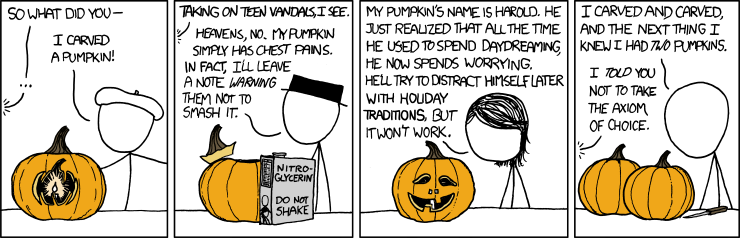
What the Axiom of Choice says is that if you have an infinite collection of nonempty sets, it is possible to choose an item from each set. So if you had, for instance, an infinite set of sock drawers, you could choose a sock from each drawer.
There are two "choice" types of situations where you don't need AC. If you have a finite number of sets, no matter how many, then you don't need AC. You can use the principle of mathematical induction instead. That is, you can say, basically, OK, I can choose something from the first bin because, duh, it's not empty. Then, if I've chosen something from some number of bins up to this point, I can always choose something from the next bin, because again, it's not empty. But even though this works for any finite number of bins (even one billion bins), it doesn't cover an infinite number of bins.
You also don't need AC if you have a specific method of choosing from the sets (bins). For instance, if you have an infinite collection of pairs of shoes, you could say, "From each pair, choose the left shoe." That's basically creating a function from the pairs to the chosen objects, which is what we want. (AC says there is such a function whether we can define it explicitly or not.) People often contrast shoes with socks to explain this difference, because shoes have a right and left and so there is an explicit function for choosing, but socks are undifferentiated.
Of course, AC is usually used with sets of numbers, not sets of socks, because there are not actually an infinite number of socks even in the entire universe, as best I'm aware.
 Now, if we were talking about sets of natural numbers (subsets, that is, of {1, 2, 3, ...}) we could just say, "Always choose the smallest one." Every set of natural numbers has a smallest element. This property is called being "well-ordered."
The real numbers, though, in their normal order, don't have this property. There isn't a smallest one of all, and there are a lot of sets of them, even bounded sets, that don't have a least element. For instance, "Every real number larger than 2" doesn't have a least element. (2 isn't in the set, so that's not it, and no matter how close you to get to 2, even if you pick, say, 2.000000001, there is always a smaller one still in there, say 2.0000000000000000000001.)
The Axiom of Choice is equivalent to saying that the real numbers are well-ordered. It's not true in their normal order, but AC says that there is some order you could put them in such that every subset of them would have a least element. (It's sort of a crazy idea - don't try it at home. AC doesn't provide such an order, it just claims that it exists. In fact, if we could define the order, we wouldn't need AC at all!)
To see the equivalence, let's say you had an infinite collection of sets of numbers, and you wanted to choose a number from each set. If you have well-ordering then you can use the rule "always choose the smallest number."
Similarly, if we have Choice, and we want to well-order the reals, we can first choose one to be the lowest one, then choose another one to be the next lowest, and so on ad infinitum.
So why this is interesting? First, AC is an Axiom. That means you can't prove (or disprove) it from anything else in the normal theories we use about numbers. It's just an assertion from the heavens. And while most axioms that you commonly encounter (such as that two points determine a unique line, or that a*b = b*a) are what we might call "obvious," AC is...well, is it obvious to you?
In fact, its use is rather contested.
If you don't use AC, then you can't prove a lot of the important theorems of calculus. And that's not just a matter of theoretical concern - we use calculus all the time to solve all sorts of problems, and it demonstrably works. Calculus is important, and it would be nice to think that it has a sound theoretical basis and isn't just a bunch of malarkey that works by chance, or for reasons beyond human comprehension.
On the other hand, if you do use AC, then you get some crazy results like the Banach-Tarski paradox. Those guys proved that, using AC, you can cut a sphere into a finite number of pieces and then reassemble the pieces into two spheres the same size as the original, which is more or less obviously not true. (The way the cuts are done is not something we can actually replicate, even though it is a small number of cuts, so this isn't an empirical question.)

So, there you have it: the Axiom of Choice.
What the Axiom of Choice says is that if you have an infinite collection of nonempty sets, it is possible to choose an item from each set. So if you had, for instance, an infinite set of sock drawers, you could choose a sock from each drawer.
There are two "choice" types of situations where you don't need AC. If you have a finite number of sets, no matter how many, then you don't need AC. You can use the principle of mathematical induction instead. That is, you can say, basically, OK, I can choose something from the first bin because, duh, it's not empty. Then, if I've chosen something from some number of bins up to this point, I can always choose something from the next bin, because again, it's not empty. But even though this works for any finite number of bins (even one billion bins), it doesn't cover an infinite number of bins.
You also don't need AC if you have a specific method of choosing from the sets (bins). For instance, if you have an infinite collection of pairs of shoes, you could say, "From each pair, choose the left shoe." That's basically creating a function from the pairs to the chosen objects, which is what we want. (AC says there is such a function whether we can define it explicitly or not.) People often contrast shoes with socks to explain this difference, because shoes have a right and left and so there is an explicit function for choosing, but socks are undifferentiated.
Of course, AC is usually used with sets of numbers, not sets of socks, because there are not actually an infinite number of socks even in the entire universe, as best I'm aware.
 Now, if we were talking about sets of natural numbers (subsets, that is, of {1, 2, 3, ...}) we could just say, "Always choose the smallest one." Every set of natural numbers has a smallest element. This property is called being "well-ordered."
The real numbers, though, in their normal order, don't have this property. There isn't a smallest one of all, and there are a lot of sets of them, even bounded sets, that don't have a least element. For instance, "Every real number larger than 2" doesn't have a least element. (2 isn't in the set, so that's not it, and no matter how close you to get to 2, even if you pick, say, 2.000000001, there is always a smaller one still in there, say 2.0000000000000000000001.)
The Axiom of Choice is equivalent to saying that the real numbers are well-ordered. It's not true in their normal order, but AC says that there is some order you could put them in such that every subset of them would have a least element. (It's sort of a crazy idea - don't try it at home. AC doesn't provide such an order, it just claims that it exists. In fact, if we could define the order, we wouldn't need AC at all!)
To see the equivalence, let's say you had an infinite collection of sets of numbers, and you wanted to choose a number from each set. If you have well-ordering then you can use the rule "always choose the smallest number."
Similarly, if we have Choice, and we want to well-order the reals, we can first choose one to be the lowest one, then choose another one to be the next lowest, and so on ad infinitum.
So why this is interesting? First, AC is an Axiom. That means you can't prove (or disprove) it from anything else in the normal theories we use about numbers. It's just an assertion from the heavens. And while most axioms that you commonly encounter (such as that two points determine a unique line, or that a*b = b*a) are what we might call "obvious," AC is...well, is it obvious to you?
In fact, its use is rather contested.
If you don't use AC, then you can't prove a lot of the important theorems of calculus. And that's not just a matter of theoretical concern - we use calculus all the time to solve all sorts of problems, and it demonstrably works. Calculus is important, and it would be nice to think that it has a sound theoretical basis and isn't just a bunch of malarkey that works by chance, or for reasons beyond human comprehension.
On the other hand, if you do use AC, then you get some crazy results like the Banach-Tarski paradox. Those guys proved that, using AC, you can cut a sphere into a finite number of pieces and then reassemble the pieces into two spheres the same size as the original, which is more or less obviously not true. (The way the cuts are done is not something we can actually replicate, even though it is a small number of cuts, so this isn't an empirical question.)
So, there you have it: the Axiom of Choice.
Monday, April 12, 2010
Fun with Word Clouds
Sally has posted a couple of word clouds from a recent paper and presentation. It made me think how much more...well, boring, a word cloud from a math paper would be. I don't write papers very often, but here, for instance, is the cloud from my last one (via wordle.net):

See?

See?
Monday, March 08, 2010
Feeling Dumb at Math
My advanced calculus class this semester (part II of the sequence), despite being taught by the same (great) professor, has so far been vastly harder than the first semester. It has been hard enough that I got an 83% on the first exam, which is lower than any of my exam grades (including the one I dropped, and knew ahead of time I would be dropping) from last semester.
We started with sequences of functions, then moved on to series (of numbers), and then to series of functions. I basically skipped this material entirely when I took Calc II in 1991, but I have since reviewed that entire chapter of a regular calculus textbook. I am keeping up with (and doing well on) the homework, but every assignment is difficult-to-impossible and the situation doesn't seem to be improving.
Assuming I go to grad school next year, I'll be taking graduate-level analysis, so the difficulty of this material only makes it more beneficial to be seeing now, rather than for the first time next year. But it's been very hard for me to persevere with it when it often seems as though I'm not improving [note: this is objectively false as best I can determine]. The assignments often frustrate me to the point of tears or rage.
I decided on Saturday night to try to take a humbler approach to the material, to not let it be about whether I am smart or not (a real weakness of mine), but to see myself as a servant (if you will) of the math. I'm not sure it's having any effect yet, but I'm going to keep trying it.
I know that if I'm going to get anywhere in math, I have to learn to work without the promise of success - to work on problems that are hard enough that I may feel stupid and hopeless for quite some time. I guess this is good practice for that.
We started with sequences of functions, then moved on to series (of numbers), and then to series of functions. I basically skipped this material entirely when I took Calc II in 1991, but I have since reviewed that entire chapter of a regular calculus textbook. I am keeping up with (and doing well on) the homework, but every assignment is difficult-to-impossible and the situation doesn't seem to be improving.
Assuming I go to grad school next year, I'll be taking graduate-level analysis, so the difficulty of this material only makes it more beneficial to be seeing now, rather than for the first time next year. But it's been very hard for me to persevere with it when it often seems as though I'm not improving [note: this is objectively false as best I can determine]. The assignments often frustrate me to the point of tears or rage.
I decided on Saturday night to try to take a humbler approach to the material, to not let it be about whether I am smart or not (a real weakness of mine), but to see myself as a servant (if you will) of the math. I'm not sure it's having any effect yet, but I'm going to keep trying it.
I know that if I'm going to get anywhere in math, I have to learn to work without the promise of success - to work on problems that are hard enough that I may feel stupid and hopeless for quite some time. I guess this is good practice for that.
Wednesday, February 10, 2010
Settling In
The first couple of weeks of my semester were a little nerve-wracking, but I seem to be settling in nicely now. I've turned in some homeworks, gotten good grades, mastered some material that originally frightened me, and my easy class is finally getting to some good stuff too. (It is still a little frustrating to sit in a room with students who are vocal about their difficulty in understanding the Euclidean algorithm despite being shown several examples, but I try to remind myself of all the times I am clueless and confused about things that will seem basic later on.)
I am a bit astonished by my progress as a math student over the past few years. It's not so much that I've learned a lot of math as that I've picked up a lot of skills I never had before. I now know how to read a math textbook (i.e., with pencil and paper, writing things down). I approach homework quite differently. I study. I am much better at tackling problems I'm not sure I can do than I was in the past. I am better at writing proofs. I know more Greek letters than ever before. And so on.
Life is good, I tell ya.
Wednesday, February 03, 2010
Two Mathy Conversations
These were both fun. The first one was between me and Ed, after advanced calculus one night. We had discussed in class the fact that infinite sums are neither commutative nor associative, e.g., if you start with
1 - 1 + 1 - 1 + 1 - 1 + ....
then
(1-1) + (1-1) + (1-1) + ... = 0
but
1 - (1-1) - (1-1) - (1-1) + ... = 1
even though those are the same terms just grouped differently. Spooky! So here was the conversation.
Ed: The stuff about series was cool.
Me: They're not associative or commutative. It's awful.
Ed: It was neat.
Me: It's wrong.
Ed: It's cool.
Me: It's an abomination.
Ed: I liked it.
Me: It's a sign from God that we aren't meant to do infinite sums.
Ed: It's a sign from God that we shouldn't confuse infinite sums with addition.
The second conversation was last night right after class, between me, another student I'm friends with (Jason), and (at the end) our professor.
Jason: I'm tired of real analysis. I want to do fake analysis.
Me: You could try rational analysis.
Jason: I want to do irrational analysis!
Me: If you're going to do irrationals, you might as well do reals.
Jason: But I'm more the irrational type.
Me: But at least the rationals are a field.
Jason: Then can I do complex analysis?
Me: That's a real course, you know. You can take that.
Jason: It is?
Me: Yeah. They have it here.
Professor: Complex analysis, it turns out, is like Disney World, in that, everything you ever dreamed might be true, turns out to be true.
1 - 1 + 1 - 1 + 1 - 1 + ....
then
(1-1) + (1-1) + (1-1) + ... = 0
but
1 - (1-1) - (1-1) - (1-1) + ... = 1
even though those are the same terms just grouped differently. Spooky! So here was the conversation.
Ed: The stuff about series was cool.
Me: They're not associative or commutative. It's awful.
Ed: It was neat.
Me: It's wrong.
Ed: It's cool.
Me: It's an abomination.
Ed: I liked it.
Me: It's a sign from God that we aren't meant to do infinite sums.
Ed: It's a sign from God that we shouldn't confuse infinite sums with addition.
The second conversation was last night right after class, between me, another student I'm friends with (Jason), and (at the end) our professor.
Jason: I'm tired of real analysis. I want to do fake analysis.
Me: You could try rational analysis.
Jason: I want to do irrational analysis!
Me: If you're going to do irrationals, you might as well do reals.
Jason: But I'm more the irrational type.
Me: But at least the rationals are a field.
Jason: Then can I do complex analysis?
Me: That's a real course, you know. You can take that.
Jason: It is?
Me: Yeah. They have it here.
Professor: Complex analysis, it turns out, is like Disney World, in that, everything you ever dreamed might be true, turns out to be true.
Tuesday, February 02, 2010
A Math Class of the Second Kind
My third math class this semester is "Senior Mathematics Seminar," which is a 1-hour class that meets once a week and could be about anything. Our particular class is about wavelets, which are like functions with finite absolute area. (In other words, the area under the curve, whether above or below the x-axis, is finite over the reals.) That's my understanding so far, at least.
I realized after the first day of this class that I've experienced two types of math classes, and this is the rarer second type. Of course, this categorization is as suspect as all such attempts, but bear with me, if you please.
I used to think of math courses as going in a line, roughly from arithmetic up through algebra and then calculus. But that's really as far as that particular line seems to go. Beyond that, the field spreads out and you have classes like probability & statistics, linear algebra, etc., that do not go in a specific order. Of course, those classes then spawn their own chains.
But these days a different classification makes more sense to me. Now I see most classes as sort of "tool" classes, where you learn a lot of tools that are broadly applicable (like calculus, linear algebra, set theory, etc.). And then the other classes are more "application" classes (whether they are applied or theoretical) in which you use various kinds of tools to understand some new area. My second geometry course was one of these application-type classes, using a lot of linear and abstract algebra (and a touch of geometry, though not much), and this wavelets course is the same way (so far mainly with respect to calculus and analysis).
At any rate, the class has been all right so far. Our professor has roughly the style and personality of a very toned-down Steve Martin - like maybe Steve Martin playing a math professor in a serious movie. I was confused a lot this past week, and left class feeling like I'd been crying, though of course I did not actually cry, and I've realized that I really need to read the book before class rather than only looking at it afterwards (which is kind of obvious, but not my usual M.O. for math). It looks like we'll only have graded assignments and possibly some kind of small projects later on; there's been no talk of exams. So it should be all right, though it's hard for me to see how I have time for two classes (this one and Advanced Calc II) that require serious thought.
I realized after the first day of this class that I've experienced two types of math classes, and this is the rarer second type. Of course, this categorization is as suspect as all such attempts, but bear with me, if you please.
I used to think of math courses as going in a line, roughly from arithmetic up through algebra and then calculus. But that's really as far as that particular line seems to go. Beyond that, the field spreads out and you have classes like probability & statistics, linear algebra, etc., that do not go in a specific order. Of course, those classes then spawn their own chains.
But these days a different classification makes more sense to me. Now I see most classes as sort of "tool" classes, where you learn a lot of tools that are broadly applicable (like calculus, linear algebra, set theory, etc.). And then the other classes are more "application" classes (whether they are applied or theoretical) in which you use various kinds of tools to understand some new area. My second geometry course was one of these application-type classes, using a lot of linear and abstract algebra (and a touch of geometry, though not much), and this wavelets course is the same way (so far mainly with respect to calculus and analysis).
At any rate, the class has been all right so far. Our professor has roughly the style and personality of a very toned-down Steve Martin - like maybe Steve Martin playing a math professor in a serious movie. I was confused a lot this past week, and left class feeling like I'd been crying, though of course I did not actually cry, and I've realized that I really need to read the book before class rather than only looking at it afterwards (which is kind of obvious, but not my usual M.O. for math). It looks like we'll only have graded assignments and possibly some kind of small projects later on; there's been no talk of exams. So it should be all right, though it's hard for me to see how I have time for two classes (this one and Advanced Calc II) that require serious thought.
Monday, January 25, 2010
Class Report: Advanced Calc II
I wasn't going to blog about this class, but I actually had a reader request, if you can believe that.
At any rate, we are in a new classroom this semester, but otherwise the course is much the same as Advanced Calc I - same professor, a subset of the students from last semester, and a very similar syllabus. There are two new students, including Ed.
The one thing the prof changed on the syllabus is how he handles late work. Last semester he gave a 5% bonus to homework turned in on time, and hypothetically took 5% off for every day it was late (so you'd get full credit for turning it in one day late). But I don't think he ever actually gave a penalty, and he would accept things up to a week or two late, which resulted, naturally, in some people getting pretty far behind on homework. This semester the on-time bonus is only 2%, and he will not take homework more than 2 days late except by prior arrangement. In practice, I suspect this means he'll take late work anyway (which he seems to suspect as well). I only turned in one assignment late last semester (and it was only one day late, I think), so I don't think this policy change will affect me.
I enjoy the style of this class a lot. It's a straight-up lecture that is very well organized, and the professor has excellent handwriting and a great presentation style. Partly because this course is taken mainly by math majors who are not secondary math ed folks, it seems to be a sharper crowd than I've seen in some of my other courses.
We get weekly homework that consists of six problems to turn in and several more problems that we don't turn in. I did the "several more problems" on the first couple of homeworks last semester, and then stopped doing them. I typically find it hard enough to finish the six mandatory problems every week; the other time I put into the class is more profitably spent reviewing definitions and proofs.
So that's Advanced Calc II.
At any rate, we are in a new classroom this semester, but otherwise the course is much the same as Advanced Calc I - same professor, a subset of the students from last semester, and a very similar syllabus. There are two new students, including Ed.
The one thing the prof changed on the syllabus is how he handles late work. Last semester he gave a 5% bonus to homework turned in on time, and hypothetically took 5% off for every day it was late (so you'd get full credit for turning it in one day late). But I don't think he ever actually gave a penalty, and he would accept things up to a week or two late, which resulted, naturally, in some people getting pretty far behind on homework. This semester the on-time bonus is only 2%, and he will not take homework more than 2 days late except by prior arrangement. In practice, I suspect this means he'll take late work anyway (which he seems to suspect as well). I only turned in one assignment late last semester (and it was only one day late, I think), so I don't think this policy change will affect me.
I enjoy the style of this class a lot. It's a straight-up lecture that is very well organized, and the professor has excellent handwriting and a great presentation style. Partly because this course is taken mainly by math majors who are not secondary math ed folks, it seems to be a sharper crowd than I've seen in some of my other courses.
We get weekly homework that consists of six problems to turn in and several more problems that we don't turn in. I did the "several more problems" on the first couple of homeworks last semester, and then stopped doing them. I typically find it hard enough to finish the six mandatory problems every week; the other time I put into the class is more profitably spent reviewing definitions and proofs.
So that's Advanced Calc II.
Tuesday, January 19, 2010
Class Report: Abstract Algebra
Tonight was the first meeting of my abstract algebra class. So far, I have very good feelings about the class. Some good things:
The classroom for this class is sort of awful - comparatively long front-to-back and cramped side-to-side, with those desks I hate. It's also excessively warm and airless. But that's me being finicky about spaces.
- The professor is very charming. (It may seem trivial but I really do appreciate this.)
- She is going to give a quiz every Thursday that is all definitions. I think it's really smart to emphasize definitions in a class like this. If you don't know the real math definition of something you can't do proofs, etc., with it.
- Expectations seem high so far. For instance, the material I was afraid would be reviewed in this class (some basic definitions I've had in a lot of math classes) is stuff we are to review on our own and be prepared to take a quiz on on Thursday.
The classroom for this class is sort of awful - comparatively long front-to-back and cramped side-to-side, with those desks I hate. It's also excessively warm and airless. But that's me being finicky about spaces.
Sunday, January 10, 2010
The Impending Semester
My schedule for next semester (starting Tuesday Jan 19) is as follows:
MW 7:00-8:15PM - Advanced Calc II
TR 5:30-6:45PM - Abstract Algebra I
F 10:00-10:50AM - Math Senior Seminar
It is going to suck a bit having to go to school every day of the week, and that Friday time is a killer as far as work goes. But at least my weeknight classes are 75 minutes instead of 110 like last semester; that should make those a lot easier as far as attendance goes.
I'm really looking forward to the second half of advanced calculus. I enjoyed the first half a lot, both the material and the professor, who is one of the best I've had. I'm looking forward to seeing all of the familiar people from last semester. Also, Ed is taking the class with me this time, so that will be fun too.
Abstract algebra is a great topic - I listed algebra as an interest in most of my grad school statements of purpose - but I'm a bit concerned that I already know so much of it from my other classes (especially Proofs and the geometry class I took a year ago). It's not always fun when a lot of a class is a review. But it should be proofs-intensive, and that is always exciting. I hope there is a lot of homework. (I always feel this way before and after the semester, but never during.) The professor scheduled to teach it has excellent reviews, so I have high hopes for her.
I'm not sure exactly what to expect from the Friday seminar. There are only six students enrolled, which is fun for any class, but especially good for a seminar, assuming the class actually has that type of format. I'm not sure how a seminar works in math, but that's probably just ignorance on my part. The topic is wavelets. We'll see.
Anyway, I'm pretty ready. I just need to clean my room (I try to do this between semesters so it's not chaotic for homework) and clean out my school binder.
MW 7:00-8:15PM - Advanced Calc II
TR 5:30-6:45PM - Abstract Algebra I
F 10:00-10:50AM - Math Senior Seminar
It is going to suck a bit having to go to school every day of the week, and that Friday time is a killer as far as work goes. But at least my weeknight classes are 75 minutes instead of 110 like last semester; that should make those a lot easier as far as attendance goes.
I'm really looking forward to the second half of advanced calculus. I enjoyed the first half a lot, both the material and the professor, who is one of the best I've had. I'm looking forward to seeing all of the familiar people from last semester. Also, Ed is taking the class with me this time, so that will be fun too.
Abstract algebra is a great topic - I listed algebra as an interest in most of my grad school statements of purpose - but I'm a bit concerned that I already know so much of it from my other classes (especially Proofs and the geometry class I took a year ago). It's not always fun when a lot of a class is a review. But it should be proofs-intensive, and that is always exciting. I hope there is a lot of homework. (I always feel this way before and after the semester, but never during.) The professor scheduled to teach it has excellent reviews, so I have high hopes for her.
I'm not sure exactly what to expect from the Friday seminar. There are only six students enrolled, which is fun for any class, but especially good for a seminar, assuming the class actually has that type of format. I'm not sure how a seminar works in math, but that's probably just ignorance on my part. The topic is wavelets. We'll see.
Anyway, I'm pretty ready. I just need to clean my room (I try to do this between semesters so it's not chaotic for homework) and clean out my school binder.
Tuesday, December 22, 2009
Grad Apps In
As of today, I have done every single thing for my graduate school applications. One of my recommenders has submitted all of his letters, and the other two have shown signs of working on theirs, so everything seems to be well in hand.
I'm glad to be done with the process. I have applied to the following schools (in no particular order):
I'm glad to be done with the process. I have applied to the following schools (in no particular order):
- Colorado State University
- New Mexico State University
- Texas A&M
- University of North Texas
- University of Florida
- University of Tennessee
- University of Kentucky
- University of Pittsburgh
Sunday, December 06, 2009
Taking the Putnam
Yesterday morning, I went to school to participate in the Putnam Competition. This is a six-hour math exam (if you want to call it that), split into two 3-hour sections, with a lunch break in between. Each section has six questions that require college mathematics and a lot of creative thinking to solve. Each question is worth a maximum of 10 points, with partial credit given, and the median score is typically 1 or 2 points (out of 120).
I didn't really have time to go, but I didn't see how I could miss it. The competition is only for undergraduates, so this was my last chance, and I'd never done it before (nor had an opportunity to, that I was aware of, though you can take it four times overall and needn't be a senior nor a math major). I wanted to support our math department as well; I knew some people wouldn't show up, and I wanted to be able to say that, yes, we can at least field a Putnam team. (I wasn't on the actual team, which is three people from each school, in the end. But that's fine. You don't work together anyway - it's a purely individual endeavor.)
The morning session was fun. Of the six problems, one looked tractable, but I didn't get anywhere with it. I turned to another question that looked less tractable and ended up writing out an answer. (You have to write a full proof for the answer, not just solve the problem.) I am pretty sure a central assertion in my proof was wrong, though, but I haven't had a chance to check it yet. (It involved an 18x16 matrix, which I'm sure was not how the problem was meant to be solved.)
What was fun was that I was only trying to score any points at all. On a normal exam you're trying to get all of the points, or fall short as little as possible, but I was aiming to just get above 0, so it wasn't really stressful. I had three hours to work on as little as one problem.
The professor running the show bought us lunch - we all walked over to Old Chicago. It was actually pretty blissful. There were six of us students, of whom two are in my advanced calculus class, one is in my "senior seminar" next semester (but I hadn't met him yet), and the other two were unknown to me. (One I'm not so sure about - he argued on the way to lunch that irrational numbers can be accurately represented as fractions, using 22/7 - a classic approximation for pi - as an example.) We talked about the test, and other math topics, all through lunch. The professor kept quiet and just let us talk, which for all I know might have been out of peevishness at our annoying qualities, but felt gracious.
I found myself hoping that this is what grad school is like - that there are other people around and you can talk about math with them sometimes. I realize undergrad is like that for some people, but it hasn't been for me. I really enjoyed it. I also realized that I hope my graduate program does not have a competitive feel to it, because I wouldn't have enjoyed lunch nearly as much had we all been trying to one-up each other.
After lunch, we had six new problems. Several of them seemed tractable but I couldn't gain any traction for a long time. I was really tired from my week (I've been exhausted pretty much all week, and had to get up extra early for this thing), and that started to kick in, and I had had too much iced tea at lunch, so I had that nervous/sick kind of feeling, plus I kept having to pee. I finally did get an answer to one question. I now think that part of my answer was wrong, but I was really happy with the way that I approached it and the style of proof that I wrote for it. Still, I did not enjoy the afternoon session very much.
In the end, I am really glad that I went, and I'm hopeful that I might have scored 2 or 3 points on the exam. I'll post when scores come out.
I didn't really have time to go, but I didn't see how I could miss it. The competition is only for undergraduates, so this was my last chance, and I'd never done it before (nor had an opportunity to, that I was aware of, though you can take it four times overall and needn't be a senior nor a math major). I wanted to support our math department as well; I knew some people wouldn't show up, and I wanted to be able to say that, yes, we can at least field a Putnam team. (I wasn't on the actual team, which is three people from each school, in the end. But that's fine. You don't work together anyway - it's a purely individual endeavor.)
The morning session was fun. Of the six problems, one looked tractable, but I didn't get anywhere with it. I turned to another question that looked less tractable and ended up writing out an answer. (You have to write a full proof for the answer, not just solve the problem.) I am pretty sure a central assertion in my proof was wrong, though, but I haven't had a chance to check it yet. (It involved an 18x16 matrix, which I'm sure was not how the problem was meant to be solved.)
What was fun was that I was only trying to score any points at all. On a normal exam you're trying to get all of the points, or fall short as little as possible, but I was aiming to just get above 0, so it wasn't really stressful. I had three hours to work on as little as one problem.
The professor running the show bought us lunch - we all walked over to Old Chicago. It was actually pretty blissful. There were six of us students, of whom two are in my advanced calculus class, one is in my "senior seminar" next semester (but I hadn't met him yet), and the other two were unknown to me. (One I'm not so sure about - he argued on the way to lunch that irrational numbers can be accurately represented as fractions, using 22/7 - a classic approximation for pi - as an example.) We talked about the test, and other math topics, all through lunch. The professor kept quiet and just let us talk, which for all I know might have been out of peevishness at our annoying qualities, but felt gracious.
I found myself hoping that this is what grad school is like - that there are other people around and you can talk about math with them sometimes. I realize undergrad is like that for some people, but it hasn't been for me. I really enjoyed it. I also realized that I hope my graduate program does not have a competitive feel to it, because I wouldn't have enjoyed lunch nearly as much had we all been trying to one-up each other.
After lunch, we had six new problems. Several of them seemed tractable but I couldn't gain any traction for a long time. I was really tired from my week (I've been exhausted pretty much all week, and had to get up extra early for this thing), and that started to kick in, and I had had too much iced tea at lunch, so I had that nervous/sick kind of feeling, plus I kept having to pee. I finally did get an answer to one question. I now think that part of my answer was wrong, but I was really happy with the way that I approached it and the style of proof that I wrote for it. Still, I did not enjoy the afternoon session very much.
In the end, I am really glad that I went, and I'm hopeful that I might have scored 2 or 3 points on the exam. I'll post when scores come out.
Friday, December 04, 2009
Mathematics Genealogy
I was looking at The Mathematics Genealogy Project today. It's a project that kind of sounds like what it is - for (many) math professors, it lists their advisor and students, so you can trace up and down. And it's kind of astonishing.
I did a search on one of my professors, and this is what I found as I went up the chain of advisors (leaving out some initial steps for anonymity):
1. my Professor - no known students (makes sense; my school doesn't have graduate programs)
2. his advisor
3. the advisor's advisor, PhD from Indiana University, 1960.
4. Tracy Yerkes Thomas, Princeton, 1923. I knew I was getting into the past because the dissertation title was "The Geometry of Paths," which is just way too basic and short to be modern.
5. Oswald Veblen, U of Chicago, 1903.
6. E.H. Moore, Yale, 1885.
7. H.A. Newton, Yale, 1850.
8. Michel Chasles, École Polytechnique, 1814.
9. Simeon Denis Poisson, École Polytechnique, 1800.
10. Poisson had two advisors - Joseph Lagrange, and Pierre-Simon Laplace.
11. Lagrange's advisor was Euler, and Laplace's was d'Alembert.
12. Euler's advisor was Bernoulli.
Anyway...it's kind of amazing how few steps it takes to get from anyone to someone famous (even famous to me).
Another of my previous professors led me upward to Darboux (of Darboux sums fame, presumably) within a few clicks.
I got from one of Sally's professors to Isaac Newton! (It did take a few clicks, though.)
I did a search on one of my professors, and this is what I found as I went up the chain of advisors (leaving out some initial steps for anonymity):
1. my Professor - no known students (makes sense; my school doesn't have graduate programs)
2. his advisor
3. the advisor's advisor, PhD from Indiana University, 1960.
4. Tracy Yerkes Thomas, Princeton, 1923. I knew I was getting into the past because the dissertation title was "The Geometry of Paths," which is just way too basic and short to be modern.
5. Oswald Veblen, U of Chicago, 1903.
6. E.H. Moore, Yale, 1885.
7. H.A. Newton, Yale, 1850.
8. Michel Chasles, École Polytechnique, 1814.
9. Simeon Denis Poisson, École Polytechnique, 1800.
10. Poisson had two advisors - Joseph Lagrange, and Pierre-Simon Laplace.
11. Lagrange's advisor was Euler, and Laplace's was d'Alembert.
12. Euler's advisor was Bernoulli.
Anyway...it's kind of amazing how few steps it takes to get from anyone to someone famous (even famous to me).
Another of my previous professors led me upward to Darboux (of Darboux sums fame, presumably) within a few clicks.
I got from one of Sally's professors to Isaac Newton! (It did take a few clicks, though.)
Thursday, November 19, 2009
Math Gaps
I read something recently where a person was talking about her approach to teaching math - that she reassures her class that they are not "bad" at math, but that somewhere along the way, they had a bad teacher, or they missed a day, and the lacking knowledge accumulated so that now they are confused by various things. And I was thinking of how many gaps I have in my own knowledge of math, and how crazy these gaps drive me when they show up.
It's hard to even recognize that something is caused by a gap. A certain topic will show up (infinite series, say, or rules of limits) and my mind will just go "that's too hard" or "I can't do those" without asking why. Are these topics somehow such that I alone cannot learn them? Do I have some tiny genetic flaw that has knocked out the part of my mind that would let me understand what a Taylor series is?
No. I just don't understand something because I have some gaps, and the thing to do, then, if I'm serious about math, is to figure out what the gaps are and fill them in. It's unlikely I'm missing anything that I can't learn, so I need to just get on that, as it comes up. And now that I'm finally more of a badass about reading and understanding math, I'm in a perfect position to do so.
It's hard to even recognize that something is caused by a gap. A certain topic will show up (infinite series, say, or rules of limits) and my mind will just go "that's too hard" or "I can't do those" without asking why. Are these topics somehow such that I alone cannot learn them? Do I have some tiny genetic flaw that has knocked out the part of my mind that would let me understand what a Taylor series is?
No. I just don't understand something because I have some gaps, and the thing to do, then, if I'm serious about math, is to figure out what the gaps are and fill them in. It's unlikely I'm missing anything that I can't learn, so I need to just get on that, as it comes up. And now that I'm finally more of a badass about reading and understanding math, I'm in a perfect position to do so.
Subscribe to:
Posts (Atom)