Showing posts with label geometry. Show all posts

Wednesday, June 24, 2009

Metaphor and Mapping

If you look at the longitude and latitude lines on a globe, you may notice (if you haven't in the past) something interesting: we don't handle north-south and east-west the same way.The longitude lines are great circles that meet at the north and south poles, while the latitude lines are just horizontal (if you will) circles of varying size, like cross-sections of the planet.

I commented to Ed recently that we should try doing east-west like we do north-south, and he said, "But then, if you went east for a while, you'd eventually be going west."

"What?" I asked.

"Well, now, if you go north far enough, then eventually you start going south, so if we handled east-west the same way..."

And that was a very weird thought. At first I couldn't make any sense of the idea that if you go east for a while you'll find yourself heading west (because it's not true), and then I started wondering why it does seem to make sense for north-south. Why am I comfortable with the idea that once you're at the north pole, if you keep going, you're heading south?

Is it purely because I was educated about how latitude/longitude lines work?

Then it occurred to me that it's because I think of the north pole as "up" (the way that north is up on most maps). And so I associate it metaphorically with the direction that heads away from gravity. And clearly if you were to climb up a sphere for long enough (using your sticky gecko feet), you'd get to the top, and if you kept going, you'd be headed back down. While if you just geckoed your way sideways around the sphere, there wouldn't be any reversals.

Is it natural that we think of north as up, or is it just a convention? Clearly it's a matter of convention whether north or south is up, but could east or west be up just as easily? We would then picture the earth as rolling around through its orbit rather than spinning, and we would view the solar system as being a flat vertical plane rather than a horizontal platter.

What do you think?

Tuesday, April 28, 2009

Math Satori: Generalized Quadrangle

One thing I came across in various articles about Laguerre planes was references to their "well-known" relationship with the generalized quadrangle. I eventually decided to try to hunt this down and use it for my paper, and it's been a very hard slog, causing me to have to look up term after term after term and try to understand all kinds of things.

The first thing I had to try to understand was what the hell the generalized quadrangle is. I mean, I know what a quadrangle is - a four-sided figure (like a rectangle, square, diamond, etc.) - but there's no obvious relationship between that and a Laguerre plane.

So, it turns out that a generalized quadrangle is a kind of incidence structure, like a projective plane. An incidence structure is something that has two sets - like points and lines - and a relation describing which ones are on or contain each other. So, for instance, if your whole structure consisted of one line, m, with three points, A, B, and C, on it, and a fourth point, D, not on it, your structure would be something like this:

P: {A, B, C, D}
L: {m}
I: {(A, m), (B, m), (C, m)}

where P is the set of points, L is the set of lines, and I is the set of pairs of points and lines that are on each other.

The Euclidean plane is also an incidence structure, but it has an infinite number of points, so it looks more like:

P: all pairs (x, y) of real numbers
L: all pairs (m, b) of real numbers, plus vertical lines that just have an x-intercept (a)
I: a point (x, y) is on a line (m, b) if y = mx + b; also, a point is on a vertical line (a) if its x-coordinate is a

So, the generalized quadrangle is an incidence structure that satisfies these axioms:
  1. Two points can't have more than one line in common. (Note: they can have no lines in common, unlike in Euclidean space, where any two points determine a line.)
  2. If you have a point A and a point B that aren't on the same line, plus a line m that B is on, there is a unique point C and line n such that A is on n and C is on both n and m.
There will also be some other axioms to make sure the generalized quadrangle is big enough to be worth dealing with. (Under most systems, for instance, a quadrangle is not a generalized quadrangle.)

Now you may have gotten this right away, but I got these axioms after working through a giant example of a generalized quadrangle, and one thing I couldn't see was why it was called a generalized quadrangle. What did it have to do with quadrangles?

In pursuit of this answer, I came across a couple of places that commented that a projective plane is, of course, a generalized triangle. What? I never heard this before. What the...ohhhhh.

I got it.

A projective plane is a generalized triangle because any two points determine exactly one line, and every two lines cross at exactly one point. That's just like a triangle. (Go ahead, draw one and see, if you need to.)

And a generalized quadrangle has the same kind of relationship as a quadrangle:
  1. Lines don't cross more than once.
  2. If you pick opposite corners, plus a side, you can get from one corner to the other exactly one way, and that trip involves one additional side and one additional point.
Wow.

This may seem kind of trivial, I don't know, but when I got it, I was ridiculously excited. I wanted to race around and explain it to everyone.

Wednesday, April 08, 2009

The Isomorphic Thrill

The other night, I decided to turn momentarily away from the Polster/Steinke line of thought on Laguerre Planes (covered in my previous post) and look at one of my other sources. The third author I have a lot of writing by, including his dissertation, is Robert Knight. I opened up an article by him...something about bundle forms and "ovoidal Laguerre planes."

My impression of Knight so far, from lightly perusing some of his stuff, is that he's mostly going kind of old school with the Laguerre business. And indeed, in this paper, as background, he presents a set of axioms that I think are pretty close to Laguerre's own.

In the original Laguerre system, instead of circles and points, we have cycles and spears. Cycles (in the original representation) can be either oriented circles or points, and spears are oriented lines. That's my understanding at least.

But when I started jotting down the axioms, I was very excited to find that they were more or less isomorphic to the Polster/Steinke set. I got that pure mathematical thrill as I confirmed that my octahedron "plane" satisfied all of them (treating the points as spheres, the faces as cycles, and with one other additional but obvious rule to account for something not present in the other system).

A phrase I've encountered in this course, but not before, is "up to isomorphism," as in, "There exists a unique field of order 2, up to isomorphism." What it means is that you might be able to make different ones, but they all have the exact same structure even if the elements have different names. And, in a more general sense as well, I've encountered a ton of isomorphism in this class.

The obvious approach to hearing about Laguerre planes, for instance, is to ask "What is a Laguerre plane?" And you expect to get an answer, maybe something like, "Well it's like a normal plane except it curves around," or, "It's the surface of a sphere," or, "They call it a plane but it's really an octahedron." But there just isn't actually an answer like that. What makes something a Laguerre plane is satisfying some set of axioms about Laguerre planes, from which a bunch of theorems will then hold. Anything that satisfies those axioms is a Laguerre plane.

I mean, I had that octahedron, but there's nothing special about that. The Polster book had another finite example with the same number of points and circles; I found the octahedron easier to represent for the blog post. But the two were (clearly) isomorphic.

And that's the way in which the Polster axioms and the Knight axioms are (more or less) isomorphic as well: the same conditions satisfy (or pertain to) both.

As I mentioned, this kind of stuff gives me a real mathematical high when I get it.

Friday, April 03, 2009

Laguerre Planes

I am required to do a project for my Geometry class, and my topic is Laguerre planes. Since I have finally (basically) figured out what a Laguerre plane is, I thought I'd blog about it, while it's still fresh. Hold on to your hats, folks! There's gonna be pictures!

A lot of projective geometry is about incidence, that is, what points are collinear, which lines intersect, and that kind of thing. We don't really seem to talk about the normal things you talk about in Euclidean geometry - things like lengths, angles, areas, or in other words, the particulars of shapes. It's just about which points are in which lines, really.

So, a Laguerre plane is a type of circle plane (also called a Benz plane in one source). A circle plane has points, and the circles are made up of points. Points can be considered parallel to each other by some kind of equivalence relation*. If you make up a system like this, then it's a circle plane if it satisfies these axioms:
  1. Any three different points, no two of which are parallel to each other, determine a unique circle. (Note: In Euclidean space, any three different points determine a unique circle.)
  2. Given a point P on a circle C, and another point Q that is not parallel to P, there is a unique circle that contains both P and Q and either touches C at exactly one point, or else is C.
  3. Every circle contains exactly one point from every parallel class. (For instance, if A, B, and C are all parallel, and no other point is parallel to them, then every circle contains exactly one of A, B, or C. A, B, and C would be a "parallel class.")
  4. If you have different parallel relations - that is, completely different standards about what makes points parallel or not - then if you choose two parallel classes, each from a different relation, they'll have exactly one point in common. (You're allowed to have up to 2 parallel relations.)
  5. A circle has at least three points.
(* An "equivalence relation" is something that works like equals, or like parallelism typically does more or less, in that, if A is parallel to B, then B is parallel to A, and if A is parallel to B and B is parallel to C, A is also parallel to C. Points are considered parallel to themselves as well, which is the third thing that makes something an equivalence relation.)

Now, Laguerre planes are a subset of these circle planes - specifically, the subset that has only one parallel relation, or way of determining whether points are parallel.

An example of a Laguerre plane could start with the points that make up a vertically-oriented cylinder. We'll call points "parallel" if they are on the same vertical line on the cylinder. The circles will be non-vertical cross-sections of the cylinder, which can be straight across or at an angle (making them what we'd usually call ovals).

Does this satisfy the axioms?
  1. Given three points around the cylinder, no two of which are straight up or down from each other, can we make a cut of the cylinder that contains these points? Since three points determine a unique plane, and the intersection of that plane with the cylinder will be a circle or oval, yes, we can.
  2. Given a point on a circle, and another point that isn't vertical from the first point, can we find exactly one circle that contains both and touches the first circle at exactly one point? I think we can.
  3. It's pretty clear that any non-vertical cut across the cylinder crosses every vertical line exactly once.
  4. This axiom doesn't apply since we only have one parallel relation (the one about the vertical lines).
  5. Does every circle have at least three points? Yeah - we're doing this in the reals, so every circle has an infinite number of points.
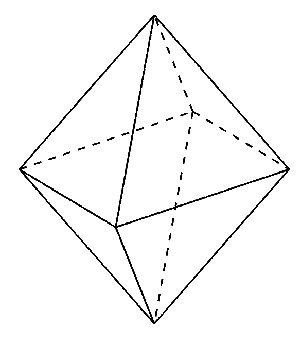
That's (assuming I'm not mistaken) an example of a Laguerre plane with an infinite number of points, but we can make a finite Laguerre plane. In fact, an example of the smallest kind of Laguerre plane can start with an octahedron. The points are the vertices, and the "circles" are the faces. Points are parallel if they are not joined by an edge. Here we have only six points, and eight circles.

The parallel classes in this example are the three pairs of opposing points of the octahedron (for instance, the topmost and bottommost points in this picture make up a parallel class). You can see that each circle (i.e., face of the octahedron) touches exactly one of each pair of opposing points.

I really enjoy the elegance of this, especially the finite example (stolen directly from A Geometrical Picture Book).

Sources

B. Polster and G. F. Steinke, "Criteria for Two-Dimensional Circle Planes", Contributions to Algebra and Geometry, Volume 35, 1994.

B. Polster, A Geometrical Picture Book. Springer-Verlag, 1998.

Thursday, April 02, 2009

Homogeneous Coordinates in the Extended Euclidean Plane

I've discussed the Extended Euclidean Plane ("EEP") before. Now I want to talk about homogeneous coordinates, because they are just very cool and convenient. They are used in all field planes, but the EEP works well as something to blog about without having to go into a whole bunch of other "stuff." (But in particular, we use them in a lot of finite field planes - that is, planes defined over a field that has a finite number of members rather than a field like the real numbers.)

So, the main distinguishing feature of the EEP is that there are no parallel lines. Lines that are parallel in the Euclidean plane meet at a "point at infinity" associated with their slope. These different points at infinity (one for each possible slope of line) make up the "line at infinity."

Normally, when we talk about coordinates in the Euclidean Plane, we use two numbers, so for instance, (2,3) might be the coordinates of a point. But for homogeneous coordinates, we are going to use three numbers - a 3-dimensional vector. What makes them "homogeneous" is that every scalar multiple of this vector refers to the same point, so that, for instance,

(1, 1, 1)

and

(2, 2, 2)

refer to the same point.

As a convention, we will make these coordinates from the usual Euclidean coordinates by making using the x and y values unchanged, and using 1 as the third coordinate. So the point formerly referred to as (2, 3) is now (2, 3, 1). It can also be called any scalar multiple of that, like (4, 6, 2) or (2/3, 1, 1/3), but there is no reason not to reduce any of those to (2, 3, 1).

Lines will also have three coordinates, which will come from the usual definition of a line:

y = 2x + 4

is the same as

2x - y + 4 = 0

and gives rise to homogeneous coordinates: [2, -1, 4]

A point is on a line iff the dot product of the vectors of the point and line is 0. So let's say we have the line y = 2x + 4, and the point (1, 6). The homogeneous coordinates for the line are [2, -1, 4] and for the point we have (1, 6, 1).

(1, 6, 1) (dot) [2, -1, 4] = 1 * 2 + 6 * -1 + 1 * 4 = 0

so the point is on the line as we expect. Note that this is the same thing as saying that a line with coordinates [a, b, c] has the equation

ax + by + cz = 0

and a point with coordinates (x, y, z) is on the line iff it satisfies that equation.

But what's with the three dimensions, yo? That doesn't make any sense.

The deal here is that we're kind of analogizing points (which usually have two coordinates) to lines (which usually have three), and lines to planes. Specifically, points become lines through the origin, and lines become planes through the origin. A point is on a line if the corresponding line is in the corresponding plane. Since two distinct lines through the origin determine a unique plane through the origin, and two distinct planes through the origin intersect in a unique line through the origin, this corresponds to our desired relationship between points and lines.

Now then. I've said that two parallel lines intersect at a point at infinity. How does that work? Well, let's look at these two parallel lines:

y = 2x + 1
y = 2x + 3


and, using the homogeneous coordinates, see them as a system of equations:

2x - y + z = 0
2x - y + 3z = 0


Using a bit of linear algebra (or regular algebra, if you prefer), we find that in order to solve these equations, a point (x, y, z) has to have the form (t, 2t, 0) for some t. So we can say that the homogeneous coordinates for this point are (1, 2, 0).

Using coordinates this way, in the EEP we will always get 0 as the final coordinate of a point on the line at infinity. The line at infinity, meanwhile, has homogeneous coordinates [0, 0, 1], as you can confirm if you like.

The linear algebraic qualities of this sytem mean that solving for the point of intersection of two lines, and for the line determined by two points, are exactly the same operation. In fact, given two line or point coordinates (a, b, c) and (d, e, f) we can solve for the point of intersection or the common line, respectively, by solving this determinant:

| x y z |
| a b c | = 0
| d e f |


i.e.,

(bf - ce)x - (af - cd)y + (ae -bd)z = 0

so the coordinates of the desired point or line are (bf - ce, cd - af, ae - bd).

So that's what I've been up to lately...

Thursday, March 05, 2009

Desargues' Theorem

My geometry class this semester seems to revolve around Desargues' Theorem (pronounced dezargs), which is a slightly complicated theorem that doesn't hold in the Euclidean plane, but holds in a lot of projective spaces. It took me a long time to be really comfortable with it, but it now seems quite simple to me, probably because of the dozens of times that I have drawn and explained it.

Desargues' says, simply, that if two triangles are perspective from a point, they are also perspective from a line.

"Perspective from a point" is relatively simple, though it took me a while to learn what motivated calling it that.

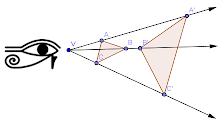
In this picture, the two triangles ABC and A'B'C' are perspective from V because if you were looking from V (hint: like the giant eye), the corresponding points of the triangles would be on the same lines. (Here, "triangle" actually refers to the points, not the line segments or the interior, though it's not very important in this case.)

"Perspective from a line," alas, doesn't allow quite such a simple explanation. What it means is that the intersections of the corresponding sides (e.g., where AB crosses A'B', if you extend the line segments) are collinear, or all on the same line. Let's expand the drawing above to include those points and their (possible) line of perspective. (Note: I've also moved the points around slightly to make the intersections show up.)


Here, I've colored the corresponding sides the same color, so AB and A'B' are blue, AC and A'C' are red, and BC and B'C' are green. Where each pair intersects, you get the purple points L, M, and N, and the big purple line goes through all of them. So, in this case, Desargues' Theorem does hold: ABC and A'B'C' are perspective from both V and the the purple line.

The only reason Desargues' doesn't always hold in a Euclidean plane (the kind of geometry we're used to) is that some of the lines might be parallel. For instance, if AC and A'C' were parallel, N (their intersection) wouldn't exist. Projective geometry basically does away with parallel lines, so it doesn't have that limitation.

Monday, February 23, 2009

Oral Exam

I had my oral exam in geometry today. I spent almost the entire weekend (with some breaks for meals, roleplaying, and Diablo) preparing myself for it. The prof had given us a list of examples, theorems, definitions, and problems from the book that he might ask us about during the exam, and I wrote up and/or reviewed all of them for myself. Today at lunch, I went over a couple of the more complicated ones again, just to be sure I could do them. (There was one I still never could do properly, but the rest I was fine on.)

I had envisioned that he might ask me a couple of questions. I was worried that he might ask me the one I couldn't quite get. The grading scheme for these oral exams (and for presentations in this class) is good/fair/poor (95/75/35), with a possible 100 if you are magically perfect, or a 0 if you totally don't do it. I knew I would get at least the 75, but I would have been very disappointed; I wanted the 95 and thought that was realistic.

Instead of a couple of questions, he had me do problems (at a chalkboard) for the full half hour, and actually a little bit beyond. He gave me my choice of the first problem, and I chose a nice hard one that I did understand, and when he asked me if there was another one I liked, I said that there was only one I could not do, and so we discussed it a bit. (It was one of the homework problems, and he said that my proof was actually better than his except that I did have that one minor thing I wasn't able to do. So that was cool. He had copied my proof - with corrections - on the answer key after his own, saying, "Here is a better way to prove this, courtesy of one of your fellow students." This is the homework that I got the C on.)

He didn't make me do the one I couldn't do - we just talked about it - but we did a ton of other ones. I was able to handle all of them. He said, at one point, "These problems are too easy for you," and, for the first time in my life, I wanted to assure him that I had actually worked quite hard to develop the mastery I was displaying and was not finding the class to be a cakewalk at all.

In the end, he gave me the 100, which wasn't even on my radar of possible scores. I left feeling like a Brilliant Math Genius. He also asked me if I was planning to go to grad school in math, and said that I should.

Afterwards, we talked a bit about the course, and I told him that the homework that I got the C on was extremely long, conceptually. He said he is just starting to figure out where everyone is. And apparently my 14 out of 18 points was the highest grade on that assignment. So...yeah. He might need to adjust his thinking a bit.

Sunday, February 22, 2009

A Bad Grade

Last week, in my Geometry course, we had a homework assignment consisting of 5 problems, 4 of which were proofs. I spent many, many hours on it. I probably spent at least 10 hours writing the proofs up, plus numerous other hours thinking about them, discussing them with Ed, working on them in my head, scribbling notes on pieces of paper, drawing diagrams, and so on. There were mornings when I woke up with a clear sense of having worked on a proof all night in my head. (And indeed, in one case I was able to wake up and quickly resolve my remaining issues and then write the proof. All before the alarm went off.)

I got 78% credit on the assignment.

I'll grant you that the class median was 64%, and the average grade was even lower. Most of the class did worse than I did, which comports with my experience of generally being an above average student in my classes.

But I worked fantastically hard on that assignment. What I turned in was six very neat pages of proofs, handwritten, with diagrams. All but one of the proofs was, as best I can determine (I haven't gotten the homework back yet, just seen the grade online), correct, and the incorrect proof had only a trivial section that I wasn't able to complete. The professor's solutions take up 3 pages of single-spaced type, so it was a long assignment, and not just for me.

It's not that I think I should get high grades just because I worked hard. (I certainly don't want other people who work hard to get the same grades as me if I outperform them. That may be uncharitable but I also think it's not good for grades to work that way.) But it's disheartening to have spent so very many hours producing so very much good work and get a C.

What I have to remind myself of is that this class is an elective. I signed up for it because I thought it would be fun, interesting, a challenge, and good on my transcript (assuming, you know, I don't get a C in the class, which I most likely won't). And right up until I got that stupid grade, I was enjoying the whole thing immensely. I had a wonderful time doing that homework. I was fantastically engaged. I talk about this stuff with Ed all the time for pure fun, and my understanding of it is pretty strong (relative to what I think is reasonable for being at this point in the course). The geometry is beautiful, clean, and thrilling.

I need to use the grade(s) only as motivation to keep stretching because I love the stretching itself. I can't let myself be demotivated by some sense of futility when I'm only doing this for the joy of it anyway.

Tuesday, February 17, 2009

The Whiteboard

A couple of weeks ago, Ed bought a whiteboard for our apartment ($8 at Walmart). He already had a tripod-style easel that his mom gave him, so this easel-mounted whiteboard now lives in his room. The idea was to make it easier for us to show each other things, and also as a general math-working space for him (I think).

Last night, quite late, he was eating dinner and I wanted to show him the smallest finite projective plane (the Fano Plane). It's really hard to show someone something on paper, because you just can't write on paper while holding it such that the other person can see it, at least not easily. This is doubly true if the person is trying to eat a plate of pasta at the same time.

"Want to use the whiteboard?" he asked.

It was our first time to try it together. He got to chill out sitting on his bed with the pasta while I drew and explained the plane (shown at left). And it was awesome.

I wasn't that into having a whiteboard, but now I can't see how we could live without it.

Thursday, February 05, 2009

The Extended Euclidean Plane

Here is a little bit of fun geometry that isn't too hard to understand (I promise).

As you probably remember or can easily confirm, in regular (Euclidean) geometry, any two points determine a unique line (that is, there is exactly one line that goes through both). And two lines either cross each other one time (that is, they have one point in common), or they are parallel and never meet.

When we talk about "the Euclidean plane" (which is just the usual flat space used in normal geometry), one way to define it is this:

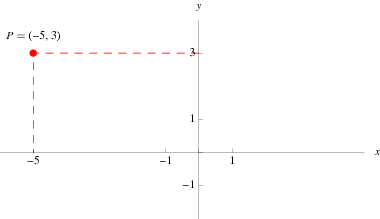
  • A point has two coordinates (x, y), each of which is a real number (as shown on the right).
  • A line has the form ax + by + c = 0 for some real number values of a, b, and c. For instance, defining a line as "y = 2x + 4" is the same as saying "2x - 1y + 4 = 0".
  • A point is on a line (and the line contains the point) when the point's x and y coordinates satisfy the equation for the line. For instance, the point (1, 6) is on my example line above because 2(1) - 1(6) + 4 = 0.
In the geometry course I'm taking, the definition of a particular geometry follows this pattern: you define what the points and lines are, and how they intersect.

What we talked about last night is the extended Euclidean plane, which exists in order to get rid of the annoying concept of parallel lines. (They're "annoying" because they muddy up some theorems, which I won't get into.) The extended Euclidean plane is different from the normal Euclidean plane in that any two lines that are parallel in the Euclidean plane are said to meet at a "point at infinity." Every class of parallel lines (that is, any set of lines that are all parallel to each other, or all of the lines with the same slope) has a unique point at infinity at which all of the lines meet. And all of the different points at infinity make up the "line at infinity." Well, why not?

So, the extended Euclidean plane could be described like this:
  • The points include all points of the Euclidean plane, plus a point at infinity corresponding to each class of parallel lines (alternately, corresponding to every slope).
  • The lines include all lines of the Euclidean plane, plus the line at infinity.
  • Euclidean lines contain all of the points they would in the Euclidean plane, plus the point at infinity corresponding to their parallel class. The line at infinity contains all of the points at infinity.
This leads to at least one nifty result. Now, in addition to this:
  • Any two points determine a unique line.
we also get this:
  • Any two lines meet at a unique point.
These statements are "duals" - formed by changing points to lines and collinearity (being on the same line) to concurrence (meeting at a point).

Fun stuff!

Thursday, January 22, 2009

New Classes

Since my new classes started yesterday, here is a brief overview.

Higher Geometry II

This course covers affine and projective geometry. Last night we went over groups, abelian groups, and fields, which are abstract algebra concepts. (A field, which is the highest level of this particular hierarchy, is something like the real numbers - a set with two operators comparable to addition and multiplication, with associativity, commutativity, distributivity, identities, and reciprocals.) The prof (a grad student) told us not to worry if we felt like we were drinking from a firehose. He called this "Abstract Algebra in an hour."

15% of our class grade will be based on problems that we individually present in class, 15% on problems that we turn in, 25% on a paper that we have to write (15% for the paper, 10% for a presentation based on the paper), and the remainder on the three exams (no cumulative final). For the exams, we have a choice of take-home (several new problems) or oral (problems from the book or handed out in class), and we have to choose an oral exam for at least one of them.

Oral exams and all of the presentations are graded as Perfect (100%), Good (95%), Fair (75%), or Poor (35%). He suggested that he will not be very harsh with the grading and if you do a decent job you will probably get the 95%.

Principles of Programming Languages

This is an upper-division CS course, pretty standard at most schools, that discusses the different paradigms of programming languages, their features, and something about their implementation. The professor was funny and charming.

There will be 7 coding assignments that will take about 2 weeks each. These are graded pass/fail, and at the deadline we must have turned in a "serious effort." He'll give it back and if he requests additional work or fixes on it, we have a week to turn it back in with the fixes. These coding assignments are worth 7 points each for the total course grade. The remainder of the points come from 3 exams (again no cumulative final) that are worth 17 points each.

Apparently the professor used to let people turn in their assignments whenever, but he discovered (unsurprisingly) that this just encouraged students to prioritize classes that did have deadlines. So now, barring "both of your grandparents dying in a horrible blimp accident [and if anyone's grandparents have died in a horrible blimp accident I'm sorry, didn't mean to be insensitive]" he'll only accept one assignment up to a week late per student.

There is no textbook for this class. He's used several, including (many times) the most popular one, by Sebesta, but he finds that he uses them mostly to make fun of how bad and wrong they are. Also, he said that for us having a textbook just means thinking, "Oh, there's this thing I should be reading, but I don't." And that sounds about right; I haven't actually read a CS textbook yet. He plans to attempt to produce whatever materials he wants us to read, which will be necessarily brief given that he has to produce them.

It's going to be a fun but difficult, I think, semester.

Saturday, January 17, 2009

Spring 2009

My semester begins Tuesday, and originally I was only scheduled to take one class - Principles of Programming Languages, the last computer science class in my degree plan. It is on Mondays and Wednesdays at 7 PM, and I just couldn't find another class before it to fill in the gap, at least among classes that I need or would like to take. (I only have three classes left after this semester, but I would have been happy to have taken another math.)

Last night, I decided to do a search through the online schedule for all classes that are around 5 on M/W. And I found that UCD (University of Colorado at Denver) has a cross-listed math class at 5:30. This one:
MATH 4220-3. Higher Geometry II. Studies affine and projective geometries. Coordinates are introduced in this framework. Planes and higher dimensional spaces are examined. Prereq:MATH3191.
The prereq is for linear algebra, which I started but didn't finish (and will retake next year). I feel relatively confident that I can remember and/or pick up whatever linear algebra it will require. I have also taken the Metro class that is equivalent to their Higher Geometry I, although that is not a prereq.

I am excited about this on several levels. One: math! Two: scary geometry! Three: it's at UCD, where I want to get my master's, so it's possible it could help me. Four: it's another 400-level math class, which I could use.

I was looking forward to a kind of laid-back semester with only the one class, but now I'm very excited about the geometry addition. It will make my semester difficult but enjoyable and rewarding. I can't wait.

Wednesday, April 04, 2007

Good Teacher, Bad Teacher

Sometimes they are the same teacher.

Last week we got an assignment in Geometry that has been taking everyone hours and hours. First of all, some of the algebra is taking an extremely long time. The first problem out of seven took me about 5 pages of (not very densely written) algebra to get through, though I left the vast majority of it off of my homework paper because I know he doesn't care that we show that we can do a bunch of dumb algebra. And second of all, the concepts behind the homework are a bit challenging and require thought.

The way Dr. T gives homework is that it never includes solving problems of a type we have been shown in class or anything like that - it's always an extension or a related sidebar. This is appropriate but makes the homework and tests (which are the same way) pretty challenging.

Anyway, when he asked for questions at the beginning of class, I asked if the homework due date could be pushed back because it was taking a really long time for me and, I imagined, for others people too. Instead of hanging me out to dry, the class agreed. So he agreed to move the due date to Tuesday. Good teacher!

Then he told us we shouldn't be doing all this algebra by hand, but should be using Mathematica. I was already planning to do this, but a lot of the class was astonished to find out that it would be OK and not cheating. My take on it (having known for a few weeks that it was OK) is that using Mathematica to do algebra in this class is like using a calculator for arithmetic in a Calculus class - kind of a no-brainer. (It's assumed that we know algebra.)

You could, of course, program Mathematica to solve the whole problem, rather than just using it for fill-in algebra, but you'd be demonstrating total mastery of the problem in so doing, so it ought to be fine.

Anyway, then it came up that most of us don't know how to use Mathematica. So he actually spent about 10 minutes showing us how (writing the commands on the board). That was neat since I had just taught myself the same stuff earlier in the day.

This led to more questions about the homework, and I got into a little argument with Dr. T over a point I had misunderstood, and some other folks argued over different things, and he eventually said, "The concepts in this course are not difficult. If you think they are, you might be barking up the wrong tree."

Well, fuck you too. (Bad teacher!)

There are times when it's appropriate to suggest that having unusual difficulty with the material of a course might suggest an ill-chosen field of study, but this wasn't one of them. For one thing, every student in this class besides me is a secondary math education major. You need to know a lot of math to pass the tests to get certified, and of course you should know a lot of math to teach high school math, but (a) none of the material for this course is needed for teaching, and (b) you don't need to be a math genius for it either.

And for another thing, even a person good enough to potentially pursue a Math PhD will probably occasionally have conceptual difficulty with a math topic, and it's impossible for someone very familiar with the math to judge how hard it is. I'm not a math genius, but I'm not unfit for advanced study either, and I find this material pretty challenging at times.

Anyway, I got Mathematica in the mail yesterday (joy!) and I've decided to do my entire homework in it - write-up, graphs, drawings, and all. I've been working on that all day (I took the day off work) and it's going to take me hours and hours but be incredibly fun and result in a beautiful paper to turn in. What could be better?

My wall now sports a banner-shaped poster that proclaims "MATHEMATICA SPOKEN HERE" and I hope that will soon be true.

Wednesday, February 21, 2007

What Is a Geometry?

That was the question answered in my Geometry class last night. Here, for your entertainment, I will produce a (non-rigorous) version of the answer.

Let's start with the idea that geometry is about congruence - which figures are congruent to each other? In Euclidean geometry, as I said yesterday, figures are congruent if you can make them line up by rotating them, moving them around, or flipping them over.

So basically, a geometry is a set (in our class so far, typically this is the complex plane - which is basically just a flat 2-dimensional space that extends infinitely) plus rules about what figures are congruent.

What types of rules pass as a geometry? Well, the basic thing is that congruence is an "equivalence relation," which means it has to satisfy these criteria:


  • A figure is always congruent to itself. [reflexivity]

  • If figure A is congruent to figure B, then B is congruent to A. [symmetry]

  • if figure A is congruent to figure B, and B is congruent to figure C, then A is congruent to C. [transitivity]

These properties, which define an equivalence relation, are also true for common ideas like "equals" or "makes the same amount of money as" or "lives in the same city as" - basically, stuff that seems like it's related to things being equal. They aren't necessarily true for other types of relations, like "likes" (Sally likes me, and I liked David, but Sally didn't like David - liking is not transitive - and actually it's not reflexive or symmetric either) or "is bigger than" (which is transitive, but anti-symmetric and anti-reflexive).

So, getting a bit more formal, a geometry is a set (such as the complex plane) plus a group of allowable functions on the set, where the group of allowable functions forms an equivalence relation. Since we're doing this with algebra, not by picking up pieces of paper and moving them around ala Euclid, this can be set out rigorously with...well, math. Here are some types of transformations, or functions on the complex plane:


  • Rotation - You can rotate around the origin (0) or around some other point.

  • Translation - This means moving the plane side to side, up and down, or diagonally, without rotating it.

  • Reflection - This means making the figure into a mirror image of itself across some line, such as the x-axis, or y-axis, or anywhere else you want.

  • The identify function - this just maps each point to itself. It doesn't change anything.

So the next part of class was investigating some combinations of these to see if they could constitute a geometry.

For instance, if your only function is reflection across the x-axis, this is not a geometry. Why? Because under that system, a figure is not congruent to itself. (It's only congruent to its reflection.)

But if you add the identity function, so that you have the identity function plus reflection across the x-axis, you have a geometry! You can formally test the properties of an equivalence relation in this case like this:


  • Reflexivity - the identify function must be included

  • Symmetry - if a function f is included, it must have an inverse, and the inverse must be included.

  • Transitivity - if functions f and g are included, the composition of f and g - that is f(g()) - must be included.

Another geometry could include only translations. Does this satisfy?


  • Reflexivity: f(z) = z + 0 is a translation and is also the identity function. So that's good.

  • Symmetry: if f(z) = z + w is a translation, then f(z) = z - w is its inverse, and is also a translation. Check!

  • Transitivity: if f(z) = z + a and g(z) = z + b are translations, then f(g(z))) = z + (b + a) and that's also a translation.

A less mathy way of saying this is to remember that translation means moving things around without rotating or flipping them. Is a figure congruent to itself? Sure - you just move it around not at all. If you can move one figure onto another, then you can surely move the other onto it instead, so it's symmetric. And if you can move figure A onto figure B, and figure B onto figure C, then you could move A onto C by just moving it onto B first, then following B's path to C, so it's transitive.

Note that all of these different geometries have different rules about, essentially, which types of figures are congruent to each other. Fun and games! (Did anyone actually finish this post?)

Tuesday, February 20, 2007

A Little Math

One of my courses this semester is Foundations of Geometry, which sounds like it would be easy, but so far has been pretty interesting, and has forced me to be more algebraically clever than usual. (Algebra, in a geometry class? Say it isn't so!)

When you have geometry in high school, it's usually Euclidean geometry, in two senses. The most important way in which it's Euclidean (in my view) is that it uses axioms and proofs to develop geometric ideas. Euclid totally invented this approach to math. Some people (like me) love this and other people (like Mosch) think it's a big waste of time. The secondary sense in which it's Euclidean is that it uses the specific axioms of Euclid. If you change one of Euclid's axioms (the parallel postulate), you can get some different interesting results.

My class is currently proceeding down two lines of work - some straight-up Euclidean stuff, usually presented as puzzles at the beginning of every class period, which we solve and then do some proofs about, and then "analytic" geometry.

Analytic geometry is where you say, "Why is Geometry the only part of math where we're still doing this weird Euclid-type stuff? Let's do everything with algebra and calculus instead!" And so it goes. Our textbook (a slender volume called "Modern Geometries: Non-Euclidean, Projective, and Discrete," by Michael Henle) uses this approach.

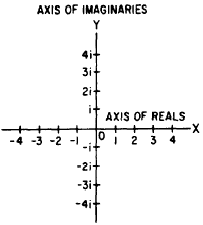
In analytic geometry, at least as presented in this course, you represent 2D shapes as coordinates in the complex plane. (This is basically like the regular cartesian plane where you have x, y coordinates, except that in this case the y axis represents the imaginary part of a complex number, so every point in the complex plane is actually just one number of the form x + iy.) Then you use regular math to prove stuff about them.

For instance, one thing you do a lot of in geometry is prove that things are congruent. "Congruent" basically means they are the same size and shape. Euclid's version of congruence is that two shapes are congruent if you can pick one up and lay it on the other and everything lines up. This makes sense, right? If you have two triangles on two pieces of paper, you can literally pick up one sheet, put it over the other, rotate it and move it around, and see if the triangles are the same or different.

In analytic geometry, you prove two things are congruent by proving that there is a one-to-one function (of an allowable type, like a rotation) that takes the set of points contained in one shape and transforms them to the set of points contained in the other shape. This is basically the same thing as what Euclid did, except that it's all algebra instead of being a physical maneuver.

These functions that change one set of points to another set of points are called "transformations" and the ones that Euclid would allow are basically rotation (where you turn something around), reflection (turning the piece of paper upside down, if you had the shapes on paper), and translation, which just means moving things up or down, side to side, or diagonally. If you think about how you'd line up shapes on two pieces of paper, those are the basic moves - you rotate the paper, flip it over, move it around, or some combination of those things. If you can change one shape into another by those types of maneuvers, then the two shapes are congruent.

So...that's about as far into analytic geometry as my class has gotten at this point. I could say more about it, but it would go into weirder math, so I'll refrain :-)