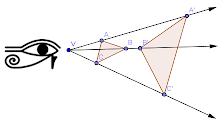
The humble View-Master is probably the most well-known type of stereogram. I sometimes had one of these as a kid, usually with reels of scenes from Disney movies or something, but the art form has been around a long time and you can find reels of wildlife, architecture, or even street shots of 1920's Germany. (I have reels like this at home in my small collection. If I could ever find a batch of like 1000 View-Master reels I would totally buy it up.)
Stereograms are also often used in remote sensing, with aerial photography. In this case, two photographs captured by an airplane in two different positions, with around 60% overlap, give you a 3D view of the ground, with significant vertical exaggeration (because the images were taken usually hundreds or thousands of feet apart, while your eyes are only a few centimeters apart). I have this book at home, with images like this:

These are typically viewed using a viewer that is basically just two (magnifying) lenses separated by some plastic, to help each eye look at the correct image. But if you are talented and practice, you can see these with the naked eye. (If you try this with the one above, try making it very level to your eyes and getting your face pretty close to the monitor - the image is a bit small for ideal viewing.)
The technique for viewing a stereogram without a viewer is to learn how to make yourself go "wall-eyed" (the opposite of cross-eyed) while maintaining your eyes' focus. In other words, you need to direct the angle of your eyes as though you are looking at something further away than the actual image, while maintaining the actual focus on the image. I am pretty good at it, and for me, the 3D usually comes before the focus, so I first diverge my eyes, then once the distance is right, I can focus.
Looking at a 2-image stereogram uses the same skill as looking at an autostereogram, which is what those "magic eye pictures" that used to be so popular in malls are. In an autostereogram, the pattern of dots or other elements is arranged such that your eyes can mistake two separate images for the same image, thus creating the illusion of 3D. I find most of the speckledy ones pretty boring, but some other ones are cool. From the Wikipedia article linked above, I especially liked this one of a chess board:
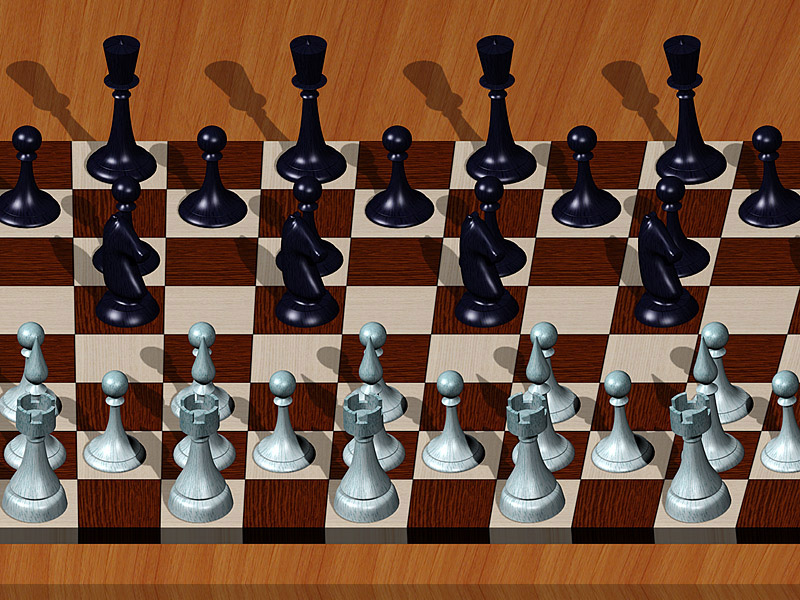
This one looks pretty much the same in 2D or 3D, though once you get the 3D, you will (through the confusion of your eyes) see more pieces. And of course it will appear to be 3D. This is a pretty easy autostereogram to practice on.
This one is much more difficult, but rather clever:

You can also get the stereo effect staring at something like bathroom tiles. Nothing will pop out, of course (though it would be great fun to tile a bathroom in such a way as to create a 3D image for discovery), but the tiles will shimmer a bit and appear to be at a different distance away than they actually are.
Some people, especially those with a lazy eye or who do not generally have depth perception, cannot make out stereograms. Ed, for instance, gets double images in a View-Master or at a 3D movie, so the odds that he can make out an autostereogram are especially low. For the rest of us it is just a learned skill.