Showing posts with label exercise. Show all posts

Friday, October 21, 2011

My Current Beliefs about Diet and Obesity

I thought it would be good to set out my current beliefs about diet, nutrition, the causes of obesity, and so on. They are what guide my (perhaps wacky-seeming) current dietary guidelines. I'd also like to distinguish them from other beliefs with which they might be confused.

Food Reward Hypothesis

I think the food reward hypothesis is the best-supported current idea about why so many of us are overweight and obese these days. The basic idea of this is that we now have the ability to make (in many cases manufacture) foods that are both hyper-palatable (really delicious) and high reward (very tempting/craveable/"addictive" in a loose sense), and that eating such foods causes our bodies to try to keep us at a higher weight than is healthy.

This shouldn't be confused with the "thrifty gene hypothesis," which is the common-sense idea that we evolved to live under the threat of starvation and are going nuts now that food is so plentiful. According to the food reward hypothesis, if our food were still the sort of plain, comparatively unvaried food eaten by our ancestors, abundance itself wouldn't cause overeating.

Stephan Guyenet has a great series on the food reward hypothesis here: Part I, Part II. He talks about the thrifty gene hypothesis as well.

(Note: I will be linking Guyenet a lot in this post. He is not my only source of information here, but he has informed a lot of my thinking, and seems to have done his homework. In many cases he's the best concise link I can give.)

Conclusion: I should eat simple foods prepared at home.

The Role of Carbs

Books like Good Calories, Bad Calories by Gary Taubes make convincing arguments that overconsumption of carbohydrates, particularly sugar and refined flour, are responsible for the obesity epidemic. Certainly, obesity travels together with insulin resistance (a problem that is all about carbs, and is the fundamental cause of Type II diabetes), and insulin resistance is a big part of what causes heart disease in general.

Guyenet, the same guy as above, has a long critical post about the idea that carbs (or insulin resistance) cause obesity. He doesn't buy it at all.

I honestly don't know what to think about this topic. But what everyone (at least, everyone I'm currently reading) seems to agree on is that if you are insulin resistant, eating a ton of carbs is a bad idea. This is contrary to the official recommendations for diabetes patients (which stress a high-carb, low-fat diet), but I've read enough to convince me that that is bunk; I'll write more below about why.

I've been testing my blood sugar lately, and my fasting morning glucose levels are slightly elevated - not in the diabetic range, not quite in the "pre-diabetic" range, but not where they should be or where they have been in the past either. I have a strong family history of diabetes and I have other signs (like PCOS) of having trouble with insulin resistance.

Insulin resistance definitely leads to heart problems and a lot of other issues. Exercise and reduced carb intake definitely combat insulin resistance.

Conclusion: I should take care not to eat too many carbs.

Dietary Fat

The dominant hypothesis of the last half-century or so of medical advice has been that overconsumption of fat is what causes obesity and (separately) heart disease. This is why diabetics and overweight people (and, really, everyone) is encouraged to eat a low-fat diet.

It is a fact that you cannot eat a low-fat diet without eating a high-carb diet. Humans can't eat the bulk of their calories as protein (you will get sick if you try, but you'll also find it very hard to try, because you will start very very badly not wanting to eat any more lean meat).

The evidence that high fat intake causes obesity is based partly on common sense (fat has more calories per gram than carbs or protein) and partly on the observation that Americans got fatter and started (perhaps) having more heart trouble around the early part of the 20th century, when (it is believed) we may have started eating more fat.

We also started eating way more sugar and refined flour and packaged products and that sort of thing at the same time, so it's very hard to tease out the effects of fat vs. carbs vs. high-reward foods (vs. unknown other factors, of course). There seems to be very little evidence that eating a high fat diet causes weight gain. Many traditional cultures (Inuit, Masai) eat very high fat diets and are very lean (despite not facing any regular food shortages).

Conclusion: It's OK to eat a high-fat diet.

What about Saturated Fat?

As someone who has lived in our culture, it is very difficult not to believe that saturated fats, especially from meat and animal products, are dangerous. I feel as though I know in my very bones that these types of fats are unhealthy and cause heart disease. This is one of the very strongest messages about food from the medical establishment.

From what I can tell from my reading, it's just not true, or at least, many very large, long-lasting studies designed specifically to support this hypothesis have completely failed to. Now, my reading isn't (can't be) exhaustive and it's possible my sources are looking at the data in a really biased way, but it doesn't seem so to me.

Here's Guyenet on saturated fat and cholesterol, the diet heart hypothesis, coronary heart disease, and on findings about full-fat dairy. I also found Good Calories, Bad Calories pretty convincing on these topics. And, of course, when you look at recent studies comparing low-carb to low-fat plans for weight loss, everyone gets healthier on both sides.

An additional bit of common-sense thinking: for a very long time before agriculture, our human ancestors got most of their fat from animals. Either they ate a very high-carb diet (and probably some did), or they ate a lot of animal fats (definitely some did). It's likely we evolved to be able to handle eating these fats.

Conclusion: It is truly safe and healthy to eat saturated fats, including from animals.

Pre-Western Cultures

The fundamental idea of the paleo and primal advocates is that we should eat the way that our hunter-gatherer ancestors did, rather than the way that our immediate agricultural ancestors did. In other words, rather than relying heavily on grains, legumes, and dairy for our food, we should eat more meat, vegetables, perhaps occasional tubers, berries, nuts, and things like that. We certainly spent a lot more time evolving to eat a hunter-gatherer diet than we have spent evolving to eat grains.

The only populations on the planet today who don't suffer from a lot of heart disease, obesity, diabetes, cancer, and other "diseases of civilization" (periodontal disease, appendicitis, gall bladder disease, etc.) are the ones people used to call uncivilized - small pockets of people living a traditional culture. It is true that they largely lack these health problems even when you adjust for age.

These groups are very different from each other. The Masai have a diet made up almost exclusively of milk, cow blood, and meat. Traditional-living Inuit have a diet that is something like 90% animal fat. On the other side, there are traditional cultures who live very healthy long lives (when they don't die in infancy) on diets composed almost exclusively of yams or sweet potatoes, and others who eat more balanced diets. But in general, my point is that there are very healthy cultures living on high-fat and on high-carb diets. It appears that healthy diets can have a wide range of macronutrient ratios.

What these cultures have in common is that they eat very little refined sugar, very little refined grains, and they don't eat "food that comes in boxes" - highly processed food manufactured to be as delicious and tempting as possible. They eat diets of mostly plain foods, with not a lot of variety by our standards.

It's hard to tease out what aspects of the western diet and/or lifestyle cause all of our problems. Is it the sugar? (There is some evidence that high-fructose foods like table sugar and corn syrup may have especially bad effects.) The comparatively recent introduction of grains to our diets? The refining of those grains and sugars? The even more recently introduced cottonseed, canola, corn, etc. oils (polyunsaturated fats)? Or the excessive variety and deliciousness of the manufactured food products that surround us?

At any rate, if the problem is dietary (as seems likely), then, while we can't say exactly what the problem is, we do know that simple diets of plain, pre-agricultural foods are healthy. (Of course, no food that I eat is actually pre-agricultural. I don't hunt or gather anything myself. But I think we can all agree that grass-fed beef or an apple is more "paleo" than a Big Mac.)

Conclusion: It may help to avoid modern agricultural products like sugar, refined grains (or any grains in large quantities), and seed oils.

Exercise

Exercise decreases insulin resistance and has many other beneficial effects, but I seem currently incapable of incorporating much into my life. If I explained why, I would just be making excuses, so I'll just say it's not a big focus for me right now.

Based on what I've read lately, I do think that high-intensity interval training is way more effective than regular steady moderate-intensity cardio. If I were designing an ideal exercise program, I think I'd go with something like Mark Sisson's recommendations in The Primal Blueprint, which means a good base of low-intensity exercise (walking, slow swimming, jogging if you're much more fit than I am), small amounts of interval training (two or three times a week for 5 or 10 minutes), and regular natural, whole-body strength training (two or three times a week for 30 minutes or so).

Conclusion: I should exercise, but I don't.

I hope this helps to make sense of why I'm doing what I'm doing, or was at least interesting on its own.

Sunday, June 20, 2010

Swimming

Today, I went swimming at the Wheat Ridge Rec Center. I haven't been swimming laps much lately at all - in fact it's been months, I think, since I've swum laps at all - but I decided on an ambitious goal for the day: swimming a mile. I wasn't sure that was realistic at all, so I wasn't really determined to make it, but I thought having a stretch goal would be fun.

A mile is just slightly over 35 laps in our 25-yard-long pool. I actually count lengths and not laps, as I'll explain later. I used the crawl (or freestyle, as I think it's sometimes called) for almost all of the laps.

I got slower as the laps went on, but ultimately I did make my goal! I think it took me about an hour and a half, which is pretty damn slow, but I don't care - I am excited about swimming such a long distance at all.

I really enjoy swimming. The environment underwater is beautiful and feels wonderful to me. Swimming is also no-impact; I suppose it's possible to get injured swimming, but I've never hurt myself. For me, it is kind of a low-stress, high-rep, light muscle exercise situation that is not extremely aerobic.

I used to have trouble counting laps, but the technique I use now is that I say the number I'm on in my head with every breath, which is a bit hypnotic too. I count lengths rather than laps so that I always know that on the way out I should be saying an odd number, and on the way back it's an even number. That helps prevent the thing where my mind drifts and suddenly '51, 51, 51, 51' turns into '51, 51, 51, 52, ...'

I also wear a mask and snorkel to swim. I first tried this when I had my neck injury, because I couldn't handle the neck strain of swimming back then. The mask and snorkel made it possible for me, since I didn't have to move my neck around to breathe, and could just keep it in a nice neutral position. And what I discovered is that swimming is much more relaxing and nice if you don't have to worry about breathing at all.

Every 5 laps or so, I come up, take off my mask, and have a short break. I try to keep some water with me and drink it during my breaks, because it is kind of easy to get a little dehydrated while swimming. I don't tend to ever feel thirsty while submerged in water.

Anyway, I had a wonderful time. I hope that the pool at my grad school will be as nice as the one at the rec center and that I can swim there on a more regular basis. I can't swim in the winter here, because the chlorine does unbearable things to my already-dry skin, and I'm hoping that won't be a problem in the new locale.

Friday, January 15, 2010

Wii Fit Plus

Since Ed and I have a Wii, I finally went ahead and ordered Wii Fit Plus, which is a video game for the Wii that incorporates the use of a balance board (similar to a shallow step you'd use in a step class, except heavier and with electronics inside to report your actions to the game) and is intended as something like a personal trainer. I thought this would be something fun to do at home for fitness. When school is in session I really never make it to the gym at all, and then between semesters it's hard to bother starting.

The game (with balance board) is $99.

When you first register your character, using your little animated Wii representation (called a Mii), it weighs you and tests your balance. (If you're like me, after it weighs you and shows your BMI, a childlike voice says, "That's obese!" Thanks, Wii Fit. I had no idea.)

(This reminds me, actually. Someone was complaining online about the Wii Fit's use of BMI, given its limitations. They specifically mentioned that someone like a trim NFL player could be called obese despite actually just being very muscly. I couldn't help but think this common argument was really silly here - as though professional athletes are really a target audience for the Wii Fit. Hint to athletes: if you are training with the Fit, it's probably time to start asking yourself whether you're really into this whole sports career thing anymore.)

Anyway, once the Fit has finished insulting (or perhaps praising) you for your BMI, it has a variety of training exercises to choose from - perhaps about 100 in all. These fall into four categories: yoga, strength training, balance or rhythm games, and aerobic exercises. Each exercise uses some combination of the balance board and the two remotes that a Wii comes with. For example, the jog uses only the main Wii remote, which you put in your pocket to act as a kind of pedometer while you jog in place on the floor. (You're not supposed to jump on the board, and that probably includes jogging, since you raise both feet at the same time for that.)

I haven't gotten into a lot of the yoga poses, but they seem decent. The strength training exercises cover a nice range of difficulty, from very easy things like a tricep extension holding the remote, to things I can't do like pushups and side planks. So far I love some of the leg exercises (very hard, especially the balance aspect) and the plank (extremely difficult and I shake like crazy, which the onscreen trainer often comments on).

The aerobic/rhythm games are so far some of my favorite. I like the basic and advanced step classes, and I adore the rhythm kung-fu. I went on a jog tonight where I actually jogged in place for far longer than I would have thought possible. Every game or activity gives you a score at the end (which, for the strength and yoga ones, is generally based on your balance and steadiness), and there is a high score list for each one. As you get better at things, more levels are unlocked - for instance, my 30-second plank was steady enough tonight that I unlocked the 60-second version.

Overall, I find it fun and very motivational. A lot of people have complained that you have to keep selecting a new activity a lot (though you can set up a full routine of strength and yoga things to do all at once, or have the game do it for you if you tell it the time you want to spend), but I like that aspect - the fact that I get to continually choose what to do stops me from getting bored or feeling trapped doing something horrible forever.

I've done this for four days in a row now, and every day I am sore in all kinds of places both expected (thighs, shoulders) and not (hips, lower abdomen). I am winded and sweaty a lot as well. So it is fun and a good workout. I can't say for sure that it won't become the video game equivalent of a treadmill used as a clothing rack, but so far, it's working for me.

Wednesday, July 08, 2009

Grainlessness Update

So, I am still doing the grainless thing, though not with perfect adherence. I've decided to add whole wheat pasta (2 oz. at a time only) as well as brown rice (small quantities, like 3/4 cup) to my diet. And I've been exercising somewhat regularly, though not quite as much as I'd like.

According to the scale at the gym last night, I am down 10 pounds from where I started in early June. I was only wearing my bathing suit (and Crocs) when I weighed myself, which may be less than I generally wear, but I was dripping wet from my shower (I hadn't dried off at all since I was headed straight for the pool anyway), so that may have balanced it out.

Despite having lost 10 pounds, I feel unsure that this way of eating/living is actually going to result in a lot of weight loss. I don't know why that is, except that weight loss is generally slow if you're doing it the way I do, and so it's hard to be sure you're really seeing a trend and not random fluctuations.

But I'm feeling really, really good about it. For the first time pretty much ever, it's crystal clear to me that I feel better when eating this way than I do when I overeat (especially in an unplanned way). I feel kind of strong and good inside. I hope that it lasts. I am really trying to think of this as a lifestyle change and not a diet to lose weight, so...well, we'll see.

Tuesday, June 23, 2009

New Blog, Extra Boring

I've decided to try keeping a food and exercise diary in the form of a blog. If you like to read it, it is here:

Fuel and Motion

I imagine it will be fairly boring, so (obviously, as though you wouldn't anyway) feel free to skip it.

Monday, June 08, 2009

No Grains Update

So far, the cunning plan is going pretty well - I haven't eaten grains, potatoes, or sugar in the past week (not counting small amounts that may be found in sauces or the like). And last night when (on a whim) I went to the gym, I was 7.5 lbs lighter than I had been on Monday. Even for a first week that is pretty nifty.

I'm eating fruit like crazy, I guess because I can't have other sweet things. I'm amazed how few calories are in most fruits. I've been having lots of blueberries and strawberries mixed with plain Brown Cow cream top yogurt. This is clearly one of the foods of the gods.

Meals are trickier, and I'm having to get more flexible about my ideas of what a meal is. Last night for dinner, I had beef fajitas from Whole Foods (the kind that come raw, marinated and mixed with peppers and onions, which I cooked in a pan with some olive oil). Once I got over feeling sad about not having tortillas, or at least rice, with them, they were actually fantastically good. The quantity I had wasn't really sufficient for a whole meal, but I didn't need a whole meal either, because I'd been snacking a lot of the day.

We have friends who come over most Sundays to do a roleplaying game, and I like to have some snacks on hand. I decided this week not to have snacks I couldn't eat, so I put out blueberries, stawberries, and a package of shrimp cocktail (i.e., cold boiled shrimp with the tails on, plus cocktail sauce), also from Whole Foods. The fruit was popular but the shrimp were not, so I ended up eating most of those (I thought they were fantastic).

Dinner Saturday (returning to the "what's the for dinner") topic was a hamburger patty made of about 1/3 lb of lean ground beef, topped with spicy brown mustard, plus half of a raw red pepper, sliced up, plus a cup of a creamy tomato soup. That was pretty tasty.

We ate out Friday night and I finally, for the first time, had the canonical Atkins food - a bunless cheeseburger. With that I had a mixed greens salad with ranch dressing.

Anyway, enough about food. I also made it to the gym three times last week, which is not very many times, but not nothing either. I swam two of those times and walked (on a treadmill) the other time.

Monday, May 04, 2009

Summertime, Summertime

This summer, for the first time in a few years, I won't be taking any classes, for the simple reason that there are no classes remaining for me to take that are taught in the summer. So, aside from work, I'll have the summer off.

"Aside from work" is a big exception, but when I am in the habit of being in school, not being in school does seem to give me oodles of spare time (with the attendant boredom, etc.) So I have two goals for the summer.

First, I'd like to cook more. I've been making dinner two or three times a week, and Ed has been enjoying and/or tolerating my food. I'd like to bump that up to five times a week, just for the summer, and see how it goes. I'd also like to plan ahead more - buy groceries only once or twice in the week. Overall, the idea of this plan is to practice cooking on a really regular basis, and I also think it will save me money and result in a healthier diet.

One challenge is that I don't currently make enough different meals for us to eat my cooking five times a week without dying of boredom. So I'll have to expand my repertoire a bit, but that's all to the good. There are certainly a lot of different meal ideas out there that meet my criteria (reasonably cheap, easy, healthy, and bountiful).

My second goal is to start exercising again. I haven't gotten any exercise to speak of since my semester heated up, and that's bad. Ed and I were going together before that. Whether he can resume joining me or not, I want to start working out in some fashion five times a week. I still have my 24 Hour Fitness membership, plus, of course, it's summer and thus wonderful and nice outside for all kinds of things, so it should be pretty easy.

I'll keep you posted on how these things go.

Wednesday, November 12, 2008

Iron

Ed and I have new arrangement whereby we travel to our local 24 Hour Fitness three times a week. We spend about 25 minutes lifting weights (we are actually using the same chart, designed by me, though naturally we have our own copies and are using different amounts of weight), and then 20-25 minutes doing some kind of cardio.

It makes me so high.

I usually don't really want to go. "Those weights are heavy!" as Mosch used to say. And the 20 minutes on the treadmill afterwards is somewhat torturous. But when I'm finished, I am often filled with a really strong feeling of well-being, and I find that later the same day, or the next day even, I am extra in love with Ed too. We had this conversation a few days ago:

Me: I just realized why I'm so in love with you right now!

Him: You pumped iron.

Me: Yeah. Is that weird?

Him: Nope. I'm all hopped up on endorphins too.

I joked the other day that we don't need to have sex anymore now that we have this instead.

I've gone through periods of doing strength training before, and I remember that I've always really liked it, despite how easy it is to get out of the habit (and despite the ways that it sucks). But I really hope I can remember how directly good this makes me feel, independent of it being good for you or whatever. I swear I fell asleep last night with a smile on my face.

Sunday, October 26, 2008

Health at Every Size


Right now I am reading Health at Every Size by Linda Bacon. Apparently Health at Every Size (HAES) is a general movement, of which Bacon is a part. The book essentially argues that you are unlikely to succeed at intentional weight loss over the long term, and that trying to do so might harm rather than improve your health, but that you can improve your health regardless of your size by other measures.

I haven't finished the book, so I won't try a full review, but although it's written at a fairly low level (similar to diet books in general) and is slightly polemical, I have only minor quibbles with what I've read so far. Bacon is an actual researcher with the kind of credentials you'd want to see. There are hundreds of citations throughout the text so that if she asserts something, you can easily investigate if you're so inclined. I think the book is worth reading whether you end up agreeing with its conclusions or not.

Bacon and some other researchers who are much more supportive of weight loss did a study in which they enrolled 78 (I think) overweight women and put them into two groups. Both groups met once per week for six months (divided into smaller support groups of 9 or 10 people), and then once a month for six months. One group followed a HAES approach and the other was a standard diet and exercise group.

After two years, neither group had lost any weight, but the HAES group had several measurable health improvements (things like fitness, cholesterol levels, and blood pressure), while the only statistically significant change among the dieting group was self-esteem, which went down.

This was, of course, only one study.

Overall, I find this approach appealing. I have lost a lot of weight (over 60 lbs) intentionally in the past, but I've regained a lot of it over time. I know that the key to maintaining the loss is to get a lot of exercise and maintain a constant focus on it, and I can't seem to do that at all right now - especially the "maintain focus" part. I can't seem to do anything systematic about my weight for more than about a week at a time.

What I can do (and I'm just starting the actual recommendations part of the book, so I'm now just writing about my own experience) is exercise and include more fruits and vegetables in my diet regardless of what or how much I am eating in general. And for now that's working out pretty well. I've got Ed going to the gym with me three times a week (which I generally enjoy a lot even though it's easier not to go) and I'm regularly eating pretty high amounts of fruits and veggies. (I'd say I average about 5 or 6 servings a day, which is not super high, but is at least within recommendations.)

I don't know. If I continue to inexorably gain weight I may have to revisit the idea of intentional weight loss. But if I can maintain some weight or other and increase my fitness to a normal level while eating a somewhat healthy diet, that might be a better approach for me.

Friday, February 29, 2008

Exercise Music

I usually listen to music when I exercise. I'll listen to almost anything, but some songs give me extra joy when my iPod plays them. There are even songs I've intentionally bought through iTunes just so I'd have them for exercising. My tastes run towards inspirational lyrics and cheesy 80s-ness. Without further ado, here are some of my favorite songs to hear while working out.

"Africa" by Toto


(I am now trying not to let the horror of that video destroy my enjoyment of the song.)

"Eye of the Tiger" by Survivor


"Rain King" by The Counting Crows


NB: This is NOT the real video for this song, but it was the best YouTube version I found. Don't let the images inform your understanding of the music.

"Jeopardy" by the Greg Kihn Band


This song just has a fantastic beat that I can't get over.

"Lose Yourself" by Eminem


"Success is my only motherfucking option, failure's not."

"I Wish" by Skee-Lo


"First We Take Manhattan" by Leonard Cohen

See the video here. Note that this should also be known as the only Leonard Cohen song that it is even possible to exercise to.

There are others, but this is a good chunk.

Wednesday, February 27, 2008

Dedicated Spaces

I am noticing a pattern - I really enjoy going somewhere specific to do something.

In the past week, I have visited my local library branch twice to work on my linear algebra homework, and both times, I was quite productive. The library just got remodeled, so it's pretty nice inside. (Unfortunately, the chairs are uncomfortable - as in, my feet don't reach the ground - but I was able to move one of the comfy sitting chairs to a table and use it instead.) There are computers there, but you have to reserve one if you want to surf the Internet, and there are no computers at the plain tables where I sit. There are virtually no distractions - just enough so that when I get bored, I can wander through the stacks for a few minutes to invigorate myself.

I am the same way about exercise. I have an annual pass to our local rec center, and going there to exercise is actually easier for me than exercising at home, or by walking around outside near my home. It's a dedicated place. It's a trip. I think I like going places to do things.

Last night, Ed and I went to Perkins (a 24-hour chain restaurant like Denny's or IHOP). We had dinner, and then pushed the plates and condiments to one side of the table while he joined me on the other. We spent the next hour or so hashing through some math that I didn't understand.

It was perfect. The flat, smooth plastic table was ideal. The restaurant was nearly empty, so I didn't feel we were stealing a table from our waitress. (I did overtip when we left.) Our drinks still got refilled. It was just much nicer than attempting the same thing at either of our homes.

I think my preferences in this respect may be the opposite of what most people want. It's not that I don't value being home. I just feel like I get more done, more easily, and with more fun, if I go to a dedicated space to work.

Monday, June 11, 2007

Weekend with Ed; "The Talk"; Condoms

I basically spent the entire weekend with Ed, which was great. He brought his computer over on Saturday night so we could continue to hang out and he could still do his stuff.

Red Rocks - 15 minutes from my apartment!We had a short but fun hike on Saturday. (He told me he must love me if he was willing to exercise for me. Not to mention be exposed to all that icky life outside.) We did the trading post loop trail mentioned on this page about hiking at Red Rocks. The first time I did this - a couple of years ago, I guess - I thought it was a pretty challenging trail, but now it's just a short romp, really. We spent a lot of the walk arguing about physics. (For instance, I argued that we had to walk uphill as much as we did downhill because we needed our up and down vectors to sum to zero, and Ed argued that it was because "gravity is a conservative force." The passers-by at a particular point probably wondered why Ed was shouting at me, "You're living in a flat earth!" All in good fun, of course.)

Late Saturday night we had the "what happens if Tam gets pregnant" talk, which is a very difficult conversation that is nonetheless a really good idea to have at some point. I of course told Ed that I want to marry him and have a million of his babies am not completely sure what I would do, but that we would discuss it in detail if it occurred. His position was compatible, but I won't expose it here. I think we are both realistic, reasonable adults who took approximately the positions you'd expect.

'And Protestantism doesn't stop with the simple condom, oh no, I can wear French Ticklers if I want!'Meanwhile, I have BC pills on hand, and am ready to start taking them at the start of my next cycle. We are using condoms right now, and plan to keep using them even once I am on the pill, so the odds of fertilization are pretty low.

I haven't had many partners who were happy with wearing condoms indefinitely. I find them slightly inconvenient and a tetch uncomfortable, but I'm figuring out how to mitigate that, and I really appreciate having a partner who sees no drawback to them and is willing to take responsibility for his own half of the equation. And of course they make sex safer and I guess the bottom line is, I'm getting to be a big fan of the stupid things.

Wednesday, June 06, 2007

Kayak Lesson

Last night from 8:00 to 10:30 PM, I took a kayaking lesson, the first in a series that I could take. The company that offers these (Confluence Kayaks) does them on lakes and (for the more advanced classes) in rivers, but you can also take them in the pool at the University of Denver, and that's where I was.

this girl should have her head tucked further towards the bowThe first thing they taught us was the "wet exit," which is how you get out of an overturned kayak if you need to. When you get into a kayak, you are wearing something they call a "skirt," which is made of wetsuit material, and fits around your torso, with a flaring part (like a skirt) with a rubber lip at the bottom. You use it to create a seal between yourself and the opening in the kayak.

Wet exits seem scary because they really wedge you into a kayak (so you can control it with your body) and you wonder if you'll actually be able to get out. We were taught to execute the wet exit using these steps.


  1. Lean forward until your face is against the skirt. In a real situation, you'd be wearing a helmet, so this is to protect your face from rocks or other things in the water.

  2. Bang three times on the sides of your kayak. This is to let people know you're trapped upside down.

  3. Rub the sides of your kayak with your fists. (This is useless for a wet exit, but practice for the bow rescue.)

  4. Reach to the front of your skirt, where you hopefully left the tab at the front facing out, and pull the skirt right off the boat.

  5. Put your hands on the kayak near your hips, push it off like pants, and do a forward somersault out.

If you're not intrinsically afraid of being trapped underwater, which I'm not, this doesn't sound so scary until the first time you try to do it. (It's not difficult, but it is a bit panic-inducing.) There were 7 students in our class, and we each practiced one at a time (taking turns) until we were comfortable. Everyone went twice, and one woman went three times. I wasn't completely sure I was comfortable after doing it twice, but I didn't feel like doing it again.

Next we learned a few basic kayaking strokes, with time to practice them. As with paddling a canoe, you want to paddle by rotating your torso rather than by pulling the paddle with your arms. (I feel like this is even more possible and necessary in a kayak, but I'm a beginner at both.) Our teacher seemed legitimately impressed by how fast we learned all of the strokes.

I tipped over by mistake while doing the forward stroke, so I got to practice another wet exit, this time under slightly more realistic conditions (i.e., while surprised).

The next thing we learned was the "bow rescue" or "eskimo rescue" - a way to get righted in your upside-down kayak without having to do a wet exit. We practiced this in stages and, frankly, I was fearful of each stage (I was very very tired by this point, especially because of my accidental wet exit and the ensuing exercise of getting the kayak out of the water, getting myself back in, etc.)

our boats were shorter and stubbier than these, which are more optimized for going straight for long distances

But the basic way this rescue works is that, after you flip over, you signal for help by banging three times (as above), and then you wait patiently while rubbing your fists or arms along the sides of your kayak. The reason for the rubbing (so mysterious earlier) is so that you can feel the other kayak when it comes to you.

Your rescuer approaches you at a right angle, and when you feel the bow of their boat, you put your hands on top of it (he showed us how, if you accidentally wrap your arms around it instead, your head will be under their bow, which is unworkable) and pull your head out. He had us rest our head right on their bow.
see how this guy is real calm and just getting ready to do his hip snap?
Your kayak itself is still upside-down at this point (though dry inside because of the skirt), and even though you feel like you want to just pull yourself up, that's not possible with an upside-down boat on top of you. You have to use your hips to flip your boat back upright, which is actually pretty easy. (In other words, you want to push your boat beneath you, not try to push yourself up over the boat.) It's hard to remember that this is what you want to do, but fortunately your head is out of the water, so you know you have until your arms give out to think about it, so it's not too hard not to panic.

We practiced this in five distinct stages, so we really eased into it. By the final stage, my partner would be off across the pool and I'd flip over, bang, wait (trying not to worry, because of course I could do a wet exit if I got desperate), and then when she hit my boat with hers (never on the side I expected, because flipping over is so disorienting), frantically dig my head out, think/struggle, then flip over. Whew, upright again.

The lesson was exhausting, but great fun. The feeling of being in a kayak is somewhat magical - the way your hips can rock the boat side to side so easily (and you don't capsize as long as you keep your body separate and over the boat - exactly opposite to how you do a bike). And all that time upside-down in the water was pretty special too. I felt the sensations of it all as I was falling asleep.

In the second class, they teach you how to roll.

Thursday, February 22, 2007

Exercise and Self-Efficacy

If this rat thinks he can win at slots by trying, he's just plain wrong. At home I have a book (A Kind and Just Parent, by William Ayers) in which the author (who taught teen boys in juvenile detention) explains why he encourages them to lift weights, even during school time. He says that by working out with weights, the boys are able to apply effort and see results - and learn, hopefully, that they can change themselves by trying. (At least, that's my vague memory from reading the book a few years ago.)

I often say that exercising, and especially weight-lifting, makes me feel "like a stud." What I really mean is that it increases my self-efficacy. Self-efficacy isn't my own invented concept, and you can read about it elsewhere, but what follows is my own take on it, which is not necessarily quite correctly in line with the original idea.

Self-efficacy is the belief that you can succeed at something through effort. I believe I could get a PhD in mathematics if I tried hard enough, but I don't believe I could ever be good at basketball - I have high self-efficacy in one area and low self-efficacy in the other (regardless of whether I'm correct in my judgments). But what I'm more interested in is self-efficacy in general - to what extent do I believe my results are influenced by my efforts, versus by factors beyond my control?

It seems to me from what I've read [note: this is a hedge to avoid providing references] that instilling self-efficacy (the idea that you can succeed through effort) in your children is much more important than instilling self-esteem (the belief that you're an OK person deep inside). In education, you can reinforce this by telling a kid who's done well on a math test, "You've been working really hard on that, I can tell," rather than, "Wow, you're really good at math." Ideally you would also put your child into situations where their effort really does determine their outcomes - not in situations where they will succeed (or fail) no matter what.

Anyway, I feel like I do increase my own self-efficacy when I exercise, and I bet this is true for most people, at least if they start with some activity they can make a good go at, because typically you make a lot of progress in the beginning of a new activity (especially if you're out of shape to begin with), and it really builds confidence.

I try to control my eating, but even if I have (momentarily) given up on that, and I get into a regular pattern of exercising, I suddenly get the feeling that I can fix my eating habits too, and then I start eating properly. In any given week, there is a high correlation between my exercise and eating habits, and I don't think it's just that I have "more will power" some weeks than others (though this might be true in some way). I really think exercise drives the whole thing for me.

Because it makes me feel like a stud.

Wednesday, November 08, 2006

Weight Routine Adjustments

During the semester, I'm trying to get to the gym to do strength training at least twice a week. I don't always meet that goal, of course, but last week I finally used up the last blank on the chart I printed in August.

I work out with arms/abs and legs/back on different days, so these days I'm basically doing each one only once per week. This results in slow progress, but I'm still progressing, so that's good.

My arms/abs routine consists of assisted pull-ups, assisted dips, shoulder presses, one-armed rows, bench presses, and ab crunches (with weight). My legs/back routine has traditionally had squats, stiff-legged deadlifts, calf raises, and back hyperextensions. (The links are to pictures, most of them from the wonderful stumptuous.com.) I do two sets of each thing, with about 8-12 reps per set, depending on what I can handle. When I can do two sets of 12 reps of anything, I increase the amount of weight I use, and for some of the moves, I increase the weight even earlier than that.

Up until very recently, I wasn't ready to try squats using a bar. I was just doing the squats with my body weight, and that was plenty. The first time I ever tried them, I did 5 or 6 and was basically crippled for a week. Now I can do two sets of 15! So it's time to move on to using a bar and, eventually, a bar with weights on it.

So last night I did a lot of experimenting, using the large aluminum bar at our rec center. The regular bars are made of iron or something, and they weigh 45 pounds, but this aluminum one is an easy-to-handle 15 pounds. I set everything up in the squat cage and had Mosch help me figure out the mechanics of the movement. I eventually did 2 sets of 10 squats with this bar.

Afterwards, I wasn't able to do the stiff-legged deadlifts, because my thighs were so weak that I couldn't stand without locking my knees, and that's not a good way to do those. The stiff-legged deadlifts are questionable in my mind anyway: they can be dangerous if you do them wrong (which is easy to do, it seems to me) and, although they are supposed to work your hamstrings (back of the thigh), the back hyperextensions seem to work my hamstrings much more.

So I think I'm dropping them from my routine completely. That pushes my legs/back routine down to just three things - squats, calf raises, and back hyperextensions. (I was able to do the calf raises and back hyperextensions even with my weak legs, so there's no major conflict there.)

I'm thinking of adding the machine that is for hamstrings and glutes to the routine to bring it up to 4 things again. I'm not sure what the machine is called, but it is similar to this picture. I don't normally use these types of machines, but I think it will help round out the workout, plus give me some intense work on that area (hamstrings are my primary concern, but anywhere I can build muscle is good).

Anyway, I absolutely love strength training. I don't like that my progress is so slow with it lately, but still, every other week or so I am raising at least one weight, and sometimes several, so things are going well.

Thursday, July 13, 2006

Squat Safety

Many people are concerned that squatting low - that is, with your knee at an acute angle, rather than just to the point that your thighs are parallel to the floor - can cause knee injury. I've seen a few sites (including the one I linked yesterday) that claim otherwise, but the very fact of seeing so many denials made me wonder whether anyone is making a credible case that deep bends are risky.

So I found this article, which argues pretty extensively (with multiple references) that squats are safe for most people, even people with various types of knee injuries, and in general have a protective effect on knees. My squats have been causing me a little bit of knee discomfort and "fuzziness" (both of which go away by the next day), and the article suggests I should do them shallower if that's the case, until I build up strength. (I've been nervous about the knee sensations, but not sure whether they were injuries or just soreness like you often have in your muscles after lifting weights.)

So I'll be keeping my squats shallower for now, but I hope to continue working up to higher reps and more depth over time as my knees adapt. The article also covers spinal concerns, but I won't be worrying about my spine until I actually start squatting with a barbell (or at least a bar).

Tuesday, July 11, 2006

Weight Training

In contrast to my not-quite-in-control eating, I've been doing really well with weight training lately. I've been going pretty regularly three times a week and spending about 45 minutes on my routine, which involves a lot of free weights, ab work, and a couple of machines.

I enjoy it in that I (usually) look forward to going and start off in a good mood, and in that I feel very good after doing it. But it's somewhat murderously hard to pick up weights that you can barely move 8 or 10 times. Your body gets into an anaerobic thing where you can't get enough air and it kind of feels like you're going to die all over. Afterwards I am completely worn out.

Last week, I found this awesome website - stumptuous.com - about women's weight training. It has a ton of information, advice, and just general kick-assness about the whole thing. (Almost all of the advice and info is gender-neutral, so guys, feel free to check it out.) I especially like the suggestions about routines and, really, all of the articles on the training page. But just click through the links at the top and enjoy.

Since finding that site, I've added squats to my workout. (You can read all about them here if you want.) I had been using a leg press machine, and doing some partial squats holding onto a railing, but a couple of visits ago I tried a real squat (not with weights). I did about 5 of them (not all with great form) and it murdered my legs. I could barely walk for three days.

But last time, I did 2 sets of 3, with better form than last time (still no weights; arms out in front zombie-style as illustrated on the link above), and my legs were weak afterwards but not sore the next day. People who are serious about weight lifting seem to think squats are super-important, so I'm glad to be headed down this path. It makes me feel like a stud, though I'm pretty far away from being able to do them with a heavy bar on my back. (Once I can do a set of 15 or 20 with my weight, I'll start working on the real thing.)

When I first wanted to do a squat, I couldn't even figure out how to try one. I mean, physically I didn't know how to start. Then I remembered peeing in the woods in snowshoes and a ski bib last winter, and realized I do at least know how to crouch, which somehow gave me the courage to just get down into some kind of a squat. I'm still working on balance so that I'll be reliably on my heels and not forward on my toes, but it gave me a place to start.

So despite the eating thing not going entirely well, I'm having success in an area that is fun and important to me. And I'm definitely getting stronger all over.

Week 10 Update

Is it a bad sign that I had to calculate from an old post what week I'm on of my 15-Week Plan?

Yep.

I haven't totally blown it or anything, but I'm not doing that well either. I seem to be hungry more than I should be (I had a few weeks there where I had no troublesome appetite), and I seem to be stuck on a Doritos kick. (Oddly, I only like Doritos when I am dieting. I much prefer other types of snacks under other circumstances.) Plus I keep eating Twix bars. Crazy stuff.

So overall I have lost about 6 pounds, which is not terrible. My coworker and I went to Weight Watchers today, after skipping the past 3 weeks, and I was the same weight as 4 weeks ago, which is...well, under the circumstances, pretty good, I guess?

Anyway, this has been the most boring post ever, but I thought I should at least post something about it.

Wednesday, June 21, 2006

Epic Hike, Part 4

Please see Part 1, Part 2, and Part 3.

Do you want to know how tired I was when I got to the car at 7 PM? This is how tired (no, I didn't know my picture was being taken):

I was also filthy, largely because the sunscreen I wore made dirt stick to me all over, but partly from the gallons of Off Skintastic I'd sprayed all over. (Speaking of bugspray, I promised Mosch that I would point out that most of these photos came at the cost of his getting bitten by more mosquitoes. Oh, the sacrifices we make for art!) Mosch was supposed to drive us home, but I needed more of a break than riding in the car, so we stopped at a local Alco store and I washed up, and then we ate Mexican food at a restaurant in Winter Park and then we drove home.

I was sore and zombie-like all day Sunday, barely able to walk. I called in sick to work on Monday. Today is the first day I haven't had any effects from the hike.

The map says it was 8 miles, and you can see there was quite a bit of uphill and downhill in there. It took us over 5 hours, with only a few short breaks. If you'd asked me if I could walk 8 miles, I'd have said definitely not, but apparently I do have it in me. I figure if I did this every week, I'd either develop enough muscles not to be crippled by it, or else develop some kind of crippling long-term injury. But I don't think I'll find out.

Thanks for reading all of this, and I hope it was at least a little bit fun.

Epic Hike, Part 3

See Part 1 and Part 2.

I did not freak out at our position. I think I said something like, "Well, this will make an amusing story later," and, after a brief discussion of whether to go back to the Zoom Trail or continue down the Flume Trail, in which Mosch argued for continuing on because we had come quite a distance downhill (about 500' if you believe the map), we set off down the Flume Trail with a quickness.

We needed to walk 2.2 miles to the intersection with the Chainsaw Trail, and then somewhat uphill to the Zoom Trail, and then a bit downhill to the car.

Most of our path was through woods, with an occasional log to rest on:


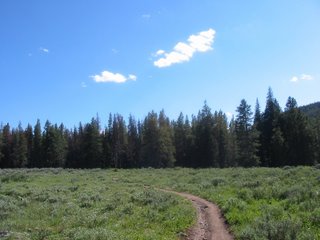
And we crossed a big meadow:


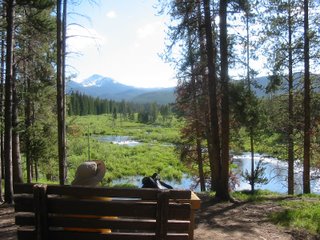
And finally came to the one single bench we found along this whole trail, where I had a good rest for about 10 minutes while mosquitoes bit Mosch all over (I looked up at one point to see about 15 just on one of his legs). My feet were incredibly sore by this point, but the scene was idyllic. I'm only sad that the camera didn't capture the blue sky properly.

When we reached the Chainsaw Trail, I thought we were home free, but it turned out that most of the trail was a pretty extreme uphill chug (as you can see on the map) through picturesques woods that I was thoroughly tired of seeing.

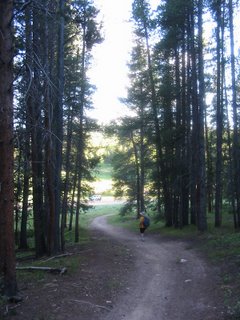
Birds sang, squirrels rustled around us, the weather was gorgeous - a bit under 70 all day, sunny and with a cool breeze - but I was just dog tired. That last uphill bit really took the stuffing right out of me. I found myself not crying involuntarily, and not intentionally trying to cry, but involuntarily trying to make myself cry. (I couldn't even do that.) Mountain bikers would pass us, all fresh on their way uphill, and we would say hi, and, yes, great day to be out, and all that, but I really thought I might die.

So we got to the Zoom trail, and even that went on further than I'd expected, though it was at least downhill.

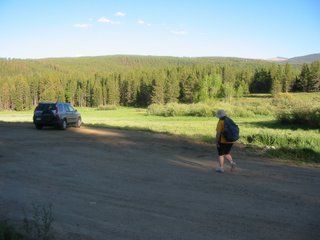
And eventually, the best moment thus far: we saw the car! Can you see it there between the trees? I was almost happy at this point.

Continue to Part 4...