I have to admit, I am kind of hating my life right now. I might even be a wee bit depressed.
If I tell you what is wrong, odds are that my life might end. Sally might actually fly up here just to kick my ass. (I'm sure she doesn't want to have to do that, but she would, and she'd enjoy it.)
But basically I am bored.
Without school and without having a roommate like Mosch who actually wants to do things (Ed basically keeps to himself most of the time), I don't have anything to structure my free time around. And just working full time, at a job 8 minutes from my apartment, is not enough to fill my time.
Of course, there are plenty of things I should be doing. I should clean the kitchen more. There are a ton of chores that need doing, actually. I should cook healthy meals. And I could study my textbooks for next semester, or go through the GRE Math Subject exam book that I have, or...well, there are so many things. But without a sense of urgency it is hard for me to do any of that stuff. And I just feel very blah.
I am kind of in that rut of feeling that I have nothing to do, yet being unwilling to do any of the things I could do. I am kind of just being a screw-up. And I don't want to develop any new hobbies, because school starts in two weeks (yay) and then I won't have time to do anything at all.
Is it a bad sign that I can't entertain myself for an entire summer? (I'm thinking yes.)
Friday, July 31, 2009


Thursday, July 30, 2009
Goodbye Grainless
Well, my magical grainless diet worked...for a few weeks. Now I can't get myself to get back on it. And, what's more, I'm distinctly eating worse than before the grainless diet. I'm obsessing over food a lot (even though I'm eating plenty) and often eating completely unnecessarily, which I wasn't doing (much) before trying the grainless diet.
I feel like dieting is just a generally doomed enterprise, to the extent that we mean anything other than "trying to keep a general focus on eating in a healthy way."
Trying to force myself to eat a particular way or amount just seems to drive me bonkers and make me obsess about food continually.
Not trying to force myself to eat a particular way or amount seems to lead to weight gain.
Obviously I should change my environment. Unfortunately, I think moving to the 19th century would probably shorten my lifespan more than it would lengthen it.
I feel like dieting is just a generally doomed enterprise, to the extent that we mean anything other than "trying to keep a general focus on eating in a healthy way."
Trying to force myself to eat a particular way or amount just seems to drive me bonkers and make me obsess about food continually.
Not trying to force myself to eat a particular way or amount seems to lead to weight gain.
Obviously I should change my environment. Unfortunately, I think moving to the 19th century would probably shorten my lifespan more than it would lengthen it.
Wednesday, July 29, 2009
Bonsai!
 On Facebook I keep seeing ads for Bonsai, a company that apparently makes "high-quality" sheepskin-lined flip-flops, which they promise will "keep your feet warm in winter and cool in summer."
 I don't know where these people are spending their winters, but I'm reasonably certain that merely standing on sheepskin is not enough to keep your feet anything like warm here in Colorado. Maybe on a nippy summer evening these would be nice, but that's about it.
I guess these sheepskin-lined monstrosities solve the problem that causes people to wear sandals with socks - wanting that little bit of extra warmth without having to go so far as wearing a real shoe. You can't wear socks with flip-flops, so you get sheepskin instead.
I am not a shoe snob like Sally and I don't mind seeing people's toes or anything, but I have to admit I am a little bit surprised how widespread flip-flops have become as all-occasion shoes. When I was a kid I think we only wore them to the pool or beach, and now you see them absolutely everywhere.
Tuesday, July 28, 2009
A Slight Disadvantage of the Facebook Era
They're really going to have to stop using your mother's maiden name as a security measure for accounts.
Being Out of Debt
For something that has almost no impact on my everyday life, it's amazing how much effect being out of debt has on me. I finally, just last month, paid off the very last dribs of credit card debt (the last bit of which was left over from when I switched back to paying cash for everything rather than using a credit card and paying it off monthly), so I owe nothing to anyone.
On a very concrete level, this has no impact. I am able to buy almost exactly as much stuff as before - which is to say, not a house, but a car or anything else I decide to go into debt for. I am not suddenly spending the hundreds of dollars I was sending to debtors every month - it's mostly going into savings (which is a real thing, but doesn't "do" anything until I spend it someday).
But the psychological relief is amazing. I worked on this for so many years, very consistently even if not always very effectively. And now...I'm done. Instead of debt I have a few thousand dollars* in the bank.
Way to go, me.
(* This is actually a slight exaggeration, but not for long.)
On a very concrete level, this has no impact. I am able to buy almost exactly as much stuff as before - which is to say, not a house, but a car or anything else I decide to go into debt for. I am not suddenly spending the hundreds of dollars I was sending to debtors every month - it's mostly going into savings (which is a real thing, but doesn't "do" anything until I spend it someday).
But the psychological relief is amazing. I worked on this for so many years, very consistently even if not always very effectively. And now...I'm done. Instead of debt I have a few thousand dollars* in the bank.
Way to go, me.
(* This is actually a slight exaggeration, but not for long.)
Friday, July 24, 2009
How Is Kaiser Permanente Not Like Walmart?
Timothy Noah has an article in Slate today about health care reform, in which he laments the fact that, according to a recent poll, Americans are more afraid of the government having a larger role in determing what medical treatments people receive than they are of the role played by insurance companies. He writes:
Noah concludes with this even more bizarre assertion (emphasis added):
As often happens when I read Noah on health care reform, I was a bit boggled by this. Let's try a slight substitution:The discouraging finding concerns a question that [the Kaiser Family Foundation] doesn't appear to have asked in previous polls. In his July 22 press conference on health reform, President Obama parried a question about the prospect that the government would ration health care by saying:
[T]he government already is making some of these decisions. More importantly, insurance companies right now are making those decisions. And part of what we want to do is to make sure that those decisions are being made by doctors and medical experts based on evidence, based on what works. Because that's not how it's working right now.
It's a powerful point: Wouldn't you rather decisions about your medical treatment were made by government-paid medical experts, focused on which treatment may help you get better, than by private insurance companies focused on maximizing corporate profits? Granted, once a treatment is approved, the government would probably pay less for it than a private insurer would. But, ultimately, government is answerable to the public. Insurance companies are answerable to their stockholders.
Wouldn't you rather decisions about what types of cereal are available be made by government-paid consumer research experts, than by private retailers focused on maximizing corporate profits? ... Ultimately the government is answerable to the public. Retailers are answerable to their stockholders.Now, it is somewhat clear (or so it seems to me) that medicine isn't really acting in the normal market way. This is probably because of the ways it's regulated already (e.g., the way we get insurance through our employers without paying taxes on it). So we can't really just choose a better insurer as freely as we can choose to stop in a different store. And, honestly, I don't want health care to just be a completely free market, because I think that would (overall) be worse instead of better. But it is certainly not obvious (and is quite possibly not true) that having the government decide what you can and can't have is going to be nicer than having a variety of private companies making those same decisions based on a contract between you and them.
Noah concludes with this even more bizarre assertion (emphasis added):
The larger point, though, is that evidence is growing that even the seemingly bumbling intervention by President George W. Bush's treasury secretary, Henry Paulson, helped the United States avert the onset of a second Great Depression. President Obama's maladroit stimulus probably helped, too. The same may be assumed of legislation that would increase government control over medical decisions. If it doesn't help, voters can make their legislators change it. What their legislators can't do is protect them from the rapacity of private health insurers should no health reform be enacted.I guess we may assume, then, that any and all government intervention will "probably help," since growing evidence suggests that the bumbling and maladroit stimulus bills did. Perhaps the government really should step in and take care of that breakfast cereal issue. After all, if it doesn't help, we can make legislators change it, while what the legislators can't do is protect us from the rapacity of, well, Walmart.
Thursday, July 23, 2009
Buying to Last?
Ellen Ruppel Shell has a small article in the Atlantic ("Buy to Last") arguing that, rather than buying cheaply-made products from Ikea (much less, one presumes, Walmart), we should be buying well-made items that we intend to keep. Some of her argument is about specific Ikea practices, which I won't address here (we don't even have a local Ikea), but I'm interested in the general idea of buying good things.
Let's talk about bookcases. I bought mine a few years ago, and they are pretty much the cheapest kind you can get - tall white particleboard ones that were, I think, something like $30 each. I like how they look, but they are definitely not made to last, and if I move often, eventually they will become casualties. (In the meantime, just sitting there, they seem to hold up fine. It's not as though bookcases see a lot of wear and tear in ordinary life. I don't even dust!)
I could have spent a few hundred dollars each and gotten bookcases made of solid wood, or I could spend even more and get glass or steel ones. Or I could do something like elfa shelving that I would install in the wall, with high-quality components that I could reuse wherever I went. I think metal or solid wood bookcases would be the most likely to last, and I could treat these as important pieces that I would keep forever.
But I'm just not sure this comes out as more environmentally sound. For one thing, particleboard is basically made of sawdust or something anyway. Perhaps it's environmentally horrible to produce - I don't know - but I don't think old growth forests are cut down to make it. And it seems to last an awfully long time despite being basically crappy. I'm not replacing my bookcases every five or even, I suspect, every ten years.
In the meantime, if I bought a nice solid wood bookcase, I might still need to replace or discard it (if I move overseas or it doesn't match my other tasteful pieces or I go completely electronic on books). Yes, in theory it lasts forever and someone else could have it and keep it, but I'm not going to spend thousands of dollars on something so nice that nobody would dare throw it away.
My general strategy for most household items is that I buy things that are pretty cheap (or use whatever I already have, like my mother's small teak dining table that she bought around 1988) and then just keep them anyway.
I guess I worry a bit that even if the "buy something nice to keep forever" idea is actually better for something like bookcases or bedsteads, it will kind of spread over my entire life to where it is just a waste of money. Corelle dishes are (reasonably) cheap, my silverware from Ikea was cheap, and towels from Walmart are cheap, and all of these things last about as long as more expensive things. (In fact I'm sure Corelle dishes outlast more expensive china since they don't break very easily.) And I don't imagine these things are more environmentally costful than their expensive counterparts, either.
I feel like the idea of buying something nice to last instead of "being part of our throw-away consumer culture" is sometimes just an excuse for spending a lot of money on something fancy or extra-tasteful. Outside of outright disposable items, are there items that need to be expensive, hand-crafted, or made of the best materials in order to last for a long time?
Let's talk about bookcases. I bought mine a few years ago, and they are pretty much the cheapest kind you can get - tall white particleboard ones that were, I think, something like $30 each. I like how they look, but they are definitely not made to last, and if I move often, eventually they will become casualties. (In the meantime, just sitting there, they seem to hold up fine. It's not as though bookcases see a lot of wear and tear in ordinary life. I don't even dust!)
I could have spent a few hundred dollars each and gotten bookcases made of solid wood, or I could spend even more and get glass or steel ones. Or I could do something like elfa shelving that I would install in the wall, with high-quality components that I could reuse wherever I went. I think metal or solid wood bookcases would be the most likely to last, and I could treat these as important pieces that I would keep forever.
But I'm just not sure this comes out as more environmentally sound. For one thing, particleboard is basically made of sawdust or something anyway. Perhaps it's environmentally horrible to produce - I don't know - but I don't think old growth forests are cut down to make it. And it seems to last an awfully long time despite being basically crappy. I'm not replacing my bookcases every five or even, I suspect, every ten years.
In the meantime, if I bought a nice solid wood bookcase, I might still need to replace or discard it (if I move overseas or it doesn't match my other tasteful pieces or I go completely electronic on books). Yes, in theory it lasts forever and someone else could have it and keep it, but I'm not going to spend thousands of dollars on something so nice that nobody would dare throw it away.
My general strategy for most household items is that I buy things that are pretty cheap (or use whatever I already have, like my mother's small teak dining table that she bought around 1988) and then just keep them anyway.
I guess I worry a bit that even if the "buy something nice to keep forever" idea is actually better for something like bookcases or bedsteads, it will kind of spread over my entire life to where it is just a waste of money. Corelle dishes are (reasonably) cheap, my silverware from Ikea was cheap, and towels from Walmart are cheap, and all of these things last about as long as more expensive things. (In fact I'm sure Corelle dishes outlast more expensive china since they don't break very easily.) And I don't imagine these things are more environmentally costful than their expensive counterparts, either.
I feel like the idea of buying something nice to last instead of "being part of our throw-away consumer culture" is sometimes just an excuse for spending a lot of money on something fancy or extra-tasteful. Outside of outright disposable items, are there items that need to be expensive, hand-crafted, or made of the best materials in order to last for a long time?
Tuesday, July 21, 2009
Madame Bovary vs. Anna Karenina - More Thoughts
I've now finished reading Madame Bovary. I enjoyed it reasonably well. I now can't remember the tone of Anna Karenina as well, so comparing the actual writing in the two books is difficult. There are obvious plot parallels between the books, at least if we only look at the stories of the title characters (AK has more different plot lines).
An obvious plot difference is that the people in AK are of a much higher social stratum. Both books deal with money issues, but very differently. People like the Bovaries are basically invisible in AK, which deals with aristocracy (close up) and peasants (as accessories).
But I guess the biggest difference, for me, is sort of like the difference between where I work now and my old job - the people in Anna Karenina are smart! Anna herself is actually an intelligent, strong woman. (She reminded me of Sally in some parts.) Emma Bovary is...well, not necessarily completely stupid, but definitely weak.
When you read Madame Bovary, it's a bit like watching a horror movie - you want to yell at the characters about the stupid things they are doing. And, of course, you are forced to listen to a lot of rather idiotic dialogue. (I could have done without Homais the Chemist entirely.)
The characters in Anna Karenina are mostly smart and strong, so the things they do fall more easily along a kind of intellectual or moral axis. You watch them make choices that are more moral in nature. And the non-plot conversations in the book are far, far more interesting. Tolstoy seems to actually respect most of the characters, where Flaubert was obviously making fun of many of his.
I wouldn't really tell someone to go read Madame Bovary for fun, though I didn't hate it or anything. I still recommend Anna Karenina to all but the most determined haters of the (broadly-defined) genre.
An obvious plot difference is that the people in AK are of a much higher social stratum. Both books deal with money issues, but very differently. People like the Bovaries are basically invisible in AK, which deals with aristocracy (close up) and peasants (as accessories).
But I guess the biggest difference, for me, is sort of like the difference between where I work now and my old job - the people in Anna Karenina are smart! Anna herself is actually an intelligent, strong woman. (She reminded me of Sally in some parts.) Emma Bovary is...well, not necessarily completely stupid, but definitely weak.
When you read Madame Bovary, it's a bit like watching a horror movie - you want to yell at the characters about the stupid things they are doing. And, of course, you are forced to listen to a lot of rather idiotic dialogue. (I could have done without Homais the Chemist entirely.)
The characters in Anna Karenina are mostly smart and strong, so the things they do fall more easily along a kind of intellectual or moral axis. You watch them make choices that are more moral in nature. And the non-plot conversations in the book are far, far more interesting. Tolstoy seems to actually respect most of the characters, where Flaubert was obviously making fun of many of his.
I wouldn't really tell someone to go read Madame Bovary for fun, though I didn't hate it or anything. I still recommend Anna Karenina to all but the most determined haters of the (broadly-defined) genre.
Thursday, July 16, 2009
Stupid Consultant Tricks
A couple of weeks ago, I finished up the beta version of a data importer that a client (the representative of whom I'll call "Rick") had asked for. Specifically, he wanted a way to automate monthly well production and test data imports from their oilfield management software into their reserves database for Aries (the economics software we use). Rick asked "Jim" (one of the engineers I work for) if we could whip something like this up for them, and Jim asked me, because he knows I can do tricky technical/coding things.
It was a pretty fun project. They sent us sample data in Excel, and I learned enough VBA to write a nice little program in Access. Basically, you click a button to start the import, and it asks you where the Excel file is, sucks the data in, determines what data is duplicate and what data is new, asks you if you want to update existing records, then if you want to add new records, does all of those things, and outputs a form of log letting you know exactly what was done.
Unfortunately, after Rick (the client) had a chance to play with what we sent him, he sent Jim this email:
And at first I felt quite annoyed with Rick. Why the hell would you send sample data in Excel if you weren't intending to import the data from Excel? I mean, I worked with what I was given. Stupid client!
But, no. This is actually my fault. I mean, I have most of an entire degree in software engineering. I know better than to just go off half-cocked and write a bunch of code without doing even a minimal amount of requirements engineering. (It's probably not appropriate to write up an entire set of requirements for this project, but a simple email to the client clarifying his needs would have been prudent.) It is not the client's job to know how to unambiguously ask for what he wants.
Stupid consultant! ;-)
It was a pretty fun project. They sent us sample data in Excel, and I learned enough VBA to write a nice little program in Access. Basically, you click a button to start the import, and it asks you where the Excel file is, sucks the data in, determines what data is duplicate and what data is new, asks you if you want to update existing records, then if you want to add new records, does all of those things, and outputs a form of log letting you know exactly what was done.
Unfortunately, after Rick (the client) had a chance to play with what we sent him, he sent Jim this email:
Looking back on our initial email, I thought we were looking at a loading process from our production database into the Aries database. Both are in Access so it would seem that there should be a way to link the tables with some type of load query. Your current load process is workable for other areas but it would be a huge benefit if the we could do this loading internally within Access.Apparently what he had wanted was an import from one Access database to another, not from Excel into Access. Although this is not a gigantic change, and is in some ways easier to code, it wasn't what I thought we were doing.
And at first I felt quite annoyed with Rick. Why the hell would you send sample data in Excel if you weren't intending to import the data from Excel? I mean, I worked with what I was given. Stupid client!
But, no. This is actually my fault. I mean, I have most of an entire degree in software engineering. I know better than to just go off half-cocked and write a bunch of code without doing even a minimal amount of requirements engineering. (It's probably not appropriate to write up an entire set of requirements for this project, but a simple email to the client clarifying his needs would have been prudent.) It is not the client's job to know how to unambiguously ask for what he wants.
Stupid consultant! ;-)
Tuesday, July 14, 2009
Stereograms
A stereogram is (roughly speaking) a pair of pictures (or sometimes just one picture) designed to create a 3D image, and I find I really enjoy just about every form of this art.
 The humble View-Master is probably the most well-known type of stereogram. I sometimes had one of these as a kid, usually with reels of scenes from Disney movies or something, but the art form has been around a long time and you can find reels of wildlife, architecture, or even street shots of 1920's Germany. (I have reels like this at home in my small collection. If I could ever find a batch of like 1000 View-Master reels I would totally buy it up.)
Stereograms are also often used in remote sensing, with aerial photography. In this case, two photographs captured by an airplane in two different positions, with around 60% overlap, give you a 3D view of the ground, with significant vertical exaggeration (because the images were taken usually hundreds or thousands of feet apart, while your eyes are only a few centimeters apart). I have this book at home, with images like this:

These are typically viewed using a viewer that is basically just two (magnifying) lenses separated by some plastic, to help each eye look at the correct image. But if you are talented and practice, you can see these with the naked eye. (If you try this with the one above, try making it very level to your eyes and getting your face pretty close to the monitor - the image is a bit small for ideal viewing.)
The technique for viewing a stereogram without a viewer is to learn how to make yourself go "wall-eyed" (the opposite of cross-eyed) while maintaining your eyes' focus. In other words, you need to direct the angle of your eyes as though you are looking at something further away than the actual image, while maintaining the actual focus on the image. I am pretty good at it, and for me, the 3D usually comes before the focus, so I first diverge my eyes, then once the distance is right, I can focus.
Looking at a 2-image stereogram uses the same skill as looking at an autostereogram, which is what those "magic eye pictures" that used to be so popular in malls are. In an autostereogram, the pattern of dots or other elements is arranged such that your eyes can mistake two separate images for the same image, thus creating the illusion of 3D. I find most of the speckledy ones pretty boring, but some other ones are cool. From the Wikipedia article linked above, I especially liked this one of a chess board:

This one looks pretty much the same in 2D or 3D, though once you get the 3D, you will (through the confusion of your eyes) see more pieces. And of course it will appear to be 3D. This is a pretty easy autostereogram to practice on.
This one is much more difficult, but rather clever:

You can also get the stereo effect staring at something like bathroom tiles. Nothing will pop out, of course (though it would be great fun to tile a bathroom in such a way as to create a 3D image for discovery), but the tiles will shimmer a bit and appear to be at a different distance away than they actually are.
Some people, especially those with a lazy eye or who do not generally have depth perception, cannot make out stereograms. Ed, for instance, gets double images in a View-Master or at a 3D movie, so the odds that he can make out an autostereogram are especially low. For the rest of us it is just a learned skill.
The humble View-Master is probably the most well-known type of stereogram. I sometimes had one of these as a kid, usually with reels of scenes from Disney movies or something, but the art form has been around a long time and you can find reels of wildlife, architecture, or even street shots of 1920's Germany. (I have reels like this at home in my small collection. If I could ever find a batch of like 1000 View-Master reels I would totally buy it up.)Stereograms are also often used in remote sensing, with aerial photography. In this case, two photographs captured by an airplane in two different positions, with around 60% overlap, give you a 3D view of the ground, with significant vertical exaggeration (because the images were taken usually hundreds or thousands of feet apart, while your eyes are only a few centimeters apart). I have this book at home, with images like this:

These are typically viewed using a viewer that is basically just two (magnifying) lenses separated by some plastic, to help each eye look at the correct image. But if you are talented and practice, you can see these with the naked eye. (If you try this with the one above, try making it very level to your eyes and getting your face pretty close to the monitor - the image is a bit small for ideal viewing.)
The technique for viewing a stereogram without a viewer is to learn how to make yourself go "wall-eyed" (the opposite of cross-eyed) while maintaining your eyes' focus. In other words, you need to direct the angle of your eyes as though you are looking at something further away than the actual image, while maintaining the actual focus on the image. I am pretty good at it, and for me, the 3D usually comes before the focus, so I first diverge my eyes, then once the distance is right, I can focus.
Looking at a 2-image stereogram uses the same skill as looking at an autostereogram, which is what those "magic eye pictures" that used to be so popular in malls are. In an autostereogram, the pattern of dots or other elements is arranged such that your eyes can mistake two separate images for the same image, thus creating the illusion of 3D. I find most of the speckledy ones pretty boring, but some other ones are cool. From the Wikipedia article linked above, I especially liked this one of a chess board:
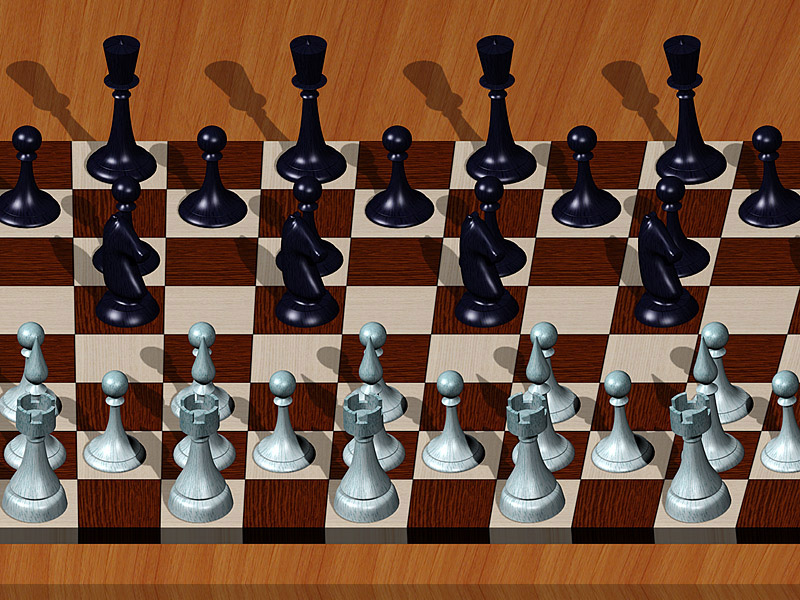
This one looks pretty much the same in 2D or 3D, though once you get the 3D, you will (through the confusion of your eyes) see more pieces. And of course it will appear to be 3D. This is a pretty easy autostereogram to practice on.
This one is much more difficult, but rather clever:

You can also get the stereo effect staring at something like bathroom tiles. Nothing will pop out, of course (though it would be great fun to tile a bathroom in such a way as to create a 3D image for discovery), but the tiles will shimmer a bit and appear to be at a different distance away than they actually are.
Some people, especially those with a lazy eye or who do not generally have depth perception, cannot make out stereograms. Ed, for instance, gets double images in a View-Master or at a 3D movie, so the odds that he can make out an autostereogram are especially low. For the rest of us it is just a learned skill.
Monday, July 13, 2009
Everything Old Is New Again
When the economy is up, there are always plenty of people out there proclaiming that it will go up forevermore because everything is different now and we'll have continuous growth.
When the economy is down, plenty of people likewise proclaim that it won't turn around because the world situation has structurally changed in ways that will prolong the recession indefinitely. Things will never be the way they used to be.
If you're going to use induction it really, really helps to look more than a few months back. Seriously.
When the economy is down, plenty of people likewise proclaim that it won't turn around because the world situation has structurally changed in ways that will prolong the recession indefinitely. Things will never be the way they used to be.
If you're going to use induction it really, really helps to look more than a few months back. Seriously.
Lunch Math
This morning, I heard a radio ad for Applebee's new "Pick 'N Pair" lunch combos. They said you could choose any two of their (delicious, etc.) soups, salads, sliders, pasta, or sandwiches, starting as low as $5.99. There were, they said, over 75 possible combinations.
Rather than thinking, "Hmm, that sounds good - maybe I should eat lunch at Applebee's," I, being a math geek, thought, "How many items must there be in order for it to be correctly and reasonably described as 'over 75' combinations?"
Starting with the idea that you could choose from the same pool twice, the number of combinations would seem to be some number squared. For instance, if you had 9 choices for the first item, and 9 for the second item, you might think you had 81 possible combinations. Except that order doesn't matter (choosing french onion soup + shrimp salad is the same as choosing shrimp salad + french onion soup). So 9 items would actually give us 45 choices using this model (assuming I'm calculating correctly). And 12 items would give us 78 choices. So perhaps there are 12 different items.
But this assumes you might order the same thing twice - say, two orders of BBQ Pulled Pork sliders. And that doesn't seem likely. If we instead have to choose two different items, again with order not mattering, then it becomes a combination. Here, 13 items would give us 78 choices, which you'd probably describe as "more than 75."
So, with my guess that the menu has 13 choices, I went to look at the actual menu:

It seems to me that there are in fact 14 different items, which means 91 combinations of 2. But you wouldn't describe 91 as "over 75" (although it is, of course).
Perhaps they are thinking that you would order any two items, but not two of the same item, and not two different sliders. In that case, you would take our 91 choices and subtract the 6 that involve two sliders, leaving 85 choices. If you further assume that ordering two soups would be strange, we could subtract those 6 combos as well, leaving 79 choices, which is a reasonable value for "more than 75."
Perhaps the Applebee's folks reasoned this all out. Or maybe the menu originally had 13 items (giving us the straightforward "13 choose 2" calculation of 78), and one was added at the last minute, after they had already designed the ad campaign.
Rather than thinking, "Hmm, that sounds good - maybe I should eat lunch at Applebee's," I, being a math geek, thought, "How many items must there be in order for it to be correctly and reasonably described as 'over 75' combinations?"
Starting with the idea that you could choose from the same pool twice, the number of combinations would seem to be some number squared. For instance, if you had 9 choices for the first item, and 9 for the second item, you might think you had 81 possible combinations. Except that order doesn't matter (choosing french onion soup + shrimp salad is the same as choosing shrimp salad + french onion soup). So 9 items would actually give us 45 choices using this model (assuming I'm calculating correctly). And 12 items would give us 78 choices. So perhaps there are 12 different items.
But this assumes you might order the same thing twice - say, two orders of BBQ Pulled Pork sliders. And that doesn't seem likely. If we instead have to choose two different items, again with order not mattering, then it becomes a combination. Here, 13 items would give us 78 choices, which you'd probably describe as "more than 75."
So, with my guess that the menu has 13 choices, I went to look at the actual menu:

It seems to me that there are in fact 14 different items, which means 91 combinations of 2. But you wouldn't describe 91 as "over 75" (although it is, of course).
Perhaps they are thinking that you would order any two items, but not two of the same item, and not two different sliders. In that case, you would take our 91 choices and subtract the 6 that involve two sliders, leaving 85 choices. If you further assume that ordering two soups would be strange, we could subtract those 6 combos as well, leaving 79 choices, which is a reasonable value for "more than 75."
Perhaps the Applebee's folks reasoned this all out. Or maybe the menu originally had 13 items (giving us the straightforward "13 choose 2" calculation of 78), and one was added at the last minute, after they had already designed the ad campaign.
Friday, July 10, 2009
Oh, Yeah. That.
I was sitting here at my desk feeling utterly crappy - tired, spiritless, bored, whiny. I haven't been tired all week, so even though I'm slightly underslept, there's no reason I should be that tired now. I was just kind of disgruntled all over.
Oh.
Of course.
Our office building had a BBQ lunch for us, and I drank water with it. Not iced tea, like I have every day at lunch. When you're used to being caffeinated in the afternoon, skipping the lunch caffeine is a perfect way to become doldrumated.
I am now reviving myself with a glass of this Elixir of Life.
Oh.
Of course.
Our office building had a BBQ lunch for us, and I drank water with it. Not iced tea, like I have every day at lunch. When you're used to being caffeinated in the afternoon, skipping the lunch caffeine is a perfect way to become doldrumated.
I am now reviving myself with a glass of this Elixir of Life.
Wednesday, July 08, 2009
Grainlessness Update
So, I am still doing the grainless thing, though not with perfect adherence. I've decided to add whole wheat pasta (2 oz. at a time only) as well as brown rice (small quantities, like 3/4 cup) to my diet. And I've been exercising somewhat regularly, though not quite as much as I'd like.
According to the scale at the gym last night, I am down 10 pounds from where I started in early June. I was only wearing my bathing suit (and Crocs) when I weighed myself, which may be less than I generally wear, but I was dripping wet from my shower (I hadn't dried off at all since I was headed straight for the pool anyway), so that may have balanced it out.
Despite having lost 10 pounds, I feel unsure that this way of eating/living is actually going to result in a lot of weight loss. I don't know why that is, except that weight loss is generally slow if you're doing it the way I do, and so it's hard to be sure you're really seeing a trend and not random fluctuations.
But I'm feeling really, really good about it. For the first time pretty much ever, it's crystal clear to me that I feel better when eating this way than I do when I overeat (especially in an unplanned way). I feel kind of strong and good inside. I hope that it lasts. I am really trying to think of this as a lifestyle change and not a diet to lose weight, so...well, we'll see.
According to the scale at the gym last night, I am down 10 pounds from where I started in early June. I was only wearing my bathing suit (and Crocs) when I weighed myself, which may be less than I generally wear, but I was dripping wet from my shower (I hadn't dried off at all since I was headed straight for the pool anyway), so that may have balanced it out.
Despite having lost 10 pounds, I feel unsure that this way of eating/living is actually going to result in a lot of weight loss. I don't know why that is, except that weight loss is generally slow if you're doing it the way I do, and so it's hard to be sure you're really seeing a trend and not random fluctuations.
But I'm feeling really, really good about it. For the first time pretty much ever, it's crystal clear to me that I feel better when eating this way than I do when I overeat (especially in an unplanned way). I feel kind of strong and good inside. I hope that it lasts. I am really trying to think of this as a lifestyle change and not a diet to lose weight, so...well, we'll see.
Tuesday, July 07, 2009
Oh, Pandora, You Kidder
Before the song even started, I saw in my Pandora window the following album cover.

Oh my goodness. Not a good sign, and yet it perfectly captures a certain aesthetic, doesn't it? Don't you just know what the music will sound like? It was "Heat of the Moment":
And we get even more dragons!

Oh my goodness. Not a good sign, and yet it perfectly captures a certain aesthetic, doesn't it? Don't you just know what the music will sound like? It was "Heat of the Moment":
And we get even more dragons!
Monday, July 06, 2009
Tennis Lesson
 Ed and I are currently taking tennis lessons through the City of Lakewood. Our class has been really small - the highest number of people was four, and that was on the first night; since then there have only been three of us.
Last Wednesday, Ed worked late, and I was the only one at class. So I basically got a private lesson for 50 minutes, which was awesome and also exhausting.
The tennis teacher kind of takes an iterative approach to improving us, which I really appreciate. As an example, this is how he improved my serve.
First, he had me do a few serves. Most of them went in, which is generally about the best thing you can say about my serve - it does go in. I stand sideways to the court (like you're supposed to) and start with my racquet over my shoulder and sideways to my back - like I'm scratching my back with it. (This eliminates having to do the back swing - you just come forward with the racket instead.) Then I toss the ball up and hit it (duh).
After he watched me serve 5 or 6 balls, he said, "Now I want you to toss the ball higher." So I tried that, and he kept pushing me on it, for perhaps 10 more serves.
"OK," he said. "Now I want you to follow through with the racquet to under your left arm." He demonstrated, and I tried to replicate the motion a few times without actually serving. Then I served balls that way, at first not getting them in (and thwacking myself once), but then learning to get them in with this new style. I did notice, once they started going in, that they were indeed better serves.
So after maybe 15 of these serves, he said, "All right. Now I want you to lean into the court when you do it."
I added that to my serve, hit about 10 more balls, and we were done with serving. I think my serve got much better over just this ~ 10 minutes (if that) of instruction, and without my having to be overwhelmed by 20 different new ideas all at once.
(In the picture above, you will note that Goofy has mastered a skill I have not - stepping with the correct foot for a volley.)
Saturday, July 04, 2009
Selling a Lifestyle
Brooks Brothers ads (which I see online often) really hit me with their lifestyle-selling - more so than other ads, although I realize many do this. Here is an example I got from the Washington Post website.
 You are rich. You don't just live in a house, but rather you have a compound of buildings all in the classical style. Your yard is perfectly manicured, with a pool. Most of your days are spent taking your adorable, tow-headed children with you to pleasant garden parties and other outings. Perhaps croquet or badminton is to be played on the lawn.
One way you can tell the people are upper class (as though there weren't plenty) is that the men are wearing somewhat girlish colors (yellow, baby blue, lavender). This is a kind of upper crust privilege; regular men of the proletariat wear much more macho tones.
The pair on the left are clearly a couple. The woman on the left may be a bit more youthful and free-spirited than the one on the right; we can tell because she has gone out with her head uncovered. Is the woman on the right married to the slightly elderly gentleman? Perhaps she is a youthful grandmother to the two boys. Or perhaps she is the gentleman's daughter, and her husband is out practicing his remunerative but respectable profession.
 You are rich. You don't just live in a house, but rather you have a compound of buildings all in the classical style. Your yard is perfectly manicured, with a pool. Most of your days are spent taking your adorable, tow-headed children with you to pleasant garden parties and other outings. Perhaps croquet or badminton is to be played on the lawn.
One way you can tell the people are upper class (as though there weren't plenty) is that the men are wearing somewhat girlish colors (yellow, baby blue, lavender). This is a kind of upper crust privilege; regular men of the proletariat wear much more macho tones.
The pair on the left are clearly a couple. The woman on the left may be a bit more youthful and free-spirited than the one on the right; we can tell because she has gone out with her head uncovered. Is the woman on the right married to the slightly elderly gentleman? Perhaps she is a youthful grandmother to the two boys. Or perhaps she is the gentleman's daughter, and her husband is out practicing his remunerative but respectable profession.
Wednesday, July 01, 2009
Should I Be Worried?
This morning, when I woke up, Ed was right outside my bedroom door.
"I was just dreaming about you," I said.
"Me too!" he said.
In my dream, Ed and I were taking some kind of calculus class together. I didn't understand the material presented on the first day - I was missing some background - but I intended to research it once I got home. I knew that Ed would be happy to help me with it, but the thought was intolerable. As I was walking out of class, I was thinking about how he would say, "I can think of nothing I'd rather do than teach you this stuff," and it made me feel deeply annoyed.
In Ed's dream, he was trying to get ready for work, and before he got dressed, a girl from our tennis class came over, and she and I were conspiring to make him late for work. In fact, when he consulted his watch, it was 8:30!
I dream about annoying, unwanted help from Ed. He dreams about being thwarted and having his space invaded.
:-)
"I was just dreaming about you," I said.
"Me too!" he said.
In my dream, Ed and I were taking some kind of calculus class together. I didn't understand the material presented on the first day - I was missing some background - but I intended to research it once I got home. I knew that Ed would be happy to help me with it, but the thought was intolerable. As I was walking out of class, I was thinking about how he would say, "I can think of nothing I'd rather do than teach you this stuff," and it made me feel deeply annoyed.
In Ed's dream, he was trying to get ready for work, and before he got dressed, a girl from our tennis class came over, and she and I were conspiring to make him late for work. In fact, when he consulted his watch, it was 8:30!
I dream about annoying, unwanted help from Ed. He dreams about being thwarted and having his space invaded.
:-)
Sunday, June 28, 2009
Roger Ebert on "Transformers"
Roger Ebert's 1-star review of the new movie "Transformers: Revenge of the Fallen" is a real delight. A couple of excerpts:
"Transformers: Revenge of the Fallen" is a horrible experience of unbearable length, briefly punctuated by three or four amusing moments. One of these involves a dog-like robot humping the leg of the heroine. Such are the meager joys. If you want to save yourself the ticket price, go into the kitchen, cue up a male choir singing the music of hell, and get a kid to start banging pots and pans together. Then close your eyes and use your imagination.Go read the whole thing.
...
The human actors are in a witless sitcom part of the time, and lot of the rest of their time is spent running in slo-mo away from explosions, although--hello!--you can't outrun an explosion. They also make speeches like this one by John Turturro: "Oh, no! The machine is buried in the pyramid! If they turn it on, it will destroy the sun! Not on my watch!" The humans, including lots of U.S. troops, shoot at the Transformers a lot, although never in the history of science fiction has an alien been harmed by gunfire.
Friday, June 26, 2009
Mathematician's Lament
I really enjoyed this, and I think you will too:
A Mathematician's Lament
Read whether you love or hate math.
A Mathematician's Lament
Read whether you love or hate math.
Thursday, June 25, 2009
The Dysfunctional Company
Every time I get a new job, I start off with a very happy view of the new company. Internal divisions and politics are invisible to me, I am not aware of any possible mistakes that the company may be making, and the place just appears to me as a companionable group of people all striving towards a common purpose.
People are not eager to disabuse you of these notions either. They don't know you yet, so they won't complain about other people to you, or about the company itself. They're certainly not going to harsh your new job buzz by telling you the whole thing's going into the crapper because management can't tell its ass from a hole in the ground.
Over time, you slowly learn. So-and-so is an incompetent bully. Promotions haven't been decided fairly. Department Y is a bunch of morons. The CFO is an alcoholic. The last few announcements by management turned out to be morale-destroying lies.
(None of this is true of my current company, incidentally. I wouldn't dare blog about the things that are actually true.)
This disillusionment phase is always a little bit hard on me. I want to know the gossip and news, but part of me also wants to retain my state of innocence. I like believing that I'm working for a really functional, good company without any fatal flaws.
But it occurs to me that companies are actually just like people. If a person isn't obviously dysfunctional or grossly flawed, you will still learn, if you get to know them well enough, that they have deep flaws or dysfunctions of some kind. Often there are obvious ways you can imagine them optimizing their behavior, but which they are unwilling or unable to adopt. Sometimes these prove to be intolerable, but usually they just go into the overall balance of your feelings about the person (and can even endear them to you).
Why should a company be any different?
People are not eager to disabuse you of these notions either. They don't know you yet, so they won't complain about other people to you, or about the company itself. They're certainly not going to harsh your new job buzz by telling you the whole thing's going into the crapper because management can't tell its ass from a hole in the ground.
Over time, you slowly learn. So-and-so is an incompetent bully. Promotions haven't been decided fairly. Department Y is a bunch of morons. The CFO is an alcoholic. The last few announcements by management turned out to be morale-destroying lies.
(None of this is true of my current company, incidentally. I wouldn't dare blog about the things that are actually true.)
This disillusionment phase is always a little bit hard on me. I want to know the gossip and news, but part of me also wants to retain my state of innocence. I like believing that I'm working for a really functional, good company without any fatal flaws.
But it occurs to me that companies are actually just like people. If a person isn't obviously dysfunctional or grossly flawed, you will still learn, if you get to know them well enough, that they have deep flaws or dysfunctions of some kind. Often there are obvious ways you can imagine them optimizing their behavior, but which they are unwilling or unable to adopt. Sometimes these prove to be intolerable, but usually they just go into the overall balance of your feelings about the person (and can even endear them to you).
Why should a company be any different?
Wednesday, June 24, 2009
Metaphor and Mapping
If you look at the longitude and latitude lines on a globe, you may notice (if you haven't in the past) something interesting: we don't handle north-south and east-west the same way. The longitude lines are great circles that meet at the north and south poles, while the latitude lines are just horizontal (if you will) circles of varying size, like cross-sections of the planet.
I commented to Ed recently that we should try doing east-west like we do north-south, and he said, "But then, if you went east for a while, you'd eventually be going west."
"What?" I asked.
"Well, now, if you go north far enough, then eventually you start going south, so if we handled east-west the same way..."
And that was a very weird thought. At first I couldn't make any sense of the idea that if you go east for a while you'll find yourself heading west (because it's not true), and then I started wondering why it does seem to make sense for north-south. Why am I comfortable with the idea that once you're at the north pole, if you keep going, you're heading south?
Is it purely because I was educated about how latitude/longitude lines work?
 Then it occurred to me that it's because I think of the north pole as "up" (the way that north is up on most maps). And so I associate it metaphorically with the direction that heads away from gravity. And clearly if you were to climb up a sphere for long enough (using your sticky gecko feet), you'd get to the top, and if you kept going, you'd be headed back down. While if you just geckoed your way sideways around the sphere, there wouldn't be any reversals.
Is it natural that we think of north as up, or is it just a convention? Clearly it's a matter of convention whether north or south is up, but could east or west be up just as easily? We would then picture the earth as rolling around through its orbit rather than spinning, and we would view the solar system as being a flat vertical plane rather than a horizontal platter.
What do you think?
 The longitude lines are great circles that meet at the north and south poles, while the latitude lines are just horizontal (if you will) circles of varying size, like cross-sections of the planet.
I commented to Ed recently that we should try doing east-west like we do north-south, and he said, "But then, if you went east for a while, you'd eventually be going west."
"What?" I asked.
"Well, now, if you go north far enough, then eventually you start going south, so if we handled east-west the same way..."
And that was a very weird thought. At first I couldn't make any sense of the idea that if you go east for a while you'll find yourself heading west (because it's not true), and then I started wondering why it does seem to make sense for north-south. Why am I comfortable with the idea that once you're at the north pole, if you keep going, you're heading south?
Is it purely because I was educated about how latitude/longitude lines work?
 Then it occurred to me that it's because I think of the north pole as "up" (the way that north is up on most maps). And so I associate it metaphorically with the direction that heads away from gravity. And clearly if you were to climb up a sphere for long enough (using your sticky gecko feet), you'd get to the top, and if you kept going, you'd be headed back down. While if you just geckoed your way sideways around the sphere, there wouldn't be any reversals.
Is it natural that we think of north as up, or is it just a convention? Clearly it's a matter of convention whether north or south is up, but could east or west be up just as easily? We would then picture the earth as rolling around through its orbit rather than spinning, and we would view the solar system as being a flat vertical plane rather than a horizontal platter.
What do you think?
The Real Purpose of Neosporin
Last night, while cutting up some peppers, I sliced a bit of the end of my thumb off (just the skin). Trying not to drip all over everything, I had Ed apply a bandaid (feeling grateful, once again, that we have the nice fingertip kind that are shaped well for just such a purpose). It was partly successful at containing the mess.
This morning, I went to change the bandage. I was completely unable to remove the portion of the bandaid that was on the actual wound. I tried soaking my thumb in a cup of warm water for about half an hour (seriously) and it still wouldn't come off. It was too painful for me to pull it off and I didn't really want to start it leaking again.
Yes, I am the biggest wimp ever.
So I went to a clinic today to say, basically, "What the hell should I do with this thing?" In the meantime, I had cut away all of the old bandaid that I could, and put a new one on top of it.
It turns out it is important not to let a bandaid become a permanent part of your body (who knew) so the doctor took it off (almost painlessly somehow, though it did reopen the wound), had me soak my thumb for 10 minutes in lidocaine, and then had a nurse clean it up and dress it with some neosporin and a new bandage.
I feel I now know the real point of neosporin - to keep your bandaid from sticking. Duh.
This morning, I went to change the bandage. I was completely unable to remove the portion of the bandaid that was on the actual wound. I tried soaking my thumb in a cup of warm water for about half an hour (seriously) and it still wouldn't come off. It was too painful for me to pull it off and I didn't really want to start it leaking again.
Yes, I am the biggest wimp ever.
So I went to a clinic today to say, basically, "What the hell should I do with this thing?" In the meantime, I had cut away all of the old bandaid that I could, and put a new one on top of it.
It turns out it is important not to let a bandaid become a permanent part of your body (who knew) so the doctor took it off (almost painlessly somehow, though it did reopen the wound), had me soak my thumb for 10 minutes in lidocaine, and then had a nurse clean it up and dress it with some neosporin and a new bandage.
I feel I now know the real point of neosporin - to keep your bandaid from sticking. Duh.
Tuesday, June 23, 2009
New Blog, Extra Boring
I've decided to try keeping a food and exercise diary in the form of a blog. If you like to read it, it is here:
Fuel and Motion
I imagine it will be fairly boring, so (obviously, as though you wouldn't anyway) feel free to skip it.
Fuel and Motion
I imagine it will be fairly boring, so (obviously, as though you wouldn't anyway) feel free to skip it.
The Sally Series!
My professor for Advanced Calculus next semester emailed us the name of the book we're using for the class, so I was able to order it. It came today.
Imagine how pleased I was when I saw a logo in the corner letting me know that it is part of the Sally Series. Apparently this one is Book 5.

Now I want to collect the whole set just for the name.
Imagine how pleased I was when I saw a logo in the corner letting me know that it is part of the Sally Series. Apparently this one is Book 5.

Now I want to collect the whole set just for the name.
Monday, June 22, 2009
Simple?
Every time I see this advertisement I am attracted to it:
 ...and then I go look at their offerings.
And I think, really? Simple? Less > More? That goes with paying $55-60 for a pair of sneakers? For real?
I guess it is "less > more" in the sense of "I will be rich in this way of paying a lot for a few nicer items rather than having a lot of junk." But that's not really what I think of as simple. I think of simple (in the positive sense) as meaning that you don't obsess over the brand of your tennis shoes.
I'm glad they make the planet happy, though.
 ...and then I go look at their offerings.
And I think, really? Simple? Less > More? That goes with paying $55-60 for a pair of sneakers? For real?
I guess it is "less > more" in the sense of "I will be rich in this way of paying a lot for a few nicer items rather than having a lot of junk." But that's not really what I think of as simple. I think of simple (in the positive sense) as meaning that you don't obsess over the brand of your tennis shoes.
I'm glad they make the planet happy, though.
An Amusing Smackdown
I came across this bit of advice from a Carolyn Hax live advice discussion:
Love that.Bethesda, MD: What's the best way to deal with a supervisor who has inane policies about attendance? I'm a good employee, but I have a tendency to come in 15 or so minutes late, and if I do, my supervisor takes away vacation time. It's not like I have to be at work to answer phones or because someone's expecting me -- my work is almost totally independent. I do end up putting in an eight hour day (I'll stay late when I come late), but my supervisor has said that she doesn't want me to do that. These policies make no sense and only serve to lower the morale of the workplace. Short of quitting, is there anything I can do? She's totally inflexible about this, and talking to her does no good.
Carolyn Hax: Show up on time.
The End of Overeating
I've finished David Kessler's book "The End of Overeating." It was a pretty short and easy read, and aside from a bit of annoyance over a misdefinition of "heritability", I don't have much to say against it. I guess I'm not sure whether his ideas justified an entire book, as opposed to perhaps a long magazine article.
I did get something new out of it. I had already believed that people are getting fatter because we live in this environment that is full of food engineered to be as delicious as possible that can be obtained and consumed 24/7. I think that's kind of a no-brainer if you have thought about the issue at all. Part of this is the market at work - companies have been motivated to learn how to make tastier and tastier food, while our health is none of their concern - and part is a change in social mores such that snacking anytime, any place no longer seems gauche or inappropriate. (According to Kessler, snacks in America used to be something only children got. And in France, people still don't eat outside of mealtimes.)
But what I hadn't really "gotten" before - although I'd thought of it obliquely from time to time - is the way that these "hyper-palatable" foods act sort of like drugs in setting up a cue/reward/craving cycle. Instead of having a normal relationship to food, a lot of us think about some of our favorite foods all the time, and obsess over them. Plain, enjoyable foods don't trigger these kinds of responses, but the kind of layered/loaded extravaganza foods that are marketed to us do.
I remember as a kid, I used to fantasize about everyone else disappearing from the world. I still think about that sometimes, but as a kid, the first thing I did in this fantasy was go to McDonald's and eat all the french fries I wanted.
On vacations, I am always really interested in what we're going to eat for meals. It's probably the most interesting aspect of most vacations for me.
I moved away from Houston almost 9 years ago and I still obsess over some of the restaurants there.
These are not healthy ways to feel about food. After all, I live in an environment of plenty, and unless the world changes, I should never be threatened with starvation. (Even if my life radically changes for the worse, there are food stamps, food banks, etc., to help me out.) I don't obsess over air or water, so why should I obsess over food?
Kessler doesn't really recommend a "diet" per se (in fact, like most sensible folks, he's into the idea that you're changing your habits forever, not going on some kind of "plan" of limited duration), but the last parts of the book do have recommendations about how to eat better and (possibly) overcome what he calls "conditioned hypereating."
His recommendations aren't very systematic, but they boil down to strictly avoiding hyper-palatable foods (at least while you get them under control), finding healthy foods that are satisfying and enjoyable in appropriate quantities, using rules/planning to guide your eating, not engaging in will power struggles over food with yourself (i.e., using rules to avoid the "I want that / I shouldn't eat that / But I want it / But that's bad" type of inner dialogue), and developing negative attitudes towards hyper-palatable foods (viewing them as the enemy and something you're tricked into wanting, similar to how our view of cigarettes has changed).
I found the advice realistic...maybe too realistic. It did instill the good idea of mentally focusing on changing my relationship to food in this way that would be very positive, but it basically made me feel much more pessimistic about being able to do it. When I finished the book I was pretty much ready to give up on the whole thing and just be fat and food-obsessed instead.
Anyway, I'm basically in favor of the book - I think it raises important issues and has basically sound advice about them. And it was interesting to read.
I did get something new out of it. I had already believed that people are getting fatter because we live in this environment that is full of food engineered to be as delicious as possible that can be obtained and consumed 24/7. I think that's kind of a no-brainer if you have thought about the issue at all. Part of this is the market at work - companies have been motivated to learn how to make tastier and tastier food, while our health is none of their concern - and part is a change in social mores such that snacking anytime, any place no longer seems gauche or inappropriate. (According to Kessler, snacks in America used to be something only children got. And in France, people still don't eat outside of mealtimes.)
But what I hadn't really "gotten" before - although I'd thought of it obliquely from time to time - is the way that these "hyper-palatable" foods act sort of like drugs in setting up a cue/reward/craving cycle. Instead of having a normal relationship to food, a lot of us think about some of our favorite foods all the time, and obsess over them. Plain, enjoyable foods don't trigger these kinds of responses, but the kind of layered/loaded extravaganza foods that are marketed to us do.
I remember as a kid, I used to fantasize about everyone else disappearing from the world. I still think about that sometimes, but as a kid, the first thing I did in this fantasy was go to McDonald's and eat all the french fries I wanted.
On vacations, I am always really interested in what we're going to eat for meals. It's probably the most interesting aspect of most vacations for me.
I moved away from Houston almost 9 years ago and I still obsess over some of the restaurants there.
These are not healthy ways to feel about food. After all, I live in an environment of plenty, and unless the world changes, I should never be threatened with starvation. (Even if my life radically changes for the worse, there are food stamps, food banks, etc., to help me out.) I don't obsess over air or water, so why should I obsess over food?
Kessler doesn't really recommend a "diet" per se (in fact, like most sensible folks, he's into the idea that you're changing your habits forever, not going on some kind of "plan" of limited duration), but the last parts of the book do have recommendations about how to eat better and (possibly) overcome what he calls "conditioned hypereating."
His recommendations aren't very systematic, but they boil down to strictly avoiding hyper-palatable foods (at least while you get them under control), finding healthy foods that are satisfying and enjoyable in appropriate quantities, using rules/planning to guide your eating, not engaging in will power struggles over food with yourself (i.e., using rules to avoid the "I want that / I shouldn't eat that / But I want it / But that's bad" type of inner dialogue), and developing negative attitudes towards hyper-palatable foods (viewing them as the enemy and something you're tricked into wanting, similar to how our view of cigarettes has changed).
I found the advice realistic...maybe too realistic. It did instill the good idea of mentally focusing on changing my relationship to food in this way that would be very positive, but it basically made me feel much more pessimistic about being able to do it. When I finished the book I was pretty much ready to give up on the whole thing and just be fat and food-obsessed instead.
Anyway, I'm basically in favor of the book - I think it raises important issues and has basically sound advice about them. And it was interesting to read.
Friday, June 19, 2009
A Bit Ambiguous
I did a double-take at the first sentence of this Denver Post article:
Oh, no, they just ate Peking duck. Well that's better.
A Thornton restaurateur who served Peking duck to President George W. Bush — along with several Democratic and Republican politicos — could serve 20 years in federal prison on a charge of laundering money connected to a marijuana distribution ring.Wait - several Democratic and Republican politicos were involved in a marijuana distribution ring?
Oh, no, they just ate Peking duck. Well that's better.
Thursday, June 18, 2009
David Kessler in Salon
Salon has an interview with David Kessler, former head of the FDA, about his new book "The End of Overeating." He talks in the interview about what (in his view) causes people to overeat, which is basically just conditioning based on our experiences of eating rich food. For instance, he says,
My current "rule" is that I can eat grains/starches reasonably freely for one meal per week, I can eat them if no other food is available and I need to eat (which may come into play when, for instance, I visit my vegetarian relatives, who always cook at home), and on geniune special occasions (like cake at a birthday party). "I especially want french fries right now" is not a special occasion.
Anyway, in the usual way that people enjoy information that confirms what they already thought or were doing, I enjoyed the interview.
He seems to be at least a partial advocate of rules-based eating:In people who have a hard time controlling their eating, their brain circuits remain elevated and activated until all the food is gone. Then the next time you get cued, you do it again. Every time you engage in this cycle you strengthen the neural circuits. The anticipation gets strengthened. It's in part because of ambivalence. Do you ever have an internal dialogue? "Boy, that would taste great. No, I shouldn't have it. I really want that. And I shouldn't do it."
That sort of ambivalence increases the reward value of the food. It increases the anxiety, it increases the arousal, it keeps it in working memory. We're wired to focus on the most salient stimuli in our environment. For some people it could be alcohol or illegal drugs or nicotine or sex or gambling. For many of us it's food.
And:The question is, how have [some people] stayed lean? For many of them the fact is, they're in torment. It's a constant struggle. Others have laid down new learning, and that's made it easier. They develop rules for themselves that they follow. Then, you're not constantly eating in a chaotic, disorganized way. You're not constantly being cued. Your brain's not being constantly activated. But those rules have to be unambiguous, and they're not easy to follow.
In the end, they have what's called a critical perceptual shift. They look at food differently. How do you really cool a stimulus? How do you decrease the anticipation of the food, the power of the food to activate, to grab attention? The answer to that is you view the stimulus differently.
Some people -- and I'm not advocating it -- become vegetarian. That makes it easier. They look at animal fats and proteins and say, "I don't want that." Some people look at food and say, "That's highly processed, I don't want that. I want real food." Some people look at large portions and say, "I don't want that, that looks disgusting."I find that my no-grains diet is working pretty beautifully. I'm not sure yet whether it will have the desired results (weight loss), but it's definitely making controlling my eating pretty easy. Aside from occasional, brief, intense cravings, I'm not finding it difficult not to eat grains or potatoes. I just don't eat them. There's no wiggle room, no way to start eating the plate of fries Kessler talks about, and so no problem not eating the entire plateful.
My current "rule" is that I can eat grains/starches reasonably freely for one meal per week, I can eat them if no other food is available and I need to eat (which may come into play when, for instance, I visit my vegetarian relatives, who always cook at home), and on geniune special occasions (like cake at a birthday party). "I especially want french fries right now" is not a special occasion.
Anyway, in the usual way that people enjoy information that confirms what they already thought or were doing, I enjoyed the interview.
Wednesday, June 17, 2009
Madame Bovary vs. Anna Karenina
After Sally mentioned being disappointed by Madame Bovary (which I had mentioned in connection with Anna Karenina), I decided to read it again. I read it in high school - 10th or 11th grade - but I didn't remember much except that it was about an adulterous wife. (I hope that's not a spoiler for anyone.)
I haven't finished the book yet - in fact, I haven't gotten to any adultery yet - but it's amazingly different from Anna Karenina. They were published about 25 years apart, and I'm curious if the differences are about changes that happened over that time period or differences between French and Russian culture, or just differences between the authors themselves and their styles.
The difference is hard to characterize. If I'd read MB before AK, I think I would have found it very normal for what it was, and exactly as expected. But having read AK, I'm finding it more difficult to get through. (Let me say explicitly what should be obvious - the books are similar enough in some sense that comparing them makes sense.)
 When you read AK, it feels like you really get, on a true psychological level, what is going on with the characters, like you are right in with them. With MB, it's more like looking at a diorama - everything is removed, small, somewhat intricately described but without real "life" to it. Or like the story is wrapped in several layers of tissue paper.
Anna Karenina is just so much more...modern.
I haven't finished the book yet - in fact, I haven't gotten to any adultery yet - but it's amazingly different from Anna Karenina. They were published about 25 years apart, and I'm curious if the differences are about changes that happened over that time period or differences between French and Russian culture, or just differences between the authors themselves and their styles.
The difference is hard to characterize. If I'd read MB before AK, I think I would have found it very normal for what it was, and exactly as expected. But having read AK, I'm finding it more difficult to get through. (Let me say explicitly what should be obvious - the books are similar enough in some sense that comparing them makes sense.)
 When you read AK, it feels like you really get, on a true psychological level, what is going on with the characters, like you are right in with them. With MB, it's more like looking at a diorama - everything is removed, small, somewhat intricately described but without real "life" to it. Or like the story is wrapped in several layers of tissue paper.
 Anna Karenina is just so much more...modern.
Friday, June 12, 2009
Boooooooks
I hope you hear that title in a zombie voice.
I'm running out of books that I know I want to read, and it seems all I do is read recently, so I need recommendations, please. I'm partial to fiction but also enjoy non-fiction, especially social sciences. I don't generally enjoy mysteries, history (though I readily enjoy books written, or set, in the past), or biography.
Help!
I'm running out of books that I know I want to read, and it seems all I do is read recently, so I need recommendations, please. I'm partial to fiction but also enjoy non-fiction, especially social sciences. I don't generally enjoy mysteries, history (though I readily enjoy books written, or set, in the past), or biography.
Help!
Thursday, June 11, 2009
Brr!
I have to admit, I am getting a little sick of this cold chilly weather bullshit we have going on here.
Monday, I wore tennis shoes to work so that I could work out afterwards. I ended up feeling a little odd about walking in a treadmill in my khakis, so I walked in the small park across the street from my building instead (which was nicer anyway, pretty much). But it was so chilly - at 5:30 in the afternoon, people! - that a sweatshirt would have been really nice. It took me a good 10 minutes of walking to warm up enough that I wasn't uncomfortable.
Tuesday night, Ed and I played tennis (first time we have played together! it was a lot of fun) and it was barely warm enough to wear shorts for it. And, of course, that was a very pleasant temperature to play in, but that's as high as it seems to get lately.
Right now it is raining and probably 60 degrees outside.
Meanwhile, here is why Natalie Dee hates people:

nataliedee.com
We had a really warm winter, so I guess this is what we get. But there's a reason I didn't move to Seattle.
Monday, I wore tennis shoes to work so that I could work out afterwards. I ended up feeling a little odd about walking in a treadmill in my khakis, so I walked in the small park across the street from my building instead (which was nicer anyway, pretty much). But it was so chilly - at 5:30 in the afternoon, people! - that a sweatshirt would have been really nice. It took me a good 10 minutes of walking to warm up enough that I wasn't uncomfortable.
Tuesday night, Ed and I played tennis (first time we have played together! it was a lot of fun) and it was barely warm enough to wear shorts for it. And, of course, that was a very pleasant temperature to play in, but that's as high as it seems to get lately.
Right now it is raining and probably 60 degrees outside.
Meanwhile, here is why Natalie Dee hates people:
nataliedee.com
We had a really warm winter, so I guess this is what we get. But there's a reason I didn't move to Seattle.
Tuesday, June 09, 2009
Autism and The Curious Incident
I just finished reading The Curious Incident of the Dog in the Night-Time, which has an autistic (asperger's, I think) narrator. I enjoyed the book and found the narration very convincing - not that I know much about autism and was judging it on that basis, but more that I was convinced the narrator was a real person relating his actual experiences. I also solved a small mystery myself before the narrator did, which does not usually happen when I read mysteries, so that was good.
Afterwards, I was looking at the reviews on Amazon, and, as I sometimes do, I decided to look at the one-star reviews. When I'm reading reviews for their intended purpose, I find I can often learn more about a book (bad and good things) by reading the negative reviews, and I was curious what I would see here.
What I found was a curious dichotomy. Many people objected to the book's portrayal of autism, and they fell into two distinct categories:
Presumably there are positive reviews where people said the depiction of Asperger's or autism was dead on. I just thought the dichotomy between people who said it was too positive and people who said it was too negative was interesting. I guess it makes sense that autistic people who write Amazon reviews are mostly more functional than Chris (though I could easily imagine him reviewing a book online), while parents with less-functional autistic kids are more motivated around autism than those with high-functioning teenage or adult kids.
But I also think (uninformedly, perhaps), from what I've read by aspie writers in the neurodiversity crowd, that, at least for aspies, life makes a lot more sense from the inside than it seems to from the outside. Adults seem to describe a lot of situations where their bizarre childhood behavior actually made sense in ways that they weren't able (or didn't think) to communicate to their parents or teachers.
For instance, one guy said that haircuts actually hurt him physically as a child, thus his screaming made sense and he was not reassured by being told they did not hurt, which contradicted his experience. Having atypical experiences that those around you do not believe in is bound to make you seem crazy, so if you are unable to recognize people by their faces, or if particular sounds or sights easily overwhelm your sensory processing, or if your mind is different enough that you tend to make different assumptions from those around you, you might seem much more erratic and bizarre than you would to, say, someone who experienced the world in the same basic way. (For instance, screaming in surprise at a very loud clap of thunder might make you seem bizarre/crazy/unruly to an alien with a limited sense of hearing.)
One of the ideas people have about autistics is that they are "mind blind" - they don't really "get" that other people have their own minds and perspectives, and thus aren't able to correctly predict the state of other people's knowledge or how they might respond to things. I have heard some aspies claim that this is not true, and that instead it is only that autistics think differently and expect others to think the same way as they do, and counter that neurotypical folks read the minds of austistic people just as incorrectly, so that it is more like two alien species interacting with each other, not that one side or the other has a particular deficit. (I don't know which perspective is correct.)
Anyway, just some musings.
Afterwards, I was looking at the reviews on Amazon, and, as I sometimes do, I decided to look at the one-star reviews. When I'm reading reviews for their intended purpose, I find I can often learn more about a book (bad and good things) by reading the negative reviews, and I was curious what I would see here.
What I found was a curious dichotomy. Many people objected to the book's portrayal of autism, and they fell into two distinct categories:
- People with Asperger's ("aspies"), and a few parents thereof, claiming, "Autism isn't like that. It's not nearly that bad."
- Parents of autistic children claiming, "Autism isn't like that. It's much worse."
Having lived and worked with people with Asberger's syndrome (the type of autism Christopher Boone [the narrator] supposedly has) and having a mild case of it myself, I can confirm that the title of my review, sadly, is true. Instead of turning the narrator into someone we feel was a genuine Aspie, Mark Haddon has taken a fifteen-year-old boy younger than his years and given him the stereotypical traits of autism. He's also exaggerated them greatly; when I read the parts where Christopher says that he feels sick if he thinks about telling a lie, or if something in his living room is rearranged, or if he's in a crowd, I thought I must have been seeing things. I'm also not keen on the way, every second chapter, we have information about Christopher's problems rammed down our throats. A normal autistic or Aspie wouldn't do that, and it makes the book seem like a thinly-disguised fact book.Another ("Catherine") writes
Since I have been diagnosed with Asperger Syndrome, let me just say that Mark Haddon should spend some time interacting with individuals who have Asperger Syndrome. The character he has created is not an Aspie, it is a sick coagulation of characteristics that span the broad range of autism all thrown together and labeled by him as "Asperger" because he needs his character to be gifted enough to write a book.A third says
Most people with Asperger Syndrome lead very normal lives and are able to learn to function and interact in society. I'll admit that I would much rather sit and read a book then go to a party, but I wouldn't sit and read this book. I couldn't finish it because the portrayal was so upsetting, and the foul language was overwhelming. It is this kind of trash that makes life for people with Asperger so difficult, and increases the misunderstanding that society has for us. If you really want to understand how a person with Asperger thinks and feels then talk to one of us, or look up information on the internet. Don't go to a fictional book written by an uneducated author.
I find it hard to believe that Mark Haddon is an autism expert, because Christopher Boone isn't like any other child with Asperger's that I've ever met. We aren't all innocent and naive...on the contrary, we're often very aware of what's going on around us. We don't all talk and act like little children. We can usually realise if what we're doing is upsetting other people. We don't all have to go to specialist schools and need constant help from our support workers just to get through the day. We aren't so eccentric that we judge what our days are going to be like from how many cars we see on the road to school. We don't waffle on about frivilous things like maths problems and our favourite books. Haddon obviously thinks we do, and that shows us just how much he knows about people with Asperger's. As soon as I realised that Christopher was a stereotypical person with Asperger's, I could tell straight away that the book was going to make a reference to us being unable to cope with change, and indeed it did. Only it was worse than I had expected...the book made the implication that, if the slightest thing around us changes, we become dizzy and feel sick. I'd thought I'd misread it at first, but I hadn't. Of course, millions of people around the world will now think that's how we all act. Is it any wonder the attitude towards people with Asperger's has changed so much recently?A parent ("JB"), on the other hand, says
Granted this is fiction. Granted that autism is a spectrum disorder. People with autism vary from mildly afflicted to profoundly afflicted, but if I wanted to get an insight into the autistic mind, this book is off course.Mataja K writes
The child in this book would be classed as extremely high functioning. Not as a kids with autism. Aspergers, almost definately. ANd believe me, there are huge differences between Aspergers and autism. Aspies can talk. Aspies can write. Autism is different. Read Making Peace with Autism by Susan Senator for a real glimpse of autism.
For me, a mom with a child with autism, if my child could grow up to be this high functioning, I would be thrilled. This is written by a writer who thinks he has a handle on what autism is. He should come spend a week at our house, or any of the others that I know who have kids with real autism.
I hated this book. However, you may like it if you don't actually know much about autism and you've never lived with an autistic person. As someone who's done both, I find it nauseous becuase it's a growing trend of fictionalizing and heroizing what is a debilitating disease that as of yet has no cure. If you want to dismiss the seriousness of autism, read this book! It gives the protagonist waaaay more logic and order and an extraordinarily higher IQ than most autistic persons have. In essence, this is a "theory of autistics" fiction book, not an actual account and shouldn't be taken as anything more than a way for non-autistic people to pretend that they understand more than we do about the autistic world. The fact is the autistic world doesn't make sense, and they wouldn't be giving you these detailed explanations as if they're Plato or Aristotle or some other philosopher who's just rattling this off the top of their head. For those who choose to read it, remember this is fiction, not fact, and it was not written by someone who is autistic, and however much he knows, the fact is that autism is infinitely more incomprehensible, disturing, and debilitating that this book will let you know.
Presumably there are positive reviews where people said the depiction of Asperger's or autism was dead on. I just thought the dichotomy between people who said it was too positive and people who said it was too negative was interesting. I guess it makes sense that autistic people who write Amazon reviews are mostly more functional than Chris (though I could easily imagine him reviewing a book online), while parents with less-functional autistic kids are more motivated around autism than those with high-functioning teenage or adult kids.
But I also think (uninformedly, perhaps), from what I've read by aspie writers in the neurodiversity crowd, that, at least for aspies, life makes a lot more sense from the inside than it seems to from the outside. Adults seem to describe a lot of situations where their bizarre childhood behavior actually made sense in ways that they weren't able (or didn't think) to communicate to their parents or teachers.
For instance, one guy said that haircuts actually hurt him physically as a child, thus his screaming made sense and he was not reassured by being told they did not hurt, which contradicted his experience. Having atypical experiences that those around you do not believe in is bound to make you seem crazy, so if you are unable to recognize people by their faces, or if particular sounds or sights easily overwhelm your sensory processing, or if your mind is different enough that you tend to make different assumptions from those around you, you might seem much more erratic and bizarre than you would to, say, someone who experienced the world in the same basic way. (For instance, screaming in surprise at a very loud clap of thunder might make you seem bizarre/crazy/unruly to an alien with a limited sense of hearing.)
One of the ideas people have about autistics is that they are "mind blind" - they don't really "get" that other people have their own minds and perspectives, and thus aren't able to correctly predict the state of other people's knowledge or how they might respond to things. I have heard some aspies claim that this is not true, and that instead it is only that autistics think differently and expect others to think the same way as they do, and counter that neurotypical folks read the minds of austistic people just as incorrectly, so that it is more like two alien species interacting with each other, not that one side or the other has a particular deficit. (I don't know which perspective is correct.)
Anyway, just some musings.
Monday, June 08, 2009
No Grains Update
So far, the cunning plan is going pretty well - I haven't eaten grains, potatoes, or sugar in the past week (not counting small amounts that may be found in sauces or the like). And last night when (on a whim) I went to the gym, I was 7.5 lbs lighter than I had been on Monday. Even for a first week that is pretty nifty.
I'm eating fruit like crazy, I guess because I can't have other sweet things. I'm amazed how few calories are in most fruits. I've been having lots of blueberries and strawberries mixed with plain Brown Cow cream top yogurt. This is clearly one of the foods of the gods.
Meals are trickier, and I'm having to get more flexible about my ideas of what a meal is. Last night for dinner, I had beef fajitas from Whole Foods (the kind that come raw, marinated and mixed with peppers and onions, which I cooked in a pan with some olive oil). Once I got over feeling sad about not having tortillas, or at least rice, with them, they were actually fantastically good. The quantity I had wasn't really sufficient for a whole meal, but I didn't need a whole meal either, because I'd been snacking a lot of the day.
We have friends who come over most Sundays to do a roleplaying game, and I like to have some snacks on hand. I decided this week not to have snacks I couldn't eat, so I put out blueberries, stawberries, and a package of shrimp cocktail (i.e., cold boiled shrimp with the tails on, plus cocktail sauce), also from Whole Foods. The fruit was popular but the shrimp were not, so I ended up eating most of those (I thought they were fantastic).
Dinner Saturday (returning to the "what's the for dinner") topic was a hamburger patty made of about 1/3 lb of lean ground beef, topped with spicy brown mustard, plus half of a raw red pepper, sliced up, plus a cup of a creamy tomato soup. That was pretty tasty.
We ate out Friday night and I finally, for the first time, had the canonical Atkins food - a bunless cheeseburger. With that I had a mixed greens salad with ranch dressing.
Anyway, enough about food. I also made it to the gym three times last week, which is not very many times, but not nothing either. I swam two of those times and walked (on a treadmill) the other time.
I'm eating fruit like crazy, I guess because I can't have other sweet things. I'm amazed how few calories are in most fruits. I've been having lots of blueberries and strawberries mixed with plain Brown Cow cream top yogurt. This is clearly one of the foods of the gods.
Meals are trickier, and I'm having to get more flexible about my ideas of what a meal is. Last night for dinner, I had beef fajitas from Whole Foods (the kind that come raw, marinated and mixed with peppers and onions, which I cooked in a pan with some olive oil). Once I got over feeling sad about not having tortillas, or at least rice, with them, they were actually fantastically good. The quantity I had wasn't really sufficient for a whole meal, but I didn't need a whole meal either, because I'd been snacking a lot of the day.
We have friends who come over most Sundays to do a roleplaying game, and I like to have some snacks on hand. I decided this week not to have snacks I couldn't eat, so I put out blueberries, stawberries, and a package of shrimp cocktail (i.e., cold boiled shrimp with the tails on, plus cocktail sauce), also from Whole Foods. The fruit was popular but the shrimp were not, so I ended up eating most of those (I thought they were fantastic).
Dinner Saturday (returning to the "what's the for dinner") topic was a hamburger patty made of about 1/3 lb of lean ground beef, topped with spicy brown mustard, plus half of a raw red pepper, sliced up, plus a cup of a creamy tomato soup. That was pretty tasty.
We ate out Friday night and I finally, for the first time, had the canonical Atkins food - a bunless cheeseburger. With that I had a mixed greens salad with ranch dressing.
Anyway, enough about food. I also made it to the gym three times last week, which is not very many times, but not nothing either. I swam two of those times and walked (on a treadmill) the other time.
Friday, June 05, 2009
Trivial Math Problems
Sometimes I find myself trying to solve a math problem that turns out to be ridiculously trivial.
For instance, yesterday I was thinking about whether walking to work would be feasible. I live about 2.5 miles away from my job, and I could tolerate it if it took an hour to walk to work. How fast (in miles per hour) would I have to walk in order to cover 2.5 miles in one hour?
Oh yeah.
For instance, yesterday I was thinking about whether walking to work would be feasible. I live about 2.5 miles away from my job, and I could tolerate it if it took an hour to walk to work. How fast (in miles per hour) would I have to walk in order to cover 2.5 miles in one hour?
Oh yeah.
Thursday, June 04, 2009
My Cunning Plan
Since I began dating Ed, I have gained back the 65 lbs that I lost a few years ago.
When I told him this the other night, he asked if he had in some way influenced this, and the answer is, yes, but not in the way one might think. Ed does not ply me with bonbons or keep me from exercising. But I only lost all that weight before by concentrating on weight loss a whole lot, and Ed has been a lot more fun to concentrate on. As well, being in a relationship has made me happy and content in the usual way that often leads the newly married to gain a bit of weight.
I don't hate being fat that much. I'm not too self-conscious about my body, for instance, and Ed doesn't seem to mind (so the whole "how will I ever find someone to love me" whine is not really relevant, if it ever was). I am able to find clothes that I'm satisfied wearing. I don't go around feeling fat all the time in some kind of oppressive way.
But it isn't healthy, and it does make me much less fit than I could be otherwise, and I do notice those things. And, the thing is, I could kind of accept it, except that I keep gaining weight inexorably and I don't know where it would stop. It's easy to fall into the trap of feeling accepting of the current weight "as long as I don't gain any more" and ending up like the proverbial frog in the pot of slowly boiling water. (It is not true of frogs, by the way, that they will allow themselves to be boiled, however gradually one raises the temperature.)
I've tried losing weight here and there, but never been able to stick with anything longer than a few days. I seem to encounter a brick wall of non-caring pretty soon, and just revert to whatever I was doing before.
But I actually feel motivated right now, as though enough is finally enough, perhaps. (We'll see.) And I have devised an experimental weight-loss scheme, and this is the fourth day, and I can sort of imagine myself sticking with it.

 In short, I have given up grains, potatoes, and sweeteners. This means basically bread, noodles, rice, cereal, french fries, anything battered, tortilla chips, sodas, and so on.
I am excluding grains that are invisible and inconsequential - I will not trouble myself over whether a sauce was thickened with cornstarch or whether spaghetti sauce contains some sugar or corn syrup.
Whatever I do for weight loss needs to be compatible with eating out and with convenience foods (like pasta sauce in a jar), and this diet seems to accomplish that. In restaurants it basically looks like a low-carb diet, but I have no intention of restricting any other carbs: it's open season on fruit, milk, vegetables, and beans, for instance. So this diet will probably end up being somewhat low in carbs, but not specifically by design.
It hasn't been easy so far - the things I've given up are some of the Very Best Foods - but I've managed it, and I think it's getting easier. It's too early to say whether I'm losing weight doing this, but I do find that a lot of my meals are the same size as before except without the starches, which would obviously cut quite a few calories.
I am attracted to the utter simplicity of this idea. And, of course, I have (probably fantastical) hopes that this one particular sacrifice will, by itself (or in conjunction with a moderate amount of exercise), result in some meaningful weight loss, without my having to strenuously guard my diet in other ways. (By "strenuously" I mean something more than just "no, two bunless bacon cheeseburgers is not an appropriate dinner").
I may allow myself one meal with grains per week, because I really do hate to give up some of the restaurant food that I love. But I'm not sure if I want to do that this first week or not.
Anyway, I'll try to post about how this works out. If you never hear anything about it from me again, chances are I lost interest and jumped back in the steamy frog-pot.
When I told him this the other night, he asked if he had in some way influenced this, and the answer is, yes, but not in the way one might think. Ed does not ply me with bonbons or keep me from exercising. But I only lost all that weight before by concentrating on weight loss a whole lot, and Ed has been a lot more fun to concentrate on. As well, being in a relationship has made me happy and content in the usual way that often leads the newly married to gain a bit of weight.
I don't hate being fat that much. I'm not too self-conscious about my body, for instance, and Ed doesn't seem to mind (so the whole "how will I ever find someone to love me" whine is not really relevant, if it ever was). I am able to find clothes that I'm satisfied wearing. I don't go around feeling fat all the time in some kind of oppressive way.
But it isn't healthy, and it does make me much less fit than I could be otherwise, and I do notice those things. And, the thing is, I could kind of accept it, except that I keep gaining weight inexorably and I don't know where it would stop. It's easy to fall into the trap of feeling accepting of the current weight "as long as I don't gain any more" and ending up like the proverbial frog in the pot of slowly boiling water. (It is not true of frogs, by the way, that they will allow themselves to be boiled, however gradually one raises the temperature.)
I've tried losing weight here and there, but never been able to stick with anything longer than a few days. I seem to encounter a brick wall of non-caring pretty soon, and just revert to whatever I was doing before.
But I actually feel motivated right now, as though enough is finally enough, perhaps. (We'll see.) And I have devised an experimental weight-loss scheme, and this is the fourth day, and I can sort of imagine myself sticking with it.

 In short, I have given up grains, potatoes, and sweeteners. This means basically bread, noodles, rice, cereal, french fries, anything battered, tortilla chips, sodas, and so on.
I am excluding grains that are invisible and inconsequential - I will not trouble myself over whether a sauce was thickened with cornstarch or whether spaghetti sauce contains some sugar or corn syrup.
Whatever I do for weight loss needs to be compatible with eating out and with convenience foods (like pasta sauce in a jar), and this diet seems to accomplish that. In restaurants it basically looks like a low-carb diet, but I have no intention of restricting any other carbs: it's open season on fruit, milk, vegetables, and beans, for instance. So this diet will probably end up being somewhat low in carbs, but not specifically by design.
It hasn't been easy so far - the things I've given up are some of the Very Best Foods - but I've managed it, and I think it's getting easier. It's too early to say whether I'm losing weight doing this, but I do find that a lot of my meals are the same size as before except without the starches, which would obviously cut quite a few calories.
I am attracted to the utter simplicity of this idea. And, of course, I have (probably fantastical) hopes that this one particular sacrifice will, by itself (or in conjunction with a moderate amount of exercise), result in some meaningful weight loss, without my having to strenuously guard my diet in other ways. (By "strenuously" I mean something more than just "no, two bunless bacon cheeseburgers is not an appropriate dinner").
I may allow myself one meal with grains per week, because I really do hate to give up some of the restaurant food that I love. But I'm not sure if I want to do that this first week or not.
Anyway, I'll try to post about how this works out. If you never hear anything about it from me again, chances are I lost interest and jumped back in the steamy frog-pot.
Sunday, May 31, 2009
Anna Karenina
 Two or three weeks ago, I started reading (for the first time) Anna Karenina (on my Kindle), and during my just-finished vacation I spent many hours reading and was able to finish it. It feels in some sense hopeless, pointless to write about a classic novel, because there's just no way I could ever say anything about it that hasn't been said, or have any kind of original relationship to it whatsoever. But then that kind of thing has never stopped me before, right?
I've read a lot of novels in what I thought would be roughly the genre of AK. If you'll accept my abuse of the word "genre" I mean, basically, books written in the past that concern relationships between members of the nobility and/or fallen women. Madame Bovary. Edith Wharton. Dickens. So I expected it to fall somewhere into that very broad category.
Instead I was basically blown away by it.
It was, first of all, consistently interesting to read. I thought that it probably would be, because I do like those kinds of books (by which I mean my ill-defined "genre" above, nothing more broad), but it exceeded my expectations. But it was also amazing - philosophical, morally moving, and more psychologically astute than I would have dreamed possible.
People often accuse people of younger generations of believing that their generation invented sex, and I feel I could be accused of this about psychology relative to...well, Tolstoy. I wouldn't have thought the psychological insights of this book could possibly be available to a 19th century Russian. I just wouldn't have.
It's always kind of silly to read a recognized great work and be like, "Hey, actually that book is pretty good," but that's what I'm going to say about it. It fucking rocks. It may be the very best book I have ever read. There were so many times that Tolstoy took me places I had no idea he would go, and then blew my mind.
So, if you have never read Anna Karenina, or if you read it years ago in school and it didn't really do that much for you, and you're open at all to novels of that type (set in the past; having a lot to do with marriages and relationships between members of the nobility), I highly, highly recommend reading it.
Thursday, May 21, 2009
My Wisdom Teeth
I saw a dentist today for the first time in a few years. Aside from doing a more thorough cleaning (due to the "few years") part, I didn't need any work. But the dentist did strongly suggest that I have my wisdom teeth removed. With my current insurance, it would cost me about $100, which is certainly doable (especially since I would just use my HSA for it).
I told her I would look into it. The thing is, my wisdom teeth have all grown in - none are impacted or anything like that. They gave me trouble on and off for years, but they settled down 7 or 8 years ago and never give me any grief. I'm not sure why I should surgically remove perfectly healthy teeth from my mouth.
Her argument is that they are difficult to clean and thus may cause problems down the road, perhaps even affecting the adjacent teeth. And they will only become more difficult to remove as I become older (bones get firmer, surgery is more dangerous, etc.) But in my 34 years of life so far, I've had exactly one cavity, so I don't think my teeth are very decay-prone to begin with.
I did some research online, and from what I've read, the active question (that is, the dividing line) is whether impacted wisdom teeth that are not causing problems should be removed. This leads me to believe that settled opinion is not in favor of removing non-impacted teeth.
A dentist 10 years ago told me my wisdom teeth were fine and not to give into any baloney arguments about why they should come out. I have no reason, of course, to trust him over my current dentist. All the same, I think I am going to keep these perhaps-extraneous teeth.
I told her I would look into it. The thing is, my wisdom teeth have all grown in - none are impacted or anything like that. They gave me trouble on and off for years, but they settled down 7 or 8 years ago and never give me any grief. I'm not sure why I should surgically remove perfectly healthy teeth from my mouth.
Her argument is that they are difficult to clean and thus may cause problems down the road, perhaps even affecting the adjacent teeth. And they will only become more difficult to remove as I become older (bones get firmer, surgery is more dangerous, etc.) But in my 34 years of life so far, I've had exactly one cavity, so I don't think my teeth are very decay-prone to begin with.
I did some research online, and from what I've read, the active question (that is, the dividing line) is whether impacted wisdom teeth that are not causing problems should be removed. This leads me to believe that settled opinion is not in favor of removing non-impacted teeth.
A dentist 10 years ago told me my wisdom teeth were fine and not to give into any baloney arguments about why they should come out. I have no reason, of course, to trust him over my current dentist. All the same, I think I am going to keep these perhaps-extraneous teeth.
Friday, May 15, 2009
Asking for Help
 Ed keeps running into challenges at his new job (as one does) - things like needing to spend hours figuring out how to configure things to make them run properly. Such are the joys of a large software project, I suppose. And a question that comes up is, when do you ask for help?
Ed almost never asks for help. In fact, I've noticed that even in general life situations where contacting someone is obviously called for, he tends not to. (For instance, a while back, during his thesis work, he couldn't access the school server for a few days. "Have you asked anyone about this?" I asked. He had not.)
At my own job, I rarely ask other people for help with software. I did more often in the beginning, because it was the best way for me to learn about the programs I'd never used before. But these days, I know just about as much as the people around me, and I'd rather solve problems myself. (I guess in general, if I think someone else will just immediately know the answer, I'll ask, but if it's a matter of needing to sit down and figure it out, I'd rather do that myself than have help with it, for the most part.)
I have coworkers who ask me for help somewhat often. Over time I've become curious which way the arrow of causality points - do they ask for help often because it's hard for them to figure things out on their own, or is it hard for them to figure things out on their own because they're so willing to just ask for help rather than struggle? I've learned a lot over the years by struggling through things, and I've gotten better and better over time at the sort of debugging type of progress you go through to figure out why software isn't doing what you want. (I don't mean debugging code, but rather like figuring out why Excel isn't doing your chart right, etc. It is similar to debugging in terms of the general cognitive methods that you apply.)
The fact that struggling leads to learning and growth makes it extra-tricky to figure out when you should ask for help. It might save you time now, but make you less effective later. But on the other hand, you might learn something amazing now that you wouldn't figure out on your own, and thus avoid doing something in your own long and laborious way for years. And it depends on the people around you, too. If they know a ton of stuff you don't, or are smarter than you (in the relevant domain), then asking might make more sense.
How willing or reluctant are you to ask colleagues for help?
Tuesday, May 12, 2009
Tonight's Dinner
Since I know you guys never get tired of reading about the boring meals we have around my house, here was tonight's dinner:
It was pretty tasty. The catfish is yummier (of course) when cooked in butter and olive oil. I didn't use any oils today and it was much plainer, but I enjoyed using my new grill pan.
 A grill pan, if you don't know, is a kind of flat pan (mine is square) with raised ridges in the bottom. You use it over a burner in lieu of grilling. The ridges leave lines on your food and the sunken areas theoretically allow fat to drain way. I'm not all that hooked on having grill marks on my food, but the square flatness makes it a fun pan to cook with. I made burgers on it last week and that was neat too. I have this one.
- catfish, cooked on my grill pan with a bit of salt and lemon juice
- asparagus, cut into bite-sized pieces and sauteed in a pan with a bit of oil, salt, and crushed red pepper
- whole wheat macaroni & cheese from a box
- a small french baguette for Ed
It was pretty tasty. The catfish is yummier (of course) when cooked in butter and olive oil. I didn't use any oils today and it was much plainer, but I enjoyed using my new grill pan.
 A grill pan, if you don't know, is a kind of flat pan (mine is square) with raised ridges in the bottom. You use it over a burner in lieu of grilling. The ridges leave lines on your food and the sunken areas theoretically allow fat to drain way. I'm not all that hooked on having grill marks on my food, but the square flatness makes it a fun pan to cook with. I made burgers on it last week and that was neat too. I have this one.
Monday, May 11, 2009
The Week's Menu
In keeping with my plan of cooking dinner five times a week, I planned some meals today, and stopped at King Soopers to buy ingredients. Here is what I bought (click for a larger version):
 I'm pretty pleased with it. The total cost was $40.62, which, (incorrectly) assuming no leftovers, comes out to $4.06 per person per meal.
 I'm pretty pleased with it. The total cost was $40.62, which, (incorrectly) assuming no leftovers, comes out to $4.06 per person per meal.
Sunday, May 10, 2009
Kindle
 I bought a Kindle a few months ago. (If you've forgotten, this is Amazon's e-book reader.) At first, I pre-ordered a second-generation Kindle, but after a few days, I decided to cancel that order and pick up a used first-generation Kindle, which was a bit cheaper.
It's a hard purchase to justify from an economic standpoint. For roughly $300, you can get books slightly cheaper than otherwise, and with less effort, and read them all on the same device. It would take forever for it to pay off monetarily, and even though reading a Kindle is a lot like reading a book - the print looks very good, it's not a computer-type screen, etc. - it's not quite as nice as actually having a book.
But I really like mine. It has led to me reading a lot more than before, because I always know exactly where the book I'm reading is, it keeps the page for me, and it's just a very consistent experience. I've bought a lot of really cheap books in the public domain (for around $1 each; you can get free editions but they tend to have more errors) that I wouldn't have bothered rooting around used bookstores for.
Also, I absolutely hate the way that books accumulate. I love books, love seeing them on my bookshelves, but hate moving them, running out of space for them, donating them to goodwill, etc. Even though I hate that all my books now look the same (like a Kindle!) and have no physicality, I also love that they are not physical objects taking up space in the environment.
Yesterday, Ed and I spent about 9 hours at his mom's house. Some of the time we spent moving furniture and equipment around, but most of it Ed spent rewiring a bunch of audio/video equipment, stringing wires through the crawlspace, etc. I spent hours and hours sitting around...with my Kindle. I finished one book and started another. And had I run out of books to read, or wanted a different book, I could have purchased one right off the Kindle at any moment.
I can't say whether the Kindle has been worth $300 or not (or whatever I paid for mine, maybe $250). But it's definitely improved my life and I've really enjoyed it. I would buy it again.
Tuesday, May 05, 2009
Quesadillas
I made quesadillas tonight. I was at Whole Foods shopping for Larabars, and I had had the idea earlier in the day, so I went for it.
In the meat department, I bought chicken fajitas - a marinated mix of raw chicken, onions, and different colors of peppers. Red peppers were on sale anyway, so I bought an extra one as well. I also got cheese and whole wheat tortillas.
At home, I cooked the chicken and veggies in a bit of oil, assembled quesadillas, and cooked them in a hot very thinly oiled pan.
They came out pretty good. I didn't (apparently) use as much cheese as one uses for conventional quesadillas, and I had more fillings, so they were tall and (because I had to cook them a while and the heat I used was high) a bit crispier than you'd get at a restaurant. But very tasty and sort of chunky and substantial.
Happy Cinco de Mayo!
In the meat department, I bought chicken fajitas - a marinated mix of raw chicken, onions, and different colors of peppers. Red peppers were on sale anyway, so I bought an extra one as well. I also got cheese and whole wheat tortillas.
At home, I cooked the chicken and veggies in a bit of oil, assembled quesadillas, and cooked them in a hot very thinly oiled pan.
They came out pretty good. I didn't (apparently) use as much cheese as one uses for conventional quesadillas, and I had more fillings, so they were tall and (because I had to cook them a while and the heat I used was high) a bit crispier than you'd get at a restaurant. But very tasty and sort of chunky and substantial.
Happy Cinco de Mayo!
My Future
I'm finding lately that it is a little bit difficult to figure out how to plan my future. I have multiple conflicting goals, such as
I'd love to stay in Denver and get a master's degree at CU-Denver, which I can probably get into, and which has a program that interests me. But going part-time would take me six years, which (a) keeps me in Denver for six years while Ed is elsewhere, and (b) takes me beyond the age at which I'm likely to be able to have biological children. And I can't really see working, getting a master's degree, and having a baby. And that goes double if the baby's father is in, I don't know, Pennsylvania.
Meanwhile, if I instead blindly follow Ed to wherever he goes, then I would lose my job, which is lucrative and almost uniquely suited to my talents. There are jobs everywhere, of course, but this is a good one. And then I'd have to move again in another few years anyway.
I still have the dream of teaching.
This morning I was pondering all of this and I thought about resuming my previously abandoned plan of seeking alternative (secondary) teacher certification in Houston. The advantage of doing so in Houston vs. Denver is that Houston pays teachers much more than Denver does, has more openings, and is cheaper to live in. (Of course, you have to live in Houston. But since I haven't visited during the summer in a long time, I mostly long for its greenery and neighborhoods.)
It's kind of an interesting idea. I think I would get into the program (standards are not actually that high, and secondary math teachers are typically in somewhat short supply). The way I envision it is that, when Ed leaves for his PhD program, I would leave for Houston for this. We'd be apart, but that is likely to happen anyway unless I essentially prioritize "living in the same city with Ed" over everything else (i.e., job, master's degree,...), which seems foolish. (He's not prioritizing staying in the same city as me over his other goals, which I think is very smart. Why wouldn't I apply the same reasoning to myself?)
There are several advantages to this idea. First, teaching is something I've always wanted to try, and this would be a great opportunity for it. If the teaching doesn't work out, Houston is one of the cities I can most easily find employment in. If it does work out, I'd have teaching certification after a year-long program, and high school math teachers are employable pretty much anywhere, so that moving to be with Ed would be easy from an employment perspective. Teaching is also an ideal job for having/raising children, in terms of the hours that you work and the holidays/summers that you have off. Teaching is also reasonably compatible with getting a master's degree part-time, if I decided to go that route.
Finances-wise, the starting pay for teachers with no experience in Texas is around $41K. The program costs a few thousand dollars, which they deduct from your paychecks over the first year. The program starts in the summer, and you start teaching in the fall, so I'd have a summer of no income while I took classes (at St. Thomas), but I should easily be able to save up for that by then. And I'd have moving expenses, of course. But overall, in my current debt-free state, it seems very doable financially.
So this is something I'm strongly considering again.
- keep dating (or marry) Ed
- avoid a long-distance relationship
- have (before I'm too old) or adopt (if single or too old) children
- get a master's degree
- continue to earn money
I'd love to stay in Denver and get a master's degree at CU-Denver, which I can probably get into, and which has a program that interests me. But going part-time would take me six years, which (a) keeps me in Denver for six years while Ed is elsewhere, and (b) takes me beyond the age at which I'm likely to be able to have biological children. And I can't really see working, getting a master's degree, and having a baby. And that goes double if the baby's father is in, I don't know, Pennsylvania.
Meanwhile, if I instead blindly follow Ed to wherever he goes, then I would lose my job, which is lucrative and almost uniquely suited to my talents. There are jobs everywhere, of course, but this is a good one. And then I'd have to move again in another few years anyway.
I still have the dream of teaching.
This morning I was pondering all of this and I thought about resuming my previously abandoned plan of seeking alternative (secondary) teacher certification in Houston. The advantage of doing so in Houston vs. Denver is that Houston pays teachers much more than Denver does, has more openings, and is cheaper to live in. (Of course, you have to live in Houston. But since I haven't visited during the summer in a long time, I mostly long for its greenery and neighborhoods.)
It's kind of an interesting idea. I think I would get into the program (standards are not actually that high, and secondary math teachers are typically in somewhat short supply). The way I envision it is that, when Ed leaves for his PhD program, I would leave for Houston for this. We'd be apart, but that is likely to happen anyway unless I essentially prioritize "living in the same city with Ed" over everything else (i.e., job, master's degree,...), which seems foolish. (He's not prioritizing staying in the same city as me over his other goals, which I think is very smart. Why wouldn't I apply the same reasoning to myself?)
There are several advantages to this idea. First, teaching is something I've always wanted to try, and this would be a great opportunity for it. If the teaching doesn't work out, Houston is one of the cities I can most easily find employment in. If it does work out, I'd have teaching certification after a year-long program, and high school math teachers are employable pretty much anywhere, so that moving to be with Ed would be easy from an employment perspective. Teaching is also an ideal job for having/raising children, in terms of the hours that you work and the holidays/summers that you have off. Teaching is also reasonably compatible with getting a master's degree part-time, if I decided to go that route.
Finances-wise, the starting pay for teachers with no experience in Texas is around $41K. The program costs a few thousand dollars, which they deduct from your paychecks over the first year. The program starts in the summer, and you start teaching in the fall, so I'd have a summer of no income while I took classes (at St. Thomas), but I should easily be able to save up for that by then. And I'd have moving expenses, of course. But overall, in my current debt-free state, it seems very doable financially.
So this is something I'm strongly considering again.
Monday, May 04, 2009
Summertime, Summertime
This summer, for the first time in a few years, I won't be taking any classes, for the simple reason that there are no classes remaining for me to take that are taught in the summer. So, aside from work, I'll have the summer off.
"Aside from work" is a big exception, but when I am in the habit of being in school, not being in school does seem to give me oodles of spare time (with the attendant boredom, etc.) So I have two goals for the summer.
First, I'd like to cook more. I've been making dinner two or three times a week, and Ed has been enjoying and/or tolerating my food. I'd like to bump that up to five times a week, just for the summer, and see how it goes. I'd also like to plan ahead more - buy groceries only once or twice in the week. Overall, the idea of this plan is to practice cooking on a really regular basis, and I also think it will save me money and result in a healthier diet.
One challenge is that I don't currently make enough different meals for us to eat my cooking five times a week without dying of boredom. So I'll have to expand my repertoire a bit, but that's all to the good. There are certainly a lot of different meal ideas out there that meet my criteria (reasonably cheap, easy, healthy, and bountiful).
My second goal is to start exercising again. I haven't gotten any exercise to speak of since my semester heated up, and that's bad. Ed and I were going together before that. Whether he can resume joining me or not, I want to start working out in some fashion five times a week. I still have my 24 Hour Fitness membership, plus, of course, it's summer and thus wonderful and nice outside for all kinds of things, so it should be pretty easy.
I'll keep you posted on how these things go.
"Aside from work" is a big exception, but when I am in the habit of being in school, not being in school does seem to give me oodles of spare time (with the attendant boredom, etc.) So I have two goals for the summer.
First, I'd like to cook more. I've been making dinner two or three times a week, and Ed has been enjoying and/or tolerating my food. I'd like to bump that up to five times a week, just for the summer, and see how it goes. I'd also like to plan ahead more - buy groceries only once or twice in the week. Overall, the idea of this plan is to practice cooking on a really regular basis, and I also think it will save me money and result in a healthier diet.
One challenge is that I don't currently make enough different meals for us to eat my cooking five times a week without dying of boredom. So I'll have to expand my repertoire a bit, but that's all to the good. There are certainly a lot of different meal ideas out there that meet my criteria (reasonably cheap, easy, healthy, and bountiful).
My second goal is to start exercising again. I haven't gotten any exercise to speak of since my semester heated up, and that's bad. Ed and I were going together before that. Whether he can resume joining me or not, I want to start working out in some fashion five times a week. I still have my 24 Hour Fitness membership, plus, of course, it's summer and thus wonderful and nice outside for all kinds of things, so it should be pretty easy.
I'll keep you posted on how these things go.
Friday, May 01, 2009
My Kind of Math
I really want The Princeton Companion to Mathematics. And, oddly, one of the reasons I want it is captured in one of its few negative reviews on Amazon. You can read the whole review, by Scott Guthery, here, but I'll excerpt it (emphasis mine):
When I was researching Laguerre planes for my paper, what I found is that they are this pretty little math object, and that was enough for me. I had a wonderful time through all of the hard work I put in. It was only later, when I started to think about my presentation, or about my friends reading [under duress] the paper, that I started to feel bad about not knowing what the point of Laguerre planes is.
Do they have a point? Possibly. They are related to other things in geometry, and some things in geometry do have a point. (No pun intended.) But damned if I can figure out enough of the literature to know what the point is. And I don't really care.
I may begin my presentation by openly acknowledging this - that as far as I am concerned, Laguerre planes are just a pretty little math object, and look, isn't it shiny?
On one side of the divide we have mathematicians playing a parlor game called Bourbaki with other mathematicians. The game goes like this. Think up definitions for a handful of cute nouns, verbs, adjectives and adverbs: oblate corkscrewed doubly-banded sub-farkleoid. Now write a stream of papers classifying the nouns with their adjectives and composing the verbs with their adverbs. Tenure is only another 10 turns of the crank away. This mathematics 100% content-free; synthetic problems worked in synthetic settings."Playing Bourbaki" is exactly the kind of math I like.
On the other side of the Great Divide we have mathematicians talking to students. Here we have politically correct (or at least not politically incorrect) problems cast in severely dumbed-down non-Bourbaki mathematics. Have the student push the numbers around for an hour or two and mix in a couple x's and y's until they start to feel really good about saving the world from something.
...
Except for Part VII, The Influence of Mathematics, the Companion is all on the Bourbaki side of the Great Divide. This is not to say that there aren't some execellent sections. When an author really knows the subject you become convinced as you read that you understand it too. Barry Mazur on Algebraic Numbers is a wonderful example as is Computational Complexity by Oded Goldreich and Avi Wigderson. And the biographies in Part VI are by and large written with a light yet informative and insightful touch.
When I was researching Laguerre planes for my paper, what I found is that they are this pretty little math object, and that was enough for me. I had a wonderful time through all of the hard work I put in. It was only later, when I started to think about my presentation, or about my friends reading [under duress] the paper, that I started to feel bad about not knowing what the point of Laguerre planes is.
Do they have a point? Possibly. They are related to other things in geometry, and some things in geometry do have a point. (No pun intended.) But damned if I can figure out enough of the literature to know what the point is. And I don't really care.
I may begin my presentation by openly acknowledging this - that as far as I am concerned, Laguerre planes are just a pretty little math object, and look, isn't it shiny?
Subscribe to:
Posts (Atom)