Tuesday, April 20, 2010

Brand Recognition

When the very first slide (shown at left) of this semi-animated ad came up in my browser, it drew my eye. More than that, I knew exactly what company it came from -- a combination, I think, of the font and what is shown in the ad (which I had not seen before, as far as I can recall). I think it's pretty impressive that the company in question has made its mark on me to this extent.

Do you recognize it too?

Wednesday, April 14, 2010

My SOP Word Cloud

I think it's safe to say my SOP was a bit less focused than Sally's. It also looks, to me at least, a bit more me-me-me.
Incidentally, when I made this word cloud it contained the name of a state my university is not in. I really hope that was an artifact of saving drafts at the wrong time and that I did not tell University of [Delaware] that I looked forward to studying at University of [North Dakota]. I guess it worked out all right regardless, but sheesh.

Tuesday, April 13, 2010

Getting Rid of Stuff

Due to a server glitch, it wasn't possible to work at my job today. I thought about coming home and taking a nap, but instead I came home and got rid of some crap, namely

  • a saxophone, donated to local middle school
  • 7 of the $1 reusable grocery bags full of books (and I mean really full), dropped off at the library
  • 1 box of Ed's books (hanging out in the car for a while now), also donated to the library
  • my camping equipment (tent, sleeping bag, and a foam mat), dropped off at a thrift store
  • a big pile of DVD's (most of a $1 grocery bag), sold to a used CD/DVD store

So that was good. I am now down to about 3 shelves of books, total, and a couple more shelves of things I can't get rid of, like photo albums and binders full of CD's.

Monday, April 12, 2010

Fun with Word Clouds

Sally has posted a couple of word clouds from a recent paper and presentation. It made me think how much more...well, boring, a word cloud from a math paper would be. I don't write papers very often, but here, for instance, is the cloud from my last one (via wordle.net):


See?

Friday, April 09, 2010

Grad School Applications Round-Up

Earlier this week, I accepted the one funded offer that I received as a result of my grad school applications, and as of tonight, I have declined my offers of admission from the four other schools that admitted (but did not fund) me, and withdrawn my applications from the two schools I hadn't yet heard from. I of course did not need to communicate with the two programs that rejected me.

One of the four schools that admitted me informed me I would not receive funding. One had me on a waitlist for funding. Two had not said anything one way or the other. It's possible that I might have received an offer, especially after April 15, but now we'll never know.

So, I guess that's all done with.

Thursday, April 08, 2010

Sweet Little Pandora

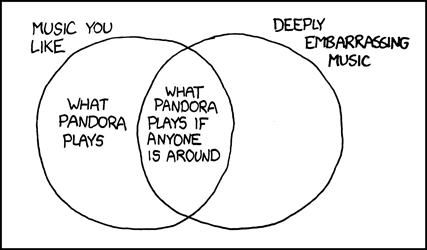
In the spirit of this XKCD cartoon, I will share with you all an experience I had tonight. A song came on Pandora that I think I have literally not heard since high school -- a song I would never in a million years have remembered -- and it immediately touched me, and I remembered loving it quite dearly. It was "Blue Savannah" by Erasure:


(I can't recommend the video, unfortunately. If this song were more famous it would be absolutely ripe for one of those literal video remakes.)

Erasure is one of the only two bands I have ever seen in concert, and I was totally into them in high school. There is a swoony (gay) voice thing they do that, for my adolescent self, brought up vast feelings of romantic and sexual longing -- you can hear that when he sings "to you only" in this song. In the development of my musical tastes as well as what I thought was sexy, Erasure fell chronologically right between George Michael and Depeche Mode.

Thank you, Pandora.

Friday, March 19, 2010

The Fantasy of an Uncluttered Life

Tomorrow, assuming we can make it in the snow, Ed and I are headed to our rental cabin for four days of relaxation. I plan to do a lot of math homework, read for hours on end, hang out in a hot tub (for which the snow is a bonus, assuming, again, that we can get to the cabin), eat homemade food, and just generally chill.

Aside from the hot tub and the general beauty of the surroundings,the aspects of this vacation that I'm most looking forward to are theoretically possible at home. No Internet. No TV. (The cabin has one, but I don't plan to use it.) No distractions. A lot of reading. But I wouldn't do that at home.

Sometimes I feel like it's the sheer amount of stuff in my home that keeps me distracted and unproductive. I don't really have that much stuff - we are not hoarders or anything - but I wish I had even less. I have a persistent fantasy of living in a place that is sparse, simple, utilitarian, and not only uncluttered, but incapable of becoming cluttered, by virtue of not containing things that could clutter it.

Some of this is pure fantasy, but I do want to get rid of a number of things before I leave for grad school next year. I have a lot of things I need (or choose to) hang on to, but there are other things I really can get rid of. Some highlights:
  • A few years ago, I got rid of most of my books, and I'm ready to do that again. (I haven't gotten many new books in the interim, I'm just ready for the next stage.) Most of my books I will never read again, so why should I hold onto them? I plan to take these to the library nearby, where they happily accept donations for their various fundraisers.
  • I am finally giving away my saxophone, which I got several years ago, and really enjoyed taking lessons in before I ran out of time and energy for it. This kind of entails giving up the fantasy of playing sax regularly, which feels sad, but it's not as though I couldn't buy a saxophone and take up playing again in the future if I wanted to. I found a local middle school that is, in the words of the band director, "always looking for quality instruments," and I will drop it off there.
  • I have way more pairs of shoes than I need. Most will just go in one of those ubiquitous clothes + shoes donation dumpsters, but I have a couple of new pairs that I got a few years ago but that didn't work out for me. I have scheduled those to go up on eBay.
  • Once I finish the process (begun years ago) of putting my music CDs into binders, my music collection will be reduced to three or four binders, which will take up a lot less space than the gazillion CDs in their original cases did. Most of my music is on the computer anyway.
  • Various old computer equipment can go to Goodwill or a pawn shop or something.
  • I am going to get rid of my tent and sleeping bag. I never, ever go camping.
  • Almost all of my DVDs and videos can go. I won't watch most of them again and it's not hard to rent a movie when you want one.
In addition, here are some things I do not plan on moving with me to a new place:
  • My dining room chairs, which do not match my table either aesthetically or in terms of height, and are just annoying.
  • A couple of my bookcases, which will be empty after the book purge.
  • My entertainment center, video game consoles, DVD player, receiver, speakers, or TV. I could change my mind on this, but for now I think I'm just not going to bother having a TV or any of that in the new place. (If Ed moves with me, we'll probably take this stuff, but I hope not to really have TV service. If I live alone, I think I just won't have any of it.)
  • Most of my framed posters - I don't seem to care about them enough to hang them up, and they're kind of a pain to move. I can always get something else for the walls.
My dining room table and desk are both useful pieces of furniture that can be disassembled into a much more convenient size, so they will stay (unless Mosch decides he wants the desk back). I may get another sparse type of desk - I would like to have one that doesn't have my computer on it at all, since computers are very distracting to me. I'd like a desk like this or this from Ikea.

Here are some other things I plan to keep:
  • My bed (it's great, very comfy, and everyone needs a bed)
  • My clothes (at least the ones that fit)
  • Towels and sheets
  • Kitchen equipment
  • Photo albums
  • Yearbooks
  • Seymour (my first stuffed animal)
  • My filing cabinet and its contents
  • My little nested teak end tables
  • Cat equipment (litter box, carriers, etc.)
That's the plan.

Monday, March 15, 2010

Or There Is Always Plan B

Next week, after my cabin vacation with Ed (woot), I am flying to visit one of the graduate programs to which I have been admitted. I think I might get a pretty sweet financial deal there and I want to get a feel for the department. Meanwhile, given that I don't have financial packages piling up on my doorstep, I have made preparations for a solid Plan B.

Plan B would consist of doing a master's degree in applied math at a local public university. I hadn't applied to this school, but the deadline is April 1 (and it's not a very firm deadline), and today I filled out the application, wrote the SOP, had the transcripts and GRE scores sent, begged one more letter from my poor recommenders, and am about to mail them the signed forms and stamped, addressed envelopes, etc., so that should be completely taken care of. (In other news, I have gotten pretty good at doing at least basic graduate school applications.)

I don't feel that this master's program is very competitive, so I think I have a good chance of being admitted, especially as I am not seeking any funding. My plan would be to do this program full time, but cut back my actual job to half-time. I think a 20-hour job plus full time graduate study is doable (many TAships take 20 hours anyway), particularly at a perhaps not terrifically demanding program, and half-time at my job would pay more than most graduate stipends, even with full tuition and fees deducted.

In related news, today I let my boss at work in on my graduate plans. She was happy for me, and supportive, but afterwards also (jokingly) called me "bitch" and "ignorant slut." She was quite grateful for the ~ four months of notice, which should give them enough time to hire someone to replace me. She said she is selfishly hoping that the Plan B option is what happens, so that they can keep me part time. (This company is also quite possibly moving to within a few blocks of the Plan B University, which would be mighty convenient.)

I am pretty excited about both Plan A and Plan B at this point even though they are rather different paths. The idea of Plan B is that afterwards I could either work in industry (or government) in a more professional position, or apply to doctoral programs as a (hopefully) stronger candidate.

Friday, March 12, 2010

Living Under Threat

I made a discovery about myself and my motivations a few months ago in therapy, and I think I wrote about it at the time, but it's worth revisiting because I keep realizing it over and over and it's something I need to remember to apply. And that is that (a) I respond much more strongly to positive than to negative motivations, and yet (b) my natural instinct is to try to motivate myself negatively.

I don't remember, as a child, ever being given positive reasons to do anything. (I mean, of course I was given positive motivations for things that are intrinsically fun, like swimming or going to Disney World. I'm talking here about things one would not naturally want to do.) It was never, "Eat your vegetables so you'll grow big and strong," or, "Think how great you'll feel when your homework is all finished," or, "If you're an honest person then people will trust and respect you." The reason for doing something hard was always the avoidance of some negative outcome like not getting into a good program in school or being disbelieved or being one of those ridiculous children who will only eat hamburgers.

This strikes me now as a bit odd (although possibly not as odd as it actually is).

Last night, I needed to finish the homework for my Seminar class today. I really didn't want to - I wasn't looking forward to puzzling out the proofs I needed to write, and the class doesn't (generally) interest me that much. I really fought myself over it, but there was no way I could justify not turning it in. But I didn't want to do it. But if I didn't do it, then I wouldn't have it, and I'd have to do it later and apologize to Dr. Ruch again and feel bad about it.

Eventually I was able to cajole myself into doing the assignment, which turned out to be really easy once I was willing to put in the required organized effort. And once it was done, I felt amazing! I absolutely love the feeling of having a completed assignement ready to turn in. Also, the proofs turned out to be moderately fun. Overall it was terrifically satisfying and I was really high from it.

And that is how I should have motivated myself, not by pondering how screwed I would be if I didn't do it, and by convincing myself I had no choice (which is pretty much never true, and don't think I don't know it), but by thinking about how much I would enjoy having it done, and how good I would feel about finishing it on time and doing a good job on it. But that type of motivation doesn't often occur to me.

The thing is, after a lifetime of living under threats (my mom's, when I was a kid, and my own internal ones), I am not very responsive to them. Not that many horrible things have ever happened to me as a result of my actions (or inaction), so most of those past threats have turned out to be baloney. Other threats ("I need to lose weight or I'll die of diabetes") are either far in the future or so horrible that they cause me to avoid thinking about the topic at all.

And who wants to live a life of doing things just to avoid some bad outcome? I mean, seriously? I am a descendent of millions of generations of humans and other creatures who survived despite the perilous nature of living, and I live in the safest and happiest time of all (so far). It's no wonder I'm not that easily frightened.

For the most part, if my only motivations for doing something are negative, it better be pretty easy. Wearing a seat belt is a good example of something easy that we only do to avoid something bad. Everything else worth doing has some positive reason behind it - it's satisfying, or remunerative, or improves the quality of one's life in some other way.

So, to hell with threats. I am gonna MESS THESE THREATS UP. I call them out.

Tuesday, March 09, 2010

Looks Like I'm Going to Grad School

Nothing is fully determined yet, but I have been assured by the grad director at one school that I will either get a nice fellowship from the school, or a TAship and tuition + fee waiver. I should find out either at the end of this week, or in a couple of weeks. The offer is good enough (either way) that, if it's my best offer, I'll go. I'm pretty psyched.

Once I have an offer on paper I will let my boss (and, by extension, my coworkers) know. I'm friends with one and he knows already, but the rest do not, and I don't see any reason not to give them a few months' notice rather than a couple of weeks. And it's getting a little awkward when people congratulate me on my impending graduation and either ask what I'm going to do next or say I must be relieved that I won't have to do icky school anymore.

Monday, March 08, 2010

Feeling Dumb at Math

My advanced calculus class this semester (part II of the sequence), despite being taught by the same (great) professor, has so far been vastly harder than the first semester. It has been hard enough that I got an 83% on the first exam, which is lower than any of my exam grades (including the one I dropped, and knew ahead of time I would be dropping) from last semester.

We started with sequences of functions, then moved on to series (of numbers), and then to series of functions. I basically skipped this material entirely when I took Calc II in 1991, but I have since reviewed that entire chapter of a regular calculus textbook. I am keeping up with (and doing well on) the homework, but every assignment is difficult-to-impossible and the situation doesn't seem to be improving.

Assuming I go to grad school next year, I'll be taking graduate-level analysis, so the difficulty of this material only makes it more beneficial to be seeing now, rather than for the first time next year. But it's been very hard for me to persevere with it when it often seems as though I'm not improving [note: this is objectively false as best I can determine]. The assignments often frustrate me to the point of tears or rage.

I decided on Saturday night to try to take a humbler approach to the material, to not let it be about whether I am smart or not (a real weakness of mine), but to see myself as a servant (if you will) of the math. I'm not sure it's having any effect yet, but I'm going to keep trying it.

I know that if I'm going to get anywhere in math, I have to learn to work without the promise of success - to work on problems that are hard enough that I may feel stupid and hopeless for quite some time. I guess this is good practice for that.

Monday, March 01, 2010

Shutter Island

On a whim, at 7:00 last night I went to see Shutter Island, the Martin Scorcese movie about two federal marshals (Leonardo DiCaprio and Mark Ruffalo) in the 1950's who investigate a woman's disappearance on a small island on which there is an asylum for the criminally insane. It may be that the asylum is being used for cruel psychiatric experiments, or something of the kind, and the previews hint at questions of whether it will be possible for the marshals to leave once they have arrived.

The movie was creepy and a bit scary, and the ending was less predictable than I had anticipated. I'd say that if the premise or previews for this movie appeal to you, it's well worth seeing.

(Oh, one note. If you try to avoid movies with Holocaust imagery, know that one of the marshals has frequent flashbacks/dreams about liberating Dachau.)

Sunday, February 28, 2010

Sunday! Sunday! Sunday!

It's only 6:45 PM here, but I'm about at the end of my homework-doing rope. I got the abstract algebra homework finished this morning with relative ease, and I have finished two out of six homework problems for advanced calculus, and made a good start on a third, but I can't seem to continue further. Apparently there are limits to my ability to work on math. Who knew?

In other news, I got 5 loads of laundry done this weekend as well, which is pretty good.

Bah.

Saturday, February 27, 2010

My Day

I've been sick most of this week, and have fallen grievously (by my standards) behind in my courses. So I am counting on this weekend as a big catch-up time.

I got up at 8:30, unusual in and of itself. I went to bed at 10:30 last night promising myself a good 12-14 hours of sleep (I needed it), but I seemed ready to get up at 8:30, so I did.

With breaks for breakfast, lunch, and dinner, I spent nearly all day at my desk doing math. I have to admit that the math was interspersed with web-surfing, which is a very bad habit of mine that is hard to break. Nevertheless, I was at my desk from about 9:30 AM until about 10:30 PM with only a couple of hours of breaks, which means I got a lot done even though I didn't work consistently all day (and the ratio of surfing to work increased as the day wore on).

Here is what I did:
  • Reviewed about five sections of my old calculus textbook to learn/remember what there is to know about power series, Taylor polynomials, and Taylor series, on that level.
  • Completed the homework due last Wednesday in Advanced Calc II.
  • Wrote my academic-oriented resume (or slightly CV-like document).
That doesn't sound like much, but it actually was. The homework was long and involved some concepts I felt shaky on, so I had to do a lot of exploratory work to really get it. I think it is a good homework.

Oh, and about the CV/resume. I was asked to send one to the graduate director of one of the programs I've applied to because they want to submit me for a university-wide fellowship that they think I have a good shot at. So that is very exciting! The professor told me that the resume (he did not call it a CV) did not need to be anything "fancy" so I just buckled down and did it without trying to make it ultra-perfect. There is not that much to say, really. I basically took my regular resume, put academic things on top of the work things, and very concisely summarized the work things so they wouldn't be bored out of their minds by lists of industry-specific software packages I know, etc.

Here is what I hope to do tomorrow:
  • Finish the abstract algebra homework that is due Tuesday.
  • Go over the material I missed in seminar Friday, and start on that homework. (It is due Friday, but I need to start early to give myself a good chance to think about the hard parts between now and then.)
  • Get a good start on the advanced calculus homework due Wednesday.
Between now and tomorrow morning, I have one very important task:
  • Get a good night's sleep.
So I will go do that now. Best wishes to you for a productive (or relaxing, as you choose) weekend!

Monday, February 15, 2010

Google Buzz

Google Buzz (the new Facebooky-thing you may have seen it show up in your Gmail account) is causing a lot of stir around privacy concerns. I've turned mine off for now (it's a link at the bottom of the Gmail screen).

It's not that I'm that careful about privacy things in general. I don't care much that my grocery store card is tied to my real name so anyone might find out how often I buy razor blades or what flavors of ice cream I prefer. But the thing about these various offerings from Google (including the thing where someone can follow you on Google Reader) is that I can never figure out exactly what information is and isn't being shared.

You see, I have various email correspondents. Very few are private, but those few do exist. And I subscribe to a variety of RSS feeds in Google Reader, and I most definitely do not want them shared with everyone I email from my Gmail account (e.g., my coworkers, directors of graduate studies for the schools I've applied to, ...). I can't tell if Buzz does that or not.

What I like about Facebook is that it's a self-contained universe. Don't want something about yourself on Facebook? Just don't do that thing on Facebook. If you're secretly obsessed with manga, you don't have to share that with your Uncle Herbert or your best friend from 5th grade as long as you don't join some kind of manga-lovers group. You can craft your (more or less public) image however you choose. Since nothing manga-related is in any part of your profile, you don't have to know too much about the various privacy setting options in order to keep clear of it.

The various things I do with Gmail and Google Reader, on the other hand, are closer to my real interests, and thus I would rather not share them willy-nilly in a way I don't completely understand. In short, there is something to be said for not integrating services.

Survey Says...

Today, at my school's request, I took the National Survey of Student Engagement. A screenshot of one of the last pages of the survey:


I am old.

Sunday, February 14, 2010

Hipster Puppies

Via Andrew Sullivan, Hipster Puppies, which attains a certain kind of bloggy perfection.

Saturday, February 13, 2010

Another Grad School Admission

Today, I was notified of my admission to the highest-ranked (according to the decade-old NRC rankings) program on my list, the University of Florida. Funding notifications will begin in a few weeks.

So far, I am two for three with my admissions. There is hope I could still be admitted at the school that rejected me (they said so), but I'm not holding my breath. I don't have any funding offers as of yet (both schools will make those decisions in a few weeks), so we'll see, but I'm feeling moderately optimistic.

Update: I got a letter in the mail from the school that rejected me (Tennessee) and they have indeed now admitted me. The letter was from the graduate school and not the math department, and said nothing about funding at all, but presumably I would hear about that at a later date if they want to offer me any.

Friday, February 12, 2010

My Favorite Super Bowl Ad

Far and away, it was this one for the Kia Sorento. I especially like the ending.

Wednesday, February 10, 2010

Settling In

The first couple of weeks of my semester were a little nerve-wracking, but I seem to be settling in nicely now. I've turned in some homeworks, gotten good grades, mastered some material that originally frightened me, and my easy class is finally getting to some good stuff too. (It is still a little frustrating to sit in a room with students who are vocal about their difficulty in understanding the Euclidean algorithm despite being shown several examples, but I try to remind myself of all the times I am clueless and confused about things that will seem basic later on.)

I am a bit astonished by my progress as a math student over the past few years. It's not so much that I've learned a lot of math as that I've picked up a lot of skills I never had before. I now know how to read a math textbook (i.e., with pencil and paper, writing things down). I approach homework quite differently. I study. I am much better at tackling problems I'm not sure I can do than I was in the past. I am better at writing proofs. I know more Greek letters than ever before. And so on.

Life is good, I tell ya.

Monday, February 08, 2010

My Not-Very-Informative Review of Avatar

Saturday afternoon, I finally dragged Ed with me to see Avatar. I knew the plot wasn't supposed to be that great, but it was supposed to be really pretty. It was indeed quite pretty and the plot was more offensive than I'd imagined, but not as bad otherwise.

We saw it in 3D. It is, as others have mentioned, not very flashy 3D - arrows don't come whizzing out at your head or anything like that. But it was nice to see the depth, and little details, like the 3D displays on people's computer screens in the movie, excited me from time to time. The 3D made my eyes feel slightly tired by the end, and gave Ed a bad headache.

The movie is definitely racially offensive in a wide variety of ways, but I found it easy to overlook while actually watching it. The action was enjoyable despite my not being a fan of action movies. And I really did enjoy the alien world and the aliens themselves. The aliens are more attractive when they move than they look in regular pictures.

I did have trouble identifying with the main character, who is a hero man in the stupid/impulsive/brave/doesn't-take-directions mold. Given that I'm smart, extremely chicken, and a careful listener, I often don't sympathize with the choices made by such men. But then, that's why they don't send me to Pandora to be eaten by the first clawy thing that comes along.

One detail that doesn't come up as often as you'd expect is that the aliens are humanoid but about twice as tall as humans. I was surprisingly moved and excited by a scene in which the main human is tenderly picked up by his alien girlfriend. I'd love to be twice as tall as Ed (you know, assuming this didn't cause a lot of other problems).

As an experience, the movie was worth seeing. I would even see it again pretty happily if I knew anyone who wanted to go.

Wednesday, February 03, 2010

Two Mathy Conversations

These were both fun. The first one was between me and Ed, after advanced calculus one night. We had discussed in class the fact that infinite sums are neither commutative nor associative, e.g., if you start with

1 - 1 + 1 - 1 + 1 - 1 + ....

then

(1-1) + (1-1) + (1-1) + ... = 0

but

1 - (1-1) - (1-1) - (1-1) + ... = 1

even though those are the same terms just grouped differently. Spooky! So here was the conversation.

Ed: The stuff about series was cool.
Me: They're not associative or commutative. It's awful.
Ed: It was neat.
Me: It's wrong.
Ed: It's cool.
Me: It's an abomination.
Ed: I liked it.
Me: It's a sign from God that we aren't meant to do infinite sums.
Ed: It's a sign from God that we shouldn't confuse infinite sums with addition.

The second conversation was last night right after class, between me, another student I'm friends with (Jason), and (at the end) our professor.

Jason: I'm tired of real analysis. I want to do fake analysis.
Me: You could try rational analysis.
Jason: I want to do irrational analysis!
Me: If you're going to do irrationals, you might as well do reals.
Jason: But I'm more the irrational type.
Me: But at least the rationals are a field.
Jason: Then can I do complex analysis?
Me: That's a real course, you know. You can take that.
Jason: It is?
Me: Yeah. They have it here.
Professor: Complex analysis, it turns out, is like Disney World, in that, everything you ever dreamed might be true, turns out to be true.

Tuesday, February 02, 2010

A Math Class of the Second Kind

My third math class this semester is "Senior Mathematics Seminar," which is a 1-hour class that meets once a week and could be about anything. Our particular class is about wavelets, which are like functions with finite absolute area. (In other words, the area under the curve, whether above or below the x-axis, is finite over the reals.) That's my understanding so far, at least.

I realized after the first day of this class that I've experienced two types of math classes, and this is the rarer second type. Of course, this categorization is as suspect as all such attempts, but bear with me, if you please.

I used to think of math courses as going in a line, roughly from arithmetic up through algebra and then calculus. But that's really as far as that particular line seems to go. Beyond that, the field spreads out and you have classes like probability & statistics, linear algebra, etc., that do not go in a specific order. Of course, those classes then spawn their own chains.

But these days a different classification makes more sense to me. Now I see most classes as sort of "tool" classes, where you learn a lot of tools that are broadly applicable (like calculus, linear algebra, set theory, etc.). And then the other classes are more "application" classes (whether they are applied or theoretical) in which you use various kinds of tools to understand some new area. My second geometry course was one of these application-type classes, using a lot of linear and abstract algebra (and a touch of geometry, though not much), and this wavelets course is the same way (so far mainly with respect to calculus and analysis).

At any rate, the class has been all right so far. Our professor has roughly the style and personality of a very toned-down Steve Martin - like maybe Steve Martin playing a math professor in a serious movie. I was confused a lot this past week, and left class feeling like I'd been crying, though of course I did not actually cry, and I've realized that I really need to read the book before class rather than only looking at it afterwards (which is kind of obvious, but not my usual M.O. for math). It looks like we'll only have graded assignments and possibly some kind of small projects later on; there's been no talk of exams. So it should be all right, though it's hard for me to see how I have time for two classes (this one and Advanced Calc II) that require serious thought.

Sunday, January 31, 2010

Weight Watchers Ice Cream Sandwiches

Lately I have enjoyed many ice cream sandwiches. It started when I picked up a package of Blue Bunny ones with peppermint ice cream - yum! I find it easy to eat just one (vs. having just one serving of ice cream) and they satisfy the craving for something sweet.

Anyway, yesterday at Walmart I picked up some of the Weight Watchers ones. They have ~ 30 less calories than most regular ice cream sandwiches, and I thought it would be nice to give them a try. I've never had a bad ice cream sandwich, so I was sure they would be fine.

But, god, do they ever suck. They're not artificially sweetened or anything, but there is something dramatically wrong with the flavor profile, at least as far as I'm concerned. Once you get past the nice cold sweetness of the initial bite, there is just nothing there to enjoy at all, and they have a "wrong" taste I can't identify - something like the aftertaste of an artificial sweetener, but in a different area of the flavor. Like maybe secretly the wafer part is made of seaweed.

Anyway, I definitely cannot recommend these. Ordinary generic-brand ice cream sandwiches are almost the same calories, much cheaper, and far more delicious. I doubt I will eat the remainder of the box of WW ones.

Saturday, January 30, 2010

Contempt

My abstract algebra class has a clump of students in it who were also in my linear algebra class, and I've noticed that the dislike I felt towards them in linear algebra has carried right over to the new class. I think I actually hold them in contempt, which is definitely uncharitable of me. But I've been thinking about why this is.

I initially thought it was because I view them as stupid. Viewing people as stupid because they are confused in a class, and then finding them contemptible for it, is definitely not an attractive trait. But I don't think it's actually that, because I certainly don't always dislike (much less feel contempt for) other students who seem to have trouble with the material. A lot of people in my advanced calculus class struggle, some noticeably more than I do, and I respect them.

I think there are two things these algebra kids do that I dislike. First of all, they talk to each other helplessly about their difficulties. In advanced calc, the conversations go something like

A: Man, this series stuff is hard.
B: I know, dude. Did you do the homework?
A: Some of it. Did you get #3?
B: Yeah. I talked to Dr. X about it and he said to use [xyz].
A: Oh, duh. That makes sense. I was totally stuck on that.

By contrast, these algebra kids have conversations more like

A: This class is impossible.
B: I know, right!
A: That homework didn't make any sense at all.
B: Totally. There was nothing like that in the notes.
A: I just don't get this kind of stuff.

The other thing they do that bugs me, and this was greatly on display in our last class together, is blame the professor when they are confused. This was the group of people who always got angry after the exams because they didn't feel like they were adequately warned of what kinds of questions would appear (despite our receiving several practice exams that were similar to the real one each time). They seem to view any expectations they can't meet as unfair and wrong.

Most of the time, it doesn't occur to me to blame a professor when I'm confused. I guess I could, if the material were completely out of line with reasonable expectations (like that one stats class Sally took years ago), but generally, I assume it's my own problem to solve. Since these students don't ever seem to mention anything they've tried (like studying, or working extra problems on their own), one gets the sense that they want absolutely everything spoon-fed to them.

I remember once in linear algebra, one of them asked our prof for a recommendation of some sample problems to try at home. She pointed out the relevant section of the textbook, but that wasn't enough - they really wanted to be told specific problems from the section that they should do. I don't really get that.

It's not that I'm such an awesome student, always studying and doing everything that I should in order to understand the material. I'm decent now, but I have really sucked in the past. But I've always known that my sucking was about me, and not about the unfairness of the universe.

I'm starting to feel that in general, the question, "What have you tried?" (or, to yourself, "What could I try?") should be asked more often. I definitely find it a helpful one when I start to feel helpless.

Monday, January 25, 2010

First Grad School Application Result

Today, I got an email from the Graduate Advisor of one of the math departments I applied to. He has emailed me before to say that my application was complete. Today he emailed me to say that he is requesting my unconditional admittance to the PhD program. He also said that the first round of teaching fellowship offers will go out in early March, and he's not sure how many positions they will have.

Needless to say, I was excited to get the email, which came earlier than I had anticipated anything. Afterwards, I went to the website where I can look at such things, and sure enough, my application status had changed from "Complete" to "Admitted." So I guess it's official that I'm in.

This isn't one of my more highly-rated schools - it's near the bottom of my list in terms of rankings. It is, however, one of the schools I have in common with Ed (assuming he hasn't changed his mind), and it's in a place I wouldn't mind living. So we'll see.

Class Report: Advanced Calc II

I wasn't going to blog about this class, but I actually had a reader request, if you can believe that.

At any rate, we are in a new classroom this semester, but otherwise the course is much the same as Advanced Calc I - same professor, a subset of the students from last semester, and a very similar syllabus. There are two new students, including Ed.

The one thing the prof changed on the syllabus is how he handles late work. Last semester he gave a 5% bonus to homework turned in on time, and hypothetically took 5% off for every day it was late (so you'd get full credit for turning it in one day late). But I don't think he ever actually gave a penalty, and he would accept things up to a week or two late, which resulted, naturally, in some people getting pretty far behind on homework. This semester the on-time bonus is only 2%, and he will not take homework more than 2 days late except by prior arrangement. In practice, I suspect this means he'll take late work anyway (which he seems to suspect as well). I only turned in one assignment late last semester (and it was only one day late, I think), so I don't think this policy change will affect me.

I enjoy the style of this class a lot. It's a straight-up lecture that is very well organized, and the professor has excellent handwriting and a great presentation style. Partly because this course is taken mainly by math majors who are not secondary math ed folks, it seems to be a sharper crowd than I've seen in some of my other courses.

We get weekly homework that consists of six problems to turn in and several more problems that we don't turn in. I did the "several more problems" on the first couple of homeworks last semester, and then stopped doing them. I typically find it hard enough to finish the six mandatory problems every week; the other time I put into the class is more profitably spent reviewing definitions and proofs.

So that's Advanced Calc II.

Wednesday, January 20, 2010

New Comments Moderation

I'm tired of seeing spam comments here, so there is now moderation. Comment as usual, please, and I'll be happy to release you from the queue :-)

Tuesday, January 19, 2010

Class Report: Abstract Algebra

Tonight was the first meeting of my abstract algebra class. So far, I have very good feelings about the class. Some good things:
  1. The professor is very charming. (It may seem trivial but I really do appreciate this.)
  2. She is going to give a quiz every Thursday that is all definitions. I think it's really smart to emphasize definitions in a class like this. If you don't know the real math definition of something you can't do proofs, etc., with it.
  3. Expectations seem high so far. For instance, the material I was afraid would be reviewed in this class (some basic definitions I've had in a lot of math classes) is stuff we are to review on our own and be prepared to take a quiz on on Thursday.
She had us get into teams (not "groups" because that is an abstract algebra term) for about the second half of class and work on a set of exercises she gave us. That felt a little bit awkward for me because I had already seen (in two different past courses) the material in the first half of the exercise. Fortunately, the person in our team who volunteered to write up the answers was also the person with the most trouble, which meant that we took enough time for her to understand what we were doing. (I would rather write up the group answers myself so I can control their quality, but if the person having the most difficulty writes them up, the others are compelled to make sure that person understands the material at least well enough to write correct answers.)

The classroom for this class is sort of awful - comparatively long front-to-back and cramped side-to-side, with those desks I hate. It's also excessively warm and airless. But that's me being finicky about spaces.

Friday, January 15, 2010

Wii Fit Plus

Since Ed and I have a Wii, I finally went ahead and ordered Wii Fit Plus, which is a video game for the Wii that incorporates the use of a balance board (similar to a shallow step you'd use in a step class, except heavier and with electronics inside to report your actions to the game) and is intended as something like a personal trainer. I thought this would be something fun to do at home for fitness. When school is in session I really never make it to the gym at all, and then between semesters it's hard to bother starting.

The game (with balance board) is $99.

When you first register your character, using your little animated Wii representation (called a Mii), it weighs you and tests your balance. (If you're like me, after it weighs you and shows your BMI, a childlike voice says, "That's obese!" Thanks, Wii Fit. I had no idea.)

(This reminds me, actually. Someone was complaining online about the Wii Fit's use of BMI, given its limitations. They specifically mentioned that someone like a trim NFL player could be called obese despite actually just being very muscly. I couldn't help but think this common argument was really silly here - as though professional athletes are really a target audience for the Wii Fit. Hint to athletes: if you are training with the Fit, it's probably time to start asking yourself whether you're really into this whole sports career thing anymore.)

Anyway, once the Fit has finished insulting (or perhaps praising) you for your BMI, it has a variety of training exercises to choose from - perhaps about 100 in all. These fall into four categories: yoga, strength training, balance or rhythm games, and aerobic exercises. Each exercise uses some combination of the balance board and the two remotes that a Wii comes with. For example, the jog uses only the main Wii remote, which you put in your pocket to act as a kind of pedometer while you jog in place on the floor. (You're not supposed to jump on the board, and that probably includes jogging, since you raise both feet at the same time for that.)

I haven't gotten into a lot of the yoga poses, but they seem decent. The strength training exercises cover a nice range of difficulty, from very easy things like a tricep extension holding the remote, to things I can't do like pushups and side planks. So far I love some of the leg exercises (very hard, especially the balance aspect) and the plank (extremely difficult and I shake like crazy, which the onscreen trainer often comments on).

The aerobic/rhythm games are so far some of my favorite. I like the basic and advanced step classes, and I adore the rhythm kung-fu. I went on a jog tonight where I actually jogged in place for far longer than I would have thought possible. Every game or activity gives you a score at the end (which, for the strength and yoga ones, is generally based on your balance and steadiness), and there is a high score list for each one. As you get better at things, more levels are unlocked - for instance, my 30-second plank was steady enough tonight that I unlocked the 60-second version.

Overall, I find it fun and very motivational. A lot of people have complained that you have to keep selecting a new activity a lot (though you can set up a full routine of strength and yoga things to do all at once, or have the game do it for you if you tell it the time you want to spend), but I like that aspect - the fact that I get to continually choose what to do stops me from getting bored or feeling trapped doing something horrible forever.

I've done this for four days in a row now, and every day I am sore in all kinds of places both expected (thighs, shoulders) and not (hips, lower abdomen). I am winded and sweaty a lot as well. So it is fun and a good workout. I can't say for sure that it won't become the video game equivalent of a treadmill used as a clothing rack, but so far, it's working for me.

The Grad School Application Process

Am I an idiot, and/or going to be shot if I admit that I have, overall, found the process of applying to grad schools to be, well, fun?

I'll admit, the beginning was pretty bad. I had to figure out all of the schools to apply to (easier for me than for some since my interests are not narrow and well-defined and I was not aiming for the tippy-top schools), try to get a handle on their requirements, and write the dreaded Statements of Purpose. There was a lot of anxiety and uncertainty around that aspect of it. And then I had to recruit recommenders and get them the information about where to write to and all of that, and fret over whether they would come through. More stress.

But there have been a lot of fun aspects as well. I've applied to eight schools; that is eight new cities to think about living in, eight campuses, eight fantasy school situations. Thinking about being in graduate school is neat.

I did not (successfully) contact any faculty before applying anywhere, but for two of my schools, I've had several interactions with the directors of graduate studies, and their emails have been very individualized and friendly. For some reason, that's been very enjoyable.

I don't know if I'll get in anywhere. Sometimes I think my obvious flakiness (I have a lot of dropped classes on my transcripts, even in recent years, and I'm 35 and just now graduating from college) will make me a non-starter. Other times I think my intelligence, gender, and ability to speak English will at least get me a spot somewhere as cheap TA labor. But I feel an overall warm glow thinking about this whole process and the various small pleasures it has afforded me.

Thursday, January 14, 2010

The Two Acceptable Approaches

At work, I have noticed two approaches that people use when being shown how to do something new:
  1. They write it down, sometimes in great detail, so that they can refer to their notes in the future, or
  2. They do not write it down, and later they use a combination of memory, trying things, struggling, etc., to perform the action.
Now, either of these approaches is just fine. I tend to use Method 2 unless I'm doing something so complicated that I know I won't remember it, but I know people who almost always use Method 1, and it's a good plan.

What is not acceptable is doing neither. Specifically, it is not OK to ask me to show you how to do the same things over and over again, ten or more times each over a period of several months, while you
  • don't take notes
  • don't remember anything
  • are unwilling to struggle to figure something out on your own
  • refuse to consult outside reference materials, and
  • act helpless
That will really just piss me off, which I will then struggle (and probably fail) to hide in my tone of voice when you call me for the umpteenth time. And if you make more money and have a fancier title than I do while doing (or failing to do, as the case may be) the same kind of work, that goes double.

Conversation with a Baby Engineer

I'm working on a project for a boss, Saul. Saul sent me some forecast curves generated by one of our young, somewhat recent engineering hires, Ricky. (Names changed to protect, well, me.) When I looked at the curves, they were unfortunately printed in such a way that the parameters I needed were not printed on them. Once I realized this, I called Ricky.

Me: Hey, Ricky. Remember these curves you did for Project X?
Ricky: Oh yeah, sure.
Me: Unfortunately I can't get the Qi or the initial decline off them because, when you printed them, the walk point was way down the curve.
Ricky: Oh, that's too bad.
Me: Yeah. So, do you know what those are, or can you open them and look?
Ricky: Shit. I don't know if I saved those, or what project I did them in. Let me look and call you back.
Me: All right.

[Two minutes later]

Ricky: Hey, Tam. Yeah, I don't think I saved those. Do you need me to redo them?
Me: Yes, unless you have some magical engineer way to calculate the decline from the curve - I don't know how, but it seems like maybe you could. I can guess the Qi from the graph, but I don't know how to get the decline.
Ricky: You can do it with graph paper, but it's probably easier to just redo it.
Me: OK.
Ricky: So do you want me to do that?
Me: Whatever's easiest for you.
Ricky: OK, well, let me finish up what I'm doing and I'll do that next thing.
Me: OK.

I'm sorry to admit that my first impulse, before calling Ricky, was just to send an email back to Saul explaining why the document that Ricky sent was not useful. Then it occurred to me to maybe not throw my coworker under the bus. Heh.

Tuesday, January 12, 2010

Laughing at the Unexpected

On some blog or other, I came across this laughing baby:


In this clip, the baby's (I assume) father hands him a piece of newspaper, which he has started a tear in, and when the baby takes it, it tears into two pieces, causing the baby to crack the hell up. Over and over again. It's really very endearing.

And later I was thinking, why does this make the baby laugh? Is it social laughter because the father is laughing? And I remembered that one reason people laugh, perhaps, is that something unexpected has occurred.

So you're a baby, right? And you've probably just gotten this whole "handing" thing sort of down. People push an object towards you, and you reach for it, and then it's in your hand. Neat! Now the objects handled by babies are usually plastic, or cloth, or some kind of food. Newspaper isn't something a baby generally has much use for.

So here you are, and something is held out towards you, and you take it. And then what happens is that the object makes a noise, and somehow comes apart into pieces, and you and daddy both have one now.

Hilarious!

Sunday, January 10, 2010

The Impending Semester

My schedule for next semester (starting Tuesday Jan 19) is as follows:

MW 7:00-8:15PM - Advanced Calc II
TR 5:30-6:45PM - Abstract Algebra I
F 10:00-10:50AM - Math Senior Seminar

It is going to suck a bit having to go to school every day of the week, and that Friday time is a killer as far as work goes. But at least my weeknight classes are 75 minutes instead of 110 like last semester; that should make those a lot easier as far as attendance goes.

I'm really looking forward to the second half of advanced calculus. I enjoyed the first half a lot, both the material and the professor, who is one of the best I've had. I'm looking forward to seeing all of the familiar people from last semester. Also, Ed is taking the class with me this time, so that will be fun too.

Abstract algebra is a great topic - I listed algebra as an interest in most of my grad school statements of purpose - but I'm a bit concerned that I already know so much of it from my other classes (especially Proofs and the geometry class I took a year ago). It's not always fun when a lot of a class is a review. But it should be proofs-intensive, and that is always exciting. I hope there is a lot of homework. (I always feel this way before and after the semester, but never during.) The professor scheduled to teach it has excellent reviews, so I have high hopes for her.

I'm not sure exactly what to expect from the Friday seminar. There are only six students enrolled, which is fun for any class, but especially good for a seminar, assuming the class actually has that type of format. I'm not sure how a seminar works in math, but that's probably just ignorance on my part. The topic is wavelets. We'll see.

Anyway, I'm pretty ready. I just need to clean my room (I try to do this between semesters so it's not chaotic for homework) and clean out my school binder.

Wednesday, December 30, 2009

The One-to-Many Problem

I've been thinking about a class of related phenomena recently: those where a one-to-many relationship leads to inappropriate feelings or behaviors. I'll give a few examples.

Often, some shared cultural item (The Chronicles of Narnia, Amsterdam, Ernest Hemingway, chopsticks, etc.) comes up, and I feel as though I have a special relationship to it. I want to impress upon others my special relationship, to tell them the stories about myself and the item. And then I realize how extremely common it is for someone to have specific personal memories of reading a popular book series or using or watching others use chopsticks or whatever. Just because I visited Holland in the mid-90s doesn't really mean I have a special relationship with the country.

Professors commonly get a lot of annoying emails from their students. If you think about it, a student generally has at most five or six professors at a time, while a professor may have anywhere from 20 to several hundred students. Three or four emails per semester to each professor is easily manageable to the student, and overwhelming for professors. Students also feel that their own experiences are more unique than professors find them to be.

There are a few well-known blog authors whose blogs I have read for years. (John Scalzi and Andrew Sullivan, for instance.) I feel like I know these bloggers, have a sense of their personalities and experiences, etc. If I saw one of them, it would be easy for me to assume some kind of mutual familiarity that does not exist at all; they don't know me from Adam. I think people often have this feeling about celebrities.

Of course, it is always tempting to regard one's own experiences and situations as unique and special anyway, given that one's world revolves around oneself. But I do think these one-to-many situations, where something is more unique for you than you are for it, are especially prone to provoking such feelings. Perhaps this is why people like to have known indie bands before they became popular; it makes their special relationship to the band more plausible because it existed when the many wasn't so multitudinous.

Tuesday, December 22, 2009

Grad Apps In

As of today, I have done every single thing for my graduate school applications. One of my recommenders has submitted all of his letters, and the other two have shown signs of working on theirs, so everything seems to be well in hand.

I'm glad to be done with the process. I have applied to the following schools (in no particular order):
  • Colorado State University
  • New Mexico State University
  • Texas A&M
  • University of North Texas
  • University of Florida
  • University of Tennessee
  • University of Kentucky
  • University of Pittsburgh
I think I have a decent chance at some of these schools, but we'll see. If I don't get in this year, I will take some more classes (perhaps a graduate-level one in the fall, though I could also use a couple more undergrad classes to improve my background), take the GRE mathematics subject exam, and apply again next year.

Sunday, December 20, 2009

Fake English

I really enjoy listening to people do "fake English" - I mean things like improv comedians in foreign countries doing gobbledegook that is supposed to represent someone speaking English. This guy did a whole song, and to me, the "English" is really so convincing that it's almost frustrating that I can't understand it. It's actually a pretty good song too, of a particular, easily recognizable American genre. I've seen this a few times, anyway, but ran across it again today, so here it is:

Friday, December 18, 2009

Netflix to Blockbuster

I've had a Netflix subscription for several years now, but I've never gotten as much out of it as I could. It's very hard for me to mail movies away, since I can't get anything right away. And then when I do want a movie, I can't have it right now. I probably watch 4 or 6 movies a year from Netflix, which is ridiculous considering that I could buy a couple of DVDs every month for what I pay them.

Lately we rent a lot at Blockbuster. (By "a lot" I mean once or twice a month.) That's very convenient and nice, except that I never take the movies back, so I end up owning them. They are only $10 or $12 each, so it's not that expensive, but...still.

So, I have cancelled Netflix (and I give them major props for letting you do this on the website; so many services make you call them) and opened an account with Blockbuster online. What I got, for $12/month, is 1 DVD at a time by mail, and up to 5 in-store exchanges per month. This means that for less than the cost of one rental (when you figure in the high probability that I will never return the movie), we can just go to Blockbuster any time and switch out our movie. Or we can get one by mail if we want one that isn't available locally.

I'm pretty happy with this decision.

Wednesday, December 16, 2009

Attitudes

For weeks, two of my coworkers (let's call 'em James and Morgan) and I have been speculating over the situation with bonuses, which are typically given out in December at my company. James has been saying all along that he didn't think we'd get a bonus this year. We had been assured (since our president heard about these rumors) that a bonus with forthcoming, but James pointed out that any token amount could qualify as a "bonus" so the assurances were meaningless.

Last year, my first year here, I got quite a magnificent bonus. I was told that 1/3 of it came from the group that had recently purchased our company, and the rest was from our company. It was awesome. My offer letter says that the company typically pays bonuses of around 10%, depending on company profits and individual performance. I didn't have much hope of getting the same bonus as last year, but I was hoping for around 10%. That is still a really large bonus, in my book, despite what we may have seen last year.

Santa Claus finally came today, in the form of our president telling us our amounts. Mine was slightly less than last year, and well above any line at which I would have felt disappointed. I am pretty thrilled with it.

I made the mistake of going to lunch with James and Morgan. James is angry - he saved the company some large amount of money this year, was told this would be remembered at bonus time, and yet he didn't get a proportionately large bonus, he didn't feel. Morgan was not dissatisfied with her amount (she also reported getting slightly less than last year, but none of us shared our amounts or percentages), but was fretful over various things she's heard. She fears that because she is sort of mousy and doesn't often work directly with the people who decided the bonus amounts, it might be easier to "screw her" by not giving her as much as she should get. She had a lot of process worries over how these amounts were decided, and was also upset because of some conflicts over other people's bonuses. (Apparently one employee was upset that another employee got a larger bonus - something she was in a position to know about - and left for the day.)

It was basically non-stop negativity from those two. The president had apparently made a comment to James that, given that she didn't have as much total bonus money as she would like, she trimmed down the bonuses to some people who are highly paid in order to boost bonuses for people who make less. He was very angry and upset over this prospect, calling it "unprofessional" and commenting, "A company that knew what they were doing would pay people their market value," and then going on for at least 5 minutes explaining how this idea that some people make a "premium" could be applied to anyone and bitching how there are no standards and so on and so forth. Morgan mostly cavilled about this, that, and the other.

Morgan also pressed me about how I felt, and though I didn't want to be self-righteous about it, I did have to make it clear that I thought the amount was very satisfying and generous, and that I have chosen not to concern myself with the sausage-making aspects of how the company is run, both in general and with regard to bonuses. (I have found that worrying or becoming annoyed at the ways of corporations only leads to madness, especially since I'm never privy to the real details of what is going on. Best to just let them run the company, assume they know what they're doing, and look out for my own interests in more productive ways.)

I did not say any of this, but I find it really unproductive and, frankly, immoral to have the attitude (in life in general) that, while what you got might be OK, someone else might be unfairly getting more. Our whole economic system invariably leads to a lot of "unfair" things that people at my company, at least, are benefitting from. I have friends who are harder working, probably smarter, and definitely more educated than I am, and who make less money than I do even though their jobs are not in any sense easier. That is not "fair." It is not supposed to be fair. Fair did not come into it at any point.

Morgan was concerned that some people might get higher bonuses because they are more liked rather than because they are better employees. On what basis is an employee liked? How do we judge "better"? Why worry about the parts you can't control? Why choose to be dissatisfied when things are, actually, really good?

I don't think either of these people has had a serious job working for another company, or they would know that all companies are fucked up, to a lesser or greater extent, and that this one is particularly great to work for, and very generous in every way. And, you know, if you don't think you're being paid your "market value," there is an easy remedy for that. (That would be the, um, job market.)

If I do go to grad school, and if my cohort is large enough that there are subgroups to it, I really need to be part of a subgroup of people who work hard and have good attitudes. Because this stuff does influence me and I don't want to be around a bunch of whiners who think life is unfair all the time.

(NB: I don't think people are wrong for complaining about legitimate grievances. If you work at Walmart and can't afford to take your child to the doctor, rail all you want - I'm with you. But if all you have are upper middle class problems, then STFU with your BS about "unfair.")

Sunday, December 06, 2009

Taking the Putnam

Yesterday morning, I went to school to participate in the Putnam Competition. This is a six-hour math exam (if you want to call it that), split into two 3-hour sections, with a lunch break in between. Each section has six questions that require college mathematics and a lot of creative thinking to solve. Each question is worth a maximum of 10 points, with partial credit given, and the median score is typically 1 or 2 points (out of 120).

I didn't really have time to go, but I didn't see how I could miss it. The competition is only for undergraduates, so this was my last chance, and I'd never done it before (nor had an opportunity to, that I was aware of, though you can take it four times overall and needn't be a senior nor a math major). I wanted to support our math department as well; I knew some people wouldn't show up, and I wanted to be able to say that, yes, we can at least field a Putnam team. (I wasn't on the actual team, which is three people from each school, in the end. But that's fine. You don't work together anyway - it's a purely individual endeavor.)

The morning session was fun. Of the six problems, one looked tractable, but I didn't get anywhere with it. I turned to another question that looked less tractable and ended up writing out an answer. (You have to write a full proof for the answer, not just solve the problem.) I am pretty sure a central assertion in my proof was wrong, though, but I haven't had a chance to check it yet. (It involved an 18x16 matrix, which I'm sure was not how the problem was meant to be solved.)

What was fun was that I was only trying to score any points at all. On a normal exam you're trying to get all of the points, or fall short as little as possible, but I was aiming to just get above 0, so it wasn't really stressful. I had three hours to work on as little as one problem.

The professor running the show bought us lunch - we all walked over to Old Chicago. It was actually pretty blissful. There were six of us students, of whom two are in my advanced calculus class, one is in my "senior seminar" next semester (but I hadn't met him yet), and the other two were unknown to me. (One I'm not so sure about - he argued on the way to lunch that irrational numbers can be accurately represented as fractions, using 22/7 - a classic approximation for pi - as an example.) We talked about the test, and other math topics, all through lunch. The professor kept quiet and just let us talk, which for all I know might have been out of peevishness at our annoying qualities, but felt gracious.

I found myself hoping that this is what grad school is like - that there are other people around and you can talk about math with them sometimes. I realize undergrad is like that for some people, but it hasn't been for me. I really enjoyed it. I also realized that I hope my graduate program does not have a competitive feel to it, because I wouldn't have enjoyed lunch nearly as much had we all been trying to one-up each other.

After lunch, we had six new problems. Several of them seemed tractable but I couldn't gain any traction for a long time. I was really tired from my week (I've been exhausted pretty much all week, and had to get up extra early for this thing), and that started to kick in, and I had had too much iced tea at lunch, so I had that nervous/sick kind of feeling, plus I kept having to pee. I finally did get an answer to one question. I now think that part of my answer was wrong, but I was really happy with the way that I approached it and the style of proof that I wrote for it. Still, I did not enjoy the afternoon session very much.

In the end, I am really glad that I went, and I'm hopeful that I might have scored 2 or 3 points on the exam. I'll post when scores come out.

Friday, December 04, 2009

Mathematics Genealogy

I was looking at The Mathematics Genealogy Project today. It's a project that kind of sounds like what it is - for (many) math professors, it lists their advisor and students, so you can trace up and down. And it's kind of astonishing.

I did a search on one of my professors, and this is what I found as I went up the chain of advisors (leaving out some initial steps for anonymity):

1. my Professor - no known students (makes sense; my school doesn't have graduate programs)
2. his advisor
3. the advisor's advisor, PhD from Indiana University, 1960.
4. Tracy Yerkes Thomas, Princeton, 1923. I knew I was getting into the past because the dissertation title was "The Geometry of Paths," which is just way too basic and short to be modern.
5. Oswald Veblen, U of Chicago, 1903.
6. E.H. Moore, Yale, 1885.
7. H.A. Newton, Yale, 1850.
8. Michel Chasles, École Polytechnique, 1814.
9. Simeon Denis Poisson, École Polytechnique, 1800.
10. Poisson had two advisors - Joseph Lagrange, and Pierre-Simon Laplace.
11. Lagrange's advisor was Euler, and Laplace's was d'Alembert.
12. Euler's advisor was Bernoulli.

Anyway...it's kind of amazing how few steps it takes to get from anyone to someone famous (even famous to me).

Another of my previous professors led me upward to Darboux (of Darboux sums fame, presumably) within a few clicks.

I got from one of Sally's professors to Isaac Newton! (It did take a few clicks, though.)

Friday, November 27, 2009

Pandora on xkcd

This is so true:

Saturday, November 21, 2009

Grad School Applications

As of today, I have applied to four graduate schools. I've finished the online applications for all four, submitted my Statement of Purpose (except to one school, pending an email inquiry), sent my GRE scores, and emailed instructions to my professors on how they can send/submit their letters of recommendation for me.

I can't send my transcripts from Metro until the semester ends, because I need those grades on there, and that will be mid/late December, which is in time for all of the deadlines, but still makes me feel a little bit nervous. I don't want to send my other transcripts until then either, because I don't want them to be looking at all my crappy older grades without the better, newer grades. (That's probably just irrational, but whatever.)

I still have five more schools to finish my applications to, but I'm glad that I've made progress and have some apps in. I still have no idea how good or bad a candidate I am; I can't tell if I'll be lucky to even sneak into my lowest-rated programs or if I can expect several programs to invite me. But all I can do at this point is apply and wait.

Thursday, November 19, 2009

Math Gaps

I read something recently where a person was talking about her approach to teaching math - that she reassures her class that they are not "bad" at math, but that somewhere along the way, they had a bad teacher, or they missed a day, and the lacking knowledge accumulated so that now they are confused by various things. And I was thinking of how many gaps I have in my own knowledge of math, and how crazy these gaps drive me when they show up.

It's hard to even recognize that something is caused by a gap. A certain topic will show up (infinite series, say, or rules of limits) and my mind will just go "that's too hard" or "I can't do those" without asking why. Are these topics somehow such that I alone cannot learn them? Do I have some tiny genetic flaw that has knocked out the part of my mind that would let me understand what a Taylor series is?

No. I just don't understand something because I have some gaps, and the thing to do, then, if I'm serious about math, is to figure out what the gaps are and fill them in. It's unlikely I'm missing anything that I can't learn, so I need to just get on that, as it comes up. And now that I'm finally more of a badass about reading and understanding math, I'm in a perfect position to do so.

Monday, November 16, 2009

Gendered Language

Sometimes my grandmother used to tell me, "Act like a little lady," and it always rankled me. Even when I was four years old I didn't like the word "lady" and didn't want to be one. But it strikes me that I have an unusual aversion to unnecessarily gendered language.

I noticed right away that my new therapist tended to say things like, "You're clearly a very [adjective] woman," and that it rubbed me completely the wrong way, even though the adjectives were positive things like "intelligent" or "passionate." (I mentioned it and he seems to have stopped.)

I never say things like "when I was a little girl" -- it's always "kid" or "child." I don't think I ever refer to myself as a woman unless there are situations that clearly call for it ("I'm not sure how other women manage their facial hair").

I found myself saying the other day that Ed would probably not be a good partner for the type of person who prefers not to know certain things. I don't think Ed will ever date a man, so I'm not sure why the language is gender-neutral except that "the type of woman who prefers not to know certain things" seems slightly offensive to me, like it invokes a stereotype, while "type of person" does not.

I don't think it's only female gender that I tend not to specify. I would never say, "What were you like as a little boy?" instead of "kid." I wouldn't call someone a sensitive, smart, fair, or caring "man" instead of "person." (I would only use "man" if I intended a constrast, e.g., "You're a really maternal man," and even then I'd probably say "person" most of the time.)

I don't do this gender-neutrality on purpose, I don't think. I use common words like "waitress" and "actress" and "handyman." I certainly use pronounce like "he" and "she" in the normal way (though I'm also a fan of the unfairly-maligned singular "they").

I wonder if this is a function of my feminism (using the word in a very basic sense to incorporate the feminism I already had when I was 4 years old), something that is more accepted in my social environment, or a result of some personality trait.

Friday, November 13, 2009

Idiot David Lane

So, Richard Heene pled guilty today to a felony. He's the guy who, along with his family, engineered the hoax that caused a big rescue operation to save his son who was supposed to have accidentally taken off in a helium balloon, but who was actually hiding in the garage as instructed by his parents. A lot of Americans watched this rescue effort anxiously, including some people in my office.

From the Denver Post article, we get this:
After the hearing, Richard Heene's attorney David Lane said that the seriousness of the charges reflects the anger Americans felt after learning they had been duped by the parents into fearing for Falcon's safety.

"Don't mess with America's emotions," Lane said. "America has the emotional instability of a hormonal teenager."
I can't believe the man's lawyer would say something so offensive and unprofessional. It is not "emotional instability" that causes people to become angry when they've been tricked into fearing for a young child's life, or to want restitution for a foolish crime that wasted public money on an unnecessary rescue operation.

Thursday, November 12, 2009

Thomae's Function and Integrability

Thomae's Function is something we've discussed in advanced calc a few times - it's basically a sort of pathological function that is discontinuous at every rational number. I've drawn a picture here, along with the definition:

For irrational numbers, the value of f(x) is zero, and for rational numbers (other than 0), it's 1 over the denominator in reduced terms, so for instance f(1/5) = f(2/5) = f(3/5) = 1/5.

Between any two real numbers, there is a rational number, and between any two real numbers, there is an irrational number, so there are two things to notice here, to wit:
  1. the x-axis is extra black because there are infinite irrational points on this interval [0, 1] that are irrational so that f(x) = 0
  2. points below 0.1 on the y axis aren't shown, but would continue this sort of ever-thickening pyramid structure all the way down
Now let's talk about integration.

When Newton and Leibniz invented caculus, they conceived of integration solely as using antiderivatives. That is, if you have two functions, F and f, such that the slope of F at a point x is the value of f(x) -- i.e., F'(x) = f(x) -- then f is the derivative of F, and F is the antiderivative of f. By the Fundamental Theorem of Calculus, you can use an antiderivative to calculate a definite integral of f - that is, to find the area under the f(x) curve between two points (the area of S in this picture):

Now, obviously, you can't conceive of integration in quite the same way for something like Thomae's function. It can't possibly have an antiderivative - even if you can make a function with that kind of infinitely discontinuous slope, which I can't imagine you could, it wouldn't have a derivative.

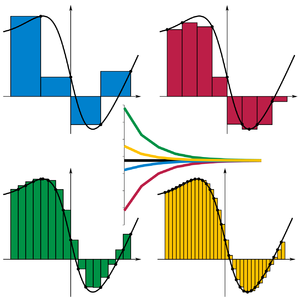
So in the 19th century, a different way of conceiving of integrals was conceived. In calculus, you learn about Riemann sums. Basically, if you divide the area under the curve into vertical boxes, and then calculate the area of each box, that's an approximation of the area under the curve. The more boxes you have, the closer your approximation gets to the actual value, and the limit of those approximations is the area under the curve, as in this picture:
It turns out that using a method similar to this, Thomae's function can be integrated on the interval [0, 1]. The method is called "Darboux Sums."

One question when you use Riemann sums is how to calculate the height of each box. An easy way to do it is to use the leftmost or rightmost edge of the box as the height. As long as you use some method, it actually doesn't really matter what it is -- the approximations will still get better and better -- but Darboux does it a particular way.

Specifically, for Darboux sums you get an upper sum and a lower sum. For the upper sum, you use, as the height of each box, the highest value inside of that box, and for the lower sum, you use the lowest value inside of each box. You then add up the areas of all of the boxes, and that gives you an upper sum and a lower sum for the integral.

What next? Darboux's Criterion for Integrability is a theorem that says that if, given an error amount (epsilon), there is a way to divide up the function (i.e., a placement of the boxes - they don't all have to be the same width) such that the difference between the upper and lower sums is less than epsilon, the function is integrable.

If we apply this method to Thomae's function, no matter how we partition the function, the lower Darboux sum will always be 0, because every interval will contain irrational numbers. Since, if it's integrable, the upper sum has be able to be made arbitrarily close to the lower sum, it's clear that, if we can integrate Thomae's function on [0, 1], the result (the area under the "curve," if you will) must be 0.

And it turns out that we can indeed get the upper sum to be as close as we want to 0 (though never actually 0 - but that is never required in calculus, which deals in limits). I won't go through the proof of that, but it relies on the fact that, basically, if you draw a horizontal line somewhere above 0 in this function, there will only be a finite number of points above that line. Then you can just make the boxes that contain those points skinny enough that their overall area is arbitrarily low, and there you go.

Wednesday, November 11, 2009

Google Images as Visual Dictionary

One of my favorite ways to use Google lately is to look up things I'm unfamiliar with in Google Images. It doesn't work for straight-up words (like "mendacious"), but it works great for things like "hipster" or "umbros" or "engineer boots." You almost immediately find out what the thing is without the annoying mediation of words.

It's like the best visual dictionary of all time.

Friday, November 06, 2009

And Then What?

In a recent Since You Asked column, a woman asks, "How can I detach from my mother without feeling like a horrible person?" Cary counsels:
Cognitive therapy lets us ask, OK, so, What if, indeed, I were to feel like a horrible person? What does that really mean? What would be the end result of that? Would I die? Would I feel intense pain? Would others be harmed? Maybe we have had this voice in our heads, this little voice, saying, You can't do that or you'll feel like a horrible person! If we write these thoughts down, and see them, we see that they are not so accurate. We can ask ourselves, OK, how long would I feel like a horrible person? Would it be momentary? Would it last an hour, or days? And just how horrible a person would I feel like?
I have discovered lately that this general technique - going down the "what if" path rather than treating it as intolerable - works for a lot of fears. Sometimes it is the key to resolving insecurities.

For instance, if I am worried that Ed is mad at me, it can make me very upset. I might then expend mental energy trying to figure out if he is, indeed, angry. Maybe he says he's not, but I think he's lying, or he's angry and doesn't even know it. (A lot of this is hypothetical, but such concerns do come up around some of my other insecurities. For another person, the question might be, "What if he/she is cheating on me?") There's no way to be sure.

I have to stop and say, OK, so he might be angry. What then? Everyone gets angry sometimes. It's not a big deal to have someone angry at you. It's not like he's going to physically attack me. If he yells I'll just wait until he stops, or I can always leave. He probably won't yell anyway. And who is he to be angry? Why do I care? Fuck him if he's mad, I didn't do anything. Whatever.

Sometimes consequences really are pretty catastrophic. What if I have an incurable cancer? The best I can do there is perhaps to consider that I knew I would die of something someday in any case. It's not much comfort. But most fears don't have consequences that are actually that bad. What if I have a panic attack on the airplane? Well, then, I'll feel absolutely horrible for a while, but at some point it will end, and I'll still land on the other side and go on with my life. What if this woman cutting my hair accidentally nicks my ear? Well, it'll hurt a little and then heal.

So I think the key to a lot of those "Oh my god, what if...?" moments is to go ahead and answer the question.

Thursday, November 05, 2009

Fenceless Confusion

Every Monday and Wednesday when I go to my class in the science building, I park in a corner lot, walk up to and then through the North Classroom building, and when I emerge, walk around the gigantic fence that has surrounded the Science building for probably about two years while they've been working on the new building.

Monday night I came out of North Classroom and...what? Was I in the wrong place? Everything looked different.

Oh. The fence was gone. Amazing! Now you can walk right up to the new science building:


Later, when I came out of class, I headed down the sidewalk, and automatically turned left where the fence has a corner, except...there was still no fence, and I was automatically dodging nothing.

So I walked over to the new building instead and looked through the windows. They're not quite done finishing the inside, and it's not open yet (to judge by all the signs direly warning you not to go in), but it looks pretty great. One thing I was happy to see was that at least the classrooms I could look in had tables with simple chairs rather than one-piece desks. I find that type of arrangement far more comfortable.

Hopefully at least one of my three classes next semester will be in there so I get to experience it before I graduate. It's the least I deserve for having to walk around that fence for years.

Wednesday, November 04, 2009

Severely Awesome Response

On this Ask MeFi thread, a woman asks
Sometimes my partner says silly things. I forgive him because, after all, we do all have our faults--and mine is leniency. However, sometimes he makes statements like,

"I'm glad I didn't go; if I had gone, and seen hipsters running amok, I would have cried severely."

He uses 'severely' in that fashion ALL THE TIME. I finally took issue with his grammar, & he said that it can mean "to a great degree, or requiring great effort," in which case I put up with him (severely), but that's hardly a good explanation.

I understand that 'severely' is an adverb modifying 'crying.' I still think he's ENTIRELY INCORRECT. MeFi, help a girl out?

When asked later whether she's objecting to the grammar (e.g., the word order or something) of the statement or the semantics, she clarifies that it's the semantics.

I loved this response by ROU_Xenophobe:
I feel that, semantically, one cannot cry severely.

If it's just a light slang usage of a perfectly cromulent word, sure you can.

I mean, say that he was using "thermonuclear" instead. As in, "I would have cried, thermonuclear" or "You hurt me thermonuclear bad." Clearly, he cannot actually cry thermonuclear because his body could not survive converting matter to energy inside his tear ducts.

Or say that he used "level 10" instead. I would have cried level 10. This also can't be, because crying does not involve discrete levels.

Or say he used "filthy." As in "I would have cried filthy" or "I kill you filthy, Vorga." Obviously you can't cry filthy, unless you consider tears to be filth, which is verging on the pathological.

But in all cases you know what he means. He sounds a bit like... dude... but in most circumstances that's not a big deal. If he can speak proper when he needs to, and if he'll stop if this is causing you actual no-shit consternation, all is well.
I love those examples so hard.

Wavelets

When I looked up my professor for next semester's "Senior Math Seminar" (the 1-hour class I have on Fridays), I saw that he had written a book about wavelets. And apparently that is going to be the topic for our class, and we'll be using his book.

I don't think I've had a textbook written by my actual professor since...well, Rice. And I only know I had one at Rice because of Jason's famous comment (on a course evaluation he happened to be present for) that the lectures were much better than the textbook (which had been written by the professor). And come to think of it, that may have been Sally's class, so I'm not sure I've ever had this particular experience.

Monday, November 02, 2009

Next Semester

I was only going to have two classes (one 3-hour and one 1-hour) next semester, but when I checked the schedule, I saw an opportunity to take Abstract Algebra, which, along with Differential Equations, is one of the most noticeable courses missing from my schooling so far. As of this moment, I am registered for the following classes next semester:

Advanced Calc II (Mon/Wed 7:00-8:15 PM)
This is the continuation of my current class, but unlike my current one, it is 3 hours instead of 4, which will be easier on the schedule.

Abstract Algebra I (Tue/Thu 5:30-6:45 PM)
Yes, once again I will be going to school every day of the week. But wait! There's more!

Senior Mathematics Seminar (Fri 10:00-10:50 AM)
This is a one-hour course required of all math majors. I've looked up past syllabi, and it looks like the professor just picks a topic of some kind and you do projects or something like that. It's convenient that this only meets once, for an hour, and I'm glad it's not on the same day as any of my other classes, but of course it's a bit inconvenient to go to campus in the middle of my morning at work.

Anyway, it should be a fun semester. It's technically 1 less credit hour than I have this semester, despite that I'm taking one more class. We'll see. And, of course, I am supposed to graduate at the end.