Friday, March 16, 2007
A Geek's Story
I continue to read I Blame the Patriarchy despite its excessive anti-patriarchalism (aka too-radical feminism). But this entry "A Geek's Story" is just delightful, and you don't even have to be a feminist to enjoy it. Try it and see!


Thursday, March 08, 2007
Blog Against Sexism Day
According to Amanda Marcotte on Pandagon, today is Blog Against Sexism Day. (It is also International Women's Day.) This is something I feel pretty strongly about, so I'll try to put together a semi-coherent post. Marcotte's is better and I highly recommend it.
One question she asks is
This is a tricky one for me. As a very young child, I already had some feminist instincts, which I can only assume came from my mom. I remember my grandmother telling me, "Act like a little lady," and how much it rankled me. Being anti-feminine, as I have been as long as I can remember, is not identical to being feminist, but the two are related insofar as one agrees that femininity is a social construct to keep women down, or, alternately, a coping mechanism that allows women to survive under patriarchy.
At the same time, there were always giant gaps in my feminist understanding. I remember one time at church (First Unitarian in Houston), I visited the women's group because Houston's mayor (Kathy Whitmire) was giving a speech there. After the speech, a woman from the group cornered me (as I perceived it) and demanded to know whether I was a feminist. I think I probably stammered that I was a humanist. My view of this incident is different now, but I remember complaining to Mosch about it later. I had a resistance - one I think is typical to people my age - to describing myself as a feminist. Didn't it imply valuing women above men? Wouldn't it be wrong to consider oneself a masculinist? etc.
A more important area in which I was wrong was that my sexuality had too strong an emphasis on pleasing men. I believed that being "good in bed" (by which I meant "able to please a man") was important - far more important than getting pleasure myself. (I would have described this differently at the time, probably explaining that giving pleasure to another was how I got off.) Because of this and because I am slightly tricky to bring to orgasm, it took many years for me to learn as much as I now know about my own body.
In general, I had the view that men will not stick around, or will suffer unduly, if they don't have orgasms whenever they want them. I had an early boyfriend who definitely encouraged this view. There were many other ways in which I failed to be adequately selfish in that early relationship, especially sexually.
I remember learning that a friend of mine would, if she got tired of having intercourse (during the act, I mean), actually just stop (say "I'm done" or whatever). That kind of blew my mind at the time - wasn't it your obligation as a decent human being to continue until the guy came? Wasn't the decision to fuck basically a contract?
Well, no. I don't mean to portray myself as a totally selfish jerk - I am actually a pretty generous lover, all things considered - but I have gotten over my early ideas that (a) a man will die or be harmed by not having an orgasm, and, more importantly, that (b) a woman's duty is to be a receptacle for male pleasure. (Of course, I would never have said otherwise, but I think that was the basic idea underlying my attitudes.)
There is lots of stuff at the Pandagon post I linked earlier that is more germane to global feminist aims, so I won't address that here, but just leave this as a report of (some of) my personal experiences. Of course sexuality is not the only area in which I think feminism is important, even on a personal level - but it's one thing.
One question she asks is
When did you become a feminist? Either when you embraced the word or when you realized that sexism is still a problem and that feminism is still necessary?
This is a tricky one for me. As a very young child, I already had some feminist instincts, which I can only assume came from my mom. I remember my grandmother telling me, "Act like a little lady," and how much it rankled me. Being anti-feminine, as I have been as long as I can remember, is not identical to being feminist, but the two are related insofar as one agrees that femininity is a social construct to keep women down, or, alternately, a coping mechanism that allows women to survive under patriarchy.
At the same time, there were always giant gaps in my feminist understanding. I remember one time at church (First Unitarian in Houston), I visited the women's group because Houston's mayor (Kathy Whitmire) was giving a speech there. After the speech, a woman from the group cornered me (as I perceived it) and demanded to know whether I was a feminist. I think I probably stammered that I was a humanist. My view of this incident is different now, but I remember complaining to Mosch about it later. I had a resistance - one I think is typical to people my age - to describing myself as a feminist. Didn't it imply valuing women above men? Wouldn't it be wrong to consider oneself a masculinist? etc.
A more important area in which I was wrong was that my sexuality had too strong an emphasis on pleasing men. I believed that being "good in bed" (by which I meant "able to please a man") was important - far more important than getting pleasure myself. (I would have described this differently at the time, probably explaining that giving pleasure to another was how I got off.) Because of this and because I am slightly tricky to bring to orgasm, it took many years for me to learn as much as I now know about my own body.
In general, I had the view that men will not stick around, or will suffer unduly, if they don't have orgasms whenever they want them. I had an early boyfriend who definitely encouraged this view. There were many other ways in which I failed to be adequately selfish in that early relationship, especially sexually.
I remember learning that a friend of mine would, if she got tired of having intercourse (during the act, I mean), actually just stop (say "I'm done" or whatever). That kind of blew my mind at the time - wasn't it your obligation as a decent human being to continue until the guy came? Wasn't the decision to fuck basically a contract?
Well, no. I don't mean to portray myself as a totally selfish jerk - I am actually a pretty generous lover, all things considered - but I have gotten over my early ideas that (a) a man will die or be harmed by not having an orgasm, and, more importantly, that (b) a woman's duty is to be a receptacle for male pleasure. (Of course, I would never have said otherwise, but I think that was the basic idea underlying my attitudes.)
There is lots of stuff at the Pandagon post I linked earlier that is more germane to global feminist aims, so I won't address that here, but just leave this as a report of (some of) my personal experiences. Of course sexuality is not the only area in which I think feminism is important, even on a personal level - but it's one thing.
Friday, March 02, 2007
Doctor Visit
Today I visited "Dr. Lisa," the family practice physician currently being seen by my entire household. (Sweet, isn't it?) This was my first time to see her, and my first time in about three years to go in for my physical and whatnot. (I did visit the Health Fair last spring and get my bloodwork done.)
As I'd been told beforehand, Dr. Lisa was great - she took plenty of time to ask me lots of questions, and to listen to my concerns. (When I told her my maternal grandmother died of ovarian cancer, after telling her my dad and his parents all have Type II diabetes - from which my dad died last year at the age of 53 - she said, "You have a sucky family history!" Heh.)
Her other comment, later, was, "Boy, you really do not like to have your cervix touched." This is very true, but I survived, as usual.
[Note: Anyone with blood phobias - hello, Sally - should stop reading now. I'm inserting a pleasing graphic to ensure total isolation.]
When she was done with me, she sent me to get my blood drawn by one of her assistants. I used to have a lot of trouble getting blood drawn, but lately I've been fine. I basically got over my blood-draw phobia by donating blood a few times. This had the negative effect of making some of my veins no good, but I also got much calmer about having blood taken. The last time I got tested for stuff - at the Health Fair - I had no trouble at all.
As I'd been told beforehand, Dr. Lisa was great - she took plenty of time to ask me lots of questions, and to listen to my concerns. (When I told her my maternal grandmother died of ovarian cancer, after telling her my dad and his parents all have Type II diabetes - from which my dad died last year at the age of 53 - she said, "You have a sucky family history!" Heh.)
Her other comment, later, was, "Boy, you really do not like to have your cervix touched." This is very true, but I survived, as usual.
[Note: Anyone with blood phobias - hello, Sally - should stop reading now. I'm inserting a pleasing graphic to ensure total isolation.]

When she was done with me, she sent me to get my blood drawn by one of her assistants. I used to have a lot of trouble getting blood drawn, but lately I've been fine. I basically got over my blood-draw phobia by donating blood a few times. This had the negative effect of making some of my veins no good, but I also got much calmer about having blood taken. The last time I got tested for stuff - at the Health Fair - I had no trouble at all.
Unfortunately, today was difficult. The first time the woman stuck me, it didn't hurt at all. The bad news was that it also did not pierce a vein at all. She worked in that area for a while, with increasing amounts of pain, but got nowhere, and gave up to find a different spot (nearby, as it turned out). The second attempt was very painful but successful.
I didn't like how it felt, but I was fine - after all, I am a trooper about this stuff now. I told her how they sometimes have to take it from the back of my hand, and how one person once took it from my wrist. (They use tiny needles for this and it takes forever.) I told her how the next person, after the wrist person, said, "Don't ever let them take it from your wrist! Have them do the back of your hand!"
Then I said, "We have to stop talking about this," because I was starting to feel faint. She started asking me questions about where I work, and I was answering for a bit, but then I just started feeling worse and worse and couldn't answer. I tried desperately to think of other things. Blood was rushing in my ears and I leaned over to put my head on my hand. She called in another nurse who put a cold compress on my forehead. I just felt worse and worse until I felt I could not take much more.
Eventually I managed to mutter, "Are you almost done?" and the other woman who had come in said, "She's already done, honey," and I said, "...oh, I didn't know she was done..." and she said, "That's because you were out." Oh.
I could have sworn the needle was still in, but sure enough it was gone, a band-aid was there, and the rubber-bandy tourniquet was also off my arm. After a minute, they walked me very cautiously to an exam room where I lay on a table for a few minutes and drank some Hi-C before gradually sitting up and being allowed to leave (with an admonition to eat something on the way to work; I'd been fasting for the blood tests, though I didn't feel hungry at all, even before passing out).
They made a note on my chart and will have me lie down in the future. I know this isn't uncommon but I was surprised that it happened to me, especially since lately I have not been phobic about this at all. I am also surprised how terrible it feels to pass out.
Thursday, March 01, 2007
More on Self-Efficacy and Praising Kids
(Update: Sally over at Empirical Question has a great, longer commentary on this article.)
Via Uncertain Principles, I discovered this New York Magazine article ("How Not to Talk to Your Kids" by Po Bronson, 2/19/07) about exactly what I was writing about the other day - praising kids for their efforts versus their intelligence.
The article is about a study by Carol Dweck and others from Columbia University, where they took a group of fifth graders and gave them an easy puzzle task (easy enough that everyone would do pretty well). After the test, each child was praised either for their smarts or for their effort, with a one-line remark. Being praised for smarts vs. effort had a variety of surprising negative effects on subsequent performance in the experiment. (Read the whole article if this is up your alley; it's pretty interesting.)
This type of research feels very meaningful to me, because I grew up as a smart kid who almost never worked hard at anything. ("Grew up as?" Try "still am.") I have, or used to have, a seemingly instinctive feeling of slight contempt for people who work hard, especially in an academic setting. (As the article says, "Expending effort becomes stigmatized—it’s public proof that you can’t cut it on your natural gifts.") Every bad effect described in that article (giving up on difficult tasks too soon; feeling unreasonably insecure about my abilities; unwillingness to work hard at something) is one I have observed in myself.
Contempt for effort is a really wrong value to hold. From a kind of touchy-feely moral perspective, people can't control their innate talents, while they can control how hard they work, so working hard is morally preferable to being talented. And, more importantly, working hard is what determines your results relative to your talent, and to some extent regardless of your talent. And out here in the "real world", almost anyone would (rightly) prefer to work with a diligent person of ordinary talents than with a lazy smarty-pants.
Via Uncertain Principles, I discovered this New York Magazine article ("How Not to Talk to Your Kids" by Po Bronson, 2/19/07) about exactly what I was writing about the other day - praising kids for their efforts versus their intelligence.
The article is about a study by Carol Dweck and others from Columbia University, where they took a group of fifth graders and gave them an easy puzzle task (easy enough that everyone would do pretty well). After the test, each child was praised either for their smarts or for their effort, with a one-line remark. Being praised for smarts vs. effort had a variety of surprising negative effects on subsequent performance in the experiment. (Read the whole article if this is up your alley; it's pretty interesting.)
This type of research feels very meaningful to me, because I grew up as a smart kid who almost never worked hard at anything. ("Grew up as?" Try "still am.") I have, or used to have, a seemingly instinctive feeling of slight contempt for people who work hard, especially in an academic setting. (As the article says, "Expending effort becomes stigmatized—it’s public proof that you can’t cut it on your natural gifts.") Every bad effect described in that article (giving up on difficult tasks too soon; feeling unreasonably insecure about my abilities; unwillingness to work hard at something) is one I have observed in myself.
Contempt for effort is a really wrong value to hold. From a kind of touchy-feely moral perspective, people can't control their innate talents, while they can control how hard they work, so working hard is morally preferable to being talented. And, more importantly, working hard is what determines your results relative to your talent, and to some extent regardless of your talent. And out here in the "real world", almost anyone would (rightly) prefer to work with a diligent person of ordinary talents than with a lazy smarty-pants.
Wednesday, February 28, 2007
Snowing Up
I would like to report that, right now, outside my office window and for as far as the eye can see (which isn't too far), it is snowing UP. I take it this means that the snow that has accumulated on the ground will fly away to Kansas or somewhere. Bonus!
Tuesday, February 27, 2007
Finished My Round-Trip Project
My project for my software engineering class for the past five days was to use three technologies (Apache, PHP, and MySQL) to make a webpage that would take data from a form, store it in a database, and another webpage that would read it from the database and display it. This "round trip" is a part of the technical backbone for our group project.
I worked hard on this all weekend, got most of it done by Sunday night, and finished up the rest last night. It took me a lot of work and many parts of it were pretty fiddly, so I feel like a super stud for getting it to work.
Since the purpose of my work was to make this process faster and easier for the rest of the group (which consists of the entire class; there are only 5 of us), I also wrote up a 9-page document with installation instructions, tips, the code that I used, and screenshots of the web pages. I'll bring copies of that to class tonight.
I worked hard on this all weekend, got most of it done by Sunday night, and finished up the rest last night. It took me a lot of work and many parts of it were pretty fiddly, so I feel like a super stud for getting it to work.
Since the purpose of my work was to make this process faster and easier for the rest of the group (which consists of the entire class; there are only 5 of us), I also wrote up a 9-page document with installation instructions, tips, the code that I used, and screenshots of the web pages. I'll bring copies of that to class tonight.
A Cure for Nearsightedness?
Today's Medical Examiner in Slate is partly about a potential cure or treatment to keep nearsightedness from progressing in children. It was a strange read for me, because the cure sounds so much worse than the disease. Apparently by putting eye-dilation drops in your children's eyes every night, which forces them to wear glasses that change color in light (so their eyes aren't damaged by being dilated) and possibly to wear bifocals for reading (since you can't focus close-up when your eyes are dilated), you can keep their nearsightedness from progressing.
I started needing glasses when I was around 7, and I hated them at first, and my eyes got rapidly worse in those first few years, and continued to get worse for a while after that. I have to wear glasses to do pretty much anything (even read a book). But I think I would have hated nightly eyedrops and wearing light-sensitive bifocals for years way more than I hated just wearing glasses.
In fact, if you told me right now that by doing that for five years, I could have perfect vision restored to me, I wouldn't take the deal. And I'm an adult.
I wore contacts for a while in high school. I was so happy to not have to wear glasses - mainly for reasons of vanity. At some point I got a little eye infection and had to wear my glasses again for a while, and it made me realize how wonderfully convenient and easy glasses are compared to something you wear on your eye. (Sorry, Sally!) Truly they are just not a big deal.
I know some people have really terrible eyesight, and maybe the results of this research can become something useful, but for now, it doesn't sound like a useful finding to me (even assuming it is confirmed in subsequent research). I feel so strongly about it that I'm not even sure about the ethics of carrying out the research. What am I missing?
I started needing glasses when I was around 7, and I hated them at first, and my eyes got rapidly worse in those first few years, and continued to get worse for a while after that. I have to wear glasses to do pretty much anything (even read a book). But I think I would have hated nightly eyedrops and wearing light-sensitive bifocals for years way more than I hated just wearing glasses.
In fact, if you told me right now that by doing that for five years, I could have perfect vision restored to me, I wouldn't take the deal. And I'm an adult.
I wore contacts for a while in high school. I was so happy to not have to wear glasses - mainly for reasons of vanity. At some point I got a little eye infection and had to wear my glasses again for a while, and it made me realize how wonderfully convenient and easy glasses are compared to something you wear on your eye. (Sorry, Sally!) Truly they are just not a big deal.
I know some people have really terrible eyesight, and maybe the results of this research can become something useful, but for now, it doesn't sound like a useful finding to me (even assuming it is confirmed in subsequent research). I feel so strongly about it that I'm not even sure about the ethics of carrying out the research. What am I missing?
Monday, February 26, 2007
"Fourthmeal"?
I have visited Taco Bell a couple of times lately (which is unusual for me) and both times noticed prominent advertisements for "Fourthmeal," Taco Bell's name for a meal that putatively exists between dinner and breakfast. (In other words, that meal that teenagers and adults-who-live-like-teenagers get late at night from Taco Bell.)
I happen to think this is a potentially brilliant marketing concept. If you can legitimize late-night snacking as a meal, and eventually convince people that they have to eat this new fake meal every day, it could work.
But "Fourthmeal"? I can't think of any name less likely to stick or become widely used. Couldn't they get someone to come up with a catchy name that they could promote the hell out of?
(By the way, if you go to the Fourthmeal site linked above, you will have to choose your gender in order to enter. Is that creepy to anyone besides me?)
I happen to think this is a potentially brilliant marketing concept. If you can legitimize late-night snacking as a meal, and eventually convince people that they have to eat this new fake meal every day, it could work.
But "Fourthmeal"? I can't think of any name less likely to stick or become widely used. Couldn't they get someone to come up with a catchy name that they could promote the hell out of?
(By the way, if you go to the Fourthmeal site linked above, you will have to choose your gender in order to enter. Is that creepy to anyone besides me?)
Friday, February 23, 2007
Software Project
My Software Engineering Principles class has so far been rather like a seminar. There are only five students, and typically we just meet, and everyone should have read up on the topic we're going to discuss, and then we discuss the topic and what we've read. Sometimes we have to write a little reflection or some "nuggets" (pithy statements on a topic), but pretty much it's just been reading & talking. I like it!
But, since the follow-up class to this (Software Engineering Practices, my "senior experience" course) is all about working on a big software project, we're going to have a miniature software project for this class, and we started on that Tuesday.
Dr. Paul's idea, which nobody vetoed, is that we should write a requirements management tool. (Requirements are very precise statements about what a piece of software is meant to do and not do. They essentially form the contract between developers and customers/clients. Requirement engineering is what you do before you start working on design or actual coding, in theory.) The most commonly used requirements management tool is probably, alas, Microsoft Word.
I am not one of those anti-MS people, but the problem with keeping requirements in Word (or any word processing software) is that it limits them to being a flat document. What you really want is for requirements to be "live", to facilitate tracking changes over time, to allow for dependency relationships between different requirement statements, and to be able to link requirements to specific parts of the design and the actual code. And of course you also want to be able to produce them as a document.
What Dr. Paul would like is for our application to be open source, web-based, and backed by a database, and for it to support the Volere shell and template. (Volere is basically a style of requirements - sort like how APA or MLA are styles for writing papers.) He suggested (though this is up to us, ultimately) that we could use CSS (cascading style sheets, into which you feed HTML files that it then formats in a consistent way, so that you can take the same HTML pages and show them different ways), PHP (a scripting language that generates HTML pages), and mySQL (an open source database) to solve our technology needs.
Of course, in our first meeting on this (the day he told us about it), we all started jumping in talking about coding the thing, and he sort of interrupted us to say, essentially, "Uh, how about using proper software engineering practices since that's what this class is about, dummies." So we discussed our software lifecycle model (settling on a risk-based iterative model, for now), and started working on requirements. (Too bad we don't have a web-based, open source requirements management tool! Oh yeah.)
So as of this moment we have a pretty good list of proto-requirements. Near the end of class last night we discussed deliverables for Tuesday, so that everyone would have something to work on. Warren is going to get our proto-requirements partly into the Volere template (which has the dual purpose of making our requirements nicer while increasing familiarity with the Volere template) and think about a database schema. Nobody else volunteered for a specific responsibility (despite the suggestion from Dr. Paul that we do so) besides me.
My job is to download PHP, mySQL, set up an Apache server on my own machine, and figure out how basically to make the round trip from a web page where you enter something, to a database, and back out to a display page. I should have this done by Tuesday and be ready to show the class the code and process for how this is done.
(What I mean by "make the round trip" is to code up a page that has blanks where you type stuff in, and then it takes the typed in stuff and stores it in the database, and then you can go to another page to see what is in the database.)
I've never worked with PHP or mySQL before, or really done any web-based stuff at all, so this should be a fun challenge to put together by Tuesday.
But, since the follow-up class to this (Software Engineering Practices, my "senior experience" course) is all about working on a big software project, we're going to have a miniature software project for this class, and we started on that Tuesday.
Dr. Paul's idea, which nobody vetoed, is that we should write a requirements management tool. (Requirements are very precise statements about what a piece of software is meant to do and not do. They essentially form the contract between developers and customers/clients. Requirement engineering is what you do before you start working on design or actual coding, in theory.) The most commonly used requirements management tool is probably, alas, Microsoft Word.
I am not one of those anti-MS people, but the problem with keeping requirements in Word (or any word processing software) is that it limits them to being a flat document. What you really want is for requirements to be "live", to facilitate tracking changes over time, to allow for dependency relationships between different requirement statements, and to be able to link requirements to specific parts of the design and the actual code. And of course you also want to be able to produce them as a document.
What Dr. Paul would like is for our application to be open source, web-based, and backed by a database, and for it to support the Volere shell and template. (Volere is basically a style of requirements - sort like how APA or MLA are styles for writing papers.) He suggested (though this is up to us, ultimately) that we could use CSS (cascading style sheets, into which you feed HTML files that it then formats in a consistent way, so that you can take the same HTML pages and show them different ways), PHP (a scripting language that generates HTML pages), and mySQL (an open source database) to solve our technology needs.
Of course, in our first meeting on this (the day he told us about it), we all started jumping in talking about coding the thing, and he sort of interrupted us to say, essentially, "Uh, how about using proper software engineering practices since that's what this class is about, dummies." So we discussed our software lifecycle model (settling on a risk-based iterative model, for now), and started working on requirements. (Too bad we don't have a web-based, open source requirements management tool! Oh yeah.)
So as of this moment we have a pretty good list of proto-requirements. Near the end of class last night we discussed deliverables for Tuesday, so that everyone would have something to work on. Warren is going to get our proto-requirements partly into the Volere template (which has the dual purpose of making our requirements nicer while increasing familiarity with the Volere template) and think about a database schema. Nobody else volunteered for a specific responsibility (despite the suggestion from Dr. Paul that we do so) besides me.
My job is to download PHP, mySQL, set up an Apache server on my own machine, and figure out how basically to make the round trip from a web page where you enter something, to a database, and back out to a display page. I should have this done by Tuesday and be ready to show the class the code and process for how this is done.
(What I mean by "make the round trip" is to code up a page that has blanks where you type stuff in, and then it takes the typed in stuff and stores it in the database, and then you can go to another page to see what is in the database.)
I've never worked with PHP or mySQL before, or really done any web-based stuff at all, so this should be a fun challenge to put together by Tuesday.
Another Way to Increase Self-Efficacy
...is to be forced to change your car tire on the way to work at 8 AM.
I can't recommend it, though. Phew.
I can't recommend it, though. Phew.
Thursday, February 22, 2007
Exercise and Self-Efficacy
 At home I have a book (A Kind and Just Parent, by William Ayers) in which the author (who taught teen boys in juvenile detention) explains why he encourages them to lift weights, even during school time. He says that by working out with weights, the boys are able to apply effort and see results - and learn, hopefully, that they can change themselves by trying. (At least, that's my vague memory from reading the book a few years ago.)
I often say that exercising, and especially weight-lifting, makes me feel "like a stud." What I really mean is that it increases my self-efficacy. Self-efficacy isn't my own invented concept, and you can read about it elsewhere, but what follows is my own take on it, which is not necessarily quite correctly in line with the original idea.
Self-efficacy is the belief that you can succeed at something through effort. I believe I could get a PhD in mathematics if I tried hard enough, but I don't believe I could ever be good at basketball - I have high self-efficacy in one area and low self-efficacy in the other (regardless of whether I'm correct in my judgments). But what I'm more interested in is self-efficacy in general - to what extent do I believe my results are influenced by my efforts, versus by factors beyond my control?
It seems to me from what I've read [note: this is a hedge to avoid providing references] that instilling self-efficacy (the idea that you can succeed through effort) in your children is much more important than instilling self-esteem (the belief that you're an OK person deep inside). In education, you can reinforce this by telling a kid who's done well on a math test, "You've been working really hard on that, I can tell," rather than, "Wow, you're really good at math." Ideally you would also put your child into situations where their effort really does determine their outcomes - not in situations where they will succeed (or fail) no matter what.
Anyway, I feel like I do increase my own self-efficacy when I exercise, and I bet this is true for most people, at least if they start with some activity they can make a good go at, because typically you make a lot of progress in the beginning of a new activity (especially if you're out of shape to begin with), and it really builds confidence.
I try to control my eating, but even if I have (momentarily) given up on that, and I get into a regular pattern of exercising, I suddenly get the feeling that I can fix my eating habits too, and then I start eating properly. In any given week, there is a high correlation between my exercise and eating habits, and I don't think it's just that I have "more will power" some weeks than others (though this might be true in some way). I really think exercise drives the whole thing for me.
Because it makes me feel like a stud.
Wednesday, February 21, 2007
What Is a Geometry?
That was the question answered in my Geometry class last night. Here, for your entertainment, I will produce a (non-rigorous) version of the answer.
Let's start with the idea that geometry is about congruence - which figures are congruent to each other? In Euclidean geometry, as I said yesterday, figures are congruent if you can make them line up by rotating them, moving them around, or flipping them over.
So basically, a geometry is a set (in our class so far, typically this is the complex plane - which is basically just a flat 2-dimensional space that extends infinitely) plus rules about what figures are congruent.
What types of rules pass as a geometry? Well, the basic thing is that congruence is an "equivalence relation," which means it has to satisfy these criteria:
These properties, which define an equivalence relation, are also true for common ideas like "equals" or "makes the same amount of money as" or "lives in the same city as" - basically, stuff that seems like it's related to things being equal. They aren't necessarily true for other types of relations, like "likes" (Sally likes me, and I liked David, but Sally didn't like David - liking is not transitive - and actually it's not reflexive or symmetric either) or "is bigger than" (which is transitive, but anti-symmetric and anti-reflexive).
 So, getting a bit more formal, a geometry is a set (such as the complex plane) plus a group of allowable functions on the set, where the group of allowable functions forms an equivalence relation. Since we're doing this with algebra, not by picking up pieces of paper and moving them around ala Euclid, this can be set out rigorously with...well, math. Here are some types of transformations, or functions on the complex plane:
So the next part of class was investigating some combinations of these to see if they could constitute a geometry.
For instance, if your only function is reflection across the x-axis, this is not a geometry. Why? Because under that system, a figure is not congruent to itself. (It's only congruent to its reflection.)
But if you add the identity function, so that you have the identity function plus reflection across the x-axis, you have a geometry! You can formally test the properties of an equivalence relation in this case like this:
Another geometry could include only translations. Does this satisfy?
A less mathy way of saying this is to remember that translation means moving things around without rotating or flipping them. Is a figure congruent to itself? Sure - you just move it around not at all. If you can move one figure onto another, then you can surely move the other onto it instead, so it's symmetric. And if you can move figure A onto figure B, and figure B onto figure C, then you could move A onto C by just moving it onto B first, then following B's path to C, so it's transitive.
Note that all of these different geometries have different rules about, essentially, which types of figures are congruent to each other. Fun and games! (Did anyone actually finish this post?)
Let's start with the idea that geometry is about congruence - which figures are congruent to each other? In Euclidean geometry, as I said yesterday, figures are congruent if you can make them line up by rotating them, moving them around, or flipping them over.
So basically, a geometry is a set (in our class so far, typically this is the complex plane - which is basically just a flat 2-dimensional space that extends infinitely) plus rules about what figures are congruent.
What types of rules pass as a geometry? Well, the basic thing is that congruence is an "equivalence relation," which means it has to satisfy these criteria:
- A figure is always congruent to itself. [reflexivity]
- If figure A is congruent to figure B, then B is congruent to A. [symmetry]
- if figure A is congruent to figure B, and B is congruent to figure C, then A is congruent to C. [transitivity]
These properties, which define an equivalence relation, are also true for common ideas like "equals" or "makes the same amount of money as" or "lives in the same city as" - basically, stuff that seems like it's related to things being equal. They aren't necessarily true for other types of relations, like "likes" (Sally likes me, and I liked David, but Sally didn't like David - liking is not transitive - and actually it's not reflexive or symmetric either) or "is bigger than" (which is transitive, but anti-symmetric and anti-reflexive).
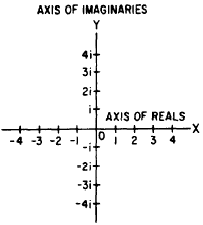 So, getting a bit more formal, a geometry is a set (such as the complex plane) plus a group of allowable functions on the set, where the group of allowable functions forms an equivalence relation. Since we're doing this with algebra, not by picking up pieces of paper and moving them around ala Euclid, this can be set out rigorously with...well, math. Here are some types of transformations, or functions on the complex plane:
- Rotation - You can rotate around the origin (0) or around some other point.
- Translation - This means moving the plane side to side, up and down, or diagonally, without rotating it.
- Reflection - This means making the figure into a mirror image of itself across some line, such as the x-axis, or y-axis, or anywhere else you want.
- The identify function - this just maps each point to itself. It doesn't change anything.
So the next part of class was investigating some combinations of these to see if they could constitute a geometry.
For instance, if your only function is reflection across the x-axis, this is not a geometry. Why? Because under that system, a figure is not congruent to itself. (It's only congruent to its reflection.)
But if you add the identity function, so that you have the identity function plus reflection across the x-axis, you have a geometry! You can formally test the properties of an equivalence relation in this case like this:
- Reflexivity - the identify function must be included
- Symmetry - if a function f is included, it must have an inverse, and the inverse must be included.
- Transitivity - if functions f and g are included, the composition of f and g - that is f(g()) - must be included.
Another geometry could include only translations. Does this satisfy?
- Reflexivity: f(z) = z + 0 is a translation and is also the identity function. So that's good.
- Symmetry: if f(z) = z + w is a translation, then f(z) = z - w is its inverse, and is also a translation. Check!
- Transitivity: if f(z) = z + a and g(z) = z + b are translations, then f(g(z))) = z + (b + a) and that's also a translation.
A less mathy way of saying this is to remember that translation means moving things around without rotating or flipping them. Is a figure congruent to itself? Sure - you just move it around not at all. If you can move one figure onto another, then you can surely move the other onto it instead, so it's symmetric. And if you can move figure A onto figure B, and figure B onto figure C, then you could move A onto C by just moving it onto B first, then following B's path to C, so it's transitive.
Note that all of these different geometries have different rules about, essentially, which types of figures are congruent to each other. Fun and games! (Did anyone actually finish this post?)
Tuesday, February 20, 2007
"From Scratch"
Today for lunch, I am eating a Stouffer's frozen dinner - Tuna Noodle Casserole, to be exact. I normally try not to buy frozen meals that do not contain a vegetable, but I suppose the mushrooms and pieces of celery shown on the box momentarily lured me. Also they were on sale.
The back of the box advertises a "Tasty Fact", to wit:
I think this might be one of the funnier things I have ever seen on a frozen food box, and if you eat a lot of frozen food, you know it is a pretty rich genre.
What exactly does it mean for a giant corporate food conglomerate to make pasta "from scratch"? Is there a Stouffer's factory somewhere filled with Italian grandmas rolling out noodles based on a timeless tradition? Or do they just mean that they (Stouffer's, or a wholly owned Stouffer's subsidiary) actually manufacture the pasta used in their frozen foods? And how would this be different, exactly, from buying pasta manufactured by another giant corporate food conglomerate?
Next they'll be telling me the tuna was "fresh caught."
The back of the box advertises a "Tasty Fact", to wit:
At Stouffer's, we feel that making pasta from scratch is worth the extra effort.
I think this might be one of the funnier things I have ever seen on a frozen food box, and if you eat a lot of frozen food, you know it is a pretty rich genre.
What exactly does it mean for a giant corporate food conglomerate to make pasta "from scratch"? Is there a Stouffer's factory somewhere filled with Italian grandmas rolling out noodles based on a timeless tradition? Or do they just mean that they (Stouffer's, or a wholly owned Stouffer's subsidiary) actually manufacture the pasta used in their frozen foods? And how would this be different, exactly, from buying pasta manufactured by another giant corporate food conglomerate?
Next they'll be telling me the tuna was "fresh caught."
Sally's New Blog
If you get tired of checking this blog and having it be empty all the time, or if you just like Sally (!) and want to know what she's up to, please go check out her fabulous new blog, Empirical Question.
A Little Math
One of my courses this semester is Foundations of Geometry, which sounds like it would be easy, but so far has been pretty interesting, and has forced me to be more algebraically clever than usual. (Algebra, in a geometry class? Say it isn't so!)
When you have geometry in high school, it's usually Euclidean geometry, in two senses. The most important way in which it's Euclidean (in my view) is that it uses axioms and proofs to develop geometric ideas. Euclid totally invented this approach to math. Some people (like me) love this and other people (like Mosch) think it's a big waste of time. The secondary sense in which it's Euclidean is that it uses the specific axioms of Euclid. If you change one of Euclid's axioms (the parallel postulate), you can get some different interesting results.
My class is currently proceeding down two lines of work - some straight-up Euclidean stuff, usually presented as puzzles at the beginning of every class period, which we solve and then do some proofs about, and then "analytic" geometry.
Analytic geometry is where you say, "Why is Geometry the only part of math where we're still doing this weird Euclid-type stuff? Let's do everything with algebra and calculus instead!" And so it goes. Our textbook (a slender volume called "Modern Geometries: Non-Euclidean, Projective, and Discrete," by Michael Henle) uses this approach.
In analytic geometry, at least as presented in this course, you represent 2D shapes as coordinates in the complex plane. (This is basically like the regular cartesian plane where you have x, y coordinates, except that in this case the y axis represents the imaginary part of a complex number, so every point in the complex plane is actually just one number of the form x + iy.) Then you use regular math to prove stuff about them.
For instance, one thing you do a lot of in geometry is prove that things are congruent. "Congruent" basically means they are the same size and shape. Euclid's version of congruence is that two shapes are congruent if you can pick one up and lay it on the other and everything lines up. This makes sense, right? If you have two triangles on two pieces of paper, you can literally pick up one sheet, put it over the other, rotate it and move it around, and see if the triangles are the same or different.
In analytic geometry, you prove two things are congruent by proving that there is a one-to-one function (of an allowable type, like a rotation) that takes the set of points contained in one shape and transforms them to the set of points contained in the other shape. This is basically the same thing as what Euclid did, except that it's all algebra instead of being a physical maneuver.
These functions that change one set of points to another set of points are called "transformations" and the ones that Euclid would allow are basically rotation (where you turn something around), reflection (turning the piece of paper upside down, if you had the shapes on paper), and translation, which just means moving things up or down, side to side, or diagonally. If you think about how you'd line up shapes on two pieces of paper, those are the basic moves - you rotate the paper, flip it over, move it around, or some combination of those things. If you can change one shape into another by those types of maneuvers, then the two shapes are congruent.
So...that's about as far into analytic geometry as my class has gotten at this point. I could say more about it, but it would go into weirder math, so I'll refrain :-)
When you have geometry in high school, it's usually Euclidean geometry, in two senses. The most important way in which it's Euclidean (in my view) is that it uses axioms and proofs to develop geometric ideas. Euclid totally invented this approach to math. Some people (like me) love this and other people (like Mosch) think it's a big waste of time. The secondary sense in which it's Euclidean is that it uses the specific axioms of Euclid. If you change one of Euclid's axioms (the parallel postulate), you can get some different interesting results.
My class is currently proceeding down two lines of work - some straight-up Euclidean stuff, usually presented as puzzles at the beginning of every class period, which we solve and then do some proofs about, and then "analytic" geometry.
Analytic geometry is where you say, "Why is Geometry the only part of math where we're still doing this weird Euclid-type stuff? Let's do everything with algebra and calculus instead!" And so it goes. Our textbook (a slender volume called "Modern Geometries: Non-Euclidean, Projective, and Discrete," by Michael Henle) uses this approach.
In analytic geometry, at least as presented in this course, you represent 2D shapes as coordinates in the complex plane. (This is basically like the regular cartesian plane where you have x, y coordinates, except that in this case the y axis represents the imaginary part of a complex number, so every point in the complex plane is actually just one number of the form x + iy.) Then you use regular math to prove stuff about them.
For instance, one thing you do a lot of in geometry is prove that things are congruent. "Congruent" basically means they are the same size and shape. Euclid's version of congruence is that two shapes are congruent if you can pick one up and lay it on the other and everything lines up. This makes sense, right? If you have two triangles on two pieces of paper, you can literally pick up one sheet, put it over the other, rotate it and move it around, and see if the triangles are the same or different.
In analytic geometry, you prove two things are congruent by proving that there is a one-to-one function (of an allowable type, like a rotation) that takes the set of points contained in one shape and transforms them to the set of points contained in the other shape. This is basically the same thing as what Euclid did, except that it's all algebra instead of being a physical maneuver.
These functions that change one set of points to another set of points are called "transformations" and the ones that Euclid would allow are basically rotation (where you turn something around), reflection (turning the piece of paper upside down, if you had the shapes on paper), and translation, which just means moving things up or down, side to side, or diagonally. If you think about how you'd line up shapes on two pieces of paper, those are the basic moves - you rotate the paper, flip it over, move it around, or some combination of those things. If you can change one shape into another by those types of maneuvers, then the two shapes are congruent.
So...that's about as far into analytic geometry as my class has gotten at this point. I could say more about it, but it would go into weirder math, so I'll refrain :-)
Sunday, January 07, 2007
The Strokes
I remember seeing an article in Slate - or maybe Salon - asking whether The Strokes were as good as people said. I had never heard of them at the time, so I just skimmed the article, but it made me curious about them. (I'm always curious about things if I find some commentary on them.)
A few months later, three Strokes songs showed up on one of Sally's KSAL collections. I totally loved them.
The Strokes are like crack cocaine to me. There is some cockamamie idea about how music makes some primitive part of your brain respond in a similar rhythm (I'm not going to provide a link because I doubt this is true), and I feel like their songs do that to me.
The pattern seems super simple - every song seems to alternate some heavier guitar-rhythm parts with some more melodic parts, with vaguely jerk-ass lyrics that are interesting enough not to annoy you, but not so interesting as to actually engage you. It drives me up the wall - in a good way, of course.
Here is a video:
A few months later, three Strokes songs showed up on one of Sally's KSAL collections. I totally loved them.
The Strokes are like crack cocaine to me. There is some cockamamie idea about how music makes some primitive part of your brain respond in a similar rhythm (I'm not going to provide a link because I doubt this is true), and I feel like their songs do that to me.
The pattern seems super simple - every song seems to alternate some heavier guitar-rhythm parts with some more melodic parts, with vaguely jerk-ass lyrics that are interesting enough not to annoy you, but not so interesting as to actually engage you. It drives me up the wall - in a good way, of course.
Here is a video:
Thursday, January 04, 2007
1994 Political Quiz
I took this 1994 Political Quiz linked by Andrew Sullivan. I thought it was pretty fun, though some of the questions seemed slightly dated (but only slightly). I scored an 18 out of 40, which means I fall just on the liberal side. On the chart of public figures, I fell right between Bill Clinton and Colin Powell. (Keep in mind the quiz is from 1994.)
Saturday, December 30, 2006
Stuck in Dallas
This post comes to you live (um) from Dallas, where I am officially stuck. I'm here at the public library, with16 minutes remaining on my Internet session. I guess I better type fast :-)
The plan for this week was that Mosch and I would drive to Dallas on Saturday (done), I'd drive to Houston on Sunday (done) and spend the week with my mom and the dogs (done), drive back to Dallas on Friday (done), and Mosch, Terpsichore, and I would drive back to Denver starting today (not done).
Terpsichore, Mosch's girlfriend, is moving to Denver, so Mosch's plan for the week was to pack up her apartment and get ready for us to leave this morning. At this point I personally doubt we'll be ready to leave even tomorrow morning, and I should probably be at the apartment helping to make sure that happens, but I pretty much am just not willing to do it. I think I'm leaving in the morning whatever happens, so...we'll see if anyone is in the car with me or not. (In the plan, Mosch drives the U-Haul, towing Terpsi's car, and Terpsi and her cat Cybele ride with me.)
I'll post more later when my clock resets. 13 minutes to go!
The plan for this week was that Mosch and I would drive to Dallas on Saturday (done), I'd drive to Houston on Sunday (done) and spend the week with my mom and the dogs (done), drive back to Dallas on Friday (done), and Mosch, Terpsichore, and I would drive back to Denver starting today (not done).
Terpsichore, Mosch's girlfriend, is moving to Denver, so Mosch's plan for the week was to pack up her apartment and get ready for us to leave this morning. At this point I personally doubt we'll be ready to leave even tomorrow morning, and I should probably be at the apartment helping to make sure that happens, but I pretty much am just not willing to do it. I think I'm leaving in the morning whatever happens, so...we'll see if anyone is in the car with me or not. (In the plan, Mosch drives the U-Haul, towing Terpsi's car, and Terpsi and her cat Cybele ride with me.)
I'll post more later when my clock resets. 13 minutes to go!
Thursday, December 07, 2006
End of Semester To-Do
This is the list of what I still have to do for the rest of the semester. I'm dividing it by due date.
For Monday
Finish the 3 (short) sections of Proofs homework assigned last week.
Finish up the last homework, which was returned pending the final, so that it's complete when I turn in it - I have to complete one short additional section for that.
Write a 4-5 page "axiomatic development" paper on hyperbolic geometry.
Study for the final exam.
For Wednesday
Complete as many sections of homework as I can manage, but at least 4-5 so I don't have to do extremely well on the final to get an A. (I am about 10 sections behind in total.)
Study for the final exam.
See, that's all ;-)
For Monday
Finish the 3 (short) sections of Proofs homework assigned last week.
Finish up the last homework, which was returned pending the final, so that it's complete when I turn in it - I have to complete one short additional section for that.
Write a 4-5 page "axiomatic development" paper on hyperbolic geometry.
Study for the final exam.
For Wednesday
Complete as many sections of homework as I can manage, but at least 4-5 so I don't have to do extremely well on the final to get an A. (I am about 10 sections behind in total.)
Study for the final exam.
See, that's all ;-)
Wednesday, December 06, 2006
Successful and Exhausting Campus Trip
I went to campus today at lunchtime to accomplish various tasks related to graduating, passing classes, etc., and I managed to miraculously accomplish all of them. I drove to campus and got 12-hour parking for $5, and then walked over to the library.
I went there last night to try to get some books on hyperbolic geometry (the topic for my Proofs paper due Monday) and I found two good books (both slim - whew) and went to check them out, figuring I could pay my years-old fine at the circulation desk. But no. My fine is in collections and I had to pay it at the admin office, which was already closed.
So that was my first stop today, and I found the admin office (in a far-flung corner of the extremely large library we have; I never realized how huge it is before) and waited a few minutes until the fine guy showed up so I could pay the money I owed. Then I got my two books from where they were held from me and checked them out. Score!
Next I went to the Math Department office, where they were holding my signed Individualized Degree Plan. It got signed two weeks ago, and I had them hold it for me so I could pick it up, but I never got around to actually picking it up. That was dumb. But after I retrieved it, I carried it over to a different building where the Center for Individualized Studies is to deliver it.
Of course, the guy there who I talked to last semester about wanting to do an IDP was pretty huffy that I had gotten it signed by the department folks without running the final one by him first. "Did I tell you to get it signed?" he asked. But once I backed down and explained that yes, I knew I was doing everything in the wrong order, but that I kept not getting it done and was trying to get it finalized this semester so I can graduate on time (because you can't file an IDP with fewer than a certain number of hours remaining to take), he became helpful and kind, and told me he would look it over and email me with any problems.
The one problem I already know about is that, when the transfer office evaluated my transcripts, they transferred 12 hours of German credits from Rice, but did not count any of it as having satisfied my "Communications" general studies requirement. For that, you need the second semester of a foreign language sequence, and I was able to skip that at Rice because I had 3 years of German in high school. So I needed to get a form from the Modern Languages department, via the head of the German sub-department (whatever they call it), stating that I've met the requirement.
I've been trying to contact the German person by email and phone, but she hadn't replied yet. I went by her office (in another far-flung building) and, amazingly, she was there, about to go to her class starting in 10 minutes. I explained my situation ("oh, you emailed me" she said) and, after she was done sternly correcting me for making mistakes - like saying I needed my "foreign language general studies requirement" (which they don't have here; it's 'Communications' and I guess you don't have to take a foreign language if you can meet it another way) - she said I could leave my transfer evaluation form and she would do the form I need and forward it to the registrar, leaving me a copy (which I already know I'll never pick up) in her mailbox. Catching her like that was pure luck.
After all that, I ate lunch in yet another building on campus, and then walked back downtown. I have classes tonight, so I'll walk down and then be able to drive straight home. So right now I'm pretty tired, but very pleased to have accomplished all of my missions, even the improbable ones.
Subscribe to:
Posts (Atom)