Before I moved here and started grad school, I felt that I had no idea what this life would be like. I know just what it's like to go to an office job every day, and I think the tenor of that life is similar across different jobs. But being in school full time - especially doing nothing but school, as I'm doing now - is a different thing. What would it be like not having as much income? A more variable schedule? A choice of where to work most of the time?
Well, I know what it's like now, I guess. In some ways, it's surprising how much I feel the same, like the same person as I was before. I know that couldn't surprise anyone else about me - of course I'm the same Tam! - but it feels surprising inside somehow.
One observation is that my current life feels much simpler than my old life. Every day, M-F, I walk to school, do stuff, and then walk back home. I almost never drive anywhere during the week, and on the weekends I usually only make one or two trips, for groceries and maybe to go eat somewhere or something. As a result, I don't see as many different things as I used to. My world has contracted a bit physically.
5 times a week, usually at lunch, I eat at a dining hall here, usually the same one. The food is different every day, but the experience is very similar. I used to eat out almost every weekday for lunch, at all different places, so this is another simplification. I go to this place and I eat whatever they have there. The rest of my meals I eat at home, and they are also not greatly varied.
At work, I used to interact (for work purposes) with a bunch of different people, and my assignments were varied, numerous, and overlapping. I'm doing more work now than I was then, yet it is given by fewer people and is less varied while at the same time also being far less routine. And everything has very clear deadlines, which wasn't the case when I was working.
It feels like in general, my life is more tightly circumscribed than before. And I pretty much like it.
For the most part, I don't find myself struggling as much as usual with motivation. Having clear deadlines and more difficult, interesting work makes it much easier for me to get stuff done. I've been operating in a pretty high gear (for me) since school started. I have found, however, that I will need to kick that up a notch to really do well, because my high gear isn't quite adequate to keep me out of the danger of not getting things finished on time. Work comes due in little clumps, so I have the option of relaxing for a few days and then having a few more stressful days, and I'd like to smooth that curve out a bit more than I've been doing.
But there is no question that this life is more enjoyable in just about every way than working for a living.
Thursday, September 30, 2010


Saturday, September 25, 2010
Landslide
There are certain songs that speak to me very strongly, sometimes for reasons I don't understand. "Landslide" by Fleetwood Mac is one of them. I've always felt an affinity for the idea of speaking to my younger self, or more generally the relationship between younger and older selves, which is what the song strikes me as being about, at least today.
Thursday, September 23, 2010
The Problem of Measure
One of the central ideas, perhaps the central idea, of my real analysis course concerns something that is called "the problem of measure." Measure Theory is important in analysis and, eventually, probability theory and other things as well. (During my visit here in the Spring, I asked a grad student studying measure theory whether that was an area in probability and she said, no, it was more like probability was an area within measure theory.)
Anyway, the basic idea is like this. If you have the real line, or a plane, or 3-dimensional space, or as many dimensions as you want, can you measure every subset of it? I'm just going to talk about the real line (all of the real numbers). If you have an interval, we usually talk about the length of the interval as its measure. But not all subsets are intervals. For instance, the rational numbers are a subset of the real numbers, but they don't have a "length." Is there something like length, but more general, that we can use to measure all subsets?
 Remember Riemann integration, where you find the area under a curve by approximating with boxes? One way to do that is to measure the boxes that go outside of the curve (the brown ones) and the ones that go inside (the orange ones), then take the limit as you make the boxes narrower, and then see if the two limits are the same, in which case, that limit is the area under the curve. (Intuitively, you can see that if you make the boxes "infinitely narrow," the inside and outside boxes would be the same under a smooth curve like this one. That's what it means to take the limit.)
There is a similar definition of measure, called Jordan Measure. Unfortunately, it doesn't exist for quite a lot of subsets of the real numbers (just like not every function is integrable).
What we really want is a happy kind of measure that satisfies at least the following intuitively obvious conditions:
1. The measure of an interval is the same as its length.
2. If you have two (or more) sets, and they are disjoint (don't overlap), then the measure of their union (both together) should be the sum of their individual measures. (In other words, if you cut something up into pieces, the sum of the sizes (measures) of the pieces should be the same as the size of the original.)
3. If you have two sets, A and B, and A is a subset of B, then the measure of A should be less than or equal to the measure of B. (In other words, if A fits inside of B, then A shouldn't be "larger" under this measure.)
4. It is "translation invariant" - moving a set around (like by adding something to every number in it) doesn't change its measure.
5. The measure of the empty set is 0.
6. Measures are never negative.
What we're studying now in analysis is called Lebesque Measure. Actually, what we have is Lebesque Outer Measure, which is the Lebesque equivalent of the outer box method (the brown boxes above). Here is the difference between Jordan measure and Lebesque measure. In both of them, you are looking at intervals (the 1-dimensional equivalent of boxes; of course when you do this in more dimensions you use boxes or rectangular solids, etc.). In Jordan outer measure, the intervals can't overlap, and they have to be finite in number. In Lebesque outer measure, the intervals CAN overlap, and they can be countably infinite (you can have one for each natural number, going up to infinity). In both cases, you then take the infimum (which is basically the lower limit) of the sum of the lengths of the intervals, for all such sets of intervals.
There is no Lebesque inner measure. Lebesque outer measure exists for every subset of the reals and it has a lot of the nice qualities we want, but it doesn't have criterion 2 (called "additivity") above for all sets. So what they did was, they said, hey, if a set is additive with every other set, then it's "Lebesque measurable." Otherwise, we don't care about it. (Ideally you'd have an even better measure that works perfectly for all sets, but such a thing either doesn't exist or hasn't been figured out yet, as best I'm aware.)
Basically, every kind of set you'd easily think of is Lebesque measurable. Certainly all of the intervals, all singletons, plus sets like the rational numbers are measurable.
Right now, what I'm struggling with is that we have approximately three kadrillion theorems about Lebesque outer measure and about Lebesque measurability, and I'm having a really hard time keeping them all straight, even though I've written out each one with proof and even though I've (several times) made lists of all of them. The idea that I might have to be able to reproduce any or all of these proofs on an exam is terrifying but possibly true. So...that's my own little personal addendum to this otherwise no doubt extremely boring post about math.
Anyway, the basic idea is like this. If you have the real line, or a plane, or 3-dimensional space, or as many dimensions as you want, can you measure every subset of it? I'm just going to talk about the real line (all of the real numbers). If you have an interval, we usually talk about the length of the interval as its measure. But not all subsets are intervals. For instance, the rational numbers are a subset of the real numbers, but they don't have a "length." Is there something like length, but more general, that we can use to measure all subsets?
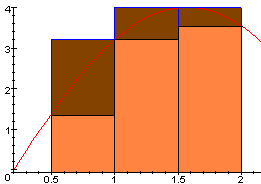 Remember Riemann integration, where you find the area under a curve by approximating with boxes? One way to do that is to measure the boxes that go outside of the curve (the brown ones) and the ones that go inside (the orange ones), then take the limit as you make the boxes narrower, and then see if the two limits are the same, in which case, that limit is the area under the curve. (Intuitively, you can see that if you make the boxes "infinitely narrow," the inside and outside boxes would be the same under a smooth curve like this one. That's what it means to take the limit.)
There is a similar definition of measure, called Jordan Measure. Unfortunately, it doesn't exist for quite a lot of subsets of the real numbers (just like not every function is integrable).
What we really want is a happy kind of measure that satisfies at least the following intuitively obvious conditions:
1. The measure of an interval is the same as its length.
2. If you have two (or more) sets, and they are disjoint (don't overlap), then the measure of their union (both together) should be the sum of their individual measures. (In other words, if you cut something up into pieces, the sum of the sizes (measures) of the pieces should be the same as the size of the original.)
3. If you have two sets, A and B, and A is a subset of B, then the measure of A should be less than or equal to the measure of B. (In other words, if A fits inside of B, then A shouldn't be "larger" under this measure.)
4. It is "translation invariant" - moving a set around (like by adding something to every number in it) doesn't change its measure.
5. The measure of the empty set is 0.
6. Measures are never negative.
What we're studying now in analysis is called Lebesque Measure. Actually, what we have is Lebesque Outer Measure, which is the Lebesque equivalent of the outer box method (the brown boxes above). Here is the difference between Jordan measure and Lebesque measure. In both of them, you are looking at intervals (the 1-dimensional equivalent of boxes; of course when you do this in more dimensions you use boxes or rectangular solids, etc.). In Jordan outer measure, the intervals can't overlap, and they have to be finite in number. In Lebesque outer measure, the intervals CAN overlap, and they can be countably infinite (you can have one for each natural number, going up to infinity). In both cases, you then take the infimum (which is basically the lower limit) of the sum of the lengths of the intervals, for all such sets of intervals.
There is no Lebesque inner measure. Lebesque outer measure exists for every subset of the reals and it has a lot of the nice qualities we want, but it doesn't have criterion 2 (called "additivity") above for all sets. So what they did was, they said, hey, if a set is additive with every other set, then it's "Lebesque measurable." Otherwise, we don't care about it. (Ideally you'd have an even better measure that works perfectly for all sets, but such a thing either doesn't exist or hasn't been figured out yet, as best I'm aware.)
Basically, every kind of set you'd easily think of is Lebesque measurable. Certainly all of the intervals, all singletons, plus sets like the rational numbers are measurable.
Right now, what I'm struggling with is that we have approximately three kadrillion theorems about Lebesque outer measure and about Lebesque measurability, and I'm having a really hard time keeping them all straight, even though I've written out each one with proof and even though I've (several times) made lists of all of them. The idea that I might have to be able to reproduce any or all of these proofs on an exam is terrifying but possibly true. So...that's my own little personal addendum to this otherwise no doubt extremely boring post about math.
Tuesday, August 24, 2010
Eating on Campus
This semester, at least, I'll be on campus every weekday. I'd like to be on campus more hours than are technically required just to go to my classes, because it's usually easier for me to do productive work away from home. So the question arises of what to do about lunch.
I considered bringing food from home, which is cheap and offers a lot of control over content. But honestly I've always sucked at follow-through on that, and every idea I have sort of sucks. A cold lunch is not that appealing. A hot lunch requires more forethought, and then you have to heat it up, and usually bring the containers back home for washing. That's a lot of trouble.
There are a various places to eat near my building. On campus there is a food court with many inexpensive options like Taco Bell and Chik-Fil-A. Off campus, but still nearby, are some more sandwich shops and the like. The downsides to this plan are that the food tends to be both unhealthy and more costly than I'd prefer on my stipend.
Instead, I opted for a meal plan, like any student. The one I got gives me a meal every day of the semester (85 in total) and the cost per meal is $5.09 including tax. The $5 cost fits into my original budget pretty well, the meals are all-you-can-eat, and it's very convenient. But is the food tolerable?
I've now eaten at a dining hall twice, and the answer is yes. Yesterday I ate at the dining hall that emphasizes more healthful foods (nothing fried, for instance) and I had a very reasonable, healthy, and enjoyable meal. Today I ate at the dining hall nearest to my office and had another decent meal. In addition to the usual hot cafeteria foods (which tend to have very reasonable options, at least so far), there is a salad bar (self-serve) and a sandwich bar (not self-serve). The place I ate yesterday also had a pasta bar and a panini bar. The biggest dining hall has a grill-type area with burgers as well. And there are numerous drink options including a tolerable imitation of iced tea.
I won't say it's gourmet, or even particularly well-prepared, but it's easy to get a healthy protein, some good vegetables, a to-die-for roll, and a salad, and that's a steal for $5. I also like the fact that I'm not wasting much packaging. I kind of hate when you get fast food and everything is all individually wrapped and it comes in a bag. The dining hall is, of course, real plates and silverware and non-disposable cups. I like getting out for lunch, going somewhere, and the atmosphere of the dining halls has been all right so far, with good music in the background too.
Next year, when I'm a TA/TF for real, the deal gets even better. If you are willing to invest in 40 meals, which roll over from semester to semester, then as a faculty or staff person, you only have to pay $3.79 per meal (including tax). At that price it starts to seem silly to bother doing anything else.
I considered bringing food from home, which is cheap and offers a lot of control over content. But honestly I've always sucked at follow-through on that, and every idea I have sort of sucks. A cold lunch is not that appealing. A hot lunch requires more forethought, and then you have to heat it up, and usually bring the containers back home for washing. That's a lot of trouble.
There are a various places to eat near my building. On campus there is a food court with many inexpensive options like Taco Bell and Chik-Fil-A. Off campus, but still nearby, are some more sandwich shops and the like. The downsides to this plan are that the food tends to be both unhealthy and more costly than I'd prefer on my stipend.
Instead, I opted for a meal plan, like any student. The one I got gives me a meal every day of the semester (85 in total) and the cost per meal is $5.09 including tax. The $5 cost fits into my original budget pretty well, the meals are all-you-can-eat, and it's very convenient. But is the food tolerable?
I've now eaten at a dining hall twice, and the answer is yes. Yesterday I ate at the dining hall that emphasizes more healthful foods (nothing fried, for instance) and I had a very reasonable, healthy, and enjoyable meal. Today I ate at the dining hall nearest to my office and had another decent meal. In addition to the usual hot cafeteria foods (which tend to have very reasonable options, at least so far), there is a salad bar (self-serve) and a sandwich bar (not self-serve). The place I ate yesterday also had a pasta bar and a panini bar. The biggest dining hall has a grill-type area with burgers as well. And there are numerous drink options including a tolerable imitation of iced tea.
I won't say it's gourmet, or even particularly well-prepared, but it's easy to get a healthy protein, some good vegetables, a to-die-for roll, and a salad, and that's a steal for $5. I also like the fact that I'm not wasting much packaging. I kind of hate when you get fast food and everything is all individually wrapped and it comes in a bag. The dining hall is, of course, real plates and silverware and non-disposable cups. I like getting out for lunch, going somewhere, and the atmosphere of the dining halls has been all right so far, with good music in the background too.
Next year, when I'm a TA/TF for real, the deal gets even better. If you are willing to invest in 40 meals, which roll over from semester to semester, then as a faculty or staff person, you only have to pay $3.79 per meal (including tax). At that price it starts to seem silly to bother doing anything else.
Wednesday, August 18, 2010
But the Worst Is...
Monday's xkcd tickled me:
 But for me, the worst random sound in a song, and this occurs in a few KSAL songs, is the sound of a bicycle bell. Do you know the kind of bell I mean? It's the kind you put on a bike and it has a little lever on the side and when you pull it, the bell goes "zhing, zhing." Hearing that when you're backing out of a parking spot or tooling along in a neighborhood is definitely enough to trigger a heart attack.
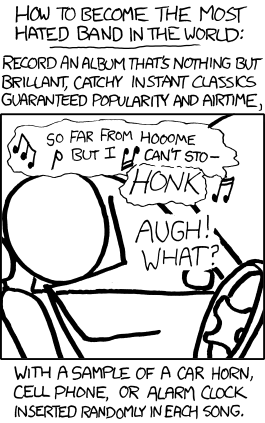 But for me, the worst random sound in a song, and this occurs in a few KSAL songs, is the sound of a bicycle bell. Do you know the kind of bell I mean? It's the kind you put on a bike and it has a little lever on the side and when you pull it, the bell goes "zhing, zhing." Hearing that when you're backing out of a parking spot or tooling along in a neighborhood is definitely enough to trigger a heart attack.
Monday, August 16, 2010
Ikea Cartoons
Ed and I recently bought some furniture from Ikea. When you buy from Ikea, you typically have to assemble the furniture yourself, and you get a large booklet full of instructions. Aside from a safety warning that is printed in 30 (!) different languages, all of the instructions are in pictures. The first page of our booklet contained the following general pieces of advice:

I find these drawings immensely charming and I love the details like the different styles of frowns on the left-hand people.
But the drawing that gets to me the most is in the second row, where it is recommended that you assemble your furniture on carpet rather than a bare floor. The guy who has broken his furniture breaks my heart:
 In contrast to his carpet-kneeling alter-ego, who strokes his new furniture with pride and delight, this fellow is greatly saddened and disappointed by his error. I realize that this is somewhat humorous, but I've always noticed that I find other people's disappointment very painful to empathize with (more painful than grief, for instance), and I actually find this drawing kind of upsetting. I found myself thinking about it in bed at night and feeling sad.

I find these drawings immensely charming and I love the details like the different styles of frowns on the left-hand people.
But the drawing that gets to me the most is in the second row, where it is recommended that you assemble your furniture on carpet rather than a bare floor. The guy who has broken his furniture breaks my heart:
 In contrast to his carpet-kneeling alter-ego, who strokes his new furniture with pride and delight, this fellow is greatly saddened and disappointed by his error. I realize that this is somewhat humorous, but I've always noticed that I find other people's disappointment very painful to empathize with (more painful than grief, for instance), and I actually find this drawing kind of upsetting. I found myself thinking about it in bed at night and feeling sad.
Wednesday, August 11, 2010
Fall 2010 Schedule
This morning, I met with the graduate advisor and we hammered out my schedule for the fall. I'll be taking four courses rather than the usual three since I have a fellowship and don't have to work as a TA this year. The final schedule is as follows:
5000 Instructional Issues for the Professional Mathematician
M/W 3:30-4:50PM
This is the class for new TA/TF's. I guess I get to take it this year even though I won't really be a TA/TF until next year. This one also meets twice before the semester starts (so, next week).
5010 Mathematical Logic and Set Theory
M/W/F 10:00-10:50AM
This isn't a normal course in the sequence, I don't think, but more of a one-off. The advisor recommended it as being probably very interesting and possibly a good prep for topology later on.
5310 Functions of a Real Variable
Tu/Th 2:00-3:20PM
This is the first course of the core sequence for real analysis. After this course and its successor, I could be ready to take the qualifying exam in real analysis.
5810 Probability & Statistics
M/W 2:00-3:20PM
Prob/stats is not a required core sequence at UNT, but they do have a qualifying exam in it (new this year; nobody has taken it yet, ever), and this is the first course of the sequence for that one.
Dr. B originally had me starting the Algebra sequence instead of Prob/Stats, but I told him I might want to do research in probability ultimately, so we swapped it out so this would happen earlier in my graduate career.
My first job at this stage in the game is to pass two qualifying exams, so it's important to get to the four required core sequences (real analysis, complex analysis, algebra, and topology) as soon as I can. If we count prob/stats (which we can since it has a qual associated with, even though it's not one of the required four sequences), I'll be taking care of two of those this year. Dr. B would like me to take my first qualifying exam next August and the second one in January of '12. I technically have four years to pass two of these exams, but doing it earlier is better.
I also got my campus ID and access to the computer labs (password, etc.) so I'm doing pretty well.
The plan for next semester is that I will take the continuation of the prob/stats, analysis, and logic courses, plus either the introductory topology course (the prelude to the core sequence in topology) or a reading course in something or other (to help me prepare for one of the exams).
5000 Instructional Issues for the Professional Mathematician
M/W 3:30-4:50PM
This is the class for new TA/TF's. I guess I get to take it this year even though I won't really be a TA/TF until next year. This one also meets twice before the semester starts (so, next week).
5010 Mathematical Logic and Set Theory
M/W/F 10:00-10:50AM
This isn't a normal course in the sequence, I don't think, but more of a one-off. The advisor recommended it as being probably very interesting and possibly a good prep for topology later on.
5310 Functions of a Real Variable
Tu/Th 2:00-3:20PM
This is the first course of the core sequence for real analysis. After this course and its successor, I could be ready to take the qualifying exam in real analysis.
5810 Probability & Statistics
M/W 2:00-3:20PM
Prob/stats is not a required core sequence at UNT, but they do have a qualifying exam in it (new this year; nobody has taken it yet, ever), and this is the first course of the sequence for that one.
Dr. B originally had me starting the Algebra sequence instead of Prob/Stats, but I told him I might want to do research in probability ultimately, so we swapped it out so this would happen earlier in my graduate career.
My first job at this stage in the game is to pass two qualifying exams, so it's important to get to the four required core sequences (real analysis, complex analysis, algebra, and topology) as soon as I can. If we count prob/stats (which we can since it has a qual associated with, even though it's not one of the required four sequences), I'll be taking care of two of those this year. Dr. B would like me to take my first qualifying exam next August and the second one in January of '12. I technically have four years to pass two of these exams, but doing it earlier is better.
I also got my campus ID and access to the computer labs (password, etc.) so I'm doing pretty well.
The plan for next semester is that I will take the continuation of the prob/stats, analysis, and logic courses, plus either the introductory topology course (the prelude to the core sequence in topology) or a reading course in something or other (to help me prepare for one of the exams).
Monday, August 02, 2010
My Visit with Mosch

Saturday, I flew to Albuquerque and spent the day with Mosch in the rehab hospital. When I parked and walked up to the building, he was waiting for me outside, standing with his sitter and with Nancy and another friend. I was astonished to see this guy who looked kind of like Mosch and then have it turn out to be actually Mosch. He recognized me as I walked up, which was awesome.
Back inside the hospital, we walked around some. He asked me to tell him about what's going on with me right now, so I did, taking a couple of videos of him on my phone. He wanted to play cards, so we fetched some from the room and played a 5-person version of War. He was able to cut the deck, deal cards to each player when it was his turn, and determine which person won each round. (The only card he didn't recognize, at least before he got a little tired out, was the Joker.) When we stopped, he was able to count his cards in his head, and arrive at the right total (15).
Mosch is walking now, which is great. When he walks, he wears a wide canvas belt around his stomach, and his sitter walks behind him, holding onto the belt. His balance isn't perfect - he walks a little like a drunk guy, basically. But one of the great things about rehab, vs. the hospital he was in before, is that he can walk anytime he wants, and has a sitter 24/7 to go with him. Before he was apparently spending hours restrained and frustrated, trying to get out of bed, which was terrible and unhealthy.
Talking to him right now is like talking to someone who is mildly mentally retarded and/or has alzheimer's or has just woken up from a compelling dream. He talks just like Mosch, with all the verbal tics of Mosch, but sometimes the things he says don't quite make sense (they make, to me, "dream sense"). For instance, Saturday night he kept asking everyone for a screwdriver, which he said he needed to "unscrew his screwdriver."
He was at his best and most alert when I first got there. He was just realizing how impaired he is, and he said to me, "My brain isn't working right, and it's so important to me, it's such a big part of who I am." (It sounded so much like normal Mosch.) Upon my saying that he was doing much better, he said, "Better than what??" He wanted to know whether he had in fact been good (smart or with it or whatever) in the past. At one point he asked if he always walked like he was drunk.
After lunch, Nancy went to the library for a while to return some books, and I sat with Mosch in his room. I told him that I knew a lot about his life, and he asked me to tell him about it, so I told him basically his whole life story as I know it, and then some more little stories about himself. Through it all he had his eyes closed a lot and was nodding, smiling with recognition. Afterwards he said, "Wow. I had no idea you could tell it like that!" When I asked him if he remembered specific things, he would say something like "vaguely." I really enjoyed that whole conversation, which felt very natural and Mosch-like.
He gets frustrated and irritated a lot. They don't really do therapy on the weekends, so there wasn't much to do all day. He seemed to be looking for a purpose a lot. He would ask, "What's next?" We would go somewhere and he'd want to know what we (his visitors) wanted to do, and we didn't really have an agenda, of course, but that was annoying too. Why did we come out here if you didn't want to do anything? was what he seemed to wonder.
At one point we had a long (for him) walk and when we got back to his room, he said, "This is the same place we started out from hours ago. This whole place is BULLSHIT!" I'm sure it's very hard to have so much energy and restlessness without having any attention span or anything you're supposed to be accomplishing. I hope it's better for him during the week when "What's next?" can be answered with the different kinds of therapies. It's obvious that he wants to work. (When we were in the dining area looking at the TV, he said, "I'm waiting for him to take off his clothes so I can practice doing that." They've been doing that in occupational therapy, I guess. While I was there I saw him unbutton and remove a long-sleeved men's shirt, twice, which is pretty great for someone who couldn't use his left hand just a week or so ago.)
He's not so easy on the nursing staff, because he's often not cooperative and doesn't remember instructions. If he wants to get up, he is supposed to let the sitter know, and then s/he will help him with the belt, but instead he usually just starts clambering over the bed rails or bolts up. He often tries to remove the belt, which I'm sure is a little uncomfortable, sometimes over and over again while it's being explained why he shouldn't. He can't seem to hold information about that in his head, or else he just doesn't care. But the sitters have pointed out that having that drive and energy will help him get better faster than if he were more complacent, and I'm sure that's true. Mosch has always been careful to call a baby "easy" rather than "good" and that's kind of what applies here - Mosch isn't an easy patient but he's a good patient.
Overall, I really enjoyed being with him. Of course, with a person who is fully unconscious, like he was on my other visits, you can imagine that they'll wake up and just be normal, and you can't do that with a person who is awake and functioning but not normal. But you can still get some of the Mosch personality and it's much more interesting to interact with someone who is walking around and talking. He seems to be improving day to day and (vastly) week to week, so now it's just a question of how far he will come in his healing process. I'm feeling pretty optimistic about his future.
Tuesday, July 20, 2010
Poor Leno
Lately I've been listening to a lot of Royksopp. I came here to post something about the song "Poor Leno," but then I saw the video on Youtube, and it is awesome. So instead of the other thing, I am going to post about the video. Go see!
Thursday, July 01, 2010
Catalog Blog
I've been enjoying a new catalog blog. This post in particular reminded me of Debbie for reasons I can't identify. (Debbie, is this your sense of humor?)
Wednesday, June 23, 2010
Hardiness
When Sally was last in town, she talked about a psychological trait called "hardiness" that I hadn't heard of before. What she said about it was something like that people with high hardiness get bored easily and have trouble motivating themselves to do things they don't want to do. (That's my paraphrase, anyway; feel free to correct me in the comments.) I think she indicated that I might have high hardiness.
I became quite curious about this, because "hardiness" sounds like something good, and if there is something good associated with my slacker qualities, I want to know what it is! (Although in fact I misunderstood her completely and when I did my Google search today, I typed in "heartiness." But anyway.)
Apparently we hardy types (assuming I am one) are unusually stress-resistant. I would say that is true of me. It's not so much that I handle stress well by rising to the occasion as that I feel somewhat immune to stress (not entirely, of course). Apparently hardiness has three components:
I don't have reason to think I have higher than usual levels of commitment and control. I can sometimes feel alienated, though not severely. I rarely feel powerless; I almost can't remember ever having felt that way.
In my cursory searching, I wasn't able to find anything about hardiness and lack of ability/motivation to do boring work. One article I saw said that hardiness was negatively correlated with neuroticism but positively correlated with the other big five personality traits (openness, conscientiousness, extraversion, and agreeableness). I would guess I am more open, less conscientious, slightly less extraverted, and slightly more agreeable than the average bear. I don't think I am very neurotic.
Going with the general meaning of the word, I do think of myself as "hardy" in ways that relate to what I've read. I usually look back at a stressful and difficult experience with joy (assuming nothing actually bad happened; I mean something like getting lost in the woods, not something like seeing your buddy gunned down in front of a liquor store) and I am fairly resilient. Hardiness is also associated with expressing satisfaction about one's life, and I'm definitely high in that area.
To cite any sources for this would suggest that it's not completely half-assed and basically along the lines of comparing oneself to characteristics expected for one's astrological sign. Still, I had a good time looking into it a little bit, and am happy (as one tends to be) to find a positive word that might describe me.
I became quite curious about this, because "hardiness" sounds like something good, and if there is something good associated with my slacker qualities, I want to know what it is! (Although in fact I misunderstood her completely and when I did my Google search today, I typed in "heartiness." But anyway.)
Apparently we hardy types (assuming I am one) are unusually stress-resistant. I would say that is true of me. It's not so much that I handle stress well by rising to the occasion as that I feel somewhat immune to stress (not entirely, of course). Apparently hardiness has three components:
- Commitment - feeling involved in life (as opposed to alienated)
- Control - believing that you can control/influence your circumstances (as opposed to feeling powerless)
- Challenge - being excited (as opposed to threatened) by changes; finding satisfaction in difficulty
I don't have reason to think I have higher than usual levels of commitment and control. I can sometimes feel alienated, though not severely. I rarely feel powerless; I almost can't remember ever having felt that way.
In my cursory searching, I wasn't able to find anything about hardiness and lack of ability/motivation to do boring work. One article I saw said that hardiness was negatively correlated with neuroticism but positively correlated with the other big five personality traits (openness, conscientiousness, extraversion, and agreeableness). I would guess I am more open, less conscientious, slightly less extraverted, and slightly more agreeable than the average bear. I don't think I am very neurotic.
Going with the general meaning of the word, I do think of myself as "hardy" in ways that relate to what I've read. I usually look back at a stressful and difficult experience with joy (assuming nothing actually bad happened; I mean something like getting lost in the woods, not something like seeing your buddy gunned down in front of a liquor store) and I am fairly resilient. Hardiness is also associated with expressing satisfaction about one's life, and I'm definitely high in that area.
To cite any sources for this would suggest that it's not completely half-assed and basically along the lines of comparing oneself to characteristics expected for one's astrological sign. Still, I had a good time looking into it a little bit, and am happy (as one tends to be) to find a positive word that might describe me.
Google Voice
I've been wanting to check out Google Voice for a long time, and I finally got an invitation from Google to sign up. It is fantastic and I'm very excited about it.
You can use Google Voice either with your existing phone number, or you can get a phone number from Google. I chose one that is local to where I'm moving to. You can search for phone numbers that spell things, and I tried my first and last name with no success, but eventually got a phone number that ends in MATH, which is pretty cool.
What GV does at this point is that, when someone calls my new number, GV will ring whatever phones I've told it to. I can tell it to ring my office phone, home phone, and cell phone all at the same time from that one number that belongs to none of the phones. I can also, if I choose, set up classes of my contacts and have GV treat them differently. (For instance, perhaps business associates get to ring only my office and cell phones, but family get to ring all three phones.)
GV also catches all of my voice mails and will email me when I get a voice mail or a text message. Voice mails are automatically transcribed (not very well, but better than nothing) and there will also be a link to play the voice mail recording on the computer. Text messages come as they are, of course, but best of all, I can text the person back just by replying to the email. (I don't do a lot of texting, but now it is at least easy to do with those few people I know who do text me.)
I can place phone calls from my Google number from any of my phones (though I forget how) and I can also place them using the website as a helper. I tell Google who I want to call and from what phone, and they ring first my phone, and then the other phone, and make the connection. It's sort of like having a secretary. One of the advantages is that I can manage all of my contacts in Google (same contacts as in Gmail) and not in my cell phone. (Of course, I might also want them in cell phone if I want to place calls when I don't have access to a computer, but there are not that many people I call regularly from outside of my home or office.)
My favorite aspect is the voice mail capture and emailing. I am pretty bad at ever getting phone calls and I especially don't notice voice mails (much less texts), but I check email all the time. This will make my chances of receiving and returning phone calls much higher.
I also really like the idea of having one phone number that will stay the same no matter what kind of phone I have. I'm considering, once I move, having a prepaid phone plan so that I don't have to pay $40/month for the five or six phone calls I make every month. I know that you can keep your numbers when you change plans these days, but this seems so much easier - just give everyone the Google number and only you and Google have to know where it's ringing. (For that matter, if I wanted to make even fewer phone calls than now, I could just have the Google number and no actual phone plan, then find a phone booth or something to place calls when necessary.)
Anyway, I'm a big fan of Google Voice so far. I have one invitation left that I can send someone, so if you're interested in trying this, just let me know.
You can use Google Voice either with your existing phone number, or you can get a phone number from Google. I chose one that is local to where I'm moving to. You can search for phone numbers that spell things, and I tried my first and last name with no success, but eventually got a phone number that ends in MATH, which is pretty cool.
What GV does at this point is that, when someone calls my new number, GV will ring whatever phones I've told it to. I can tell it to ring my office phone, home phone, and cell phone all at the same time from that one number that belongs to none of the phones. I can also, if I choose, set up classes of my contacts and have GV treat them differently. (For instance, perhaps business associates get to ring only my office and cell phones, but family get to ring all three phones.)
GV also catches all of my voice mails and will email me when I get a voice mail or a text message. Voice mails are automatically transcribed (not very well, but better than nothing) and there will also be a link to play the voice mail recording on the computer. Text messages come as they are, of course, but best of all, I can text the person back just by replying to the email. (I don't do a lot of texting, but now it is at least easy to do with those few people I know who do text me.)
I can place phone calls from my Google number from any of my phones (though I forget how) and I can also place them using the website as a helper. I tell Google who I want to call and from what phone, and they ring first my phone, and then the other phone, and make the connection. It's sort of like having a secretary. One of the advantages is that I can manage all of my contacts in Google (same contacts as in Gmail) and not in my cell phone. (Of course, I might also want them in cell phone if I want to place calls when I don't have access to a computer, but there are not that many people I call regularly from outside of my home or office.)
My favorite aspect is the voice mail capture and emailing. I am pretty bad at ever getting phone calls and I especially don't notice voice mails (much less texts), but I check email all the time. This will make my chances of receiving and returning phone calls much higher.
I also really like the idea of having one phone number that will stay the same no matter what kind of phone I have. I'm considering, once I move, having a prepaid phone plan so that I don't have to pay $40/month for the five or six phone calls I make every month. I know that you can keep your numbers when you change plans these days, but this seems so much easier - just give everyone the Google number and only you and Google have to know where it's ringing. (For that matter, if I wanted to make even fewer phone calls than now, I could just have the Google number and no actual phone plan, then find a phone booth or something to place calls when necessary.)
Anyway, I'm a big fan of Google Voice so far. I have one invitation left that I can send someone, so if you're interested in trying this, just let me know.
Tuesday, June 22, 2010
Money Fairness Without Marginal Costs
As I mentioned earlier, Ed got his driver's license last week, and I included him in my new insurance policy with Progressive. It's great (even for me) to know that he can now borrow my car and go wherever he wants. I expect this will come in very handy in grad school, where neither of us will commute to school by car, but where we may not live in (easy) walking distance of a grocery store. So far, Ed hasn't taken much advantage of this new ability, which is partly due to a lack of opportunity, and partly because I think the idea of being able to just drive somewhere hasn't penetrated his consciousness yet.
The question that arises for me is, how much (if any) of the car insurance and other car-related costs should Ed bear? I asked him this question, and he suggested that as a starting point, I find out how much extra it costs for him to be on my insurance.
At Amica, this was going to be $400/year, but according to Progressive, it is $0. Having him on my policy does not add anything to the cost. And yet, it doesn't seem that it should be free to him. If I were to move in with Sally, even if she found this desirable and enjoyable, I should pay some rent even though my being there would not affect the rent. People who benefit from a thing that costs something should bear some of the costs.
So he shouldn't pay nothing. If we drive the car about equal amounts in grad school (as opposed to now, when I drive it to work every day), should he pay half? On the one hand, borrowing your girlfriend's car is not as nice as having your own car; I'd have first dibs on the car and thus more convenient car access. On the other hand, I paid for the car and its depreciation falls on me, not him. And, of course, it might be that what I think is fair is more than it's worth to him for me to have a car that he can borrow.
It's hard for me to figure out what seems reasonable in this type of situation.
The question that arises for me is, how much (if any) of the car insurance and other car-related costs should Ed bear? I asked him this question, and he suggested that as a starting point, I find out how much extra it costs for him to be on my insurance.
At Amica, this was going to be $400/year, but according to Progressive, it is $0. Having him on my policy does not add anything to the cost. And yet, it doesn't seem that it should be free to him. If I were to move in with Sally, even if she found this desirable and enjoyable, I should pay some rent even though my being there would not affect the rent. People who benefit from a thing that costs something should bear some of the costs.
So he shouldn't pay nothing. If we drive the car about equal amounts in grad school (as opposed to now, when I drive it to work every day), should he pay half? On the one hand, borrowing your girlfriend's car is not as nice as having your own car; I'd have first dibs on the car and thus more convenient car access. On the other hand, I paid for the car and its depreciation falls on me, not him. And, of course, it might be that what I think is fair is more than it's worth to him for me to have a car that he can borrow.
It's hard for me to figure out what seems reasonable in this type of situation.
Monday, June 21, 2010
Resume Pet Peeve
I realize that even having pet peeves is obnoxious. Nevertheless, I really hate it when resumes (we are looking at some this week for the person who is to replace me) have a bullet point list of the duties associated with the job and the entries in the list are not in the same grammatical category, e.g.,
Massive Oil Company, Melbourne, Australia, 2008-2010
Massive Oil Company, Melbourne, Australia, 2008-2010
- Worked extensively with Aries.
- Finding and maintaining city and county records.
- Assist engineers with daily tasks.
Sunday, June 20, 2010
Swimming
Today, I went swimming at the Wheat Ridge Rec Center. I haven't been swimming laps much lately at all - in fact it's been months, I think, since I've swum laps at all - but I decided on an ambitious goal for the day: swimming a mile. I wasn't sure that was realistic at all, so I wasn't really determined to make it, but I thought having a stretch goal would be fun.
A mile is just slightly over 35 laps in our 25-yard-long pool. I actually count lengths and not laps, as I'll explain later. I used the crawl (or freestyle, as I think it's sometimes called) for almost all of the laps.
I got slower as the laps went on, but ultimately I did make my goal! I think it took me about an hour and a half, which is pretty damn slow, but I don't care - I am excited about swimming such a long distance at all.
I really enjoy swimming. The environment underwater is beautiful and feels wonderful to me. Swimming is also no-impact; I suppose it's possible to get injured swimming, but I've never hurt myself. For me, it is kind of a low-stress, high-rep, light muscle exercise situation that is not extremely aerobic.
I used to have trouble counting laps, but the technique I use now is that I say the number I'm on in my head with every breath, which is a bit hypnotic too. I count lengths rather than laps so that I always know that on the way out I should be saying an odd number, and on the way back it's an even number. That helps prevent the thing where my mind drifts and suddenly '51, 51, 51, 51' turns into '51, 51, 51, 52, ...'
I also wear a mask and snorkel to swim. I first tried this when I had my neck injury, because I couldn't handle the neck strain of swimming back then. The mask and snorkel made it possible for me, since I didn't have to move my neck around to breathe, and could just keep it in a nice neutral position. And what I discovered is that swimming is much more relaxing and nice if you don't have to worry about breathing at all.
Every 5 laps or so, I come up, take off my mask, and have a short break. I try to keep some water with me and drink it during my breaks, because it is kind of easy to get a little dehydrated while swimming. I don't tend to ever feel thirsty while submerged in water.
Anyway, I had a wonderful time. I hope that the pool at my grad school will be as nice as the one at the rec center and that I can swim there on a more regular basis. I can't swim in the winter here, because the chlorine does unbearable things to my already-dry skin, and I'm hoping that won't be a problem in the new locale.
A mile is just slightly over 35 laps in our 25-yard-long pool. I actually count lengths and not laps, as I'll explain later. I used the crawl (or freestyle, as I think it's sometimes called) for almost all of the laps.
I got slower as the laps went on, but ultimately I did make my goal! I think it took me about an hour and a half, which is pretty damn slow, but I don't care - I am excited about swimming such a long distance at all.
I really enjoy swimming. The environment underwater is beautiful and feels wonderful to me. Swimming is also no-impact; I suppose it's possible to get injured swimming, but I've never hurt myself. For me, it is kind of a low-stress, high-rep, light muscle exercise situation that is not extremely aerobic.
I used to have trouble counting laps, but the technique I use now is that I say the number I'm on in my head with every breath, which is a bit hypnotic too. I count lengths rather than laps so that I always know that on the way out I should be saying an odd number, and on the way back it's an even number. That helps prevent the thing where my mind drifts and suddenly '51, 51, 51, 51' turns into '51, 51, 51, 52, ...'
I also wear a mask and snorkel to swim. I first tried this when I had my neck injury, because I couldn't handle the neck strain of swimming back then. The mask and snorkel made it possible for me, since I didn't have to move my neck around to breathe, and could just keep it in a nice neutral position. And what I discovered is that swimming is much more relaxing and nice if you don't have to worry about breathing at all.
Every 5 laps or so, I come up, take off my mask, and have a short break. I try to keep some water with me and drink it during my breaks, because it is kind of easy to get a little dehydrated while swimming. I don't tend to ever feel thirsty while submerged in water.
Anyway, I had a wonderful time. I hope that the pool at my grad school will be as nice as the one at the rec center and that I can swim there on a more regular basis. I can't swim in the winter here, because the chlorine does unbearable things to my already-dry skin, and I'm hoping that won't be a problem in the new locale.
Friday, June 18, 2010
Auto Insurance
Many years ago, when I first moved to Denver, I had Progressive auto insurance. I don't remember what they were charging me, but when I called up Amica, I got a quote that was something like half as much as Progressive's, and I switched over. I've had excellent service from Amica for about 8 or 9 years now.
Ed got his driver's license a couple of weeks ago, and when I went to add him to my Amica policy, it would have added $400 to the year, and my total insurance costs (for full coverage with fairly high deductibles) were going to be about $1200. In the meantime, I had pulled up a quote from Progressive that was much less - about $700 for the year for the same coverage.
So I switched to Progressive again.
All this is to say that it might be worth checking your insurance coverage every few years to see if you get a much lower rate with another company (and to ensure that you're getting only/exactly the coverage you want).
Ed got his driver's license a couple of weeks ago, and when I went to add him to my Amica policy, it would have added $400 to the year, and my total insurance costs (for full coverage with fairly high deductibles) were going to be about $1200. In the meantime, I had pulled up a quote from Progressive that was much less - about $700 for the year for the same coverage.
So I switched to Progressive again.
All this is to say that it might be worth checking your insurance coverage every few years to see if you get a much lower rate with another company (and to ensure that you're getting only/exactly the coverage you want).
Thursday, June 10, 2010
Try. First.
I have a coworker who was hired as an engineer right out of college (by us, I mean, a year or so ago). I imagine he's relatively intelligent, yet the way that he works drives me up the wall. Today, for instance, he called me to find out the easiest way to get a map of an area.
"Probably just make the map in Petra," I said. Petra is software we use very commonly and I have walked him through many processes in Petra before.
"OK," he said, "well, I've never made a new project in Petra. I was wondering if you could walk me through it."
Now when you start up Petra, the very first screen asks if you want to open an existing project or make a new one, so it's not mysterious how to at least start making a new project. And I really resent this guy asking me to "walk him through" something in a program he already uses without even trying it himself first.
Nevertheless, I walked him through a few initial stages, at which point he had some steps to do on his own, and then I just happened not to take his follow-up phone call. (Yes, I realize it's unprofessional, but I wanted him to have the opportunity to try the next steps on his own, and I don't have the balls, I guess, to just tell him so.) He sent me an email a while later so I sent back some hints.
The next time he called, I did take the call. He was stuck at a certain point, which is a reasonable time to call someone. But when I walked him through what he was doing, he (a) repeatedly did not listen to what I was saying, (b) indicated an inability to figure out the simplest things, and (c) simply failed to try obvious things in the software.
Of course, since he never takes notes or anything like that, I expect someone will have to walk him through his next new Petra project as well.
"Probably just make the map in Petra," I said. Petra is software we use very commonly and I have walked him through many processes in Petra before.
"OK," he said, "well, I've never made a new project in Petra. I was wondering if you could walk me through it."
Now when you start up Petra, the very first screen asks if you want to open an existing project or make a new one, so it's not mysterious how to at least start making a new project. And I really resent this guy asking me to "walk him through" something in a program he already uses without even trying it himself first.
Nevertheless, I walked him through a few initial stages, at which point he had some steps to do on his own, and then I just happened not to take his follow-up phone call. (Yes, I realize it's unprofessional, but I wanted him to have the opportunity to try the next steps on his own, and I don't have the balls, I guess, to just tell him so.) He sent me an email a while later so I sent back some hints.
The next time he called, I did take the call. He was stuck at a certain point, which is a reasonable time to call someone. But when I walked him through what he was doing, he (a) repeatedly did not listen to what I was saying, (b) indicated an inability to figure out the simplest things, and (c) simply failed to try obvious things in the software.
Of course, since he never takes notes or anything like that, I expect someone will have to walk him through his next new Petra project as well.
Wednesday, June 09, 2010
Monday, June 07, 2010
War and Peace: My Review
I have now finished War and Peace.
It's hard to know what to say about a book that is a famous classic, so I will give you some random assorted thoughts, in no particular order.
It's hard to know what to say about a book that is a famous classic, so I will give you some random assorted thoughts, in no particular order.
- Parts of the book were amazing, life-altering, crazy good, in characteristic Tolstoy ways. If you were very moved by Anna Karenina you should be moved by War and Peace too, and W&P is much longer, so there is more.
- More of the moving parts of W&P are about characters facing death (or the possibility of death) or suffering.
- The book inspired in me an interest in the Napoleonic Wars (especially the Russia parts) that felt very similar to how I think a lot of people feel about the Civil War. I now want to independently read about this. I am not usually interested in battles or wars, so that's strange for me. If you tend to enjoy books about soldiers or wars (say, similarly to how Sally enjoys books about life on ships), W&P might hit your buttons.
- That said, Tolstoy is not big on describing the exact tactical moves or positions of armies taken in various battles, largely because he does not believe such things exist in a meaningful way or that they determine outcomes. He's rather adamant about this. There is one map showing the positions of the armies, but for the most part you get a broad overview and then specific details concerning the characters we care about.
- Most of the book isn't about war, but about the lives of various people, similar to how Anna Karenina was, and a fair bit concerns who will ultimately marry whom and how various fortunes will be disposed. There were many times that the book made me gasp in surprised delight or feel real despair over what happened to the characters.
- It is fantastically written.
- I got extremely annoyed reading Part II of the Epilogue, which is basically a very long essay about history and free will. I was heard to say out loud, more than once, "Tolstoy, shut up." Maybe I simply missed the brilliance of it all, but I think it could have used some serious editing and been a much stronger essay with 1/5 as many words. Since it was the last thing I read, it made me not like the book as well overall. If I reread W&P, which I hope I will someday, I will probably skip that part.
- It is long, but, by the time you get near the end, you'll wish it were longer, at least until you get to Part II of the Epilogue.
Tuesday, June 01, 2010
A Little Tolstoy
This is the beginning of Volume III (Pevear/Volokhonsky translation):
[* Original in French, but I didn't feel like typing it.]
Since the end of 1811 an intense arming and concentration of western European forces had begun, and in the year 1812 those forces -- millions of men (including those who transported and fed the army) -- moved from west to east, to the borders of Russia, towards which, since the year 1811, the forces of Russia had been drawn in exactly the same way. On the twelfth of June, the forces of western Europe crossed the borders of Russia, and war began -- that is, an event took place contrary to human reason and to the whole of human nature. Millions of people committed against each other such a countless number of villainies, deceptions, betrayals, thefts, forgeries and distributions of false banknotes, robberies, arsons, and murders as the annals of all the law courts in the world could not assemble in whole centuries, and which, at that period of time, the people who committed them did not look upon as crimes.I could read this over and over. (And now I have.)
What produced this extraordinary event? What were its causes? Historians say with naive assurance that the causes of this event were the offense inflicted upon the duke of Oldenburg, the non-observance of the Continental System, Napoleon's love of power, Alexander's firmness, diplomatic mistakes, and so on.
Consequently, it needed only that Metternich, Rumyantsev, or Talleyrand, between levee and rout, make a little better effort and write a more skillful dispatch, or that Napoleon wrote to Alexander: Dear sir, my brother, I agree to give the duchy back to the duke of Oldenburg* -- and there would have been no war.
Understandably, that was how the matter presented itself to contemporaries. Understandably, it seemed to Napoleon that the war was caused by the intrigues of England (as he said, in fact, on the island of St. Helena); understandably, to the members of the English Parliament it seemed that the war was caused by Napoleon's love of power; to Prince Oldenburg it seemed that the war was caused by the violence done to him; to the merchants it seemed that the war was caused by the Continental System, which was ruining Europe; to the old soldiers and generals it seemed that the chief cause was the need to make use of them; to the legitimists of that time, that it was necessary to restore les bons principes [Good principles]; and to the diplomats of that time, that it had all happened because the alliance between Russia and Austria in 1809 had not been concealed skillfully enough from Napoleon and because memorandum no. 178 had been clumsily worded. Understandably, these and a countless, endless number of other causes, the number of which depends on countless different points of view, presented themselves to contemporaries; but for us, the descendants, who contemplate the enormity of the event in all its scope and delve into its simple and terrible meaning, these causes seem insufficient. For us it is not understandable that millions of Christians killed and tortured each other because Napoleon was a lover of power, Alexander was firm, English policy cunning, and the duke of Oldenburg offended. It is impossible to understand what connection there is between these circumstances and the fact of killing and violence; why, because the duke of Oldenburg was offended, thousands of men from the other end of Europe should kill and ravage the people of Smolensk and Moscow provinces and be killed by them.
[* Original in French, but I didn't feel like typing it.]
Subscribe to:
Posts (Atom)