I've been thinking about all of my years of schooling and the difference between times that I excelled and times that I failed or just got by. There are some of each.
In grade school, there were structural changes that made a difference for me. In elementary school, I generally had good grades just because I was academically ahead of my peers and homework wasn't such a big deal. I also did well in the gifted program at my main elementary school, where we had a certain number of tasks to complete independently each week, the completion of each of which led to a box being hilited in your folder. If you finished early you could play (educational) games on Friday, and I loved my teacher very much.
Middle school was more of a struggle, because suddenly things like keeping your folder in a certain order were important, and homework began to be more of the grade, which was calculated in a more fixed fashion than before. Some teachers were more flexible than others if you got high test grades but didn't turn in a lot of homework.
And yet, in 7th grade, the middle year of middle school, I got all A's the entire year. I remember doing the same things I had always done - leaving assignments until the last minute if I did them at all, being smart but disorganized, etc. - but I think what made the difference was that I really loved some of my teachers. I had a giant crush on my earth science teacher (Mr. Garrett) and my English teacher (Mrs. Agrons) was the bomb as well. (She taught us to write essays. I remember a whole board filled with statements about Rikki Tikki Tavi that were and were not thesis statements, e.g., "Rikki Tikki Tavi is a weasel" - not a thesis statement - vs. "Rikki Tikki Tavi succeeds through cleverness.")
So, clearly I do better when grading is flexible, and I do better when I love (and thus want to please) my teachers. But those things are pretty much beyond my control, and in particular, the flexibility of grading becomes much less of an issue once courses become hard enough that I actually need to do the homework in order to succeed. (At that point, graded homework becomes a help to me, since it's slightly harder for me to do otherwise.)
If I go to grad school, there probably will not be classes where I can ace the tests while blowing off the homework.
But, more interesting than this stuff is something that I have noticed only recently, though I think it is a pattern of long standing. When I specifically desire to excel at a class, then I do; when I view the class as something to get through, or something I don't want to fail, then I tend to do poorly. I think most of the classes I've taken in my life I've viewed in the latter way - as obligations, basically, or something I just needed to survive - and so I haven't done very well at them.
When I find a class very tricky or puzzling (like Logic at Rice), or I love the teacher (like Mrs. Agrons), or I want to defeat my classmates, or somehow or other I really want to do well, then I generally perform at or near my best. By contrast, when I don't really see an upside to the class, I have a hard time even meeting the minimum standards.
I am not sure how much this generalizes to life, but it strikes me that one of my problems at work is that I don't really see much point to excelling at my job. When I apply a very moderate amount of effort, people are very impressed (probably because most people who have my position are not very talented, or they'd be engineers or something instead). There are not spot bonuses or anything like that. Mostly they pay me a fixed amount of money as long as I do whatever is basically required of me.
I am led to understand that some people have an internal drive to excel (or to be professional or work hard), but I seem to be much more likely to respond to external incentives like grades or professorial approval. (I do respond to some internal things, like feeling brilliant - which is part of why I can excel at math - but doing a good job at work doesn't usually make me feel brilliant since most of my job is pretty easy.)
This is probably why I like school so much, just in general. You get constant feedback (I love getting graded things back) and there are always new people to please and impress.
I wonder if I can find a way to internalize the desire for excellence such that it applies to more situations and is less reliant on external motivators.
Tuesday, October 27, 2009


Monday, October 26, 2009
Tokyo Joe's
Recently, Tokyo Joe's has changed the way they handle vegetables. It used to be that you could either get broccoli or a vegetable mix with your bowl. Now you can get up to five vegetables from a long list, or you can get a mix of popular vegetables. It's so, so nice.
I had lunch there today - brown rice with dark meat chicken (they also have steak, white meat chicken, salmon, tofu, etc.), my five vegetables (broccoli, red peppers, bok choy, snow peas, and red onions), and curry sauce. The curry sauce is good there.
The real downside to Tokyo Joe's is realizing that you could make their food at home very cheaply, if you wanted several portions of the same kind. There isn't really that value added of "I could never make this" or "This is too much trouble to cook" (e.g., how I am never going to make a chile relleno). But for convenience, cost, and health, it's hard to beat paying $7 for the bowl I just described plus a tall cup of very good iced tea.
Wednesday, October 21, 2009
Self-Motivation
In therapy lately, we've been talking (of course) about my unusual degree of inability to make myself do things. Of course, everyone struggles with self-discipline to some extent - working is hard - but I seem to struggle less successfully than most.
I got frustrated with my therapist because he was doing more talking than listening and saying things about setting goals for yourself and finding out what is holding me back from performing and blah de blah, and I felt like a person missing a leg being asked why they don't want to walk and whether they've tried building up to it with just a few steps at a time. Like, no, you don't fucking get it, that is not what is going on here.
I specifically do not believe (though I would love to find out that I'm wrong) that something is blocking or preventing me from applying myself. I think I have an actual deficit of whatever it is that people use to get things done.
Way to take responsibility there, Tam.
One of the ways people motivate themselves is by setting small (at first) goals, and then building on their success in meeting those goals. But I have set goals so many times, and not met them so unbelievably many times, that I don't even believe myself when I say I'm going to do something. I mean, I can tell myself I am going to do something that takes 5 minutes later that very same day, and I know all along that I'm probably not going to actually do it.
How many times does a person have to let you down before you stop thinking they might step up? When the person is yourself, it seems the answer is "quite a few times," but those quite a few times have long since passed by. (I'm tired tonight, so this is a slightly more negative view than I usually have, but not far off.)
However, obviously I do in fact do some things. I go to work every day, get some work done on most of those days, and I keep up with my classes well enough to ace most of them, which does require some work. I attend classes more than half the time. I sometimes clean the kitchen or wash the towels. I have clean laundry to wear every day. I am able to present as a functional person.
There are strategies I use to get myself to do things. First, I'll tell you what I don't use:
At home, for homework, I almost always sit down with a glass of iced tea, which I brew first. I keep regular and decaf tea bags for this purpose. The brewing time lets me goof off while knowing I'll soon start working. I can let the tea go for a while but eventually I need to go pour it over the ice. I really enjoy the tea and, although I sometimes drink it when I'm not doing homework, I mostly have it with homework (to the point that I feel cheated when I try to do homework with just a glass of water). Tea time = homework time.
Some household tasks are naturally appealing to me, like washing the towels. I don't have too much trouble at least getting that started, though sometimes I fail to ever fold them afterwards. Other household tasks, like doing the dishes, I just push myself to do in whatever way I can. "This will only take 5 minutes," I tell myself. "All you have to do is put them in the dishwasher. Look, it's 9:17. By 9:25 you'll be done. And Ed will be really happy." Sometimes that works.
There are two things that need to happen in order for me to do some work. First, I have to actually decide to do it. That may seem really basic, but sometimes I can feel myself, in my mind, simply refusing to do something, even a task at my actual job, where they pay me to do things I don't necessarily want to do. Dishes is a hard task to decide to do. Sending a letter or calling someone on the phone is hard. Homework, by contrast, is a very, very easy task to decide to do - there is almost no barrier there at all. I am always open to doing homework.
The second thing that needs to happen is for me to get around to actually starting to do the task. That is also often a challenge. Sometimes I start and then drift off to doing something else, if I'm not careful. Sometimes hours go by while I just don't quite get started. (Brewing tea helps this problem with homework, since it puts a soft, flexible time limit on goofing off. Of course, sometimes it takes me a while to get up and actually start the tea brewing.)
Then, of course, you have to stick with the task. Some tasks, like washing dishes, are so short and different from the rest of life that they're easy to stick with. Working at my job is the hardest task to stick with, because I'm almost always using the computer, which makes it very easy to slide over to looking at things on the Internet instead. Homework is intermediate, because I take the keyboard off my desk and usually only surf the net intermittently when I need a little break; I can't get too absorbed with all the papers between me and the monitor. Also there is my glass of tea looking at me, saying, "Don't finish me too soon - you still have a lot of homework left."
So I guess I kind of try to condition myself to work by associating work with other pleasant things - not future rewards, but things going on at the same time, like iced tea and music. (I sometimes use hot herbal tea at work in a similar way, but it's not as rewarding as iced tea, which is too much trouble to make at work.) I am like a bad little mule, led on with a lot of kind pats and the simple conditioning of, "OK, here's your lead, must be time to get on with things."
Refraining from doing things is another story entirely, and I have almost no success whatsoever with that.* Occasionally I can substitute one pleasure for another ("instead of going out to eat, I could read this book, that sounds great") but otherwise it's hard to associate refraining with an immediate pleasure.
Despite my gloomy outlook here, it should be pointed out that I am far, far better at this than I used to be, so it's possible I will continue to improve over time.
(* "No success" relative to most people, that is. Obviously I refrain from doing quite a lot of things all the time.)
I got frustrated with my therapist because he was doing more talking than listening and saying things about setting goals for yourself and finding out what is holding me back from performing and blah de blah, and I felt like a person missing a leg being asked why they don't want to walk and whether they've tried building up to it with just a few steps at a time. Like, no, you don't fucking get it, that is not what is going on here.
I specifically do not believe (though I would love to find out that I'm wrong) that something is blocking or preventing me from applying myself. I think I have an actual deficit of whatever it is that people use to get things done.
Way to take responsibility there, Tam.
One of the ways people motivate themselves is by setting small (at first) goals, and then building on their success in meeting those goals. But I have set goals so many times, and not met them so unbelievably many times, that I don't even believe myself when I say I'm going to do something. I mean, I can tell myself I am going to do something that takes 5 minutes later that very same day, and I know all along that I'm probably not going to actually do it.
How many times does a person have to let you down before you stop thinking they might step up? When the person is yourself, it seems the answer is "quite a few times," but those quite a few times have long since passed by. (I'm tired tonight, so this is a slightly more negative view than I usually have, but not far off.)
However, obviously I do in fact do some things. I go to work every day, get some work done on most of those days, and I keep up with my classes well enough to ace most of them, which does require some work. I attend classes more than half the time. I sometimes clean the kitchen or wash the towels. I have clean laundry to wear every day. I am able to present as a functional person.
There are strategies I use to get myself to do things. First, I'll tell you what I don't use:
- Ongoing To-Do Lists: I often make one for the next few hours, but never one for days from now, because then I will just avoid even looking at or thinking about the list or anything on it.
- Small Goals: Discussed above.
- Rewards: I know I won't honor this type of promise to myself, so there's no point. I'll get the reward later whether I did the thing to earn it or not, if I want it. This includes very short-term rewards like "I'll work for 30 minutes, then relax for 10 minutes," because I won't follow through on those either.
- Punishments/Consequences: I definitely won't honor these.
At home, for homework, I almost always sit down with a glass of iced tea, which I brew first. I keep regular and decaf tea bags for this purpose. The brewing time lets me goof off while knowing I'll soon start working. I can let the tea go for a while but eventually I need to go pour it over the ice. I really enjoy the tea and, although I sometimes drink it when I'm not doing homework, I mostly have it with homework (to the point that I feel cheated when I try to do homework with just a glass of water). Tea time = homework time.
Some household tasks are naturally appealing to me, like washing the towels. I don't have too much trouble at least getting that started, though sometimes I fail to ever fold them afterwards. Other household tasks, like doing the dishes, I just push myself to do in whatever way I can. "This will only take 5 minutes," I tell myself. "All you have to do is put them in the dishwasher. Look, it's 9:17. By 9:25 you'll be done. And Ed will be really happy." Sometimes that works.
There are two things that need to happen in order for me to do some work. First, I have to actually decide to do it. That may seem really basic, but sometimes I can feel myself, in my mind, simply refusing to do something, even a task at my actual job, where they pay me to do things I don't necessarily want to do. Dishes is a hard task to decide to do. Sending a letter or calling someone on the phone is hard. Homework, by contrast, is a very, very easy task to decide to do - there is almost no barrier there at all. I am always open to doing homework.
The second thing that needs to happen is for me to get around to actually starting to do the task. That is also often a challenge. Sometimes I start and then drift off to doing something else, if I'm not careful. Sometimes hours go by while I just don't quite get started. (Brewing tea helps this problem with homework, since it puts a soft, flexible time limit on goofing off. Of course, sometimes it takes me a while to get up and actually start the tea brewing.)
Then, of course, you have to stick with the task. Some tasks, like washing dishes, are so short and different from the rest of life that they're easy to stick with. Working at my job is the hardest task to stick with, because I'm almost always using the computer, which makes it very easy to slide over to looking at things on the Internet instead. Homework is intermediate, because I take the keyboard off my desk and usually only surf the net intermittently when I need a little break; I can't get too absorbed with all the papers between me and the monitor. Also there is my glass of tea looking at me, saying, "Don't finish me too soon - you still have a lot of homework left."
So I guess I kind of try to condition myself to work by associating work with other pleasant things - not future rewards, but things going on at the same time, like iced tea and music. (I sometimes use hot herbal tea at work in a similar way, but it's not as rewarding as iced tea, which is too much trouble to make at work.) I am like a bad little mule, led on with a lot of kind pats and the simple conditioning of, "OK, here's your lead, must be time to get on with things."
Refraining from doing things is another story entirely, and I have almost no success whatsoever with that.* Occasionally I can substitute one pleasure for another ("instead of going out to eat, I could read this book, that sounds great") but otherwise it's hard to associate refraining with an immediate pleasure.
Despite my gloomy outlook here, it should be pointed out that I am far, far better at this than I used to be, so it's possible I will continue to improve over time.
(* "No success" relative to most people, that is. Obviously I refrain from doing quite a lot of things all the time.)
Tuesday, October 20, 2009
Obnoxious
I was talking to Ed tonight about that famous psychology experiment where one person (the subject) is put in a room with a bunch of confederates and a researcher asks the group a question with an obvious answer and has them vote, at which point all of the confederates vote the wrong way, and the subject usually follows along despite the group being obviously wrong. (Sorry I don't have the details, but it's a widely known thing.)
My natural tendency is to scoff at the subject, but in truth, that's probably the right thing to do. It seems to me that that probability of a bunch of other people being wrong about something completely obvious is lower than the probability that you have misunderstood the question somehow. (And by "obvious" I don't mean like "It is obvious that rent controls only serve to make housing more scarce, thus exacerbating the underlying problem," but more like, "It is obvious that this line is longer than the other.")
Nevertheless, Ed and I are both the kind of obnoxious jerks who think we are right despite this kind of external evidence. When my mother taught me to write the numbers, right before Kindergarten, I argued with her that she was writing the 5 and the 6 backwards. I argued with my 5th grade teacher that "colonel" - one of our spelling words of the week - was clearly incorrect. I do not hesitate to argue with my professors now about factual issues within their areas of expertise, although I am not nearly as obnoxious now as I was as a kid. (To be clear, I don't argue with professors about matters of opinion unless it seems wanted.)
I am almost always willing to admit that I may be wrong, but I always actually believe that I'm right despite this theoretical possibility, and even in situations where the odds are against it. And I don't really mind being shown how I am wrong. (It occurs to me that this is similar to how I am with games - tending to be a bad winner, but nearly always a good loser.)
At any rate, this is probably why, when our linear algebra professor realized there was a lot of confusion over the question of whether the column space of an mxn matrix A was a subspace of Rn or Rm, and had us vote, I was willing to raise my hand for m even though 17 or 18 of my 19 classmates had voted for n. (Reminder, for those who can be reminded: the column space of a matrix A is all of the vectors that can be formed of linear combinations of the columns of A, or in other words, all of the vectors b satisfying the equation Ax = b for some x.)
I thought that I must be wrong, because even though my classmates are often confused, that was an overwhelming majority against me, and yet, what I had on my paper sure made it look like m, so that's what I went with. I turned out to be correct.
She next had us vote on the same question pertaining to the nullspace of A. (The nullspace is the vectors x satisfying Ax = 0.) This vote didn't go against me quite as strongly - it was more like 17-3. But I was again correct.
(I should note that I was perfectly capable of getting either question wrong - this is not a question where the answer was obvious to me at the time, and this is the type of thing I am often wrong about, usually because I have made some simple mental error. This post is about my psychology, not about my besting everyone in feats of dimensionality.)
I suspect that I am different from most people in this non-majority-joining respect because I am not very bothered by being mistaken, and I see the possibility of being right (i.e., winning) as having a pretty big payoff. And although holding the minority position makes it more likely that I'm mistaken, it also raises the payoff for being right. (After all, being the only one who is right is much more awesome than being right in a crowd.) Also I am just unwilling to let things go until I see why I am wrong.
Sunday, October 18, 2009
When I Grow Up
I've been considering a lot of career changes and such lately, and one idea that has arisen, that I'd previously dismissed but am now considering more closely, is going to graduate school in math full time, probably hoping to get a PhD, but at least for a Master's. There are several reasons that this appeals to me, among which are
If I do go with the full-time grad school idea, there are three general paths I could take.
Pure Math
This is the most academically appealing path. What I seem to like best in math is stuff that involves a small number of axioms and seeing what comes of them. (This could change; I don't have a lot of maturity in math yet.) I think I would enjoy (as much as one ever does) writing a master's thesis or doctoral dissertation in pure math, once I got far enough along for such a thing to become possible. (My paper on Laguerre planes last semester was as close as I've gotten, and that was thrilling and I found I could easily work on it for hours and hours.)
Having this degree would broaden my career prospects in the regular world to a degree, and enable me to try to get a job teaching at a college or, if I want to continue doing research, at a university. Academic jobs (other than horrible, low-paid adjunct positions) are often difficult to come by, however, even if you want "only" a community college job.
Applied Math
Something in applied math - perhaps Operations Research - would be the most career-applicable path. Applied math interests me somewhat less than math with no conceivable application, but is still very interesting, and, though the thought doesn't thrill me, it seems very possible to imagine writing a paper in an applied math area. As far as academic careers go, a higher applied math degree would be about the same (as best I can tell) as a higher pure math degree. They have professors in both, of course, at universities, and for lower-level teaching-oriented positions I doubt it makes any difference.
Math Education
Sally joked the other day that I could go to her interim school and get my PhD there, where they have a math education doctoral program that seems very research-oriented. I find this a very intriguing option (in general, not just at that school) because it has such strong highs and lows to it, in my view.
A PhD in math education is not at all helpful for a regular job in industry, as best I can guess, even though you do learn a lot of advanced math in the course of getting one. It pretty much limits you to the education field, if you want your degree to really count for something. It also does not feel as prestigious to me, which I admit is a consideration. ("I have a PhD in math" just sounds so much better to me than "I have a PhD in math education.")
Yet the topic of math education interests me greatly. I feel I would happily read any number of books or papers about it.
Yet I'm not sure the idea of doing original research in math education sounds that great. It doesn't really sound much better to me than the idea of doing original research in say, psychology, and I wouldn't go do that, and not just because my background for it is wrong. I like the research and want it done, but I'm not sure I should be the one doing it.
If I were to get a PhD in math education, the kinds of jobs that would be available to me would be the usual academic jobs (where I could teach either math - using my math education focus to do so more effectively, perhaps, especially if I specialized in post-secondary ed - or math education itself, like to future teachers), or I could probably get some kind of job in the public school system doing something like program or curriculum development, etc. (I'm not sure exactly what jobs exist, but there are surely jobs along those lines.)
A PhD in math education, or really any PhD, would probably make it a bit harder for me to get a high school teaching job, at least in a public school, since I would have the deadly combination of no teaching experience at that level + being required to be paid more than someone with a Bachelor's. But maybe a fancy private school would like to hire me, and I'd certainly have teaching experience in general, since teaching college courses generally happens as part of a program like that. (It's explicitly required at Sally's interim school, and would be part of TAing in any program.)
One question central to all of these considerations is really what kind of career I want to have, or at least, what kind of career I want to try next. I worry that I am not really suited, psychologically, to the general type of work I do now - i.e., working in an office. I seem to be an inveterate slacker in those types of jobs. And while having a more interesting and challenging office job - as I might after getting a higher degree - might help, it might also involve elements that I find even more impossible than what I face now, like project management.
I have never tried teaching, but I think it might be a kind of job that I would be good in. I enjoy teaching people things quite a lot, certainly. It seems like it would be very engaging and, while you can slack off as a teacher, it wouldn't have the same kind of slippery-slacker-slope thing going on, I think. I also fundamentally really like school - almost everything about school - and it would be nice to be a part of that kind of system.
Ultimately, then, I really don't know what I want to do and how I want to go about it, at all. My current plan is to apply to various schools for Fall 2010 and try to decide what to do between applying and getting the results of those applications.
- I want to study math full time, and
- I'm tired of having a job where people are surprised that I'm smart.
If I do go with the full-time grad school idea, there are three general paths I could take.
Pure Math
This is the most academically appealing path. What I seem to like best in math is stuff that involves a small number of axioms and seeing what comes of them. (This could change; I don't have a lot of maturity in math yet.) I think I would enjoy (as much as one ever does) writing a master's thesis or doctoral dissertation in pure math, once I got far enough along for such a thing to become possible. (My paper on Laguerre planes last semester was as close as I've gotten, and that was thrilling and I found I could easily work on it for hours and hours.)
Having this degree would broaden my career prospects in the regular world to a degree, and enable me to try to get a job teaching at a college or, if I want to continue doing research, at a university. Academic jobs (other than horrible, low-paid adjunct positions) are often difficult to come by, however, even if you want "only" a community college job.
Applied Math
Something in applied math - perhaps Operations Research - would be the most career-applicable path. Applied math interests me somewhat less than math with no conceivable application, but is still very interesting, and, though the thought doesn't thrill me, it seems very possible to imagine writing a paper in an applied math area. As far as academic careers go, a higher applied math degree would be about the same (as best I can tell) as a higher pure math degree. They have professors in both, of course, at universities, and for lower-level teaching-oriented positions I doubt it makes any difference.
Math Education
Sally joked the other day that I could go to her interim school and get my PhD there, where they have a math education doctoral program that seems very research-oriented. I find this a very intriguing option (in general, not just at that school) because it has such strong highs and lows to it, in my view.
A PhD in math education is not at all helpful for a regular job in industry, as best I can guess, even though you do learn a lot of advanced math in the course of getting one. It pretty much limits you to the education field, if you want your degree to really count for something. It also does not feel as prestigious to me, which I admit is a consideration. ("I have a PhD in math" just sounds so much better to me than "I have a PhD in math education.")
Yet the topic of math education interests me greatly. I feel I would happily read any number of books or papers about it.
Yet I'm not sure the idea of doing original research in math education sounds that great. It doesn't really sound much better to me than the idea of doing original research in say, psychology, and I wouldn't go do that, and not just because my background for it is wrong. I like the research and want it done, but I'm not sure I should be the one doing it.
If I were to get a PhD in math education, the kinds of jobs that would be available to me would be the usual academic jobs (where I could teach either math - using my math education focus to do so more effectively, perhaps, especially if I specialized in post-secondary ed - or math education itself, like to future teachers), or I could probably get some kind of job in the public school system doing something like program or curriculum development, etc. (I'm not sure exactly what jobs exist, but there are surely jobs along those lines.)
A PhD in math education, or really any PhD, would probably make it a bit harder for me to get a high school teaching job, at least in a public school, since I would have the deadly combination of no teaching experience at that level + being required to be paid more than someone with a Bachelor's. But maybe a fancy private school would like to hire me, and I'd certainly have teaching experience in general, since teaching college courses generally happens as part of a program like that. (It's explicitly required at Sally's interim school, and would be part of TAing in any program.)
One question central to all of these considerations is really what kind of career I want to have, or at least, what kind of career I want to try next. I worry that I am not really suited, psychologically, to the general type of work I do now - i.e., working in an office. I seem to be an inveterate slacker in those types of jobs. And while having a more interesting and challenging office job - as I might after getting a higher degree - might help, it might also involve elements that I find even more impossible than what I face now, like project management.
I have never tried teaching, but I think it might be a kind of job that I would be good in. I enjoy teaching people things quite a lot, certainly. It seems like it would be very engaging and, while you can slack off as a teacher, it wouldn't have the same kind of slippery-slacker-slope thing going on, I think. I also fundamentally really like school - almost everything about school - and it would be nice to be a part of that kind of system.
Ultimately, then, I really don't know what I want to do and how I want to go about it, at all. My current plan is to apply to various schools for Fall 2010 and try to decide what to do between applying and getting the results of those applications.
Wednesday, October 14, 2009
Stupid
If I were asked to describe myself, and if I were being honest at all, the first word out of my mouth would be "smart." It is reliably the first word to come to mind about myself, and carries more weight than any other I can think of. Being smart is central to my identity.
I am also weirdly, inexplicably defensive about being smart. When I take a class, I don't feel comfortable until I am sure that the professor has figured out that I am smart. It is the first thing I want new coworkers (people I work for, at least) to know about me. The idea that anyone - friends, bosses, or teachers - might think I am stupid is very concerning to me. I think this is odd given that it's not that likely that someone will conclude that I'm stupid. But I am very afraid of appearing stupid, probably because being smart is such an important part of my identity.
When I was a little kid, and it started to become apparent that I was "gifted," this delighted my mother. In addition to the usual delight people take in their children's positive attributes, I think there are two things about my mother that made this so. First, she's an intellectual snob, valuing intelligence and learning over most other things, and second, she herself never felt like one of the smart kids. (One of the things that attracted her to my father was that he seemed so smart.)
In therapy the other day, I was talking about what my therapist characterizes as my mother's negative attitudes towards a lot of things - for instance, the way she was so clear to me that my 2nd grade teacher's insistence on my copying my spelling words 3 times each, despite that they were very basic words I knew how to spell a hundred times over, was stupid.
Later, I was thinking about my mom's attitudes towards a lot of things, and the word "stupid" came up in my mind over and over. She especially had a lot of contempt for my dad's family, and nearly everything I told her about them was dismissed as stupid. (To give an example, I once told her that they had those rough-textured flower-shaped stickers in their bathtubs - the kind that are supposed to keep you from slipping - and she told me those were stupid.)
My grandmother once chided me, saying, "It's more important to be nice than to be smart." When I told my mom about this (I had thought it stupid), she was absolutely indignant about my having been told such a stupid and insulting thing. (Let's try to be fair, and note that my mother was probably not objecting to the idea itself, but more to the fact of its being used to chide me, given that it suggests that my intelligence was not as important as I thought, and that I wasn't as nice as I ought to be.)
Stupid. Stupid stupid stupid. Everything bad is bad because it is stupid.
I was also talking in therapy about my early years of school. Was I popular? I was not. Most other kids didn't like me, as best I can recall. Why might that be?
I can't remember the details of my interactions with other kids in elementary school - the ones who weren't my (few) friends, at least. But I do remember that the other kids were mostly stupid. They couldn't read out loud without pausing at the ends of the lines. They couldn't spell words. (One time in 3rd grade, one of my classmates - a friend, actually - asked me how to spell "I'll" and I told him "a-i-s-l-e" because it hadn't even occurred to me that someone wouldn't know how to spell "I'll.")
It must be hard to like a weird kid who thinks you're stupid.
I felt bad, in therapy, reporting that I thought my classmates were stupid. I felt like an adult picking on little kids. I wouldn't describe a 3rd grader as "stupid" now. I tried to make that clear to my therapist.
Intelligence and ability are intrinsically good things. Most people would choose to be more capable in any way they could - smarter, faster, fitter, stretchier, more charming, more dextrous, you name it. But the value system that equates stupid to bad is wrong. (In my head, I say it is stupid. Out loud, I'm saying it's wrong, unethical.)
 Lileks once wrote that his young daughter said of Spongebob Squarepants's friend Patrick something like, "He's kind of dumb...but he has a good heart." Lileks was happy that she put it that way, and not the other way around. And I agree, but as a kid I would never have said something like that.
I think there are really two problems here. One is being taught that stupidity is the ultimate form of bad. The other, perhaps worse, is being taught to hold others in contempt. (Contempt comes naturally enough in adolescence; it doesn't need to be taught to toddlers.)
I wish I'd been raised with different values, because I find that adopting them as an adult is possible but difficult.
I am also weirdly, inexplicably defensive about being smart. When I take a class, I don't feel comfortable until I am sure that the professor has figured out that I am smart. It is the first thing I want new coworkers (people I work for, at least) to know about me. The idea that anyone - friends, bosses, or teachers - might think I am stupid is very concerning to me. I think this is odd given that it's not that likely that someone will conclude that I'm stupid. But I am very afraid of appearing stupid, probably because being smart is such an important part of my identity.
When I was a little kid, and it started to become apparent that I was "gifted," this delighted my mother. In addition to the usual delight people take in their children's positive attributes, I think there are two things about my mother that made this so. First, she's an intellectual snob, valuing intelligence and learning over most other things, and second, she herself never felt like one of the smart kids. (One of the things that attracted her to my father was that he seemed so smart.)
In therapy the other day, I was talking about what my therapist characterizes as my mother's negative attitudes towards a lot of things - for instance, the way she was so clear to me that my 2nd grade teacher's insistence on my copying my spelling words 3 times each, despite that they were very basic words I knew how to spell a hundred times over, was stupid.
Later, I was thinking about my mom's attitudes towards a lot of things, and the word "stupid" came up in my mind over and over. She especially had a lot of contempt for my dad's family, and nearly everything I told her about them was dismissed as stupid. (To give an example, I once told her that they had those rough-textured flower-shaped stickers in their bathtubs - the kind that are supposed to keep you from slipping - and she told me those were stupid.)
My grandmother once chided me, saying, "It's more important to be nice than to be smart." When I told my mom about this (I had thought it stupid), she was absolutely indignant about my having been told such a stupid and insulting thing. (Let's try to be fair, and note that my mother was probably not objecting to the idea itself, but more to the fact of its being used to chide me, given that it suggests that my intelligence was not as important as I thought, and that I wasn't as nice as I ought to be.)
Stupid. Stupid stupid stupid. Everything bad is bad because it is stupid.
I was also talking in therapy about my early years of school. Was I popular? I was not. Most other kids didn't like me, as best I can recall. Why might that be?
I can't remember the details of my interactions with other kids in elementary school - the ones who weren't my (few) friends, at least. But I do remember that the other kids were mostly stupid. They couldn't read out loud without pausing at the ends of the lines. They couldn't spell words. (One time in 3rd grade, one of my classmates - a friend, actually - asked me how to spell "I'll" and I told him "a-i-s-l-e" because it hadn't even occurred to me that someone wouldn't know how to spell "I'll.")
It must be hard to like a weird kid who thinks you're stupid.
I felt bad, in therapy, reporting that I thought my classmates were stupid. I felt like an adult picking on little kids. I wouldn't describe a 3rd grader as "stupid" now. I tried to make that clear to my therapist.
Intelligence and ability are intrinsically good things. Most people would choose to be more capable in any way they could - smarter, faster, fitter, stretchier, more charming, more dextrous, you name it. But the value system that equates stupid to bad is wrong. (In my head, I say it is stupid. Out loud, I'm saying it's wrong, unethical.)
Lileks once wrote that his young daughter said of Spongebob Squarepants's friend Patrick something like, "He's kind of dumb...but he has a good heart." Lileks was happy that she put it that way, and not the other way around. And I agree, but as a kid I would never have said something like that.I think there are really two problems here. One is being taught that stupidity is the ultimate form of bad. The other, perhaps worse, is being taught to hold others in contempt. (Contempt comes naturally enough in adolescence; it doesn't need to be taught to toddlers.)
I wish I'd been raised with different values, because I find that adopting them as an adult is possible but difficult.
Sunday, October 11, 2009
Christmas in October
This morning when I woke up, everything was covered in a light layer of snow. It looks oddly a bit like a spring snow, since everything is lush and green, but the trees are actually too lush and green for spring, so...well, an early fall snow after a quite wet summer, I suppose.
Ed and I spent essentially all day together. We had lunch out, and on the way home stopped to rent a movie. I mentioned my desire to buy a Wii (which I shopped for but didn't buy the other night, unsure whether I really wanted a Wii more than I wanted the $300 I would spend, including games), and he said, "Want to get one on the way home?" So we went to Best Buy, where I got the console and Mario Galaxy, and he got an extra set of controllers and the Metroid Prime Trilogy (for us to play together).
At home, he checked out some things for work and I hooked up the Wii. The smell of the plastic, computer parts, styrofoam wrapping paper, etc., reminded me of Christmas. And it was a Christmasy day outside, with snow still visible on the trees. I said this to Ed, and he said the day really felt like Christmas all the way around, and somehow his saying it made it so. The rest of the evening really felt like we were living outside of normal time, the way that holidays sometimes do. We didn't give any thought to shopping or chores or homework or any weekend tasks, just played with our new toy. And watched The Triplets of Belleville.
Buying the Wii was also a kind of budgetary triumph. I currently put some money aside every month that I'm officially allowed to spend however I want, but that I have to conserve one month of to cover budgetary excesses. After a few months of doing this, I had more than enough to buy the Wii and the game without hitting this month's savings at all. It's the first thing I've bought with that money. I feel really good that the plan worked out, then.
Ed kicked my ass (unsurprisingly) when we played Metroid Prime - he had played the game before and I had not, and I had a lot of trouble figuring out how to do anything properly while he blew me up a lot of times. But later I got to play the regular game myself and start picking up some skills. (But damn, kids, that game is kind of hard.) After Ed went to bed, I started playing Mario Galaxy.
It was really fun and great to take a day off from life and spend it playing with another kid. (Plus we're having a sleepover!)
Saturday, October 10, 2009
Facebook Poke Arrest
I found this story really funny to read, even though it seems perfectly reasonable that you could be arrested for this, actually:
Shannon D. Jackson, 36, was arrested Friday, Sept. 25 for allegedly violating an order of protection.According to the affidavit filed in Sumner County General Sessions Court, Jackson is accused of using the “poke” option on Facebook to contact a Hendersonville woman, thus violating the terms of the order of protection, which stipulates “no telephoning, contacting or otherwise communicating with the petitioner.”
Poking is a feature unique to Facebook that conveys no other message but informing a user they have been “poked” by another user.
Jackson declined to comment Thursday afternoon.
Hendersonville police have made copies of the page in which the alleged victim is shown to be “poked,” according to the affidavit.I think it's the repetition of the scare-quoted "poked" that gets funny.
Friday, October 09, 2009
Bait
This month's Mathematics Magazine (Vol 82, No 4) has an article featuring
(This journal assumes undergraduate math knowledge.)
- a familiar university
- game theory
- probability distribution functions
(This journal assumes undergraduate math knowledge.)
Thursday, October 08, 2009
Unfortunate Political Positions
I have finally been convinced, by much argumentation here and there (mostly by Megan McArdle, if I'm honest), that health care reform as currently envisioned is a bad idea. Unfortunately, I also believe that the current system is untenable, and the only kinds of solutions I can imagine are not currently under consideration, and don't seem likely to become so.
I remain reluctantly in favor of the passage of a health care form bill along current lines.
I remain reluctantly in favor of the passage of a health care form bill along current lines.
Wednesday, October 07, 2009
Weird Coincidence in the House of Nerds
Sunday night...
Me: I have a math question for you. I was just thinking about this.
Ed: Sure, OK.
Me: What's so special about linearity? Why is that so salient, or different, or important, or whatever?
Ed: You know, I've been working on that particular question all day.
Me: ?!
Ed: Yeah.
[Discussion ensues.]
Me: I have a math question for you. I was just thinking about this.
Ed: Sure, OK.
Me: What's so special about linearity? Why is that so salient, or different, or important, or whatever?
Ed: You know, I've been working on that particular question all day.
Me: ?!
Ed: Yeah.
[Discussion ensues.]
Tuesday, October 06, 2009
Motivation
In therapy yesterday, Gary (my therapist) and I talked about some of the issues I have with work and motivation. He observed that I am very dependent on the opinions of others, have an external locus of control (duh), and also, in an insight that was a bit new to me, that I depend on a lot of external pressure to get things done. I would take that last bit a step further and say that I am sort of fear-dependent.
Most of that is all sort of "well-known facts about Tam."
But he asked me to think this week about what my motivation to change is. If I want to change the patterns of behavior that I exhibit, what is my motivation for that?
And for me this tied into something I've thought about a lot in the past year or so in reference to my childhood, which also relates to what I wrote about, and that is that I was never (as far as I can recall) encouraged, as a child, and (hence?) usually fail to, as an adult, consider positive motivations for anything.
That's not entirely true. I did hear, "You're so smart, you can do anything you want, if you just apply yourself," which of course is a message with its own downsides. But I never heard anything like, "It's good to be an honest person," or, "You should take pride in your work" (or appropriate formulations of those ideas).
What I heard was, "You shouldn't lie. Don't be a liar. People won't ever believe you." Or, "If you don't do your homework you won't get into college." Or, "Nobody is going to hire you looking like that" (with reference to my weight).
This doesn't sound like a big deal, but what I find is that, as an adult, I rarely ever consider positive motivations, and when I do it can be kind of a revelation. I rarely think something like, "I want to get a lot of good work done today" in reference to my job; I generally think something more like, "If I don't get caught up on a lot of this work today I am going to be doomed."
The problem with thinking only in terms of bad consequences is that it then becomes an issue of whether those bad consequences are fearful enough to motivate you. You're kind of continually trying to scare yourself into doing things. Yet, I guess bad consequences haven't actually happened to me so very much (I did get into college; I have worked for over eleven straight years without ever being laid off or fired; I flunked out of Rice but this did not doom me to work at McDonald's), and I'm not naturally all that fearful about things like this, perhaps because of all the empty threats over the course of my life.
I am curious to know how typical or atypical my fear-based motivations are. Like, when Sally thinks about sitting down to study, is she thinking mostly something like, "I want to learn this material and do well in the course," or something more like, "If I don't do this I will flunk my exam and never get into a PhD program"? (Of course, a lot of actions become habitual and don't have thoughts with them. I don't have either fear-based or positive motivations for showering every day; I just do it. Maybe studying is like that for Sally, but surely not everything is.)
I do seem, these days, to have positive motivations towards school. I want to absolutely excel at my courses, not just avoid failing or doing poorly. But the question of whether I can excel in hard classes definitely helps motivate me, and I'm unattracted to studying topics I don't feel that fear about.
So, I don't really know. What is my motivation for wanting to be better?
Monday, October 05, 2009
Friday, October 02, 2009
More About Everyday Math
The other night, I went and read pages and pages of a forum in which parents talked about their bad experiences with the Everyday Math curriculum. Remarks like this I had expected:
I'd be surprised if my 2nd grader came home with a math problem I couldn't solve, definitely, but it also occurs to me that there might be problems that seem quite advanced but that a 2nd grader could solve by methods that aren't the ones I would use. For instance, there might be a problem I would algebra for, but that would also succumb to other methods that I wouldn't readily think of (since I have mad algebra skillz) (relative to a 7-year-old).
I don't want to dismiss these complaints out of hand, at all. Also, when I say I would like this program, I say that from my current perspective. Perhaps as a child I valued much more highly than now the ability to get a definitive right answer to a problem using a method that worked every time. But I did find one class of anti-everyday-math posts interesting. Here's an example:
or
All of which admit a different interpretation: Everyday Math was hard but made my kid good at math.
There are plenty of counterexamples in the thread - people who said their kids had Everyday Math (and the programs that come after that and are similar) and then turned out to be behind when they joined up to regular math programs. But I do wonder if some of these parents are misinterpreting what happened with their kids.
In my best math classes I spend a lot of time confused and struggling. There is really a very direct relationship between being confused and struggling and learning a lot of actual math. (Where "a lot" is defined in psychic weight, I guess - learning a lot of what is important to me to learn about math. YMMV.) This is why I've basically decided to boycott classes that teach me how to solve certain types of problems without rigor (i.e., without insisting that I understand why the solutions work).
To be any good at math, you definitely need both things - a firm, rote knowledge of algorithms and rules, on the one hand; and on the other hand, an understanding of why things work and how to explore math. I doubt any one curriculum is best for all kids. Of course, one advantage of weirdo exploration-based math is that the parents can supplement with plain old-fashioned "this is how you multiply numbers" at home. It's much harder to supplement with fancy strange problems.
A lot of parents expressed frustration on behalf of their kids for having to estimate things they could easily calculate, and were perplexed by their young children being assigned problems that they, the parents, couldn't solve.
We got my 9 year old's progress report on Friday and it wasn't good. He scored in the 99th percentile in math all the years in Catholic school, but is slipping in public. He's great with multiplication, division, measurement, graphs, etc., but neither he nor I are any good at "strategies." He can sit there and perfectly well multiply three or four digit numbers, but he doesn't have to do that. He has to create a LATTICE with the numbers. On a diagonal. With lines. And then estimate. Why can't he multiply? Why isn't the RIGHT answer good enough? It's been fine up until this unit, they've dont the usual stuff and even more geometry than his sisters did, but now he has to strategize rather than calculate, and he has to write sentences and explanations. 2+2=4 because it does, that's why!!!!!
Arrrrghhhhhh!!!!!!!!!!!!!!!!!!!!!!
I'd be surprised if my 2nd grader came home with a math problem I couldn't solve, definitely, but it also occurs to me that there might be problems that seem quite advanced but that a 2nd grader could solve by methods that aren't the ones I would use. For instance, there might be a problem I would algebra for, but that would also succumb to other methods that I wouldn't readily think of (since I have mad algebra skillz) (relative to a 7-year-old).
I don't want to dismiss these complaints out of hand, at all. Also, when I say I would like this program, I say that from my current perspective. Perhaps as a child I valued much more highly than now the ability to get a definitive right answer to a problem using a method that worked every time. But I did find one class of anti-everyday-math posts interesting. Here's an example:
We had a bad experience with Everyday Math also in 1st/2nd grade (private school). The teacher was excellent, specially trained and very enthusiastic - can't blame her. Fortunately, she was also very cooperative. When it became apparent that D simply was not going to be able to manage even rudimentary skills such as two column addition, I intervened. I was able to convince the teacher that D could master addition and get correct answers (!) with me teaching her my old fashioned method. Teacher had no difficulty with me "homeschooling" that skill (and others). She did indicate that she would continue working with D the EDM way - I think she eventually gave up! D moved to a different school after 3rd grade. They didn't use EDM and she was a solid B - B+ math student through high school. Math concepts don't seem to come intuitively, but explanation, demonstration and practice in a more traditional format served her well.And another, perhaps clearer:
I spent 3 years campaigning against the "new" math in our district. When my D had Mathematics in Context in 6th grade, I met with the teacher, principal, district math consultant, assistant superintendent, superintendent, and school board ... in that order ... giving them specific examples of its weaknesses and citing info from experts to support my concerns. I was blown off every single time. I finally put my kids in private school, even though it was a major financial strain. I just didn't see any other way to do it. It was just too important.or
My D had multiplied & divided fractions in elementary school. In 6th grade, she was being asked to compare fractions by putting water in a tuna can & pouring it into a soup can. It was so 1st grade!
D was stuck with it for 3 years, and when I put her in private high school, she scored 99th percentile on the math portion of the entrance exam...
Its funny, I was just thinking about Everyday Math a couple of weeks ago. S1 started it in 2nd grade, when it was first brought to our district (he's a college soph now)... I thought it was ridiculous then. He was never a spectacular math student, and I couldn't understand how this was better than memorization. S2 began it the following year, when he was in kindergarten. I had to admit, that seeing the program from day 1 -- it made more sense than starting it in 2nd grade. But S2 (who turned out to be a very good math student) had no troubles with it. He zipped right through the worksheets. A few weeks ago, I was doing hw with my 1st grade nephew, when he pulled out his math assignmnet, and there was an Everyday Math worksheet.... I swear! I began to get heart palpitations at the sight of the In/Out charts! I just don't agree that any of those manipulatives help them with higher level math. You just can't beat memorizing the multiplication tables and basic rules of algebra. And I am what they'd call mathematically-challenged.
or
My D, now a college freshman, went to a small private K-8 school which initially had a particularly week math program. When she was in 3rd grade, they "upgraded" to Everyday Math. At the time, I was going to graduate school to be certified to teach HS math, and I didn't see much improvement by going to Everyday Math. Fortunately, she had a great math teacher in middle school, where they used something called Transition Math for pre-algebra and algebra. The biggest frustration of the math teacher was that the students didn't come to her with "math sense"...they hadn't developed a good "feel" for the right answer, weren't comfortable with simple mental math, and the like. Fortunately my daughter found she liked math and was good in it in high school, but it was the only subject where she ever got less than an A.Now there are a lot of different kinds of posts in that thread, but there are intermittent ones like this that seem to argue something like the following: my kid struggled with Everyday Math, then when he/she got into a normal math curriculum, he/she turned out to be mathematically gifted! The Everyday Math was holding him/her back!
All of which admit a different interpretation: Everyday Math was hard but made my kid good at math.
There are plenty of counterexamples in the thread - people who said their kids had Everyday Math (and the programs that come after that and are similar) and then turned out to be behind when they joined up to regular math programs. But I do wonder if some of these parents are misinterpreting what happened with their kids.
In my best math classes I spend a lot of time confused and struggling. There is really a very direct relationship between being confused and struggling and learning a lot of actual math. (Where "a lot" is defined in psychic weight, I guess - learning a lot of what is important to me to learn about math. YMMV.) This is why I've basically decided to boycott classes that teach me how to solve certain types of problems without rigor (i.e., without insisting that I understand why the solutions work).
To be any good at math, you definitely need both things - a firm, rote knowledge of algorithms and rules, on the one hand; and on the other hand, an understanding of why things work and how to explore math. I doubt any one curriculum is best for all kids. Of course, one advantage of weirdo exploration-based math is that the parents can supplement with plain old-fashioned "this is how you multiply numbers" at home. It's much harder to supplement with fancy strange problems.
Thursday, October 01, 2009
The Bolzano-Weierstrass Theorem
Don't worry - I'm not going to try to explain the Bolzano-Weierstrass Theorem. I just like the name. Don't you?
Bolzano-Weierstrass.
We use it a lot. There is something really fun about using a theorem with a name like that, and it only improves with repetition.
Bolzano-Weierstrass.
 Advanced Calculus was really hard last night. What's happening these days is that we suddenly have a whole bunch of theorems, each of which relies on the previous theorem, going back to the aforementioned Bolzano-Weierstrass. (Of course, Bolzano-Weierstrass has its own antecedents, but I understand them already.) The last in this series is the Intermediate Value Theorem, which I think is the first time we've had a theorem I recognize the name of from calculus. So, we're finally up to calculus. Epsilons and deltas roam freely across the land.
Yes, I am a bit loopy with exhaustion today. Why do you ask?
Anyway, what's challenging about doing a bunch of theorems in a row is that, when you barely understand one theorem, using it to prove another theorem leads to confusion. And when you do five or six theorems in a row that way it starts to suck, and you sit like a zombie in class, mechanically copying from the board.
Hopefully tonight or this weekend I can sit down and go through all of the theorems, starting with Bolzano-Weierstrass, and their proofs. By "go through" I mean "write down from scratch, making sure that I understand what the theorem is saying and every step in its proof." I think this has to take priority over the homework due next Wednesday for the sake of my understanding of the material yet to come.
Bolzano-Weierstrass.
We use it a lot. There is something really fun about using a theorem with a name like that, and it only improves with repetition.
Bolzano-Weierstrass.
Advanced Calculus was really hard last night. What's happening these days is that we suddenly have a whole bunch of theorems, each of which relies on the previous theorem, going back to the aforementioned Bolzano-Weierstrass. (Of course, Bolzano-Weierstrass has its own antecedents, but I understand them already.) The last in this series is the Intermediate Value Theorem, which I think is the first time we've had a theorem I recognize the name of from calculus. So, we're finally up to calculus. Epsilons and deltas roam freely across the land.Yes, I am a bit loopy with exhaustion today. Why do you ask?
Anyway, what's challenging about doing a bunch of theorems in a row is that, when you barely understand one theorem, using it to prove another theorem leads to confusion. And when you do five or six theorems in a row that way it starts to suck, and you sit like a zombie in class, mechanically copying from the board.
Hopefully tonight or this weekend I can sit down and go through all of the theorems, starting with Bolzano-Weierstrass, and their proofs. By "go through" I mean "write down from scratch, making sure that I understand what the theorem is saying and every step in its proof." I think this has to take priority over the homework due next Wednesday for the sake of my understanding of the material yet to come.
Wednesday, September 30, 2009
Everyday Mathematics
 Denver Public Schools uses the Everyday Mathematics curriculum from the University of Chicago for elementary math instruction, which apparently causes a lot of conflict and consternation. When I was describing it to Ed the other day, he pointed out that his mother, who is one of those people who rants against New Math, would consider this to be everything that is wrong with education today.
Personally, I think it sounds pretty cool.
From what I've read, the basic idea is that, when a new math operation (for instance, adding 3-digit numbers) is to be introduced, what happens is this process:
- The kids work to develop an algorithm to accomplish the task (e.g., they are told to add two 3-digit numbers without being taught how to do that).
- Once the kids have had a chance to develop their own methods, several different algorithms are taught.
- One specific algorithm, out of those taught, is considered the basic one, and kids are required to learn and demonstrate that they can carry it out.
I think that, had I been taught with this type of approach in elementary school, I would have enjoyed math more and developed much greater math skills and understanding.
Of course, I turned out just fine in math anyway, and presumably math curricula to turn me into, say, Ed, are not nearly as much in demand as those to raise the performance of average or below-average kids. There is also the question of whether this system is too difficult for elementary school teachers to carry out properly, since many seem math-phobic and have poor math skills. (We can wish that weren't the case, but there's no magic way to change it.)
Something that annoys me about both Ed's mom's (hypothetical) rejection of this system and my own delight in it is that the effectiveness of the curriculum is an empirical question. The U of C website lists some empirical studies that (of course) support their program. In my alternate life I'd like to study these issues in more depth.
An Event of Unfortunate Rarity
This morning, the president of our company beeped me on the phone (not sure what you call that, when it doesn't ring but the person is just there).
"Hey Tam," she said. "Do you know the status of the Grablagher project?" This was something she left me to do while she was gone. (Project names have been changed to protect, well, me.)
"Yes," I said. "I made your changes, re-ran the economics, and I emailed you the new summaries and oneline yesterday afternoon."
"Oh. I haven't gotten that far in my email yet. I'm sorry. Thanks!"
It's nice when it goes that way, versus the much more common way where I tell the person I haven't finished their thing yet.
Tuesday, September 29, 2009
"Getting" Math
Tonight in linear algebra, we started talking about vector spaces. A vector space is a set of objects that you call "vectors" (whether they are traditional vectors or not does not matter), with "vector addition" and scalar "multiplication" defined however you want, and satisfying some axioms (like commutativity of the addition and having an additive identity and scalar multiplication distributing over the addition and so on).
According to our prof, this is the topic that differentiates* this course from the lower-level matrix algebra class that my school also offers.
Now, this is exactly the kind of thing I think is the most fun in math. "Here is this tiny set of rules - go see what it does." Those of you who read my Laguerre Planes paper of last semester may recall that I spent a lot of that paper discussing how various systems were, in fact, Laguerre Planes. I'm into that.
But, man, were people confused. Some of them had never had abstract algebra, or apparently even the rudiments thereof (I haven't taken the class myself), and so the idea of taking some arbitrary operation and calling it "addition" really screwed with their heads. Calling something that wasn't a vector a vector, and calling (-1, -1) "the zero vector" (as happened in one example) - all confusing.
A few semester ago - perhaps as long as two years ago - Ed told me that when you get to a certain point in math, it all starts to kind of become One Thing, and I feel like I'm reaching that point. I think what I feel is actually an illusion, but it seems like the same concepts and ideas come up over and over again in my classes. I can draw on multiple sources of knowledge for the same concepts.
When people in my classes don't "get" something that seems readily comprehensible to me, it is very hard for me not to think it's because they're stupid. Yet I know that comprehending a math concept is not completely, and probably not even mostly, about some generic intelligence. One way I can prove this to myself is to consider that I can remember being frustrated and confused by math at various points in my life, for instance many times in middle school, that I easily and completely understand now. And I have not actually gotten intrinsically smarter over time.
It feels to me like I've simply been exposed to a lot more math than some of my classmates. The kind of generic abstract algebra stuff that allows me to easily understand vector spaces comes to me from
1. Proofs (a prereq for linear algebra), where we did some abstract algebra
2. Discrete Math, where I think the idea of groups/fields came up somewhere
3. The first time I took linear algebra, where we had this exact topic, and
4. Higher Geometry II, where we did a lot of field/group stuff in the beginning
That's really quite a lot of times that I've been exposed to material that was similar enough to make this a cinch. It's no wonder I don't have any trouble with it.
(* oh no! calculus!)
Saturday, September 26, 2009
Surrogates
 Tonight, Ed and I saw the movie Surrogates, which is a near-future sci-fi movie in which most people stay at home in comfortable chairs while sending their more attractive robot alter egos out to live life for them. It's kind of like if Second Life were the real world. It has Bruce Willis as a cop.
It is not very like Minority Report in any particular, but the audience of people who would like one is probably near-identical to the audience of people who would like the other. It's a kind of sci-fi action movie that also has personal relationships in it.
I have found that I really like Bruce Willis in sci-fi movies. Maybe I like him in general and just don't realize it because I don't tend to watch the other kinds of movies he's in. But he's really very funny, attractive, and entertaining to watch. (They did well to choose him for this role, since he looks better when he's not prettied up - i.e., the man is more hunky than his robot double.)
I thought it was reasonably well done overall, so if you like this sort of thing, go see it or put it on your Netflix queue.
Thursday, September 24, 2009
GPA Fun Facts
I dug up my Rice transcript to make some GPA calculations, and now I will share my findings with you. First, for your entertainment, here is my Rice transcript itself:
 So, my GPA from Rice, calculated on a simple A/B/C/D/F scale (no pluses or minuses taken into account), was a 1.84. I also took a couple of classes at HCC, both for A's, so I have a 4.0 GPA there.
My current GPA at Metro is 3.48. Assuming I earn an A in both classes this semester, it will be a 3.65, and the highest I can graduate with under current plans is a 3.66, which is not too bad.
Combined, my GPA from Rice, HCC, and Metro put together is about a 2.89, and could be as high as 3.03 when I graduate next semester. Considering how badly I flunked out of Rice (see transcript above), that's not bad.
Some of the alternative teacher certification programs I've been looking at also care about the last 60 hours of courses, and my GPA for that will be 3.80 assuming I get all A's for remaining courses, and 3.61 if I were to get all B's. (Getting all A's in remaining courses is very likely, and it's vanishingly unlikely that I would do worse than all B's.) That is easily high enough for these types of programs.
Considering all of my colleges, my GPA in Math courses is 3.52 if I get all A's for remaining courses, and 3.26 if I were to get all B's.
My GPA in Metro Math courses will range from to 3.56 to 3.89. I will graduate, under current plans, with a total of 43 hours in math (wow). (Had I taken the same courses at a school like Rice that doesn't give 4 credit hours to almost every math class, they would have been worth 36 hours.) 27 of those hours (the Metro hours, not the imaginary Rice hours) are upper division, and 11 are 400-level.
So that's that.
Wednesday, September 23, 2009
Animal Cracker Whim
I'm eating some animal crackers here at my desk, and I mentally made a joke about animal crackers and vegetarians. Then I suddenly wanted to google "Can vegetarians eat animal crackers?" - not to find out the answer, obviously, but to see if this is a common joke/question and where/how it might be answered.
It turns out that, typing "can vegetarians eat" into my little Google search box, the fourth suggestion is "can vegetarians eat animal crackers." So apparently the fourth most common ending for that question is, in fact, animal crackers. (It's right after fish, eggs, and chicken.)
I found that far more amusing than the actual search results. Apparently I am not the only one who types smart-ass questions into Google.
Tuesday, September 22, 2009
Real Analysis
Class was especially thrilling last night.
First, we got our first exams back. I got a 98.5% (only points lost were for forgetting a quantifier in a logical statement), and apparently the median was 70%, which was lower than I expected it to be. (Of the people I know in the class, the girl who is in both of my classes did not tell me her grade, the smart but unmotivated guy got a D, the scatter-brained gay guy got a 79%, and the guy who sits behind me and seems dim got an 87%, and would have had an A had he not mixed up "converse" and "contrapositive." So much for expectations.)
But, seriously, that wasn't the exciting part.
I won't get into all this math, but this past weekend, Ed and I were arguing about the real numbers. (We were actually arguing about the real numbers in a restaurant. I think people who sit near us must really regret it. It's bad enough listening to an argument at another table about politics or religion, but math? Of course we weren't fighting, just talking, but still.) And at some point, late in the conversation, I made some observation (relating to a hypothetical process for generating a real number), and Ed said, "Well, as long as it's Cauchy."
"What's Cauchy?" I asked. "Something like convergent?"
"Something like that," he said. "I forget exactly."
Anyway, I was sitting in class last night, thinking, my god, this class is really showing me where Ed's math genius comes from. I seriously feel like it is unlocking all of the little bits that Ed has that I do not have.
The following is not quite true, but you know how sometimes, someone seems to know a lot about an esoteric field, but then you learn just a few terms, and suddenly you can talk to them all about it? And it turns out that really very little knowledge separates you? Well, it's kind of like that. There are a lot of little backgroundy things that Ed can toss around (like, in case you want an example, "strictly increasing") and use comfortably that I've always had to think about a lot and process whenever they've come up, but that are now becoming background for me as well.
So, here I was, sitting in class, and noting in my margin (where I write personal notes) that I now know where Ed's math genius comes from, and the next topic that comes up is...Cauchy.
And I am so ready. As soon as Dr. P starts talking about what makes a sequence Cauchy, I know just what it has to be, and of course that's equivalent to convergence. And I was just thrilled. It was almost a sexual thrill, and I'm not sure if the almost-sexual part was towards Cauchiness or towards Ed or what.
It was a little bit funny, because I felt extremely thrilled on the inside, but on the outside, I was quite tired, leaning slumped over on one arm, and probably looked like every bored student in the history of bored students. I marveled a bit at the contrast between my feelings and how I must look, if the prof was paying attention. (People around me were groaning a little at each new thing - lemma, proof, theorem - that arose. It was late.)
So, that is how it is for me these days.
And oddly, I came home and Mosch was online and I told him about convergence, and monotonicity (if that's a word), and Cauchy, and he got all excited and wired. So obviously it is just good stuff.
Monday, September 21, 2009
That New-Fangled Printing Press
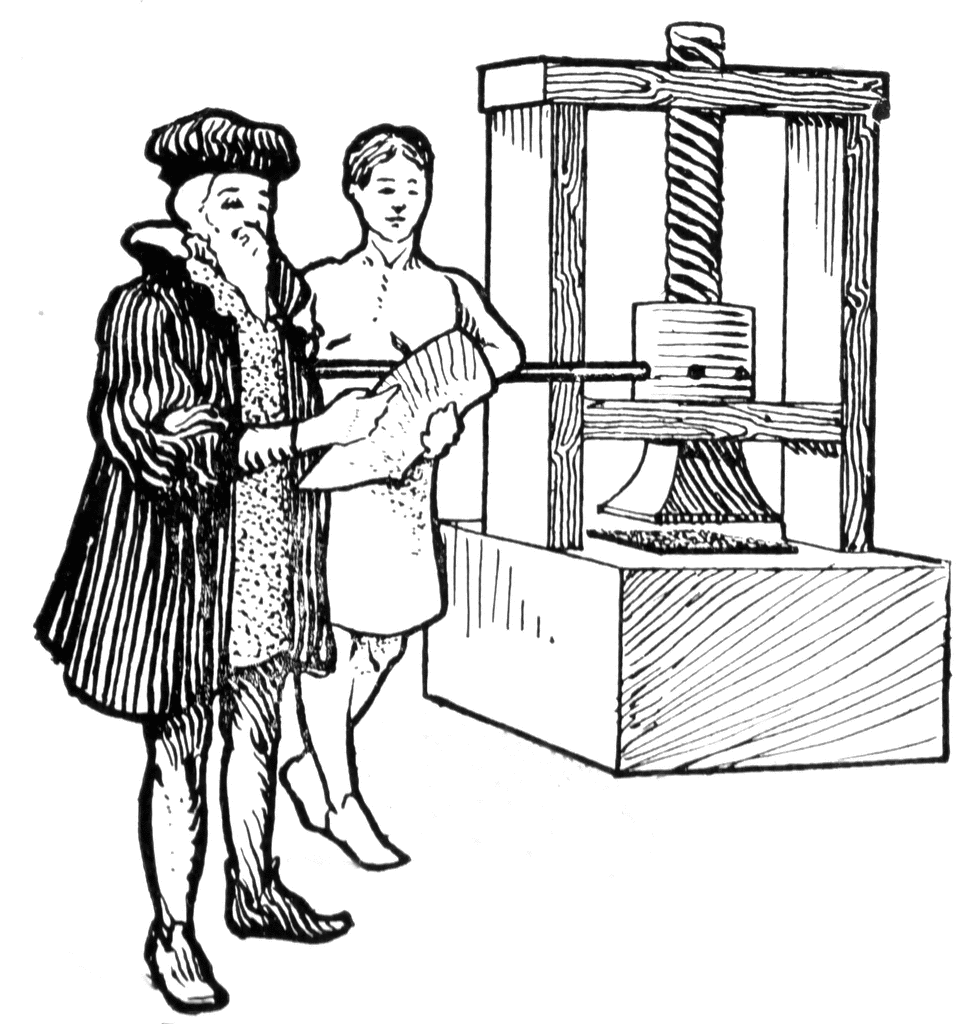
Slate has an interesting article about two new biographies of Frank Baum, the author of The Wonderful Wizard of Oz. One thing struck me as odd, though. Meghan O'Rourke writes that Baum published Oz in 1900, at the age of 44. After saying that he was a sickly, dreamy child, she continues
But he also reveled in newfangled inventions like the printing press (which, as a teenager, he used to put out a literary journal) and, later, bicycles, Model Ts, and movies.I'm baffled at the suggestion that the printing press would have seemed "newfangled" in the late 1800's. Seriously? It was invented in the 15th century and my scanty knowledge of U.S. history suggests it was commonly in use at least around the time of the American revolution (and most likely before, of course).
What am I missing?
Tuesday, September 15, 2009
Praxis II Trivia
Interestingly, according to this PDF from ETS, of states that accept or want the Praxis II test that I took ("Mathematics Content"), Colorado's required score of 156 is the highest. (A score of 165 apparently qualifies you for a "recognition of excellence" from ETS.) The median required score to pass, among states that use this test, is 136.
In 2004-2005 at least, apparently the median score on the exam was 143, and what Praxis calls the "average range" was 127-156. I'm not sure what an "average range" is. (The possible scores on this test go from 100 to 200.)
Anyway, here is a map showing the required passing scores for the various states. I left out Guam, but for the record you need a 124 to pass this in Guam.
 Click to embiggen.
I suspect the reason that Colorado wants such a "high" Praxis II score is that they'd prefer you to take the Colorado-specific PLACE test instead, which is more specific (I guess) to their needs. So if you insist on having the Praxis instead, they want a really good one.
Monday, September 14, 2009
Living Among the Humans
Sometimes I feel like I have no idea how to do it.
Yesterday, Ed and I went over to the house of our couple friends to discuss some things that went on between us last week and to play some kind of a game. The discussion went really well and was very reasonable, though my feelings were still bruised from the stuff last week. Then we sat down to play Settlers of Catan. (We played one of the many extensions and we played on a gigantic board.)
Settlers of Catan is a resource-management strategy game that involves dice-rolling and trading cards and (in the extension we played) a barbarian who topples cities. There are five types of resource cards and three types of commodity cards (or maybe vice versa - I forget which is which). There are three dice, all with different import. There is a lot of trading between players. It's actually a pretty fantastically fun game that is not as complicated as it sounds.
One of the things that happens in this game is that every so often, the barbarian arrives on our (collective) shores. One of the things you can "build" in addition to settlements, cities, and roads is soldiers. Soldiers drive off the barbarian. If we collectively have as many soldiers as cities, the barbarian is thwarted, and the person with the most soldiers gets a special reward. If we do not, then the player or player(s) with the fewest soldiers lose a city (it is downgraded to a settlement).
So, at a certain point in the game, Ed and I each had a soldier, Christine had several soldiers, and Adam had no soldiers. We had exactly as many soldiers as cities, which is enough. It was my turn, and I was able to upgrade two settlements to cities! And as a result, when the barbarian came on the next roll, Adam lost a city. Had I not built my two cities, he wouldn't have lost the city, because prior to that point we had enough soldiers.
My experience with Adam is that he becomes very frustrated when any plan he had in a game is thwarted, or things don't go his way. This doesn't normally manifest at the end of a game that he's lost, but happens throughout the game. So on this occasion, Adam was upset that I caused his cities to be toppled, and he was (according to his claims) more upset because I had done this without even considering it. In other words, intentionally exposing him to the barbarian would have been one thing, but doing it carelessly was annoying.
I, of course, do not believe that in a zero-sum game I have any obligation whatsoever to pay attention to possible negative impacts my actions may have on others. At least, I don't have such an obligation to them; it of course may behoove me to be alert so that I can screw them over as much as possible.
So he griped about this a bit, and then we continued playing. And then the topic came up again (possibly as a result of another barbarian attack) and he gave me more shit about it. This wasn't friendly shit-giving of the ordinary kind you might have in a game, but to all appearances an expression of actual annoyance and anger over my behavior.
I got really upset and said, "Fuck you." I almost quit the game, but instead I basically sat there and cried (briefly). I was still hurt from the thing earlier in the week, remember. It of course became a pretty awkward moment around the table; everyone sat quietly and watched Ed's turn. After a little while, things returned to normal.
And then he brought it up again, bitterly. (He would deny that he brought it up. I think what happened was that Christine mentioned that Ed was the only one of us who hadn't been close to winning - the rest of us had all gotten close at one time. And then Adam went off on the barbarian thing again.) Of course, we argued with him each time (we being mostly me and Christine). But this third time I banged my hand on the table (causing pieces to jump) and basically stormed out of the room. (In the interest of fairness, I should report that I shouted, "I am sick of being hated all the time for no reason!") When I came back, we had an argument that eventually devolved into yelling. Christine started to cry. I left. Ed put his hand on Christine's shoulder and Adam told him, "Just go," so he put on his shoes and joined me in the car a couple of minutes later.
Sitting in the car, I was just...wow. Fuming. And very pumped up with adrenaline, like exhaling very heavily and shaking. And a little blood-sugar-crashy. Ed was angry as well (at Adam, not me). I drove us home, trying to kind of calm down and chill out. At home, Ed made me some spaghetti and I continued to mostly feel like crap for the rest of the evening.
It's pretty clear to me that whining and griping about someone's completely legal and predictable move during a game is obnoxious behavior. I also shouldn't have taken it personally and flipped out, but I guess I finally reached my limit of dealing with Adam's bullshit. (I don't flip out all that often, but I wish I would learn how not to do that.)
What bugs me is that I've always basically put up with Adam doing that crap in the past, and maybe I shouldn't have. I want to travel back in time and, every single time he pulls that shit, tell him to stop being a whiny little crybaby when things don't go his way. And then just walk away, quit the game (whatever game it is), if he doesn't cut it the fuck out. Maybe coddling people and tolerating their flaws isn't doing them (or me) any favors, in general.
But how do you get along with people without tolerating their flaws? I have flaws that other people surely must tolerate in order to be in relationships with me. I generally try to assume that people are acting in good faith and working on their own shit as best they can. I don't want to become extremely intolerant and turn into one of those people who heads is all filled up with lines that other people shouldn't cross, etc.
I really do not know how one is supposed to relate to other humans.
Saturday, September 12, 2009
Takin' the Praxis II
This morning, bright and early at 7:30, I took the Praxis II Mathematics Content exam, accepted for secondary math certification in many states, including Colorado. I took it at East High School, a grand old school (built in the 20's) full of marble and hardwood, high-ceilinged, yet still with that sort of dingy quality of any urban high school. It sits just past the entrance to City Park - it is the city-hall-type building you see here:

The two pillars in the foreground are across the street from the high school. Grand, no?
While other Praxis takers (and some kids waiting to take the ACT) waited in the lobby for things to begin, I wandered the halls a bit. The classrooms all have enormously high ceilings and are more spacious than our classrooms at Metro, but also dirtier and more disheveled. (The dishevelment isn't surprising; a high school teacher's classroom is also their office.)
The test took two hours, and leaving early was forbidden. (You could go to the bathroom or whatever, but otherwise had to stay the entire two hours.) The test I took was 50 questions long (some of the other people had 120-question exams, in other subjects) and basically covered material from algebra, Calc I (possibly II), linear algebra, high school geometry, and prob/stats, with a slight sprinkling of other topics.
Like most tests by ETS, some of the questions can be solved either by brute force or in some simpler way. I probably brute forced most of them.
Although the topics I listed are broad, the questions about them were not deep. They were basically questions that you could answer if you remember the basic ideas about calculus, linear algebra, and so on. For instance, I did not have to actually differentiate or integrate anything, but I did have to do things like recognize when a graph showed the first derivative of another graph, or understand the nature of of integration as "area under the curve."
I got through the 50 questions and was able to review about 13 of them before the time was up. I did find some errors in my review, which is (a) good, because I fixed them, but also (b) bad, because it means there were probably errors throughout.
At any rate, I almost certainly passed, and nobody cares about the specifics of your scores in this area. My certainty about passing isn't based just on the fact that in general the test was extremely doable, but also on the idea that, if they wanted a better performance than I gave, there would be extremely few new high school math teachers.
So that's that.
Friday, September 11, 2009
Different Approaches to Intellectual Integrity
I was having a conversation today with a work friend ("Jim") about how to best handle differences of opinion on factual issues. By "factual issues" I mean things you can find out a definitive answer to, like what year the CIA was established or whether there are any Target stores in Canada, but I think Jim was also talking about differences of interpretation related to our work, like how likely recovering a certain amount of oil from a certain field is.
I have friends who seem to handle disagreements like this badly, and I myself am often overconfident in my opinions. I try pretty hard to temper my overconfidence by admitting that I may be wrong even when I am pretty sure I am not wrong (and admitting it with more force when I feel less sure), and by admitting to having been wrong once that's been shown.
Jim said, quite sincerely, that when he enters into discussions like those, he views them as an opportunity to exchange views and learn, and since he does not feel attached to the views that he holds ("attached" in the sense of feeling ownership of them, or feeling responsible for them), it is easy for him to let a conversation take its course so that the different ideas can emerge and settle. I have seen Jim in action and can confirm that he really is like this, almost to a fault; in fact you can find circulating our office a list of Jim's phrases and what they really mean, e.g.,
"That's a really interesting interpretation" -> "You are completely full of shit."
("That's a really interesting interpretation" might read as sarcastic, but would not sound at all sarcastic when he said it, and he would not mean it sarcastically, as best I can tell.)
I partly admire Jim's detached, Buddhist-like attitude in these matters, but my approach is different. What keeps me in line (to the extent that anything does) is a concern for intellectual integrity. It is not right to express unwarranted confidence, refuse to see new evidence, or fail to admit that you've been proven wrong. (Because otherwise I am really always rather sure I am right, and it's important to me, and I feel some loss of face when it turns out not to be the case.)
Jim said that, by doing what I do, perhaps I hope that in the future, people will know I am a person of integrity and will be more inclined to listen to me. Or, when I continue to insist that I am right, they will believe that I have some reason to think so and am not merely stubborn. And that is true - I do hope that - but I think I'm more motivated by the rightness of it.
I don't mean to talk like I succeed at this all the time, by any means.
Mosch and I had a different way of handling these arguments, which was that we would bet $1 on anything we disagreed about that could be confirmed one way or the other. Betting $1 puts everyone on the record about their opinion, and then you establish a winner, and the loser (note the language - winner, loser) has to actually produce and hand over a dollar bill. You can't claim you didn't really mean it or you were pretty sure you were wrong or any of that, because, let's face it, you hoped to profit off of your friend's wrongness.
Ed and I sometimes bet $1 also - most recently over my claim that "The Star-Spangled Banner" was written from on board a ship. Ed thought I was claiming it was written during a naval battle, but I'm not sure I had a real opinion on that issue; I just had the sense of that Francis Scott Key was on a ship. We determined it was not a naval battle but it was aboard a ship, and I don't think we ever actually settled up. (Now that I know the outcome I'm not sure what my opinion on the "naval battle" question actually was, but I think Ed and I may have been betting on different things - me, that Key was on a ship, and Ed, that it was not a naval battle. Ed thought I was claiming that the flag Key was looking for was on another ship, and that's not how I had pictured it.) (We were watching fireworks at the time. What can I say?)
Anyway, long-winded digressions aside...how do you keep yourself honest and/or appropriately humble?
Test Design
Our first real analysis test is coming up next Wednesday, and the other night in class we discussed its design. Dr. P has posted to the course website the first test from the last time he taught this (several years ago), and it was basically structured like this:
Part I - several mandatory questions that are fairly "easy," such as definitions, logical manipulations, and the like, for about 60% of the grade
Part II - several proofs, of which you had to choose a few, for the remainder of the grade
He intends to keep a similar format, but pointed out that, although the point of Part I is to allow you to get the bulk of the points for some fairly easy questions, in practice many students actually more or less bomb Part I.
A small digression, actually, over the topic of "definitions." Some of what we have to know for this test are various math definitions. I wouldn't normally be a fan of needing to memorize definitions for an exam, but that's because in most subjects, it's more important to know what something is than to know its definition. In math, a thing is its definition, and you need to know the definition in order to do proofs or make new theorems about the thing. For instance, if I have to prove that 3/5 is a rational number, I will need to know that a rational number is one that can be written as one integer divided by another.
Anyway, he could expand Part II (the proofs) to be be more of the points, but doing proofs as part of an exam is difficult, and he doesn't think he could realistically ask us to do more than about three in total, even if that was the whole exam. And in that case, if you seriously whiff on one of them, you're already down to a D, which is pretty harsh. He'd rather keep it so that each individual proof is worth no more than about 15% of the total exam score.
He was also talking about comprehensive exams in graduate school, where you might have six proofs to work on. He said that turning in two nearly-perfect proofs might be a pass, but turning in two nearly-perfect proofs and one garbage proof would probably make you fail, because it's important that you know the difference between math and garbage, obviously. Then he reassured us that he won't grade us in such a fashion. (Imagine if particularly stupid answers actually resulted in negative credit. People would flip. It's kind of amusing to think about.)
So he settled on making us do two proofs in Part II, in addition to a certain obligatory proof promised as part of Part I. It was brought up that he could let us turn in more than two proofs (since there will be several to choose from), and then grade them all and give us credit for the two best ones. He doesn't want to do that, though, because he fears that we will then hurry to write several proofs, and they will all be more mediocre as a result. He doesn't want us just "flinging stuff at the wall to see what sticks." I suggested that it is also much more horrible to grade 5 bad proofs than it is to grade 2 better proofs. (5 is more work than 2 anyway, but when you add in the expected difference in quality it gets horrible to contemplate.) He finally compromised and agreed that we could turn in 3 proofs and he would count the best 2. No more than 3, though! If you write more than 3, you have to pick out the best 3!
I'm looking forward to the exam. I'm pretty comfortable with most of this material, though I intend to do some more review, and I like how the test design looks.
Thursday, September 10, 2009
The Next Plan
When I graduate in May, I'd like to get a job as a teacher. Yes, I finally want to really try teaching secondary (middle or high school) math. I'm ready to jump in.
The obvious way to do this would be to apply for math teaching jobs here in Denver. If I were to be hired by a principal, it would be contingent upon my enrollment in the "Teachers in Residence" alternative certification program, which I can do at my current college.
What I don't know is whether I can actually get hired. On the one hand, math and science teachers tend to be in somewhat short supply, so it's much more favorable than if I were trying to go teach, say, social studies. But on the other hand, my understanding is that Denver has a pretty tight job market for teachers. I imagine a principal would rather hire a certified teacher than an alternative certification candidate with no experience. (I have no relevant experience at all, not even tutoring.) And it's possible the sucky job market has flooded the alternative certification programs with laid-off engineers and the like as well.
I could also try to do alternative certification somewhere else, where there might be more opporunities, like Houston (which has an easier, cheaper program and higher teacher salaries) or wherever Ed moves to for his PhD. That's another level of complexity to attempt, of course.
I could also graduate as planned and then do a post-degree teacher certification program through my school. I can't quite seem to figure out how many additional hours I would have to take, but that would take at least a year if I went full time, leaving me with the problem of how to support myself for a year with either no job or some kind of a part-time job. (One semester I would be student teaching, which would make it hard if not impossible to have any other job at all, and I don't think student teaching is a paid gig.)
Even more hardcore would be trying to enroll in a Master's program for math education, which could (if properly chosen) result in both certification and a higher salary. But that would be, I think, crazily expensive and definitely require going into debt. (It would also turn out to be futile if I don't end up liking teaching.)
I estimate that, if I were crazily frugal, I could live on about $1000/month right now (net, not gross), and it's quite possible that by next Fall I'll simply have $15-20K saved up and then I could just plan to live on savings for a year while pursuing certification. That's if Ed doesn't move away.
If Ed moves away, I'd need a much cheaper apartment (and they do exist in Denver) in order to live on either my initial teaching salary, or to go to school full time without a lucrative job.
So, why teaching? I've been interested in teaching forever, which was not surprising when I was a kid since that was the one profession I got to see up close, but which has persisted since. I find that I am somewhat obsessed with schools (I especially love books set in schools, even more so if they are really about school itself). I love to read books about how to teach, too.
Can I handle being a teacher? It's a really difficult and exhausting job. Yes, you get summers off, and a lot of other holidays and things, but you also work more than 8 hour days (at least if you want to be any good at all), deal with a lot of bureaucracy, wrangle the kids who are imprisoned in your classroom each day, constantly do paperwork and grading and so on, and the pay is not nearly enough to make up for the stress. That's my understanding, anyway.
However, I have found that currently, when I am not in school, I am horribly bored in the evenings and hate my life. Being a teacher would certainly take care of that problem since I would have a lot I needed to do all the time. And I have also found (as discussed many times before) that I enjoy things in proportion to their level of difficulty assuming I can do them, so I might enjoy the difficulty itself. And reading a book is very different from having to do something, but I have to guess that the fact that I enjoy books about classroom management techniques, how to set up your paperwork, and how to deal with troublesome kids in your class is a good sign. My fantasies about teaching don't involve a class full of attentive, bright-eyed students eager to learn algebraic concepts, so...well, maybe I'm not living in a total fantasy world.
Ed thinks this is a great idea, which I find somewhat astonishing. To me it sounds like a quite evidently bad idea, taking a > 50% pay cut to do a really difficult job that requires a lot of energy and dedication.
Of course, if it turns out that I really do like teaching (or like it well enough, all things considered), it's a very convenient career in a lot of ways. The pay is less than I make now but it's not that abysmal, at least in the places I've checked (i.e., major cities). You can live on it. It's an extremely convenient schedule for raising kids, of course, though it may be that teaching completely satisfies my desire to interact with children at all, ever. It tends to have good job security, and is a job you can get anywhere in the country, and the benefits are usually generous. Unlike oil & gas, it's not likely to collapse as an industry, nor be outsourced to India or China.
And given that I'm obsessed with it, I really need to go and try it. If I find out that I hate it or can't do it, well, I have the rest of my life to pursue other goals without worrying about it any further. If I don't do it, I'll keep thinking I should do it and wondering how. So, we'll see if I can even get such a job, or get into a program, but for now, that's my plan. I'm also taking the Praxis II secondary math exam this Saturday, which I'll need for the alternative (or any other) certification, and which is accepted in many states.
Tuesday, September 08, 2009
How Doctors Are Paid
I once read an article in Slate arguing (not that this argument is or was unique to Slate) that one of the big problems with health care is that doctors are paid on a fee-for-service basis. Obviously this encourages doctors to run more tests and do more procedures than are in patients' best interests. Of course, someone's life is also on the line in some cases, so it's not as though a doctor can't convince themself that a precautionary measure is a good idea. (At my last office visit, I was offered a $200 test - which might or might not be paid by my insurance - to check if I might have low Vitamin D, just in case I should start taking some additional Vitamin D supplement. I declined.)
Of course, the obvious drawback to not paying doctors on the basis of the services they provide is, well, what is then their incentive to do anything? Sure, you could pay them based on some stable of patients that they manage, but a fixed salary seems to encourage doing as little as possible to earn that salary.
Well, of course, you could try paying the doctors based on the health of that stable of patients. This will encourage good preventative care. It will also encourage doctors to not take on new patients who are likely to be sick, and it will mean doctors in richer areas make much more money (probably already true). I suppose you could pay doctors based on how their patients fare relative to expectations (the way some school systems try to) based on their socioeconomic status and starting health, but this gets into a lot of games.
And then, I enjoyed David Goldhill's article "How American Health Care Killed My Father" which argues (though I can't do it justice with a single quote)
But returning to the issue of doctor pay, which is an open question whether we have insurance or government footing the bill. My best guess is that different doctors respond differently to different incentives and that, assuming one system doesn't categorically pay better than another, it would be good to have different systems (some fee-for-service, some fee-for-patient, some fee-for-incident, and so on) and let each doctor choose the system that lets them do their best work.
Of course, the obvious drawback to not paying doctors on the basis of the services they provide is, well, what is then their incentive to do anything? Sure, you could pay them based on some stable of patients that they manage, but a fixed salary seems to encourage doing as little as possible to earn that salary.
Well, of course, you could try paying the doctors based on the health of that stable of patients. This will encourage good preventative care. It will also encourage doctors to not take on new patients who are likely to be sick, and it will mean doctors in richer areas make much more money (probably already true). I suppose you could pay doctors based on how their patients fare relative to expectations (the way some school systems try to) based on their socioeconomic status and starting health, but this gets into a lot of games.
And then, I enjoyed David Goldhill's article "How American Health Care Killed My Father" which argues (though I can't do it justice with a single quote)
The most important single step we can take toward truly reforming our system is to move away from comprehensive health insurance as the single model for financing care. And a guiding principle of any reform should be to put the consumer, not the insurer or the government, at the center of the system. I believe if the government took on the goal of better supporting consumers—by bringing greater transparency and competition to the health-care industry, and by directly subsidizing those who can’t afford care—we’d find that consumers could buy much more of their care directly than we might initially think, and that over time we’d see better care and better service, at lower cost, as a result.Goldhill's point is that a big problem is that patients don't really pay for their own care and, if you happen to be paying for your own care, it's impossible to find out what anything will cost anyway. There is really no way for consumers to comparison shop or determine what anything is worth to them personally.
But returning to the issue of doctor pay, which is an open question whether we have insurance or government footing the bill. My best guess is that different doctors respond differently to different incentives and that, assuming one system doesn't categorically pay better than another, it would be good to have different systems (some fee-for-service, some fee-for-patient, some fee-for-incident, and so on) and let each doctor choose the system that lets them do their best work.
Saturday, September 05, 2009
How to Learn Math from the Book
It is only recently that I've been able to learn math from a textbook without enormous mental strain. Even a year ago, I don't think I could. And the difference isn't that I've gotten smarter in the past year - it's that I've had to read and understand such difficult material that, through sheer desperation, I learned how.
The key (for me) is to write down what the book says.
Seriously. If the book has a definition, write it. Axioms, copy them out. Theorems, reproduce them on your paper word for word. If there is a proof, write it out, trying to understand each line. (If you don't understand it, just copy it down anyway.)
This seems like it wouldn't work. If you don't understand something when you read it, how can copying it help? I think it's very simple - writing is slow, so it forces you to read the words over and over at a very slow rate.
What about the parts you still don't understand? Again, for me, writing is key. Write down your questions, confusions, and speculation. You may very well answer your questions as you write.
This won't help with math that is too advanced for you to possibly understand, but it's awesome for math that you would understand if someone explained it to you. Of course, it requires work, so no wonder it took me 34 years to figure out. (Yes, I never, ever took notes from a book until recently.)
Friday, September 04, 2009
Linear Annoyance
I don't really understand why I am finding my linear algebra class so annoying this semester. The professor is pretty nice, I understand the material relatively well, and it's not like the other kids are beating me up and taking my lunch money. But I find myself really annoyed in that class.
First, I guess, it's the kind of classroom I hate - jam packed with desks that are a little too small for me to feel comfortable in, and fairly full of students. Last night the guy to one side of me kept resting his feet on one part of my desk, and the girl behind me (I think it was her) was lightly tapping my desk with her feet. I wanted to kill them both. The time before that, someone directly behind me was eating a bag of chips. There is no way to get any personal space in there, even in the basic ways.
My other class (advanced calculus, aka real analysis) is taught in a really straightforward fashion - the professor comes to class with an agenda, and he pushes us through it, showing us whatever axioms, theorems, lemmas, corollaries, proofs, and so on he has prepared. People ask questions and those questions are answered, but for the most part, it's a straight-up lecture, and it proceeds at a pace I can barely keep up with. I am usually exhausted by the end of the class (which also occurs at 8:50 PM, about 11 1/2 hours after I leave home in the morning), but I keep wanting to go back.
My linear algebra professor is much less planful. She will typically put our textbook under the overhead projector thing and show us some problem she wants us to work through, and then she'll collaboratively work through it with us on the board. People contribute their ideas, thoughts, questions, challenges, etc., continually, and eventually she takes us through the problem.
Perhaps partly because I've had the first half of this course before, the pace is really excruciating. Last night the first 45 minutes were spent reviewing what a function (or mapping) is, and those terms like "onto" and "one-to-one" that I have learned in several other classes already in my college career but that my classmates apparently had a lot of confusion over.
Eventually I tuned out and started working on some advanced calculus homework. I was able to get a fair amount of that done during the remainder of the class, but it was an annoying time, listening to people talk and ask questions and make [often wrong] assertions.
I've had classes that were more collaborative like this before, and that I enjoyed, like my discrete math class a couple of semesters ago. But discrete math only had about 12 students, and this class has about 25, which seems to make a difference for me.
I basically sound, even to myself, like a horrible person who has no tolerance for the learning processes of others. But I just find it very frustrating to sit in a room, as a student, and "get" things in 1/10th the time that is spent on them. It's like being in grade school again, listening to some kid try to read out loud, hearing him pause at the end of every line, trying to force myself to read along with him. I quickly give up and just read. (No wonder I was zoned out in classes so much as a kid.)
I also hate the way she (the prof) does homework. She assigns fairly hard problems, and when I do the homework I have to spend substantial time figuring them out and writing them up. I appreciate that. But then the class session before the homework is due, she encourages people to spend the first entire hour of class asking questions about the homework problems. And that makes me feel like either there wasn't much point to my doing the homework, or there isn't much point to my being in class now. (I admit I am ignorant of educational best practices, but I basically completely disagree with this use of class time. Homework help is what your fellow students and/or office hours are for.)
Did I mention she also takes attendance, and that "class participation" is 10% of our grade?
Tuesday, September 01, 2009
My Multicultural Great-Great-Grandmother
One of my Michael Pollan's suggested heuristics for eating is, "Don't eat anything your great-grandmother wouldn't recognize." He uses, as an example, Go-gurt:

which, he speculates, your great-grandmother wouldn't know whether to classify as a food or maybe some kind of balm. He also suggested that, depending on your age, you might need to go back more or less far to find a maternal ancestor who didn't eat the modern western diet.
I decided to go with my great-great-grandmother, and I am also assuming that I had several (this is true, of course) and that they were from a wide variety of cultures (which is probably not true). Since tofu has been eaten for several hundred (possibly thousand) years, it passes muster with my fictional great-great-grandmother, even though I doubt anyone in my actual lineage, above my grandparents, ever ate it.
My fictional GGGM wouldn't recognize some of the ingredients in Go-gurt, such as high fructose corn syrup, tricalcium phosphate, potassium sorbate, or carmine. On the other hand, she would recognize the ingredients of Stonyfield Farm strawberry yogurt: whole milk, strawberries, sugar, pectin, beet juice, natural flavor, and yogurt cultures.
This "rule" (which I'm not following strictly, but more sort of paying attention to) may have some merit on its own, to the extent that foods handed down to us from hundreds of years of culture are well-tested for eating compared to food additives invented in laboratories in this century, but I think it's better as a kind of proxy. Is this a fresh, natural food such as I might make in my own kitchen? If I had these individual ingredients around, would I use them in my cooking?
None of that guarantees healthy eating, of course. But I think, at least for me, trying to cook and/or use fresh, natural foods tends in the direction of healthy eating, because I'm not likely to cure my own ham or start saving up organic bacon grease to cook all of my greens in. My mental image of the kind of cooking and eating I'd like to do is definitely healthy. And it keeps me away from chain restaurant food, which is invariably engineered with mysterious chemicals.
So, thanks, fictional GGGM, for your fantastically healthy, ethnically diverse diet.
Subscribe to:
Posts (Atom)