I still need to write a teaching philosophy statement, but other than that, I'm all done with my first semester of grad school. Woot.
The analysis exam was not as dire as I had anticipated. We had to do 6 problems out of 9, and I finished 5.5 problems. I don't think my answers were completely correct, but the fact that I'll be getting graded out of 90+ points is very cheering. I got a 55% on the midterm and I don't think I'll have less than a 75% on this exam, so that's a large improvement. Given that our professor has told us not to worry about grades (including telling one woman who did much worse than I did on the midterm specifically not to worry about her grade), I'm expecting a B in this class.
The logic final (our only exam in that class) was today. As expected, it consisted of basic skills from the class rather than proofs or things that required us to have memorized a lot of the theorems and tricky things from the assignments. Given that I needed less than 50% credit on it to have an A in the course, I'm fairly secure in that A.
I also think I'll have an A in probability and in my math pedagogy class. That gives me a good GPA for the semester and means that I passed all of my courses (meaning that I got at least a B), which is really what counts. So: woot!
I need to do better in analysis next semester, though. The main key in that class seems to be working through the exercises in the book, so I'm going to plan to do that. Another student in the class and I are planning to work together to read the sections and work on the problems before the material is taught in class, so that if we have questions we'll know what they are in advance. We'll see how that works out, but hopefully I'll have time; I think my course load will be easier this coming semester. (I will need to make time whether I have time or not.)
Now I have a month off. I feel weird about it already. The next semester doesn't start until mid-January. (Yes, this is where you people with real jobs can want to kick my ass. Believe me, I get it.)
Coming up next semester: statistics, the second half of real analysis, and an introductory topology course.
Wednesday, December 15, 2010


Monday, December 13, 2010
The Probability Exam
Today, we had our final exam in Probability. I got a perfect score on the (very easy) first exam, and then did very poorly on the second exam. Fortunately, the two questions I couldn't answer on there (worth 32/100 points) were left mostly blank by the vast majority of the class, and the professor took them away, so that I ended up with a 90%. Nevertheless, it was a bad testing experience.
I had had an analysis exam the previous day, that I'd done very poorly on, and as I sat to take the probability exam I was exhausted and really couldn't think straight. I hadn't prepared well for it at all, and couldn't do basic things like subtract correctly (even using a calculator) or perform simple algebra tasks, much less think creatively about problems.
I felt reasonably well-prepared for this exam - the last few weeks, the material has seemed to come together for me much more than it did in the middle of the course, and I had good formula sheets written up - but I also worked hard to be rested, correctly fed, hydrated, etc., for the exam. I knew that I would need (because both probability and tests in general demand it) mental flexibility in order to be able to answer the questions.
And I did it. I completely killed the exam - I should have a perfect score, or at least within epsilon of a perfect score. (Really I could have as low as a 95% - who knows what weird errors I could have made - but I definitely got the questions basically correct.) And I didn't just kill the exam by being prepared; I killed it by being smart (relative to my baseline) and mentally flexible.
One question asked us something about three independent random variables, each uniformly distributed on the interval [0,1]. (For the "probabilists" out there: we had to determine the CDF and expected value of the minimum term. Pretty easy stuff.)
The next question asked us to consider the same three variables, and then had some questions that only involved two of the variables. I had a few moments of confusion (of the type that totally derailed me on the secon exam) before realizing that the irrelevance of the third variable meant I could draw the standard [0,1]x[0,1] box and fill in the areas I was being asked about and do the computations using areas (e.g., "What is the probability that Y1 > Y2 given that Y1 > Y2^2" - which is the just the ratio of two areas, given that the distribution is uniform).
The exam wasn't hard either, I should admit, but it did take me just about the entire time.
There were five problems (some with multiple parts) worth 15-20 points each, and then the sixth problem was worth 6 points. He's urged us to consider these last problems as pretty much optional, even though they are part of the full score. If you make sure you can do the basic problems, then it's OK if you can't do the fancy problem. But this fancy problem turned out to be exactly the type of fancy problem that I am good at. It went something like this:
I have my analysis exam tomorrow, which is triple express doom, and then the (low-stakes) logic exam on Wednesday. After that, I have to write a [maximum] 3-page teaching philosophy and fill out a short survey for one of my courses, and then I'm done.
I had had an analysis exam the previous day, that I'd done very poorly on, and as I sat to take the probability exam I was exhausted and really couldn't think straight. I hadn't prepared well for it at all, and couldn't do basic things like subtract correctly (even using a calculator) or perform simple algebra tasks, much less think creatively about problems.
I felt reasonably well-prepared for this exam - the last few weeks, the material has seemed to come together for me much more than it did in the middle of the course, and I had good formula sheets written up - but I also worked hard to be rested, correctly fed, hydrated, etc., for the exam. I knew that I would need (because both probability and tests in general demand it) mental flexibility in order to be able to answer the questions.
And I did it. I completely killed the exam - I should have a perfect score, or at least within epsilon of a perfect score. (Really I could have as low as a 95% - who knows what weird errors I could have made - but I definitely got the questions basically correct.) And I didn't just kill the exam by being prepared; I killed it by being smart (relative to my baseline) and mentally flexible.
One question asked us something about three independent random variables, each uniformly distributed on the interval [0,1]. (For the "probabilists" out there: we had to determine the CDF and expected value of the minimum term. Pretty easy stuff.)
The next question asked us to consider the same three variables, and then had some questions that only involved two of the variables. I had a few moments of confusion (of the type that totally derailed me on the secon exam) before realizing that the irrelevance of the third variable meant I could draw the standard [0,1]x[0,1] box and fill in the areas I was being asked about and do the computations using areas (e.g., "What is the probability that Y1 > Y2 given that Y1 > Y2^2" - which is the just the ratio of two areas, given that the distribution is uniform).
The exam wasn't hard either, I should admit, but it did take me just about the entire time.
There were five problems (some with multiple parts) worth 15-20 points each, and then the sixth problem was worth 6 points. He's urged us to consider these last problems as pretty much optional, even though they are part of the full score. If you make sure you can do the basic problems, then it's OK if you can't do the fancy problem. But this fancy problem turned out to be exactly the type of fancy problem that I am good at. It went something like this:
An urn contains 6 red balls and 14 blue balls. Two balls (selected at random) are removed and discarded without noting their colors, and then another ball is drawn. Given that this last ball drawn is red, what is the probability that both of the two discarded balls were blue?This is exactly the kind of thing where if you just draw a little probability tree it is pretty obvious how to compute it. (I shouldn't say it's "obvious." Many things in probability should be obvious but take me a long time to figure out or I can't figure them out at all. But this type of problem is intuitively easy for me, for whatever reason.)
I have my analysis exam tomorrow, which is triple express doom, and then the (low-stakes) logic exam on Wednesday. After that, I have to write a [maximum] 3-page teaching philosophy and fill out a short survey for one of my courses, and then I'm done.
Monday, December 06, 2010
Heartbroken
My life is so weird and messed up lately, and the worst part of it, I feel like there is almost nobody I can talk to about it other than Ed. It feels like he is the only one who actually understands all of our bizarre circumstances well enough to get it. But talking to him is hard on both of us.
I can't get over him and our break up, and I don't even know how to try. I feel a deep bond and partnership with him that isn't going away. I miss every single thing that we had together and no longer have. A lot of the time I would do anything to go back a few weeks and do things differently. (I'd go back further than this, but even the night he broke up with me I didn't make an effort to stop him. We had just started making things better. But I was so worn down and it felt so inevitable that he was leaving me - he had been so relentlessly dissatisfied - that I couldn't fight it anymore.)
I can't express even these simple feelings to people very well, because I just don't say ridiculous things to people even when I feel them. I think this makes me seem robotic or something, but I don't know how to change that about myself. Also, I don't want to say bad things about him to our mutual colleagues (and, even if I'm sometimes tempted, the truth is that in my heart of hearts I don't think he did anything wrong, and he's been amazingly kind and supportive all along).
It would probably help if I didn't see Ed all day every day, but I don't want him to go away either. I certainly can't stand the idea of moving or of having him move and then having to get a new roommate. I want us to continue having this close friendship that we still have.
My life is just really hard right now.
I can't get over him and our break up, and I don't even know how to try. I feel a deep bond and partnership with him that isn't going away. I miss every single thing that we had together and no longer have. A lot of the time I would do anything to go back a few weeks and do things differently. (I'd go back further than this, but even the night he broke up with me I didn't make an effort to stop him. We had just started making things better. But I was so worn down and it felt so inevitable that he was leaving me - he had been so relentlessly dissatisfied - that I couldn't fight it anymore.)
I can't express even these simple feelings to people very well, because I just don't say ridiculous things to people even when I feel them. I think this makes me seem robotic or something, but I don't know how to change that about myself. Also, I don't want to say bad things about him to our mutual colleagues (and, even if I'm sometimes tempted, the truth is that in my heart of hearts I don't think he did anything wrong, and he's been amazingly kind and supportive all along).
It would probably help if I didn't see Ed all day every day, but I don't want him to go away either. I certainly can't stand the idea of moving or of having him move and then having to get a new roommate. I want us to continue having this close friendship that we still have.
My life is just really hard right now.
Wednesday, November 24, 2010
Zu Ende
Ed and I began dating in May of 2007. Last night, we broke up.
It's been an interesting and mostly great three years, but I won't get into all of that now. Why did we break up? Well, I keep thinking that it's a long and complicated story, but I think that really it is a short and simple one.
My relationship with Ed has always required high inputs of energy. It has been a high-drama, high-maintenance relationship, which has mostly suited me well.
But grad school takes up all of my energy. It's not that I don't have time left over for talking or hanging out or whatever, but I don't have mental energy and space left for being an extremely involved partner. I was thinking about this last night, and what I think is, I could only be a really involved partner to someone new (where you have that crazy "new relationship energy") and, if that happened, I would probably fail my classes, because I really can't do those two things at the same time. Maybe if it were someone more studious than I am and also in grad school, then it would work out, but otherwise, I don't see how it could. (I am certainly not looking.)
Ed tried to deal with my benign neglect as best he could, but it made him increasingly hurt and angry. This came up a week or so ago in a big way and we made some changes to try to resolve it, but I think the changes were too little, too late, and last night he decided to call it quits.
It wasn't a big surprise. I had felt (and said, a few days ago) that I thought our breaking up might be inevitable. There was a lot that I valued in the relationship - so much that I couldn't decide to break up with him myself - but there was no more that I could do to fix things, I didn't think. I decided to proceed as though the relationship would continue in the best possible way and let the chips fall where they might. And this is where they fell.
We are still friends. I consider it nobody's fault that the romantic part of the relationship is over. (I started to say that it was nobody's fault that it "didn't work out," but it did work out, very much so, and the fact that it was of limited duration doesn't change that.) I don't think either of us is moving out of our shared apartment anytime soon, so we will have to get through this awkward stage of being newly broken up. I think we will.
Thanks for three and a half great years, Ed.
It's been an interesting and mostly great three years, but I won't get into all of that now. Why did we break up? Well, I keep thinking that it's a long and complicated story, but I think that really it is a short and simple one.
My relationship with Ed has always required high inputs of energy. It has been a high-drama, high-maintenance relationship, which has mostly suited me well.
But grad school takes up all of my energy. It's not that I don't have time left over for talking or hanging out or whatever, but I don't have mental energy and space left for being an extremely involved partner. I was thinking about this last night, and what I think is, I could only be a really involved partner to someone new (where you have that crazy "new relationship energy") and, if that happened, I would probably fail my classes, because I really can't do those two things at the same time. Maybe if it were someone more studious than I am and also in grad school, then it would work out, but otherwise, I don't see how it could. (I am certainly not looking.)
Ed tried to deal with my benign neglect as best he could, but it made him increasingly hurt and angry. This came up a week or so ago in a big way and we made some changes to try to resolve it, but I think the changes were too little, too late, and last night he decided to call it quits.
It wasn't a big surprise. I had felt (and said, a few days ago) that I thought our breaking up might be inevitable. There was a lot that I valued in the relationship - so much that I couldn't decide to break up with him myself - but there was no more that I could do to fix things, I didn't think. I decided to proceed as though the relationship would continue in the best possible way and let the chips fall where they might. And this is where they fell.
We are still friends. I consider it nobody's fault that the romantic part of the relationship is over. (I started to say that it was nobody's fault that it "didn't work out," but it did work out, very much so, and the fact that it was of limited duration doesn't change that.) I don't think either of us is moving out of our shared apartment anytime soon, so we will have to get through this awkward stage of being newly broken up. I think we will.
Thanks for three and a half great years, Ed.
Monday, November 08, 2010
Small Revelation about Time Management
Grad school life has been pretty great for me so far, but the major thing that I struggle with is getting work done. I don't usually have an actually overwhelming amount of work to do, but I waste a large number of hours each week procrastinating or trying to start working, when if I just worked I would have more free time to do things like read.
I have, however, realized one thing that has made a big difference over the past few weeks, and that is that I really hate doing things at the last minute. When it's "do or die" and you will stay up all night to finish something due the next morning, it feels like some giant metal rod is pressing against you. Sometimes the thought of doing the work is intolerable but, of course, not doing it at all is unthinkable.
The "correct" way to avoid this is to do the work ahead of time, but I sometimes struggle with that. My revelation is that just moving that "last minute" point up by a day has a huge impact. So my current strategy is staying up all night the night before the night before something is due, rather than just the night before.
You would think it wouldn't matter or help. Staying up all night is staying up all night, right? (I've not literally had to stay up all night yet; I'm using the term loosely.) But it actually makes an enormous difference to me. I have that "I am not going to bed until I [more or less] finish this" urgency to keep me going, but without the horrible iron bar feeling. Instead, I have the virtuous and enjoyable feeling of kicking ass by getting something done early. Also, once I get to the point where I have only a little bit left to do, I can leave off and finish up the next day with minimal stress.
It's sort of exciting to have a working, specific strategy to avoid being crushed by things at the last minute.
I have, however, realized one thing that has made a big difference over the past few weeks, and that is that I really hate doing things at the last minute. When it's "do or die" and you will stay up all night to finish something due the next morning, it feels like some giant metal rod is pressing against you. Sometimes the thought of doing the work is intolerable but, of course, not doing it at all is unthinkable.
The "correct" way to avoid this is to do the work ahead of time, but I sometimes struggle with that. My revelation is that just moving that "last minute" point up by a day has a huge impact. So my current strategy is staying up all night the night before the night before something is due, rather than just the night before.
You would think it wouldn't matter or help. Staying up all night is staying up all night, right? (I've not literally had to stay up all night yet; I'm using the term loosely.) But it actually makes an enormous difference to me. I have that "I am not going to bed until I [more or less] finish this" urgency to keep me going, but without the horrible iron bar feeling. Instead, I have the virtuous and enjoyable feeling of kicking ass by getting something done early. Also, once I get to the point where I have only a little bit left to do, I can leave off and finish up the next day with minimal stress.
It's sort of exciting to have a working, specific strategy to avoid being crushed by things at the last minute.
Thursday, November 04, 2010
Prank
Just a story I enjoyed...
When my real analysis professor was a graduate student, he had a Number Theory professor who made the homework sets available by leaving copies at local copy shops, where you would go and pay for them to make a copy of the problem set for you. One time, the week before an exam, the professor hadn't left any problem sets, so my now-professor and his pals typed up a page of unsolved problems in the field and left them for the other students.
When my real analysis professor was a graduate student, he had a Number Theory professor who made the homework sets available by leaving copies at local copy shops, where you would go and pay for them to make a copy of the problem set for you. One time, the week before an exam, the professor hadn't left any problem sets, so my now-professor and his pals typed up a page of unsolved problems in the field and left them for the other students.
Sunday, October 31, 2010
LaTex Happiness
Whoa. Thanks to Lee (and the folks at watchmath.com), I can now put stuff like this
$\int_{a}^{b}f(x)dx$
on my blog. Aren't you glad? (Note that if you view this in an RSS reader it likely won't come up right. Sorry!)
$\int_{a}^{b}f(x)dx$
on my blog. Aren't you glad? (Note that if you view this in an RSS reader it likely won't come up right. Sorry!)
Sunday, October 24, 2010
Today's Accomplishments
Life is hard around here lately. School kind of ate me, and I'm waiting to see if I will agree with its digestion. (I'm not sure which outcome to prefer, frankly.) I'm not technically "behind" at anything right now, but I still feel I'm being crushed. At any rate, here are my accomplishments for today:
 Despite the above, it hasn't felt like a very productive day. I can't tell what is or is not productive. I'm pretty sure I didn't work anywhere near 8 hours, which is a standard work day. My program doesn't seem, so far, to require that amount of work. Yet the amount of work that it does require feels like it might be beyond me. And yet, I'm basically crushing (with enormous effort) my classes so far, and, as I said earlier, I don't think I'm actually behind on anything. So I don't know what to think. I feel like a person driving a car that has lost control of steering and brakes but who happens to be going down a straight freeway with no traffic...for the moment.
At least this isn't as bad as Tuesday night, when, as I stayed up until 4AM to finish my logic homework, I kept thinking about how grad school was pitting the intolerable (finishing the homework) against the unthinkable (not finishing it).
- Wrote up the last lecture of analysis notes. (I rewrite, with additions/modifications/clarifications, the notes from each analysis lecture. This is critical to my understanding and ability to reference the material later. Lately I was several lectures behing, but I am now caught up.)
- Talked to Ed about a couple of things I didn't understand from the analysis notes. We were able to resolve them together.
- Looked extensively at the two problems on this week's analysis homework. I solved (I think) the first problem, which I typed up in LaTex. The second problem was less tractable but I identified some of the difficulties I have with it, and thought about those for a while.
- Typed up the Logic homework problems. I haven't started working on this homework yet, and I think we haven't covered almost anything that is on the homework (due 11 days from now), but at least the problems are typed up, so I can modify this document when I'm ready to start working. Also, by typing up the problems, I now have a much clearer idea of what the homework entails. ("Entails," ha ha ha.) These homeworks have typically been 15-20 pages of dense handwriting on college-ruled paper, so I've decided to experiment with typing this one up instead of killing my hand. (My right middle finger has developed a chronic bruisey ache when I write by hand for more than an hour or so at a time.)
- Tested the draft lecture notes I wrote for the 10-minute mini-lecture on completing the square that I might have to deliver on Wednesday (but probably won't deliver until the next week). My first draft took 12 minutes to deliver, which is pretty good, so I revised it downward. The second draft took 14 minutes. Oops. I have done a third draft but I didn't have the heart to deliver this (complete with writing on the board, of course) to an empty room for the third time, so that will have to wait.
- Brought my Probability book home from school so I can finish up the homework due Wednesday (which was posted to our course website yesterday, when I did about 3/4 of it when I saw that it had shown up).
 Despite the above, it hasn't felt like a very productive day. I can't tell what is or is not productive. I'm pretty sure I didn't work anywhere near 8 hours, which is a standard work day. My program doesn't seem, so far, to require that amount of work. Yet the amount of work that it does require feels like it might be beyond me. And yet, I'm basically crushing (with enormous effort) my classes so far, and, as I said earlier, I don't think I'm actually behind on anything. So I don't know what to think. I feel like a person driving a car that has lost control of steering and brakes but who happens to be going down a straight freeway with no traffic...for the moment.
At least this isn't as bad as Tuesday night, when, as I stayed up until 4AM to finish my logic homework, I kept thinking about how grad school was pitting the intolerable (finishing the homework) against the unthinkable (not finishing it).
Wednesday, October 20, 2010
Fiasco Week
The past couple of weeks, before this one, have been pretty easy. I knew that they were going to be pretty easy because I didn't have any logic homework due until this week and nothing big was happening in my pedagogy class, leaving only the normal weekly analysis and probability homework. And the first of these two weeks, I worked hard to make sure I was doing enough not to make this week hellacious. But last week I didn't do very well, and in fact I am not sure I accomplished anything at all Thursday through Saturday aside from attending classes.
This morning, our third mammoth logic homework was due. It had 10 problems. We usually have two weeks for these homeworks, but our professor was out of the country for a week, so we had three weeks for this. Last night I had finished the 8th problem by 8:30, so I had two more problems to do.
I finished (mostly) at 4:19 AM. And...ugh. That is just way too late to be up doing homework. Part of the reason it took so long is that sometime after 8:30 I just really broke down. I had a bad headache, I felt hopeless about the derivations that I had to do, and I just...I don't know. A friend from our program invited me over to her house, and I went, and working with her was great, but didn't prevent me from falling apart.
I skipped logic class this morning (got Ed to turn in my homework for me) and slept in until 12:30, then barely made it to my probability class on time at 2. (Thank goodness I had finished my probability homework, also due today, some days earlier.)
Tomorrow I have analysis homework due. We get this homework once a week and it's always one problem. Sometimes the problem is fairly tractable and other times it fills me with despair, but so far I have always gotten them done on time, correctly, for full credit, so that's promising. This is my little mountain to climb each week, and doing them, and doing them well, fills me with a lot of joy every time.
I am almost always either completely finished by Monday or I basically know what I'm doing and just need to clean up the execution a tiny bit during the week. But even though this one is due tomorrow, I still don't know how to do it. I did work on it a little bit (read: four pages worth of notes' worth of work) on Saturday, but I didn't get anywhere with it. I do have things I can try next, so I don't feel hopeless quite yet, but I'm not in a great position.
Another thing I do every week is neatly rewrite my analysis class notes, filling in the missing details and making sure that I understand them. I'm three lectures behind on doing that (there are two lectures each week), so that's not great either.
I think one thing that I need to do is regularize my sleep schedule. I have morning classes M/W/F but only afternoon classes T/Th so it's always very tempting to sleep in on those days, especially if I've stayed up late the night before working on something, but really in any case. But I don't think that's doing any favors for my productivity overall, because it means there are more days on which I feel disoriented due to getting up at a strange time.
I am also thinking of giving up caffeine (for the umpteenth time). It's getting to the point where I feel mentally dull all day until I have my tea, and that's not good, and last night's headache may have been caffeine-imbalance-related as well.
Now it's time for me to go tackle the analysis homework for real. What's unfortunate is that I am much more willing to work on something that isn't due yet than on something that is due soon. I don't like the feeling that I have to figure this out in the next, say, eight hours in order to have a legitimate shot of being able to turn in something decent tomorrow, and it makes me not want to look at it at all (or, you know, not yet).
Looking forward, next week should be a bit easier. We don't have a new logic homework yet, possibly because we have a (small) paper due in 2.5 weeks, and the only big thing I need to do other than next week's analysis is prepare and be ready to deliver a 10-minute mini-lecture on a college algebra/pre-calc topic for my pedagogy class. That means I'd better work hard on that paper next week.
This morning, our third mammoth logic homework was due. It had 10 problems. We usually have two weeks for these homeworks, but our professor was out of the country for a week, so we had three weeks for this. Last night I had finished the 8th problem by 8:30, so I had two more problems to do.
I finished (mostly) at 4:19 AM. And...ugh. That is just way too late to be up doing homework. Part of the reason it took so long is that sometime after 8:30 I just really broke down. I had a bad headache, I felt hopeless about the derivations that I had to do, and I just...I don't know. A friend from our program invited me over to her house, and I went, and working with her was great, but didn't prevent me from falling apart.
I skipped logic class this morning (got Ed to turn in my homework for me) and slept in until 12:30, then barely made it to my probability class on time at 2. (Thank goodness I had finished my probability homework, also due today, some days earlier.)
Tomorrow I have analysis homework due. We get this homework once a week and it's always one problem. Sometimes the problem is fairly tractable and other times it fills me with despair, but so far I have always gotten them done on time, correctly, for full credit, so that's promising. This is my little mountain to climb each week, and doing them, and doing them well, fills me with a lot of joy every time.
I am almost always either completely finished by Monday or I basically know what I'm doing and just need to clean up the execution a tiny bit during the week. But even though this one is due tomorrow, I still don't know how to do it. I did work on it a little bit (read: four pages worth of notes' worth of work) on Saturday, but I didn't get anywhere with it. I do have things I can try next, so I don't feel hopeless quite yet, but I'm not in a great position.
Another thing I do every week is neatly rewrite my analysis class notes, filling in the missing details and making sure that I understand them. I'm three lectures behind on doing that (there are two lectures each week), so that's not great either.
I think one thing that I need to do is regularize my sleep schedule. I have morning classes M/W/F but only afternoon classes T/Th so it's always very tempting to sleep in on those days, especially if I've stayed up late the night before working on something, but really in any case. But I don't think that's doing any favors for my productivity overall, because it means there are more days on which I feel disoriented due to getting up at a strange time.
I am also thinking of giving up caffeine (for the umpteenth time). It's getting to the point where I feel mentally dull all day until I have my tea, and that's not good, and last night's headache may have been caffeine-imbalance-related as well.
Now it's time for me to go tackle the analysis homework for real. What's unfortunate is that I am much more willing to work on something that isn't due yet than on something that is due soon. I don't like the feeling that I have to figure this out in the next, say, eight hours in order to have a legitimate shot of being able to turn in something decent tomorrow, and it makes me not want to look at it at all (or, you know, not yet).
Looking forward, next week should be a bit easier. We don't have a new logic homework yet, possibly because we have a (small) paper due in 2.5 weeks, and the only big thing I need to do other than next week's analysis is prepare and be ready to deliver a 10-minute mini-lecture on a college algebra/pre-calc topic for my pedagogy class. That means I'd better work hard on that paper next week.
Monday, October 18, 2010
The Axiom of Choice
You can't get too far in analysis without running into the Axiom of Choice (AC), which is an easy idea to explain but deceptively tricky to grasp, I think. (Analysis, for those who aren't aware, is basically the study of functions - it is what calculus is called when it gets theoretical.) I've wanted to write about AC for a while.
What the Axiom of Choice says is that if you have an infinite collection of nonempty sets, it is possible to choose an item from each set. So if you had, for instance, an infinite set of sock drawers, you could choose a sock from each drawer.
There are two "choice" types of situations where you don't need AC. If you have a finite number of sets, no matter how many, then you don't need AC. You can use the principle of mathematical induction instead. That is, you can say, basically, OK, I can choose something from the first bin because, duh, it's not empty. Then, if I've chosen something from some number of bins up to this point, I can always choose something from the next bin, because again, it's not empty. But even though this works for any finite number of bins (even one billion bins), it doesn't cover an infinite number of bins.
You also don't need AC if you have a specific method of choosing from the sets (bins). For instance, if you have an infinite collection of pairs of shoes, you could say, "From each pair, choose the left shoe." That's basically creating a function from the pairs to the chosen objects, which is what we want. (AC says there is such a function whether we can define it explicitly or not.) People often contrast shoes with socks to explain this difference, because shoes have a right and left and so there is an explicit function for choosing, but socks are undifferentiated.
Of course, AC is usually used with sets of numbers, not sets of socks, because there are not actually an infinite number of socks even in the entire universe, as best I'm aware.
 Now, if we were talking about sets of natural numbers (subsets, that is, of {1, 2, 3, ...}) we could just say, "Always choose the smallest one." Every set of natural numbers has a smallest element. This property is called being "well-ordered."
The real numbers, though, in their normal order, don't have this property. There isn't a smallest one of all, and there are a lot of sets of them, even bounded sets, that don't have a least element. For instance, "Every real number larger than 2" doesn't have a least element. (2 isn't in the set, so that's not it, and no matter how close you to get to 2, even if you pick, say, 2.000000001, there is always a smaller one still in there, say 2.0000000000000000000001.)
The Axiom of Choice is equivalent to saying that the real numbers are well-ordered. It's not true in their normal order, but AC says that there is some order you could put them in such that every subset of them would have a least element. (It's sort of a crazy idea - don't try it at home. AC doesn't provide such an order, it just claims that it exists. In fact, if we could define the order, we wouldn't need AC at all!)
To see the equivalence, let's say you had an infinite collection of sets of numbers, and you wanted to choose a number from each set. If you have well-ordering then you can use the rule "always choose the smallest number."
Similarly, if we have Choice, and we want to well-order the reals, we can first choose one to be the lowest one, then choose another one to be the next lowest, and so on ad infinitum.
So why this is interesting? First, AC is an Axiom. That means you can't prove (or disprove) it from anything else in the normal theories we use about numbers. It's just an assertion from the heavens. And while most axioms that you commonly encounter (such as that two points determine a unique line, or that a*b = b*a) are what we might call "obvious," AC is...well, is it obvious to you?
In fact, its use is rather contested.
If you don't use AC, then you can't prove a lot of the important theorems of calculus. And that's not just a matter of theoretical concern - we use calculus all the time to solve all sorts of problems, and it demonstrably works. Calculus is important, and it would be nice to think that it has a sound theoretical basis and isn't just a bunch of malarkey that works by chance, or for reasons beyond human comprehension.
On the other hand, if you do use AC, then you get some crazy results like the Banach-Tarski paradox. Those guys proved that, using AC, you can cut a sphere into a finite number of pieces and then reassemble the pieces into two spheres the same size as the original, which is more or less obviously not true. (The way the cuts are done is not something we can actually replicate, even though it is a small number of cuts, so this isn't an empirical question.)

So, there you have it: the Axiom of Choice.
What the Axiom of Choice says is that if you have an infinite collection of nonempty sets, it is possible to choose an item from each set. So if you had, for instance, an infinite set of sock drawers, you could choose a sock from each drawer.
There are two "choice" types of situations where you don't need AC. If you have a finite number of sets, no matter how many, then you don't need AC. You can use the principle of mathematical induction instead. That is, you can say, basically, OK, I can choose something from the first bin because, duh, it's not empty. Then, if I've chosen something from some number of bins up to this point, I can always choose something from the next bin, because again, it's not empty. But even though this works for any finite number of bins (even one billion bins), it doesn't cover an infinite number of bins.
You also don't need AC if you have a specific method of choosing from the sets (bins). For instance, if you have an infinite collection of pairs of shoes, you could say, "From each pair, choose the left shoe." That's basically creating a function from the pairs to the chosen objects, which is what we want. (AC says there is such a function whether we can define it explicitly or not.) People often contrast shoes with socks to explain this difference, because shoes have a right and left and so there is an explicit function for choosing, but socks are undifferentiated.
Of course, AC is usually used with sets of numbers, not sets of socks, because there are not actually an infinite number of socks even in the entire universe, as best I'm aware.
 Now, if we were talking about sets of natural numbers (subsets, that is, of {1, 2, 3, ...}) we could just say, "Always choose the smallest one." Every set of natural numbers has a smallest element. This property is called being "well-ordered."
The real numbers, though, in their normal order, don't have this property. There isn't a smallest one of all, and there are a lot of sets of them, even bounded sets, that don't have a least element. For instance, "Every real number larger than 2" doesn't have a least element. (2 isn't in the set, so that's not it, and no matter how close you to get to 2, even if you pick, say, 2.000000001, there is always a smaller one still in there, say 2.0000000000000000000001.)
The Axiom of Choice is equivalent to saying that the real numbers are well-ordered. It's not true in their normal order, but AC says that there is some order you could put them in such that every subset of them would have a least element. (It's sort of a crazy idea - don't try it at home. AC doesn't provide such an order, it just claims that it exists. In fact, if we could define the order, we wouldn't need AC at all!)
To see the equivalence, let's say you had an infinite collection of sets of numbers, and you wanted to choose a number from each set. If you have well-ordering then you can use the rule "always choose the smallest number."
Similarly, if we have Choice, and we want to well-order the reals, we can first choose one to be the lowest one, then choose another one to be the next lowest, and so on ad infinitum.
So why this is interesting? First, AC is an Axiom. That means you can't prove (or disprove) it from anything else in the normal theories we use about numbers. It's just an assertion from the heavens. And while most axioms that you commonly encounter (such as that two points determine a unique line, or that a*b = b*a) are what we might call "obvious," AC is...well, is it obvious to you?
In fact, its use is rather contested.
If you don't use AC, then you can't prove a lot of the important theorems of calculus. And that's not just a matter of theoretical concern - we use calculus all the time to solve all sorts of problems, and it demonstrably works. Calculus is important, and it would be nice to think that it has a sound theoretical basis and isn't just a bunch of malarkey that works by chance, or for reasons beyond human comprehension.
On the other hand, if you do use AC, then you get some crazy results like the Banach-Tarski paradox. Those guys proved that, using AC, you can cut a sphere into a finite number of pieces and then reassemble the pieces into two spheres the same size as the original, which is more or less obviously not true. (The way the cuts are done is not something we can actually replicate, even though it is a small number of cuts, so this isn't an empirical question.)

So, there you have it: the Axiom of Choice.
Sunday, October 17, 2010
An Idea
I never write stories or even try to write novels, but I was thinking about this today. It would be funny if you had a story involving a person (like an agent) time-traveling back to Nazi Germany to complete some mission, and the mission was put into peril when they had to wait for a late train. Imagine the annoyance at learning that the canonical one good thing about life under fascism was not true.
(Come to think of it, that is sort of how I feel when Republicans are not fiscally conservative.*)
(*No comparison of Republicans to fascists is intended or should be inferred.)
(Come to think of it, that is sort of how I feel when Republicans are not fiscally conservative.*)
(*No comparison of Republicans to fascists is intended or should be inferred.)
Thursday, October 14, 2010
The Working-Procrastination Continuum
My work habits have definitely changed a little bit since I started grad school, shifting towards the better end of what I see as a continuum between working and procrastinating that goes something like this:
Flow: You're working and not even thinking about not working. You might not notice that you're getting hungry or stiff, and when it's time to stop, you wish you could go on. If you do take a break, you spend it wanting to get back to work.
Work is Work: You're working pretty steadily, but it's rough going. You take breaks when you can, and think a lot about how much longer you have to go, or how much more you need to do.
Pretending to Work: You're sort of doing some work, but you stop every few minutes to check email or play solitaire or stare into space. You're trying to get settled down and do some work, but not much is being accomplished.
Trying to Get to Work: You have a definite plan to start working, but you're trying to pry yourself out of bed/away from the TV/off the Internet. There might be a couple of things you need to do first, like clean off your desk or get a glass of water, but you're not quite doing those things yet. But you will soon - honest!
Procrastinating: There's something you could, maybe should, be working on, but you figure you can work on it later, maybe tomorrow, maybe next week. You definitely plan to do it, there's no doubt about that, but not right now.
Pretending to Procrastinate: You claim that you're going to do something, but if you look into yourself, there is no plan at all for getting it done. You might be in a sort of passive rebellion against doing it. There is no time that it could occur to you to work on it that you would actually then go and actually work on it. It is not possible that the conditions under which you would do the work could occur. Some change in attitude (perhaps partly unconscious) would be required in order for it to happen.
Refusal/Blowing Off: You consciously have no intention of doing a particular thing, though you realize that in some sense you should. Perhaps you've given up because there is no longer enough time to get it done before it's due, and it won't be accepted late, or maybe you've just decided it's not a priority for you.
I used to spend the bulk of my working hours in the range from "Pretending to procrastinate" to "Pretending to work" range. I find that, now that I'm in school, I'm never (so far) pretending to procrastinate, and most of my work times are in the "Trying to get to work" to "Flow" range. It's hard to distinguish between procrastinating and just not working right now in my current life, since I always have work that I could be doing, and yet I don't need to work 12 or 16 hours a day either. But cutting out that "pretending to procrastinate" stage is a big deal for me, and spending more time in the various working stages is great.
I still spend a vast amount of time in the "trying to work to work" and "pretending to work" phases. I'm not sure how to get better at that.
Flow: You're working and not even thinking about not working. You might not notice that you're getting hungry or stiff, and when it's time to stop, you wish you could go on. If you do take a break, you spend it wanting to get back to work.
Work is Work: You're working pretty steadily, but it's rough going. You take breaks when you can, and think a lot about how much longer you have to go, or how much more you need to do.
Pretending to Work: You're sort of doing some work, but you stop every few minutes to check email or play solitaire or stare into space. You're trying to get settled down and do some work, but not much is being accomplished.
Trying to Get to Work: You have a definite plan to start working, but you're trying to pry yourself out of bed/away from the TV/off the Internet. There might be a couple of things you need to do first, like clean off your desk or get a glass of water, but you're not quite doing those things yet. But you will soon - honest!
Procrastinating: There's something you could, maybe should, be working on, but you figure you can work on it later, maybe tomorrow, maybe next week. You definitely plan to do it, there's no doubt about that, but not right now.
Pretending to Procrastinate: You claim that you're going to do something, but if you look into yourself, there is no plan at all for getting it done. You might be in a sort of passive rebellion against doing it. There is no time that it could occur to you to work on it that you would actually then go and actually work on it. It is not possible that the conditions under which you would do the work could occur. Some change in attitude (perhaps partly unconscious) would be required in order for it to happen.
Refusal/Blowing Off: You consciously have no intention of doing a particular thing, though you realize that in some sense you should. Perhaps you've given up because there is no longer enough time to get it done before it's due, and it won't be accepted late, or maybe you've just decided it's not a priority for you.
I used to spend the bulk of my working hours in the range from "Pretending to procrastinate" to "Pretending to work" range. I find that, now that I'm in school, I'm never (so far) pretending to procrastinate, and most of my work times are in the "Trying to get to work" to "Flow" range. It's hard to distinguish between procrastinating and just not working right now in my current life, since I always have work that I could be doing, and yet I don't need to work 12 or 16 hours a day either. But cutting out that "pretending to procrastinate" stage is a big deal for me, and spending more time in the various working stages is great.
I still spend a vast amount of time in the "trying to work to work" and "pretending to work" phases. I'm not sure how to get better at that.
Friday, October 08, 2010
A Knock at the Door
Around 4:15 this morning, I was dreaming of something with the feel of fractions, or nested intervals, or cups of varying sizes. Suddenly, something happened whose translation into the world of my dream was alarming, necessitating some sort of action. A couple of minutes later it happened again, and I put words to it: someone was knocking on the door.
I bolted upright, eyes open, heart racing. What did this sign mean? Surely it required a response, but what kind? "Someone's knocking on the door. What is - why?!" I asked out loud to Ed, who was still asleep. I patted my bedside lamp to turn it on.
Once I figured out what door-knocking means in our world, I crept to the door and peeped through the fish-eye lens set therein. I saw, I thought, two women in their early 20s.
Should I open the door? I should not, I thought. My door has (I verified) no chain or little bar to allow it to be opened partway. Perhaps these women were the harmless front of some attack. Why were they knocking at such a late hour? I crept back to my room.
I am sure they saw that I had turned on a light. They knocked again, louder, and again a minute later. They were knocking quite violently. Did they need help? Had they been attacked, raped, left abandoned at my complex? Did they hope for me to call the police, a taxi, their mom? Was I prolonging their plight by ignoring them? Were they our downstairs neighbors, dealing with a water leak?
Ed sat up in bed, dazed, Frankensteinian in his sleeping mask and earplugs. He thought it was morning. What was happening?
"Someone is knocking on the door," I said. "I don't know what to do. I think I'm going to call the police."
Yes, someone is knocking on our door, and they won't stop, I imagined saying. I don't know who they are or what they want, but they won't go away. Maybe they're in some kind of trouble.
"Unless you want to answer it," I said. I told him what I had seen of the knockers. He crept to the door and back. He hadn't seen anyone and thought they had given up - he heard them knocking next door.
Holding my phone, and knowing they were no longer at our door, I opened our door and stepped partly out onto the walkway. A woman stood alone outside of the next door down. She saw me but said nothing.
"Did you need something?" I asked.
"Yeah," she said casually. "My friend lives here." She was pointing at the door. "Do you know Jared?"
"No," I said.
"At all?"
"No," I said.
She was silent.
I went back in and to bed. It took me a while to fall asleep again.
I bolted upright, eyes open, heart racing. What did this sign mean? Surely it required a response, but what kind? "Someone's knocking on the door. What is - why?!" I asked out loud to Ed, who was still asleep. I patted my bedside lamp to turn it on.
Once I figured out what door-knocking means in our world, I crept to the door and peeped through the fish-eye lens set therein. I saw, I thought, two women in their early 20s.
Should I open the door? I should not, I thought. My door has (I verified) no chain or little bar to allow it to be opened partway. Perhaps these women were the harmless front of some attack. Why were they knocking at such a late hour? I crept back to my room.
I am sure they saw that I had turned on a light. They knocked again, louder, and again a minute later. They were knocking quite violently. Did they need help? Had they been attacked, raped, left abandoned at my complex? Did they hope for me to call the police, a taxi, their mom? Was I prolonging their plight by ignoring them? Were they our downstairs neighbors, dealing with a water leak?
Ed sat up in bed, dazed, Frankensteinian in his sleeping mask and earplugs. He thought it was morning. What was happening?
"Someone is knocking on the door," I said. "I don't know what to do. I think I'm going to call the police."
Yes, someone is knocking on our door, and they won't stop, I imagined saying. I don't know who they are or what they want, but they won't go away. Maybe they're in some kind of trouble.
"Unless you want to answer it," I said. I told him what I had seen of the knockers. He crept to the door and back. He hadn't seen anyone and thought they had given up - he heard them knocking next door.
Holding my phone, and knowing they were no longer at our door, I opened our door and stepped partly out onto the walkway. A woman stood alone outside of the next door down. She saw me but said nothing.
"Did you need something?" I asked.
"Yeah," she said casually. "My friend lives here." She was pointing at the door. "Do you know Jared?"
"No," I said.
"At all?"
"No," I said.
She was silent.
I went back in and to bed. It took me a while to fall asleep again.
Tuesday, October 05, 2010
Library Excitement
Today I went to the math & science library at school to get some books I had identified as possibly useful for the 1000-word paper I need to write about a 19th century logician. I visited that library when I was here in April, but hadn't been since school started.
The main library here seems very nice and spacious, but the science library is byzantine, cramped, low-ceilinged, and noticeably fluorescently-lit. (Of course, everything on campus is fluorescently lit, but it's not usually objectionable.) However, there were multiple shelves of books about logic and logicians and I wanted to collect them all! It was very exciting.
Also, since I am a doctoral student, my books are not due until the end of the freakin' semester, which kind of blew my mind. Overall I am pretty psyched about the library situation, thus further proving, were it necessary, that I am a nerd.
The main library here seems very nice and spacious, but the science library is byzantine, cramped, low-ceilinged, and noticeably fluorescently-lit. (Of course, everything on campus is fluorescently lit, but it's not usually objectionable.) However, there were multiple shelves of books about logic and logicians and I wanted to collect them all! It was very exciting.
Also, since I am a doctoral student, my books are not due until the end of the freakin' semester, which kind of blew my mind. Overall I am pretty psyched about the library situation, thus further proving, were it necessary, that I am a nerd.
Sunday, October 03, 2010
Indian Cookery
I've heard many times that vegetarian Indian food can be very easy and cheap to make. I happen to love Indian food, and would be really excited to be able to make it, especially easily and cheaply. (I mean, what's not to like?) So this weekend, I googled around to try to find some easy recipes for daal (lentils) and aloo saag (potatoes & spinach). I read several of these recipes, and then suddenly they all kind of gelled together and I realized I didn't need a recipe. Or at least it felt that way.
So I got some things at the grocery store (Walmart, actually; I can't bring myself to pay grocery store prices these days) and tonight I made my food, roughly as follows:
Daal
1 lb. lentils
1/2 large white onion, diced fine
1/2 clove garlic, chopped
1 can tomato paste (the usual small size)
vegetable broth (about 4 cups, from a box)
butter
peanut oil
spices including chili powder, cinnamon, cumin, cardamom pods, cloves, etc.
I put butter and olive oil in the pan, cooked the onions and garlic at high heat, then put in the spices and stirred everything around in the spice paste until it seemed like going any longer would burn things. Then I put in the broth and tomato paste, and the lentils. I just cooked those forever (they took way longer than I expected!), adding more water as necessary, until they were done
Aloo Saag
4 small red potatoes, cut into bite-size pieces
1 large bag of frozen cut leaf spinach
1/2 large white onion, diced
1/2 clove of garlic, chopped
butter
peanut oil
spices including garam masala (2T), chili powder, and crushed red pepper
salt
I again started with butter and oil, and cooked the onion and garlic in that, and then added the spices, making a paste. I pre-boiled the potatoes (before starting with the skillet part, of course), let them air dry pretty well, then tossed them into the hot skillet with the spice paste. That mixture was a little bit dry, so I kept adding little bits of water to keep everything going. Once I thought the potatoes might have a nice crisp on them (they didn't, really, but whatever), I put in the frozen spinach and a bit more water, and just let that cook down, and then I salted the whole thing.
The lentils tasted amazing all along, but the potatoes & spinach scared me because they smelled extremely much like pumpkin pie, and I didn't want to taste it. I don't usually like it when savory foods go in too much of a sweet direction. But when I did finally taste a potato, my GOD! They were fantastic! Now maybe you just can't screw up potatoes, but the spinach in there was wonderful and...wow, it was just a great dish.
For dinner I had everything, with some brown rice under the lentils. It was really amazingly good, satisfying. I'm afraid of how much leftovers I have (a really enormous amount), despite the fact that Ed also dined on my stuff. The lentils were were well spiced, but very mild (of course), and the aloo saag actually succeeded at being slightly spicy. It wasn't Indian food like you'd have in a restaurant, and it probably would have been more Indian-tasting if I'd put in some cream, but it was recognizably Indian in its general flavor profile. So I have to agree with others: vegetarian Indian food is easy and cheap to make.
So I got some things at the grocery store (Walmart, actually; I can't bring myself to pay grocery store prices these days) and tonight I made my food, roughly as follows:
Daal
1 lb. lentils
1/2 large white onion, diced fine
1/2 clove garlic, chopped
1 can tomato paste (the usual small size)
vegetable broth (about 4 cups, from a box)
butter
peanut oil
spices including chili powder, cinnamon, cumin, cardamom pods, cloves, etc.
I put butter and olive oil in the pan, cooked the onions and garlic at high heat, then put in the spices and stirred everything around in the spice paste until it seemed like going any longer would burn things. Then I put in the broth and tomato paste, and the lentils. I just cooked those forever (they took way longer than I expected!), adding more water as necessary, until they were done
Aloo Saag
4 small red potatoes, cut into bite-size pieces
1 large bag of frozen cut leaf spinach
1/2 large white onion, diced
1/2 clove of garlic, chopped
butter
peanut oil
spices including garam masala (2T), chili powder, and crushed red pepper
salt
I again started with butter and oil, and cooked the onion and garlic in that, and then added the spices, making a paste. I pre-boiled the potatoes (before starting with the skillet part, of course), let them air dry pretty well, then tossed them into the hot skillet with the spice paste. That mixture was a little bit dry, so I kept adding little bits of water to keep everything going. Once I thought the potatoes might have a nice crisp on them (they didn't, really, but whatever), I put in the frozen spinach and a bit more water, and just let that cook down, and then I salted the whole thing.
The lentils tasted amazing all along, but the potatoes & spinach scared me because they smelled extremely much like pumpkin pie, and I didn't want to taste it. I don't usually like it when savory foods go in too much of a sweet direction. But when I did finally taste a potato, my GOD! They were fantastic! Now maybe you just can't screw up potatoes, but the spinach in there was wonderful and...wow, it was just a great dish.
For dinner I had everything, with some brown rice under the lentils. It was really amazingly good, satisfying. I'm afraid of how much leftovers I have (a really enormous amount), despite the fact that Ed also dined on my stuff. The lentils were were well spiced, but very mild (of course), and the aloo saag actually succeeded at being slightly spicy. It wasn't Indian food like you'd have in a restaurant, and it probably would have been more Indian-tasting if I'd put in some cream, but it was recognizably Indian in its general flavor profile. So I have to agree with others: vegetarian Indian food is easy and cheap to make.
Thursday, September 30, 2010
My Life
Before I moved here and started grad school, I felt that I had no idea what this life would be like. I know just what it's like to go to an office job every day, and I think the tenor of that life is similar across different jobs. But being in school full time - especially doing nothing but school, as I'm doing now - is a different thing. What would it be like not having as much income? A more variable schedule? A choice of where to work most of the time?
Well, I know what it's like now, I guess. In some ways, it's surprising how much I feel the same, like the same person as I was before. I know that couldn't surprise anyone else about me - of course I'm the same Tam! - but it feels surprising inside somehow.
One observation is that my current life feels much simpler than my old life. Every day, M-F, I walk to school, do stuff, and then walk back home. I almost never drive anywhere during the week, and on the weekends I usually only make one or two trips, for groceries and maybe to go eat somewhere or something. As a result, I don't see as many different things as I used to. My world has contracted a bit physically.
5 times a week, usually at lunch, I eat at a dining hall here, usually the same one. The food is different every day, but the experience is very similar. I used to eat out almost every weekday for lunch, at all different places, so this is another simplification. I go to this place and I eat whatever they have there. The rest of my meals I eat at home, and they are also not greatly varied.
At work, I used to interact (for work purposes) with a bunch of different people, and my assignments were varied, numerous, and overlapping. I'm doing more work now than I was then, yet it is given by fewer people and is less varied while at the same time also being far less routine. And everything has very clear deadlines, which wasn't the case when I was working.
It feels like in general, my life is more tightly circumscribed than before. And I pretty much like it.
For the most part, I don't find myself struggling as much as usual with motivation. Having clear deadlines and more difficult, interesting work makes it much easier for me to get stuff done. I've been operating in a pretty high gear (for me) since school started. I have found, however, that I will need to kick that up a notch to really do well, because my high gear isn't quite adequate to keep me out of the danger of not getting things finished on time. Work comes due in little clumps, so I have the option of relaxing for a few days and then having a few more stressful days, and I'd like to smooth that curve out a bit more than I've been doing.
But there is no question that this life is more enjoyable in just about every way than working for a living.
Well, I know what it's like now, I guess. In some ways, it's surprising how much I feel the same, like the same person as I was before. I know that couldn't surprise anyone else about me - of course I'm the same Tam! - but it feels surprising inside somehow.
One observation is that my current life feels much simpler than my old life. Every day, M-F, I walk to school, do stuff, and then walk back home. I almost never drive anywhere during the week, and on the weekends I usually only make one or two trips, for groceries and maybe to go eat somewhere or something. As a result, I don't see as many different things as I used to. My world has contracted a bit physically.
5 times a week, usually at lunch, I eat at a dining hall here, usually the same one. The food is different every day, but the experience is very similar. I used to eat out almost every weekday for lunch, at all different places, so this is another simplification. I go to this place and I eat whatever they have there. The rest of my meals I eat at home, and they are also not greatly varied.
At work, I used to interact (for work purposes) with a bunch of different people, and my assignments were varied, numerous, and overlapping. I'm doing more work now than I was then, yet it is given by fewer people and is less varied while at the same time also being far less routine. And everything has very clear deadlines, which wasn't the case when I was working.
It feels like in general, my life is more tightly circumscribed than before. And I pretty much like it.
For the most part, I don't find myself struggling as much as usual with motivation. Having clear deadlines and more difficult, interesting work makes it much easier for me to get stuff done. I've been operating in a pretty high gear (for me) since school started. I have found, however, that I will need to kick that up a notch to really do well, because my high gear isn't quite adequate to keep me out of the danger of not getting things finished on time. Work comes due in little clumps, so I have the option of relaxing for a few days and then having a few more stressful days, and I'd like to smooth that curve out a bit more than I've been doing.
But there is no question that this life is more enjoyable in just about every way than working for a living.
Saturday, September 25, 2010
Landslide
There are certain songs that speak to me very strongly, sometimes for reasons I don't understand. "Landslide" by Fleetwood Mac is one of them. I've always felt an affinity for the idea of speaking to my younger self, or more generally the relationship between younger and older selves, which is what the song strikes me as being about, at least today.
Thursday, September 23, 2010
The Problem of Measure
One of the central ideas, perhaps the central idea, of my real analysis course concerns something that is called "the problem of measure." Measure Theory is important in analysis and, eventually, probability theory and other things as well. (During my visit here in the Spring, I asked a grad student studying measure theory whether that was an area in probability and she said, no, it was more like probability was an area within measure theory.)
Anyway, the basic idea is like this. If you have the real line, or a plane, or 3-dimensional space, or as many dimensions as you want, can you measure every subset of it? I'm just going to talk about the real line (all of the real numbers). If you have an interval, we usually talk about the length of the interval as its measure. But not all subsets are intervals. For instance, the rational numbers are a subset of the real numbers, but they don't have a "length." Is there something like length, but more general, that we can use to measure all subsets?
 Remember Riemann integration, where you find the area under a curve by approximating with boxes? One way to do that is to measure the boxes that go outside of the curve (the brown ones) and the ones that go inside (the orange ones), then take the limit as you make the boxes narrower, and then see if the two limits are the same, in which case, that limit is the area under the curve. (Intuitively, you can see that if you make the boxes "infinitely narrow," the inside and outside boxes would be the same under a smooth curve like this one. That's what it means to take the limit.)
There is a similar definition of measure, called Jordan Measure. Unfortunately, it doesn't exist for quite a lot of subsets of the real numbers (just like not every function is integrable).
What we really want is a happy kind of measure that satisfies at least the following intuitively obvious conditions:
1. The measure of an interval is the same as its length.
2. If you have two (or more) sets, and they are disjoint (don't overlap), then the measure of their union (both together) should be the sum of their individual measures. (In other words, if you cut something up into pieces, the sum of the sizes (measures) of the pieces should be the same as the size of the original.)
3. If you have two sets, A and B, and A is a subset of B, then the measure of A should be less than or equal to the measure of B. (In other words, if A fits inside of B, then A shouldn't be "larger" under this measure.)
4. It is "translation invariant" - moving a set around (like by adding something to every number in it) doesn't change its measure.
5. The measure of the empty set is 0.
6. Measures are never negative.
What we're studying now in analysis is called Lebesque Measure. Actually, what we have is Lebesque Outer Measure, which is the Lebesque equivalent of the outer box method (the brown boxes above). Here is the difference between Jordan measure and Lebesque measure. In both of them, you are looking at intervals (the 1-dimensional equivalent of boxes; of course when you do this in more dimensions you use boxes or rectangular solids, etc.). In Jordan outer measure, the intervals can't overlap, and they have to be finite in number. In Lebesque outer measure, the intervals CAN overlap, and they can be countably infinite (you can have one for each natural number, going up to infinity). In both cases, you then take the infimum (which is basically the lower limit) of the sum of the lengths of the intervals, for all such sets of intervals.
There is no Lebesque inner measure. Lebesque outer measure exists for every subset of the reals and it has a lot of the nice qualities we want, but it doesn't have criterion 2 (called "additivity") above for all sets. So what they did was, they said, hey, if a set is additive with every other set, then it's "Lebesque measurable." Otherwise, we don't care about it. (Ideally you'd have an even better measure that works perfectly for all sets, but such a thing either doesn't exist or hasn't been figured out yet, as best I'm aware.)
Basically, every kind of set you'd easily think of is Lebesque measurable. Certainly all of the intervals, all singletons, plus sets like the rational numbers are measurable.
Right now, what I'm struggling with is that we have approximately three kadrillion theorems about Lebesque outer measure and about Lebesque measurability, and I'm having a really hard time keeping them all straight, even though I've written out each one with proof and even though I've (several times) made lists of all of them. The idea that I might have to be able to reproduce any or all of these proofs on an exam is terrifying but possibly true. So...that's my own little personal addendum to this otherwise no doubt extremely boring post about math.
Anyway, the basic idea is like this. If you have the real line, or a plane, or 3-dimensional space, or as many dimensions as you want, can you measure every subset of it? I'm just going to talk about the real line (all of the real numbers). If you have an interval, we usually talk about the length of the interval as its measure. But not all subsets are intervals. For instance, the rational numbers are a subset of the real numbers, but they don't have a "length." Is there something like length, but more general, that we can use to measure all subsets?
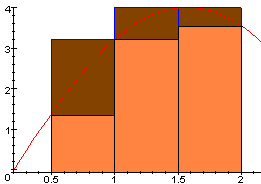 Remember Riemann integration, where you find the area under a curve by approximating with boxes? One way to do that is to measure the boxes that go outside of the curve (the brown ones) and the ones that go inside (the orange ones), then take the limit as you make the boxes narrower, and then see if the two limits are the same, in which case, that limit is the area under the curve. (Intuitively, you can see that if you make the boxes "infinitely narrow," the inside and outside boxes would be the same under a smooth curve like this one. That's what it means to take the limit.)
There is a similar definition of measure, called Jordan Measure. Unfortunately, it doesn't exist for quite a lot of subsets of the real numbers (just like not every function is integrable).
What we really want is a happy kind of measure that satisfies at least the following intuitively obvious conditions:
1. The measure of an interval is the same as its length.
2. If you have two (or more) sets, and they are disjoint (don't overlap), then the measure of their union (both together) should be the sum of their individual measures. (In other words, if you cut something up into pieces, the sum of the sizes (measures) of the pieces should be the same as the size of the original.)
3. If you have two sets, A and B, and A is a subset of B, then the measure of A should be less than or equal to the measure of B. (In other words, if A fits inside of B, then A shouldn't be "larger" under this measure.)
4. It is "translation invariant" - moving a set around (like by adding something to every number in it) doesn't change its measure.
5. The measure of the empty set is 0.
6. Measures are never negative.
What we're studying now in analysis is called Lebesque Measure. Actually, what we have is Lebesque Outer Measure, which is the Lebesque equivalent of the outer box method (the brown boxes above). Here is the difference between Jordan measure and Lebesque measure. In both of them, you are looking at intervals (the 1-dimensional equivalent of boxes; of course when you do this in more dimensions you use boxes or rectangular solids, etc.). In Jordan outer measure, the intervals can't overlap, and they have to be finite in number. In Lebesque outer measure, the intervals CAN overlap, and they can be countably infinite (you can have one for each natural number, going up to infinity). In both cases, you then take the infimum (which is basically the lower limit) of the sum of the lengths of the intervals, for all such sets of intervals.
There is no Lebesque inner measure. Lebesque outer measure exists for every subset of the reals and it has a lot of the nice qualities we want, but it doesn't have criterion 2 (called "additivity") above for all sets. So what they did was, they said, hey, if a set is additive with every other set, then it's "Lebesque measurable." Otherwise, we don't care about it. (Ideally you'd have an even better measure that works perfectly for all sets, but such a thing either doesn't exist or hasn't been figured out yet, as best I'm aware.)
Basically, every kind of set you'd easily think of is Lebesque measurable. Certainly all of the intervals, all singletons, plus sets like the rational numbers are measurable.
Right now, what I'm struggling with is that we have approximately three kadrillion theorems about Lebesque outer measure and about Lebesque measurability, and I'm having a really hard time keeping them all straight, even though I've written out each one with proof and even though I've (several times) made lists of all of them. The idea that I might have to be able to reproduce any or all of these proofs on an exam is terrifying but possibly true. So...that's my own little personal addendum to this otherwise no doubt extremely boring post about math.
Tuesday, August 24, 2010
Eating on Campus
This semester, at least, I'll be on campus every weekday. I'd like to be on campus more hours than are technically required just to go to my classes, because it's usually easier for me to do productive work away from home. So the question arises of what to do about lunch.
I considered bringing food from home, which is cheap and offers a lot of control over content. But honestly I've always sucked at follow-through on that, and every idea I have sort of sucks. A cold lunch is not that appealing. A hot lunch requires more forethought, and then you have to heat it up, and usually bring the containers back home for washing. That's a lot of trouble.
There are a various places to eat near my building. On campus there is a food court with many inexpensive options like Taco Bell and Chik-Fil-A. Off campus, but still nearby, are some more sandwich shops and the like. The downsides to this plan are that the food tends to be both unhealthy and more costly than I'd prefer on my stipend.
Instead, I opted for a meal plan, like any student. The one I got gives me a meal every day of the semester (85 in total) and the cost per meal is $5.09 including tax. The $5 cost fits into my original budget pretty well, the meals are all-you-can-eat, and it's very convenient. But is the food tolerable?
I've now eaten at a dining hall twice, and the answer is yes. Yesterday I ate at the dining hall that emphasizes more healthful foods (nothing fried, for instance) and I had a very reasonable, healthy, and enjoyable meal. Today I ate at the dining hall nearest to my office and had another decent meal. In addition to the usual hot cafeteria foods (which tend to have very reasonable options, at least so far), there is a salad bar (self-serve) and a sandwich bar (not self-serve). The place I ate yesterday also had a pasta bar and a panini bar. The biggest dining hall has a grill-type area with burgers as well. And there are numerous drink options including a tolerable imitation of iced tea.
I won't say it's gourmet, or even particularly well-prepared, but it's easy to get a healthy protein, some good vegetables, a to-die-for roll, and a salad, and that's a steal for $5. I also like the fact that I'm not wasting much packaging. I kind of hate when you get fast food and everything is all individually wrapped and it comes in a bag. The dining hall is, of course, real plates and silverware and non-disposable cups. I like getting out for lunch, going somewhere, and the atmosphere of the dining halls has been all right so far, with good music in the background too.
Next year, when I'm a TA/TF for real, the deal gets even better. If you are willing to invest in 40 meals, which roll over from semester to semester, then as a faculty or staff person, you only have to pay $3.79 per meal (including tax). At that price it starts to seem silly to bother doing anything else.
I considered bringing food from home, which is cheap and offers a lot of control over content. But honestly I've always sucked at follow-through on that, and every idea I have sort of sucks. A cold lunch is not that appealing. A hot lunch requires more forethought, and then you have to heat it up, and usually bring the containers back home for washing. That's a lot of trouble.
There are a various places to eat near my building. On campus there is a food court with many inexpensive options like Taco Bell and Chik-Fil-A. Off campus, but still nearby, are some more sandwich shops and the like. The downsides to this plan are that the food tends to be both unhealthy and more costly than I'd prefer on my stipend.
Instead, I opted for a meal plan, like any student. The one I got gives me a meal every day of the semester (85 in total) and the cost per meal is $5.09 including tax. The $5 cost fits into my original budget pretty well, the meals are all-you-can-eat, and it's very convenient. But is the food tolerable?
I've now eaten at a dining hall twice, and the answer is yes. Yesterday I ate at the dining hall that emphasizes more healthful foods (nothing fried, for instance) and I had a very reasonable, healthy, and enjoyable meal. Today I ate at the dining hall nearest to my office and had another decent meal. In addition to the usual hot cafeteria foods (which tend to have very reasonable options, at least so far), there is a salad bar (self-serve) and a sandwich bar (not self-serve). The place I ate yesterday also had a pasta bar and a panini bar. The biggest dining hall has a grill-type area with burgers as well. And there are numerous drink options including a tolerable imitation of iced tea.
I won't say it's gourmet, or even particularly well-prepared, but it's easy to get a healthy protein, some good vegetables, a to-die-for roll, and a salad, and that's a steal for $5. I also like the fact that I'm not wasting much packaging. I kind of hate when you get fast food and everything is all individually wrapped and it comes in a bag. The dining hall is, of course, real plates and silverware and non-disposable cups. I like getting out for lunch, going somewhere, and the atmosphere of the dining halls has been all right so far, with good music in the background too.
Next year, when I'm a TA/TF for real, the deal gets even better. If you are willing to invest in 40 meals, which roll over from semester to semester, then as a faculty or staff person, you only have to pay $3.79 per meal (including tax). At that price it starts to seem silly to bother doing anything else.
Wednesday, August 18, 2010
But the Worst Is...
Monday's xkcd tickled me:
 But for me, the worst random sound in a song, and this occurs in a few KSAL songs, is the sound of a bicycle bell. Do you know the kind of bell I mean? It's the kind you put on a bike and it has a little lever on the side and when you pull it, the bell goes "zhing, zhing." Hearing that when you're backing out of a parking spot or tooling along in a neighborhood is definitely enough to trigger a heart attack.
 But for me, the worst random sound in a song, and this occurs in a few KSAL songs, is the sound of a bicycle bell. Do you know the kind of bell I mean? It's the kind you put on a bike and it has a little lever on the side and when you pull it, the bell goes "zhing, zhing." Hearing that when you're backing out of a parking spot or tooling along in a neighborhood is definitely enough to trigger a heart attack.
Subscribe to:
Posts (Atom)