Thursday, January 19, 2012

Two Easy Recipes, and a Bonus Low-Rent Dessert!

I basically only cook things that are extremely easy, so here are two simple recipes, plus a bonus dessert.

Chicken and Rice Soup
1 package chicken thighs (bone-in)
1 cup rice
1 bag frozen mirepoix (diced carrots, celery, and onions)
1 tsp salt

Put chicken thighs, salt, and mirepoix into a pot and cover with plenty of water. Boil until thighs are cooked (about half an hour). Remove thighs. Remove and discard skin, and separate meat from bones. Return meat and bones back to the pot and simmer another half hour or so. Then remove the bones and add about a cup of rice. (Confirm by eye that there is at least 2 cups of liquid in the pot; more if you want genuine soup rather than, as I prefer, something more like chicken and rice.) Simmer for another 20 minutes.

Beef Stew
1 package (1-2 lbs) stew meat
1-lb bag baby carrots
2 or 3 large potatoes
2 cups beef broth
1 cup wine (optional)
1/2 tsp salt
pepper if desired

Cut up potatoes (peel first if desired) and place all items into a large pot. Simmer gently until cooked, about 2 hours, or cook all day in a crock pot on low.

Low-Rent Banana and Chocolate Dessert
1 banana
part of a chocolate bar (I use 2 squares of a Lindt 85% cocoa bar, but any chocolate bar should work)
plain yogurt (I prefer whole milk)

Cut up the banana into a bowl. Break the chocolate into small pieces and microwave for 30 seconds at a time in a tiny bowl until melted. Gently spoon/pour the chocolate on top of the banana pieces. Glop a bunch of plain yogurt on top. Enjoy!

Reading Course FTW!

This semester, I am doing a reading course in probability & measure (using Billingsley). It's the first time I've ever done a reading course or any kind of independent study (other than my grant, but that was very different).

This was the first week of school, so last week I emailed the professor to ask when he'd like to meet or whatever, and we set a meeting for today. He gave me a section to read and some exercises to look at.

I've spent probably literally (not counting Internet-procrasting-time) 20 hours on that section and the exercises this week. The book is very dense for me and the exercises were difficult. I ended up with 10 typed pages of answers. I wasn't sure if he would want me to turn those in or just discuss them or say that I had done them or what.

So we met today. The scoop is that, whatever questions we don't discuss to his satisfaction in our meetings, he will have me turn in (I ended up turning in the whole set since I had it all stapled together, though we talked about most of the questions). The meeting went well - I was comfortable presenting answers on the board and discussing the material. He told me how to do the problem I hadn't managed to figure out, and the answer was really cool (really cool).

I've been exhausted all day. The first week of school is rough and I've been working hard. I'm the kind of tired where my head naturally goes slanty and I become slack-jawed. I'm the kind of tired where I think I must look really tired even from the outside.

But that meeting was so energizing, and I think this course is going to be great. I'm realizing that, actually, I think reading courses are super fun, way better than classes. Instead of sitting in class for 3 hours a week (which I hate even when it is informative), you get to work on your own with a book (which I love even when it is really hard). It's fun in the way that my summer of qual studying was fun.

Guess what? Reading and figuring out math on your own is more fun than a class. That's a really cheerful thought for me.

I'm still worried about my workload this semester. I have two core courses plus this reading course. But I feel motivated towards at least one of my courses, and of course towards the reading course, so I'm feeling pretty good right now. And I'm looking forward to doing more reading courses in the future, bigtime.

Monday, January 16, 2012

Silas Marner

I just finished reading my second George Eliot book, Silas Marner. I chose it to read because I wanted to read another book by her and I had heard of it. I got it for free (in Kindle form) from Amazon.

The basic idea of the book is that a man named Silas Marner has lost his faith after being (in essence) exiled from his (what we would now call) fundamentalist religious community, and has settled in a new town, where he becomes a miser and a recluse. Then a series of strange events involving a nobleman and an unwanted child alter the course of his life.

Before I read it, I read a review on Amazon, by a Susan Hallander, which begins thusly:
Question: How can you ensure that a person will hate a book? Answer: Make her read it for 7th grade English class, make sure that the language is old-fashioned, and above all, make sure that the ideas and concepts are over her head. If that's what happened to you, and that's why you have an aversion to Silas Marner, and you are now over 30, pick it up again. Read it twice. Silas Marner is one of the greatest novels in the English language.
As a result, while I was reading it, I had that context in the back of my mind - what would it have been like to read this in 7th grade?

Ultimately, while I enjoyed reading it, and was always reasonably eager to continue, I found Silas Marner disappointing. In some ways I would have enjoyed it less in 7th grade, but in other ways, 7th grade might have been a better time to read it. I probably would have appreciated its folksy moralism better when I was younger and less cynical.

I don't know what to say about this book in terms of anyone's decision of whether to read it or not. The book it most reminded me of, that I did read in school, was The Scarlet Letter, but that's probably a rather ignorant comparison.

Friday, January 13, 2012

My Changing Musical Preferences

I was emailing with Sally today about the increasing distaste I feel for the habit of rating everything one encounters, and it occurred to me that this relates a bit to my changing tastes (or, really, a change in the way that I have tastes at all) in music.

When I was a kid (through middle school or a bit beyond), I liked most of the music I heard, though of course I liked some things more than others. But I was largely unconscious of what I liked - I usually didn't know what bands or artists or albums the songs I liked came from (with the exception of the music my mom really liked, which she would tell me about). I just listened to the radio and liked what I heard and was crazy about a few things. (Some songs I remember being crazy about: Do Ya Think I'm Sexy? by Rod Stewart, Strip by Adam Ant, We Built This City by Jefferson Starship.)

Sometime in high school, I started to really have taste. There was some music I loved (Erasure, Depeche Mode, Midnight Oil, Jane's Addiction, The Cure, plenty of other stuff I'm not thinking of at this moment) and other music I loathed and detested (New Kids on the Block, Tiffany, Madonna - who I had loved when I was younger - and in general most top 40 things). Through college and beyond, I developed and expanded and refined these tastes, and they were a part of my identity. (This identity-by-tastes seems really common among my friends, particularly younger ones.)

When I was 19, I think, I did have a surprising experience. I hated the song "Vogue" by Madonna. I was visiting the Netherlands at the time, and I walked into a club with some friends. In the club was a leather-clad half-naked guy in a cage, and he was dancing to "Vogue." And it was the perfect music for exactly what was happening in that moment. I had not known such a phenomenon could occur: that a song you hated could turn out to be perfect for a particular occasion.

I've noticed over the years since college that my musical tastes are not only expanding but in general just loosening. There began to be a ton of music that I enjoyed hearing despite not officially "liking." (For instance, I am now ready to admit that I really do love hearing the song "Dust in the Wind." I will always sing along.) Sometimes I felt as though, if my friends learned of my real tastes, they'd think less of me.

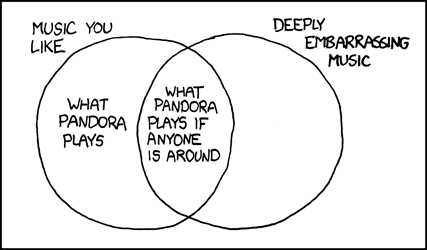
That kind of anxiety is part of why we (some of us, anyway) identify with the famous xkcd cartoon about Pandora:

It seems silly that there is such a thing as "embarrassing music" in a way. People make all this music for us to listen to and enjoy - what is embarrassing about enjoying it? I mean, I'm embarrassed about liking "Dust in the Wind" which is not exactly nazi death metal or anything. It's pretty innocuous.

I am moving more and more towards viewing my musical tastes as being more probabilistic (I tend to enjoy dance music, alternative, 80's pop, blue grass, dixieland jazz, and Beethoven, and don't tend to enjoy metal, classic rock, new country, or jazz, but I can enjoy a lot of things in the right context) and not really related to my identity. It's actually hard for me to let go of the idea that musical tastes have more than practical importance.

But I am getting more and more to the point where it seems useless to describe various artists as good or bad. Sally and I both remember a time that Robin defended Pearl Jam (who Sally didn't like) as "a quality product," but most commercially produced music could be so described (depending on what qualities you think are important). Does Garth Brooks suck just because I don't really like his sound and his lyrics aren't clever and edgy or deeply meaningful (for me)? Or is he great because his music (apparently) brings pleasure to millions of people? Who cares what I think anyway?

Tuesday, January 10, 2012

Where My Money Goes

Unlike in my former life as a corporate worker bee, these days I spend more money than I earn. Not counting the tax hit from the bonus I got when I left my last company (which, after all, came with a bonus), I'm about $2000 poorer (in terms of cash and short-term savings) now than I was a year ago.

I'm not too upset about that. I started grad school with some savings that I expect to partly deplete by the time I graduate. At the same time, considering that I live in a relatively cheap apartment ($675/month) with a roommate (so that my rent + utilities is typically under $400), my TA stipend (about $22,000 a year including the extra summer work) really ought to be enough to live on. Many people are supporting families on such a wage.

I keep track of my finances in Mint, so for your amusement and/or horror, let's take a look at how I spent my money in 2011. First, here is an overview of all of my spending:


A few things really stand out:
  1. Wow, I spend a lot of money on food!
  2. And shopping!
  3. What am I spending all that "Auto & Transport" money on?
  4. I wonder what is in "Other"?
(In case you wonder, the Education spending includes $5 of tuition and the rest is books and office supplies. Some of the books are textbooks and others are supplemental reading. I also spent $180 on eBay for the tablet I teach from.)

Let's look at where my food budget goes:

So, it turns out that I eat out a lot. This shouldn't surprise anyone who knows me. And this aspect of my life has proven extremely unresponsive to my attempts to apply budgets to it. It turns out (via the magic of revealed preferences) that eating out, and in general having nice things to eat, is important to me. I'd still very much like to spend less money on food. Over $20 a day seems a bit excessive.

Now, about the shopping:

I'll admit it shocks me that I spent over $1000 on clothes in 2011. I don't think of myself as buying many clothes (even including shoes, which are included here). I'm fine with the money I spent on books. The 'hobbies' money here was the money I spent having the photo albums of my childhood digitally scanned and I don't regret that either.

Now let's take a look at where my "auto & transport" spending is coming from:

The parking is mostly for school, of course. I shouldn't need to spend money on this at all given that I live half a mile from campus, but I started buying parking because I developed chronic foot problems that seem best remediated by avoiding walking. Hopefully over time I can cut that expense. The rest of this is just the normal costs of car ownership.

Let's take a look at "Other":

I'm happy with the money I spend on travel - I think it's money well-spent, relatively speaking. Visiting my loved ones is important to me, and if anything, I wish I spent more money on this. (That is to say, I wish I traveled more. If I could travel more for the same money that would be great too.)

What about that $418 on entertainment?

You might think from seeing this that I buy movies, but that is not the case: if you look at the individual records, it turns out that a few of these are movie rentals and the rest are actual theater tickets. (There is also my Netflix subscription for $10/month.) I hardly ever used to go to the movies, so it's a bit shocking that I apparently saw 25 in the theater this year.

Seeing movies in the theater is a bit of an extravagance, but it results from the social life I have these days that I never used to have. I really relish that aspect of my current existence and don't regret it in the slightest. I will continue to see movies with friends as much as I want.

So that's how I spent my money in 2011. I would like to cut back on shopping and on eating out; otherwise I'm relatively satisfied with my current choices, and very grateful that my life affords me so many opportunities.

Thursday, January 05, 2012

Middlemarch, and Being Human

A long time ago at a college far, far away (well, about 6 hours away by car), I was supposed to read Middlemarch by George Eliot for a 19th Century British Literature class. I ended up dropping the class and never reading the book, but then recently, Ta-Nehisi Coates has been talking it up, and I love him, so I was inspired to pick it up. I haven't finished the book yet - I've been reading it several hours a day for over a week, but it's a long book - but I want to talk about it a bit.

Middlemarch at first reminded me of Jane Austen's novels - the setting appears similar (Eliot was born around the time Austen died, but from this distance in time, it feels the same) and the book has a large and interwoven cast of characters and is heavily about courtship and marriage. There are three really clear differences, though:

  1. Eliot is much harder to read than Austen; the sentences are longer, use more fancy vocabulary words, and are structured with more complexity.
  2. If you read Austen novels and think, "But what about once they are married? These people barely know each other! Marriage is every day for years and years and years! Also women especially had no options and they didn't even have divorce back then," Middlemarch may be for you, because getting married is just the start of each story, and you get to find out exactly how the matches turn out.
  3. Eliot doesn't limit herself to describing conversations between women or between women and men; she also describes conversations that solely involve men.

There are other differences, one of which relates to an obsession of mine. The obession is the one I'm thinking of when I say, "I don't know how to be a human being," so let me digress for a moment.

Life to me seems like a constant struggle between being a decent human and being a shitbag, and we have two choices - unabashed shitbaggery, or shitbaggery accompanied by struggle and abashedness. I don't see any cure for it, and this, to me, is almost the sole appeal of Christianity - that it starts with a frank admission that we are basically horrible.

Pondering one's own "stuff" gets into what I call fractal territory, which is to say, it leads to an endless descending cycle of realizing what a crappy excuse for a person one is, at the end of which cycle I usually declare, "I have no idea how to be a human being."

I'm not talking about temptations like lying or theft, but actual internal attitudes. I'm talking about things like mocking people we don't like for qualities we readily accept in our friends, or detesting others for traits we ourselves possess, or continually (despite any efforts to the contrary) seeing the world as revolving around ourselves, or constant unremitting disregard for sometimes even really obvious things about the experiences of the people around us, or the bizarre selfish pride most of us feel.

So I guess what I'm really talking about is fundamental selfishness. Of course, some people simply embrace their own selfishness - either by conveniently not noticing it or by taking up a philosophy that justifies it. I know some people who actually seem not to be shitbags at heart, but I have no idea how they attained this state, or whether it's basically illusory. But I know that when I look at myself in terms of my internal states I basically disapprove of my overall implicit attitudes.

And the thing about Middlemarch is that George Eliot seems to really get this. She writes about this sort of thing a lot, and I like it.

Here are some good quotes (not all relating to this topic):

For my part, I have some fellow-feeling with Dr. Sprague: one's self-satisfaction is an untaxed kind of property which it is very unpleasant to find depreciated.
***

We are angered even by the full acceptance of our humiliating confessions - how much more by hearing in hard distinct syllables from the lips of a near observer, those confused murmurs which we try to call morbid, and strive against as if they were the oncoming of numbness!

***

There are answers which, in turning away wrath, only send it to the other end of the room, and to have a discussion cooly waived when you feel that justice is all on your own side is even more exasperating in marriage than in philosophy.

***

She leaned her head back against the window-frame, and laid her hand on the dog's head; for though, as we know, she was not fond of pets that must be held in the hands or trodden on, she was always attentive to the feelings of dogs, and very polite if she had to decline their advances.

***

But Duty has a trick of behaving unexpectedly - something like a heavy friend whom we have amiably asked to visit us, and who breaks his leg within our gates.

***

It is true Lydgate [a doctor] was constantly visiting the homes of the poor and adjusting his prescriptions of diet to their small means; but, dear me! - has it not by this time ceased to be remarkable - is it not rather what we expect in men, that they should have numerous strands of experience lying side by side and never compare them with each other? Expenditure - like ugliness and errors - becomes a totally new thing when we attach our own personality to it, and measure it by that wide difference which is manifest (in our own sensations) between ourselves and others.

***

The spiritual kind of rescue was a genuine need with [Bulstrode]. There may be coarse hypocrites, who consciously affect beliefs and emotions for the sake of gulling the world, but Bulstrode was not one of them. He was simply a man whose desires had been stronger than his theoretic beliefs, and who had gradually explained the gratification of his desires into satisfactory agreement with those beliefs. If this be hypocrisy, it is a process which shows itself occasionally in us all, to whatever confession we belong, and whether we belief in the future perfection of our race or in the nearest date fixed for the end of the world; whether we regard the earth as a putrefying nidus for a saved remnant, including ourselves, or have a passionate belief in the solidarity of mankind.

***

I think any hardship is better than pretending to do what one is paid for, and never really doing it.

***

There is no general doctrine which is not capable of eating out our morality if unchecked by the deep-seated habit of direct fellow-feeling with individual fellow-men.

So there you have it, folks: Tam's guide to Middlemarch.

Thursday, December 15, 2011

Sucking at Life

Yesterday, I did a load of dishes. And it's important that we're really clear about what happened here, so let me elaborate.

Ed and I collectively have quite a few dishes, and a large number of them were dirty. I was picking up these dirty dishes, one by one, and placing them on the dishwasher racks. Once I was done, I would I put a little square of soap into the dishwasher, close it, move a small lever to lock the door, and slightly rotate a dial. A couple of hours later, there would be clean dishes.

This is not at all difficult or taxing, and yet we are a couple of days behind on dishes. As usual. Whence the following conversation as I was loading:

Me: We suck at life.
Ed: Oh, I know.
Me: How could anyone have this easy of a life...
Ed: And suck at it this much?
Me: Yeah.
Ed: I don't know, but we do.
[pause]
Ed: We can't solve any real problems, that's why we solve made-up problems.
Me: Right! So that's why we're in math?
Ed: Yep.
Me: So we can be like, "Oh, what if we had this type of thing, and we called it a blah de blah, then what else could we say about it?" and just give ourselves easier problems to work on?
Ed: Yep.
Me: My god, I think you're right.

Wednesday, November 30, 2011

Self-Description

Once upon a time, Sally and I used to talk about something we called "being demonstrative," by which we meant not excessive displays of affection, but rather statements like, "Oh, isn't Paris lovely this time of year?" or the way that someone we knew once took out chopsticks to eat a burrito, claiming that the year she had just spent in Japan had made it difficult for her to eat with a fork. In other words, we were talking about statements calculated to demonstrate something - a practice akin to name-dropping.

I've recently been thinking about another type of obnoxious behavior. It's one in which many people sometimes engage, and I find myself tempted by it often. It's also something I have learned to recognize as an immediate warning sign about a person's personality. It is an almost universally obnoxious trait: self-description.

Some (hypothetical) examples:
  • I'm not the kind of person who watches TV.
  • I guess I'm just more cynical than that.
  • I'm just a big ole country girl.
  • Most people either love me or hate me.
  • I'm one of those people who can't stand pedantry.
It's interesting - it's hard to write examples of this, because some of it comes down to intent. If your intent is (honestly) humble or self-denigrating ("I'm kind of an asshole before I have my coffee"), then that's not what I'm takling about. Likewise if you're being ironic. But often these types of statements come from a demonstrative type of intent - a strong desire to demonstrate your characteristics to others, especially people you have just met. And in that context it somehow becomes really obnoxious. It is like you have this obsession to present yourself. I guess an obsession with oneself is never attractive in a social context.

A few months ago, a friend and I had a conversation via IM. Afterwards, I thought, jesus, we just had a fight - I hope she didn't notice. I could feel myself being obnoxious during it and I thought she was a little obnoxious too. Later she texted me to apologize for being that way, and I apologized too.

I'm pasting in the transcript of this because the whole thing drips with self-description of exactly the kind I'm talking about...on both sides:

Friend
: Hmm. That [story about cheating] does sound bad. I don't know.
It just makes me so upset that cheating is a thing here... cheating wasn't an issue where I went to high school or where I went to college and I hate that it's prevalent in this environment.
me: I know what you mean. I think it's pretty common here.
Friend: I just don't think I'll ever be able to teach somewhere like that ultimately, I think it would bother me too much.
me: I am cynical so it doesn't bother me, I guess. So far anyway.
Friend: I'm cynical about some things, but education isn't one of them, probably because of where I went to school.
me: I don't think that's really why. I mean, I have a lot of similar school experiences to yours.
Friend: maybe i'm just an idealist then
me: I mean, I want cheaters nailed to the wall, but it doesn't bother me that they exist, if that makes sense.

Tuesday, October 25, 2011

A Time Capsule from 2005

In May of 2004, I had some blood tests done by my doctor. My cholesterol was a bit high, so she recommended that I cut back on saturated fat. I ended up making a lot of changes to my diet then - cut saturated fat significantly (I was logging everything back then, so this was easy to say), cut back on fast food, and ate a lot more whole grains and vegetables at home.

I remembered today that I had a c-reactive protein test back then, and I thought I might have emailed Sally about it at the time, so I searched my Gmail for "CRP" and turned up an email I wrote a year later when I had more tests done. I'm interested in CRP because it is a marker of inflammation, which may be one of the causes of leptin resistance, which may be a major cause of obesity.

Anyway, I now present, for your reading pleasure, this email from 2005.

Last May, when I got my high cholesterol numbers (from tests taken
in April), I radically changed my diet. Remember? Sure you do.

I have pretty much kept with those changes, and I have also lost 29
pounds since then.

Well, I just got my blood test results back. Here is a comparison:

April
-------
total cholesterol: 211 (should be < 200)
hdl ("good"): 43 (should be > 40)
ldl ("bad"): 151 (should be < 130)
triglycerides: 85 (should be < 150)

Now (February)
----------------------
total cholesterol: 219 (should be < 200)
hdl ("good"): 38 (should be > 40)
ldl ("bad"): 166 (should be < 130)
triglycerides: 112 (should be < 150)

So basically, all of my numbers have gotten WORSE rather than better,
despite my having lost a substantial amount of weight (13% of the
weight I had in April, in fact) and changed my diet in all the
recommended ways (if not to all of the recommended extents).

In addition, this time I had that Cardio CRP test. I got a 10.7.
Here is what the reference numbers are:

< 1.0 Low Risk
1.0 - 3.0 Average Risk
3.1 - 10.0 High Risk
> 10.0 Persistent elevations may represent non-cardiovascular inflammation

Yuck. My doctor wants to have all of this retested in November, and
meantime recommends continued weight loss, exercise, and avoiding
animal fats. (What animal fats? I hardly eat any fucking animal fats
anymore anyway.)

This is kind of freaking me out.
Notice that eating less animal fat, cutting saturated fat from my diet resulted in HIGHER triglycerides (very bad) and slightly worse cholesterol numbers (probably bad), despite the fact that I lost 29 lbs over that time, which would be expected to improve things.

This proves nothing, of course, but unlike most anecdotes, this one at least applies to me specifically.

Friday, October 21, 2011

My Current Beliefs about Diet and Obesity

I thought it would be good to set out my current beliefs about diet, nutrition, the causes of obesity, and so on. They are what guide my (perhaps wacky-seeming) current dietary guidelines. I'd also like to distinguish them from other beliefs with which they might be confused.

Food Reward Hypothesis

I think the food reward hypothesis is the best-supported current idea about why so many of us are overweight and obese these days. The basic idea of this is that we now have the ability to make (in many cases manufacture) foods that are both hyper-palatable (really delicious) and high reward (very tempting/craveable/"addictive" in a loose sense), and that eating such foods causes our bodies to try to keep us at a higher weight than is healthy.

This shouldn't be confused with the "thrifty gene hypothesis," which is the common-sense idea that we evolved to live under the threat of starvation and are going nuts now that food is so plentiful. According to the food reward hypothesis, if our food were still the sort of plain, comparatively unvaried food eaten by our ancestors, abundance itself wouldn't cause overeating.

Stephan Guyenet has a great series on the food reward hypothesis here: Part I, Part II. He talks about the thrifty gene hypothesis as well.

(Note: I will be linking Guyenet a lot in this post. He is not my only source of information here, but he has informed a lot of my thinking, and seems to have done his homework. In many cases he's the best concise link I can give.)

Conclusion: I should eat simple foods prepared at home.

The Role of Carbs

Books like Good Calories, Bad Calories by Gary Taubes make convincing arguments that overconsumption of carbohydrates, particularly sugar and refined flour, are responsible for the obesity epidemic. Certainly, obesity travels together with insulin resistance (a problem that is all about carbs, and is the fundamental cause of Type II diabetes), and insulin resistance is a big part of what causes heart disease in general.

Guyenet, the same guy as above, has a long critical post about the idea that carbs (or insulin resistance) cause obesity. He doesn't buy it at all.

I honestly don't know what to think about this topic. But what everyone (at least, everyone I'm currently reading) seems to agree on is that if you are insulin resistant, eating a ton of carbs is a bad idea. This is contrary to the official recommendations for diabetes patients (which stress a high-carb, low-fat diet), but I've read enough to convince me that that is bunk; I'll write more below about why.

I've been testing my blood sugar lately, and my fasting morning glucose levels are slightly elevated - not in the diabetic range, not quite in the "pre-diabetic" range, but not where they should be or where they have been in the past either. I have a strong family history of diabetes and I have other signs (like PCOS) of having trouble with insulin resistance.

Insulin resistance definitely leads to heart problems and a lot of other issues. Exercise and reduced carb intake definitely combat insulin resistance.

Conclusion: I should take care not to eat too many carbs.

Dietary Fat

The dominant hypothesis of the last half-century or so of medical advice has been that overconsumption of fat is what causes obesity and (separately) heart disease. This is why diabetics and overweight people (and, really, everyone) is encouraged to eat a low-fat diet.

It is a fact that you cannot eat a low-fat diet without eating a high-carb diet. Humans can't eat the bulk of their calories as protein (you will get sick if you try, but you'll also find it very hard to try, because you will start very very badly not wanting to eat any more lean meat).

The evidence that high fat intake causes obesity is based partly on common sense (fat has more calories per gram than carbs or protein) and partly on the observation that Americans got fatter and started (perhaps) having more heart trouble around the early part of the 20th century, when (it is believed) we may have started eating more fat.

We also started eating way more sugar and refined flour and packaged products and that sort of thing at the same time, so it's very hard to tease out the effects of fat vs. carbs vs. high-reward foods (vs. unknown other factors, of course). There seems to be very little evidence that eating a high fat diet causes weight gain. Many traditional cultures (Inuit, Masai) eat very high fat diets and are very lean (despite not facing any regular food shortages).

Conclusion: It's OK to eat a high-fat diet.

What about Saturated Fat?

As someone who has lived in our culture, it is very difficult not to believe that saturated fats, especially from meat and animal products, are dangerous. I feel as though I know in my very bones that these types of fats are unhealthy and cause heart disease. This is one of the very strongest messages about food from the medical establishment.

From what I can tell from my reading, it's just not true, or at least, many very large, long-lasting studies designed specifically to support this hypothesis have completely failed to. Now, my reading isn't (can't be) exhaustive and it's possible my sources are looking at the data in a really biased way, but it doesn't seem so to me.

Here's Guyenet on saturated fat and cholesterol, the diet heart hypothesis, coronary heart disease, and on findings about full-fat dairy. I also found Good Calories, Bad Calories pretty convincing on these topics. And, of course, when you look at recent studies comparing low-carb to low-fat plans for weight loss, everyone gets healthier on both sides.

An additional bit of common-sense thinking: for a very long time before agriculture, our human ancestors got most of their fat from animals. Either they ate a very high-carb diet (and probably some did), or they ate a lot of animal fats (definitely some did). It's likely we evolved to be able to handle eating these fats.

Conclusion: It is truly safe and healthy to eat saturated fats, including from animals.

Pre-Western Cultures

The fundamental idea of the paleo and primal advocates is that we should eat the way that our hunter-gatherer ancestors did, rather than the way that our immediate agricultural ancestors did. In other words, rather than relying heavily on grains, legumes, and dairy for our food, we should eat more meat, vegetables, perhaps occasional tubers, berries, nuts, and things like that. We certainly spent a lot more time evolving to eat a hunter-gatherer diet than we have spent evolving to eat grains.

The only populations on the planet today who don't suffer from a lot of heart disease, obesity, diabetes, cancer, and other "diseases of civilization" (periodontal disease, appendicitis, gall bladder disease, etc.) are the ones people used to call uncivilized - small pockets of people living a traditional culture. It is true that they largely lack these health problems even when you adjust for age.

These groups are very different from each other. The Masai have a diet made up almost exclusively of milk, cow blood, and meat. Traditional-living Inuit have a diet that is something like 90% animal fat. On the other side, there are traditional cultures who live very healthy long lives (when they don't die in infancy) on diets composed almost exclusively of yams or sweet potatoes, and others who eat more balanced diets. But in general, my point is that there are very healthy cultures living on high-fat and on high-carb diets. It appears that healthy diets can have a wide range of macronutrient ratios.

What these cultures have in common is that they eat very little refined sugar, very little refined grains, and they don't eat "food that comes in boxes" - highly processed food manufactured to be as delicious and tempting as possible. They eat diets of mostly plain foods, with not a lot of variety by our standards.

It's hard to tease out what aspects of the western diet and/or lifestyle cause all of our problems. Is it the sugar? (There is some evidence that high-fructose foods like table sugar and corn syrup may have especially bad effects.) The comparatively recent introduction of grains to our diets? The refining of those grains and sugars? The even more recently introduced cottonseed, canola, corn, etc. oils (polyunsaturated fats)? Or the excessive variety and deliciousness of the manufactured food products that surround us?

At any rate, if the problem is dietary (as seems likely), then, while we can't say exactly what the problem is, we do know that simple diets of plain, pre-agricultural foods are healthy. (Of course, no food that I eat is actually pre-agricultural. I don't hunt or gather anything myself. But I think we can all agree that grass-fed beef or an apple is more "paleo" than a Big Mac.)

Conclusion: It may help to avoid modern agricultural products like sugar, refined grains (or any grains in large quantities), and seed oils.

Exercise

Exercise decreases insulin resistance and has many other beneficial effects, but I seem currently incapable of incorporating much into my life. If I explained why, I would just be making excuses, so I'll just say it's not a big focus for me right now.

Based on what I've read lately, I do think that high-intensity interval training is way more effective than regular steady moderate-intensity cardio. If I were designing an ideal exercise program, I think I'd go with something like Mark Sisson's recommendations in The Primal Blueprint, which means a good base of low-intensity exercise (walking, slow swimming, jogging if you're much more fit than I am), small amounts of interval training (two or three times a week for 5 or 10 minutes), and regular natural, whole-body strength training (two or three times a week for 30 minutes or so).

Conclusion: I should exercise, but I don't.

I hope this helps to make sense of why I'm doing what I'm doing, or was at least interesting on its own.

Thursday, October 20, 2011

Current Diet Protocols

These are the dietary rules under which I currently (try to) live.

Don't Eat
Sugar
Grains
Legumes
Seed oils (corn, cottonseed, soybean, canola, etc.)
Restaurant meals & fast food

Eat freely
Meat (any non-processed kind)
Non-starchy vegetables
Nuts
Non-starchy fruits (berries, apples, etc.)
Full-fat solid dairy products (cheese, butter, yogurt, etc.)
Coconut oil, olive oil, animal fats

Eat in moderation
Very dark chocolate
Starchy vegetables (potatoes, etc.)
Starchy fruits (bananas, etc.)
Whole milk

I am OK with eating some of the "don't eat" items a couple of times a week in order to eat at restaurants with friends. Other than that, I am trying to make my food at home and keep it relatively simple.

Sunday, October 09, 2011

Ch-Ch-Ch-Changes

This morning I hit a new low weight. Overall I've lost 22 pounds since early May, which is pretty awesome. And today is my 7th day of largely eschewing grains and legumes and of keeping my carbohydrate intake between 50 and 100 grams per day.

So what am I eating?

Yesterday I had a fajita chicken salad (w/ cheese, sour cream, and guac) for breakfast, eggs with turnip greens and cheese for lunch, and chicken tikka masala at a restaurant for dinner. I was trepidatious about eating chicken tikka masala without rice or naan. Frankly, it seems a little insane. But I managed it and it was still extremely delicious (though I did crave the naan and rice that were on the table, so that was a little uncomfortable).

Today I got up early, worked for three hours, and then made myself a breakfast of scrambled eggs mixed with tri-color peppers (from frozen), a big chicken sausage link (cut up), and cheese. I cooked this in ghee (clarified butter) and it was extremely delicious.

It's no longer the case that I don't get hungry. I do get hungry. But the hunger is like the hunger of my childhood - it doesn't really interfere with activities. You think "Where's dinner?" but then you can happily go run around some more in the meantime. It's not urgent. (More precisely, it feels urgent, but only intermittently.) I really like this change.

There has been one more change. Before I started losing weight in May, I was taking 150mg of ranitidine for heartburn twice a day - so, 300mg per day total. Eating smaller meals to reduce calories let me drop that to 1 pill per day, so in half. Then I bought some smaller ranitidine pills (75mg each) and was taking two of those a day. Now I am taking at most one of those per day, and some days I don't need any at all. I would love (so much) to stop using heartburn medication, and it seems within reach. Yesterday I didn't take any, not even a single Tums, which is amazing considering all of the spicy, fatty things I ate, which are usually exactly the things to cause heartburn.

Other than the changes to hunger and acid reflux, and the accelerated weight loss, I haven't noticed any changes. I feel good, happy, etc. Most of my meals are very satisfying due to the high fat content. It is sometimes tricky to figure out what to eat, but I've always tended to obsess over what I was eating next anyway, so this has just channeled that into a different direction.

Wednesday, October 05, 2011

Primality

Last week's no-wheat experiment went pretty well. It wasn't too hard not to eat wheat (I ended up eating a fair bit of corn tortillas and tortilla chips) and it seemed to cut my hunger a bit. I lost a pound a day for about 4 days in a row and then gained one or two back after that, so that was kind of exciting.

This week I've been reading The Primal Blueprint, and I'm experimenting with completely not eating grains or legumes and keeping my carbohydrate amount between 50 and 100 grams a day, which is the level at which the author of that book claims effortless weight loss will occur.

I'm still eating dark chocolate, having coffee if I want to, and I'm not avoiding things like soybean oil, largely because it's much easier for me to have salad at the school cafeteria if I can have ranch dressing rather than the nutritionally superior olive oil and vinegar type of thing. So I'm still basically eating sugar (which is a grain) and some legumes. Other than that, I haven't (to my knowledge) had anything - no wheat, no rice, no oats, no beans, etc.

It's a sort of radical thing to do, obviously. But it wasn't a huge transition since I'd already been eating no wheat and keeping my carbs low for a week. I haven't noticed any untoward effects this week, while last week I did have some serious crankiness and headaches.

What I have noticed is that I have absolutely no perceptible blood sugar changes. I sort of still get hungry - at least, there is a kind of feeling that grows over time that tells me I should eat something. It's kind of a gaunt or empty feeling. But it no longer seems to carry with it much urgency. (For instance, I had no breakfast today, a small lunch at 10:15, and I was fine not having dinner until 6:30.) And I never have blood sugar crashes, which I frequently did before. That's kind of a big deal.

My weight has been dropping pretty seriously - like about 2.5 pounds since Monday. I'm not recording these new weights yet, since they may settle back down. I'm still tracking everything I eat, and I'm pretty easily creating calorie deficits of 700-900 calories a day basically without trying. (I'm not really trying to limit my food intake.) So that's kind of amazing.

It could be that some of the "this is so easy!" aspects of doing this are basically just me being excited about doing something new. I could get really tired of this and find it just as hard as anything else. It's certainly extreme to not be able to eat virtually anything that normal people eat (sandwiches, pizza, tacos, muffins, fried rice,...). But I'm finding I can eat something at most places I ever go, and that's working for me just fine for now.

If this does prove to be a way to maintain a much lower weight without the extreme effort of resisting eating all the time, I think I would have to choose many extra years of healthy life over the ability to eat these common and delicious foods. So basically if this keeps up, I'd like to keep doing it. We'll see, of course, whether I feel that way in a week or a month or whatever.

It's probable that the weight loss comes more from the effects of low-carb than from avoiding grains and legumes per se. When you don't eat carbs you don't set up part of the insulin cycle that makes you hungry again a few hours later, which is a particular issue for people who are blood-sugar-challenged, like me.

But the advantage of eschewing grains and legumes while doing low-carb is that you don't end up prioritizing a muffin over the day's vegetables. I'm eating tons of vegetables most days, and some fruit as well, plus dark chocolate, plain yogurt, nuts, and other carb-bearing foods. If I were just trying to keep carbs down I think I'd trade some of that for, say, white rice, and that would be less healthy, in general.

Anyway, I'm kind of excited, and I hope this keeps up.

Sunday, September 25, 2011

Wheat Experiment

Starting yesterday between breakfast and lunch, I am experimenting with not eating wheat for the next week. I'm also trying to go (moderately) low carb in general, but I'm much more dedicated to the no-wheat aspect than to the low-carb one.

I read the book "Wheat Belly" by William Davis. Davis argues that grains in general are not great for us, and that wheat is the worst. He thinks that genetic changes to wheat over the past 50 years (through modern but not genetic-engineering-based methods) have made it particularly dangerous to humans and responsible for a host of different medical problems. Celiac disease is an obvious thing that is indeed (indisputably as far as I know) due to wheat; the rest is more speculative, I think.

He has a lot of references in the book, which is good, but the way he argues leaves holes you could drive a truck through. It's not the worst pseudoscientific bullshit I've ever read - even the term "pseudoscientific bullshit" might be an exaggeration - but it's not fully convincing either.

Still, it's hard for me to resist the pull of sense-making conspiracy theories about food. I do think that the overconsumptions of carbs, especially from grains, is a big part of the obesity problem for some people (including me), and not just because it's easy to eat a lot of carbs. I think they actually encourage overeating beyond just being tasty, readily available, and cheap, by changing your body chemistry such that you have more blood sugar fluctuations (which cause eating) and possibly by encouraging your body to store fat (through insulin-related stuff).

With my family history of diabetes and my PCOS, it seems pretty clear that I will (do) struggle with insulin resistance. My odds of avoiding diabetes feel pretty low at times (assuming I'm not already diabetic, which I haven't been so far when tested, but which of course could happen anytime).

I think that if I can eat less carbs over my lifetime, I'll be doing myself a huge favor. Aside from non-starchy vegetables and a moderate intake of fruit, I don't think there's any biological reason that humans need to eat carbohydrates at all. I think grains are completely unnecessary to a human diet. (They're practically necessary as there is no other way to feed the number of humans on this planet, but that's a different issue.)

So, Dr. Davis claims that when his patients stop eating wheat (without making any other changes, but in the context of generally trying to have a healthy lifestyle), they magically lose tons of weight and all of their mysterious ailments (IBS, chronic fatigue, acne, arthritis, asthma, acid reflux, etc.) miraculously disappear. This is pretty clearly not a clinical finding that would hold up.

Nevertheless, if giving up wheat did make it a lot easier for me to lose weight, I feel like it would be worth it, and if I gained more energy or a better overall life feeling in the process, that would be even more awesome. It seems worth a try given that I think it's basically a healthy choice anyway.

Hence my exploratory week of non-wheat-eating.

So far I've been having meats, salads, vegetables, eggs, and today I had about 1/2 cup of a straight-up starch (rice or potatoes) at my meals. I also ate some extremely dark chocolate today, plus raw walnuts and almonds. It seemed like a very healthy day of eating overall.

I've also been feeling like shit, which was true other times that I tried to dramatically cut carbs as well. (Carbs made up 25% of my diet today, so I haven't cut them to a really extreme extent. It's usually more like 50%, though.) I've often felt a bit hungry yet nauseated at the thought of eating, and I've been a little headachy and extremely irritable. I think these aren't just nocebo effects, but of course they could be, and I have no way of distinguishing them. I expect them to get worse but I hope they subside before the week is up (and before I give in and eat 15 pieces of naan) so I can see what life is like afterwards.

Friday, September 16, 2011

Dreams

I've had a few strange ones lately.

Dream 1

Apparently in this dream, Sammy (my cat) was my romantic partner. In the manner of all dreams, this was not strange. He was standing on an ironing board talking to me about how dissatisfied he was recently, and how sad, because I was not spending enough time with him, or giving him enough attention. I felt very sad too. I was petting him while he spoke, though it occurred to me that this was disrespectful because I knew he didn't want to be petted - he was unhappy with me. But of course I always pet him when he is nearby because I like to.

Then I (very insensitively) asked him how he'd feel about us getting a new kitten, because I thought that would be fun. I knew it was insensitive when I asked it. It also felt a bit novel to me - just asking the current cat whether to get a new kitten or not. I wondered why I hadn't thought to ask in the past.

Dream 2

This dream took place in an enormous old house that apparently all of the grad students in my program used for parties. Our director of grad students was there. Sally was also visiting. There were a ton of rooms, all with different things going on. The decor sort of looked like the Old Spaghetti Factory, if you've ever been to one of those (or in other words like an old or possibly haunted house).

For a long time I was trying to track Sally down, but couldn't because she was planning some sort of big surprise or show or experience for the rest of us. In the meantime, I talked to the DGS. He was funny as always. I asked him whether this house had always been owned by the department, or was loaned to us by some kind of alumn, or how it had come to be used for parties this way? (In the dream, I don't think anyone lived in the house full time.) He told me that, no, actually, it belonged to [something like] an aunt or uncle of Lee Ann (who has only been in our program a short time). I was telling him how I could now understand the appeal of being in a fraternity or sorority, just so you'd have that big house for parties.

Sunday, September 11, 2011

The Midnight Conundrum

Here you are, it's midnight on a Saturday night. You feel tired, you could definitely go to sleep, but you also feel able to continue working. You have two big assignments due on Tuesday and have put a few hours into one of them already today, and you're primed to continue. But if you stay up late doing this, you'll sleep late tomorrow, and then getting up Monday will be even harder than usual.

Go to bed or keep working?

For me, the answer usually has to be "keep working." This is because I really cannot (or, at any rate, do not, ever) get up in the morning and get right to work. So if I go to bed, I may never recover the momentum that I feel right now, or at best I may recover it hours after getting up on Sunday. For the most part, I get stronger and find it easier to work more and more as the day goes on, at least when I'm vaguely able to structure my time that way.

I made the choice to continue working and I got some really excellent work done despite also feeling tired. Now it's 3:15 and I'm really quite tired and ready for bed, but I have big tasks completed. I also happened to stop at a "downhill" point, which is good. (By "downhill" I mean a point from which it is easy to continue. It's like riding on hills with your bike - if you need to stop, it's better to stop on a downward slant so that you can easily start up again.)

Basically when I feel "tempted" to work I have to make use of that temptation unless there are truly compelling reasons not to. As long as I get overall something like enough sleep, getting my work done is more important than sleeping at any particular time.

Sunday, September 04, 2011

Grad School vs. Working

Back when I was thinking about going to grad school, I had one hope that I was almost afraid to confess. I hoped, despite how hard grad school was reputed to be, and how many hours it was said that I would have to work (i.e., way more than 40 per week), that it would take me away from the horrible feeling associated with having a regular job.

I don't know exactly how to describe the feeling, and I feel like a spoiled brat or a wimp for even having it, but I'm basically talking about that kind of bored feeling of waiting for the day to be over, killing time, trying to think of a good reason to leave work early, etc. I mean the basic feeling of just not wanting to be at work.

It turns out to be true that grad school, for me, totally does not have this feeling. I had it over the summer when I worked in the math lab (a worse job than any I've had in many years, though still not bad in the overall scheme of possible jobs), but I don't have it during the regular semesters at all.

It's interesting. I spend more hours at school now than I ever have at a job, and (more or less completely independently) more hours working than when I had a job. But I simply do not have that feeling of being required to be in a place for 8-9 hours every day. Aside from my office hours (4 per week), I am always either doing a specific thing (teaching or attending class or a seminar) or I am free to go if I want to. Everything now is about accomplishing specific tasks on time rather than spending a particular amount of time appearing to work.

Consequently, my office, and the building where I work, doesn't feel like a workplace to me. It feels a lot like my dorm felt when I was originally in undergrad, actually - like a cool place to hang out, the place where I do most of my work, and the place where, at all hours of the day and night, some of my friends and acquaintances are around.

I was able to confirm this when I was working in the math lab. I left there one day during my shift to go to the restroom, and when I walked out into the hall, past the offices of my friends, I had a feeling like, "Oh, I am trapped in the math lab, and all these people out here get to have their regular lives."

That dreadful feeling of being trapped at work was a really large feature of my previous life, and it's pretty fantastic for me that I don't have it anymore. It's like, as I wrote once before, my work life and life life have all become the same thing. Some people hate that aspect of grad school but I think, for the most part, I really like it.

Saturday, September 03, 2011

The Difference a Year Makes

Last week, I started my second year of graduate school. It feels so very different from my first year - really almost astonishingly so.

I spent the entire summer studying for my qualifying exam in real analysis. I wrote over 300 pages of notes, by hand, working through proofs and ideas, some over and over again. I worked about 2-4 hours pretty much every single weekday, and many weekend days, for all but about 2 weeks of the summer. (I also tutored students in the math lab.)

Even though that may not seem like a huge amount of time to spend (because it wasn't), it was huge for me. I've historically been terrible at making myself work to a far-off deadline, and this work was both hard and sort of ambiguous. How much would be enough? Was it even possible for me to pass (like, ever)? Had others passed these exams in the past only because they were smarter than I am, or had better memories? I struggled with these thoughts a lot, but I kept working.

The qual was an 8-hour exam. It took me 6 hours and 40 minutes, which is somewhere in the typical range. And I passed. I passed it. Amazing.

Now that I've passed it, the material doesn't actually seem like it was that big of a deal. Now that I know the proofs, they don't seem to have all that much to them. Ha.

I also, of course, made it through my first year of classes last year. I struggled with the material a lot at times, but I did well in terms of grades. I didn't seriously screw anything up. I was never one of the worst students. Occasionally I was mildly praised.

Last year, when I started grad school, I was extremely enthusiastic, and then when it got hard, I was really scared a lot. Especially that first semester I had really dramatic mood swings. I sometimes fantasized about leaving, going back to my old job, resuming a better life with more money and things and free time and less failure and stress.

This year, honestly, I wasn't that enthusiastic at the start of school. When I went to the mandatory all-TA/TF meeting, I remembered how exciting it had been the previous year, but I was pretty meh about it. I was mildly interested in meeting the new first-years, but that was about it. I was still recovering from the qual.

But...I'm not scared anymore, either. I still don't know if I can actually do research, but I now know I can pass classes and quals. (I need to pass one more qual, and I have four tries.) I now know I am not borderline for the program, barely clinging to life.

Last year, I remember the first homework that I got with a problem I couldn't easily figure out. It really freaked me out. I'm pretty sure I cried. I calculated what percentage of my grade this one problem would be and thought about the fact that I was already losing that much so early in the term. I wondered whether I belonged here. I did eventually solve the problem, but man, the stress.

Last week, my topology homework had a problem I couldn't figure out. I worked on it on a few different days, but never with any real feeling of stress. I figured out all of the other problems. This one remaining one wasn't a big deal. Turning it in unfinished would not harm my grade or standing or anything like that. I wanted to get it but there was no fear there. It certainly did not drive me to tears.

And that, my friends, is the difference that a year makes.

Hated Professors

Back in 2007, I took "Introduction to Proofs," the class at my alma mater that was designed to transition you from the computational type of math with which most people are familiar to proofs-based theoretical math. It is kind of a grab-bag course at that school, dabbling in proposition logic, (abstract) algebra, analysis, discrete math, etc.

I hated my professor, Dr. J.

Hated him.


He would talk to the class in this sort of angry way all the time. He barely graded our homework. One time he gave us a quiz and then, when he returned it, and someone asked him how to do one of the problems, he couldn't do it on the board. One time he mistakenly declared that "Fish only bite when the moon is full" would translate to "The moon is full implies that the fish are biting" instead of the converse.

Ugh. I hated that guy. He was ugly too.

I did hear from someone else that their proofs class had covered way fewer chapters than ours. So we covered a lot of material, and at the end had to write a paper (ugh!). I wrote about taxicab geometry, which was very interesting for me when I did it. (The taxicab metric has appeared in so many courses since then it's not even funny - including this year in topology.)

Over the years, my hatred of Dr. J faded. I'd see him in the halls or elevator and he was always friendly to me. I guess he remembered me, probably as a good student. He was happy that I was going to grad school. For all I know he was a nice guy after all.

And in the meantime, time after time, these weird "obscure" (to me at that time) topics that we covered in that class came up. When I took my second non-Euclidean geometry course in undergrad, the abstract algebra we'd done in Proofs was really useful. Having covered (very well) the definitions of sets, relations, functions, etc., made them so much easier to understand in future classes. Cardinal numbers didn't show up again until my second semester of grad school, so it's great that I learned about them in there. The Peano axioms showed up in the first semester of grad school and nowhere inbetween.

Did I mention I really did not know the first thing about writing math (as opposed to logic) proofs when I started that class, but totally learned how?

Man, that class was awesome. It was easily one of the most useful classes I ever took. From an outcomes perspective, Dr. J was brilliant. I bet he was one of the best Proofs professors at my school. I bet he still is.

All of this is to say that my feelings about a professor can have very little relationship to how much I am learning or how useful the course is. This is not the only example of me hating someone and then thinking later that they were pretty great, or that I learned a ton. What it tells me is that I should put a lot less stock in my own feelings in situations like this.

Saturday, August 20, 2011

Qual Cloud

I took my real analysis qual yesterday, which I hope to write more about later. This morning I wrote Sally another long email about it. Reading it over after I sent it, the language itself seemed obsessive. Perhaps this tag cloud will give you some sense.

(P.S. Try saying "qual cloud" five times fast.)