Class tonight was amazing. I didn't really take anything away that would be fun to describe here, but wow. I was really "on" mentally and able to get a lot from it.
I love math so much.
Monday, April 13, 2009


Cute
All right, I just found this picture (from Getty Images) too cute not to share:

(Obama jogging along in the White House with new First Dog, Bo.)

(Obama jogging along in the White House with new First Dog, Bo.)
Sunday, April 12, 2009
When Inanimate Objects...Cooperate

Tonight, I had to clean the kitchen. It was pretty bad, both because we hadn't cleaned it all week and because Ed finally unpacked some ancient boxes and donated some more equipment that was all over the counters. Over the course of the day, we ran five (5) dishwasher loads, and in addition to putting in that fifth load, I had to handwash a few items and then clean the counters and stovetop. It's not really that huge of a deal, but I was feeling overwhelmed by it. I also felt that if I didn't do it, I would never want to come home again.
I decided to try listening to my iPod in case it would help. Music is generally motivational.
Now, I have to admit, I skipped the first couple of songs that came on. But then I got this amazing assortment of, for me, possibly the very finest collection of songs to get some shit done to:
1. "Rapture" by Blondie. A fantastic beat, plus the story it tells fascinated me as a kid.
2. "Touching the Untouchables" by Men at Work. All right, this is not a great song. But I had this album on tape as a kid, recorded with my tape recorder from my almost-brother Thad's record player, so it brought me warm childhood feelings.
3. "Disco Inferno" by the Trammps. I can hardly imagine a better song to work to. So catchy! So hot!
4. "No One Knows My Plan" by They Might Be Giants. Yet another energizing song with a recognizable dance beat. The fact that the narrator is probably a serial killer is just a bonus when you're stuck scrubbing counters at 9:00 at night...
(All links go to Youtube videos featuring the studio versions of the songs.)
Saturday, April 11, 2009
Smooth Move
This morning, Ed and I went on a hike at Red Rocks. As we were leaving the house, I couldn't find my keys. Now this may sound commonplace, but it's not; I really don't misplace my keys. They should have been either on their hook or in my bag, and they weren't. I looked around all of the other obvious places, and they were not to be found.
I knew Ed had let us in the front door the previous night, so I thought perhaps I had left my keys in the car. That's conceivable - I was bringing a lot of things up. So I suggested we could go down to the car and see if they were there and, if not, I could borrow his car key and find my keys at home later.
They were on the hood of the car.
I left my keys, including my car key, overnight, on the hood of my goddamn car. And they were still there in the morning.
Wednesday, April 08, 2009
The Isomorphic Thrill
The other night, I decided to turn momentarily away from the Polster/Steinke line of thought on Laguerre Planes (covered in my previous post) and look at one of my other sources. The third author I have a lot of writing by, including his dissertation, is Robert Knight. I opened up an article by him...something about bundle forms and "ovoidal Laguerre planes."
My impression of Knight so far, from lightly perusing some of his stuff, is that he's mostly going kind of old school with the Laguerre business. And indeed, in this paper, as background, he presents a set of axioms that I think are pretty close to Laguerre's own.
In the original Laguerre system, instead of circles and points, we have cycles and spears. Cycles (in the original representation) can be either oriented circles or points, and spears are oriented lines. That's my understanding at least.
But when I started jotting down the axioms, I was very excited to find that they were more or less isomorphic to the Polster/Steinke set. I got that pure mathematical thrill as I confirmed that my octahedron "plane" satisfied all of them (treating the points as spheres, the faces as cycles, and with one other additional but obvious rule to account for something not present in the other system).
A phrase I've encountered in this course, but not before, is "up to isomorphism," as in, "There exists a unique field of order 2, up to isomorphism." What it means is that you might be able to make different ones, but they all have the exact same structure even if the elements have different names. And, in a more general sense as well, I've encountered a ton of isomorphism in this class.
The obvious approach to hearing about Laguerre planes, for instance, is to ask "What is a Laguerre plane?" And you expect to get an answer, maybe something like, "Well it's like a normal plane except it curves around," or, "It's the surface of a sphere," or, "They call it a plane but it's really an octahedron." But there just isn't actually an answer like that. What makes something a Laguerre plane is satisfying some set of axioms about Laguerre planes, from which a bunch of theorems will then hold. Anything that satisfies those axioms is a Laguerre plane.
I mean, I had that octahedron, but there's nothing special about that. The Polster book had another finite example with the same number of points and circles; I found the octahedron easier to represent for the blog post. But the two were (clearly) isomorphic.
And that's the way in which the Polster axioms and the Knight axioms are (more or less) isomorphic as well: the same conditions satisfy (or pertain to) both.
As I mentioned, this kind of stuff gives me a real mathematical high when I get it.
Friday, April 03, 2009
Laguerre Planes
I am required to do a project for my Geometry class, and my topic is Laguerre planes. Since I have finally (basically) figured out what a Laguerre plane is, I thought I'd blog about it, while it's still fresh. Hold on to your hats, folks! There's gonna be pictures!
A lot of projective geometry is about incidence, that is, what points are collinear, which lines intersect, and that kind of thing. We don't really seem to talk about the normal things you talk about in Euclidean geometry - things like lengths, angles, areas, or in other words, the particulars of shapes. It's just about which points are in which lines, really.
So, a Laguerre plane is a type of circle plane (also called a Benz plane in one source). A circle plane has points, and the circles are made up of points. Points can be considered parallel to each other by some kind of equivalence relation*. If you make up a system like this, then it's a circle plane if it satisfies these axioms:
Now, Laguerre planes are a subset of these circle planes - specifically, the subset that has only one parallel relation, or way of determining whether points are parallel.


 An example of a Laguerre plane could start with the points that make up a vertically-oriented cylinder. We'll call points "parallel" if they are on the same vertical line on the cylinder. The circles will be non-vertical cross-sections of the cylinder, which can be straight across or at an angle (making them what we'd usually call ovals).
Does this satisfy the axioms?
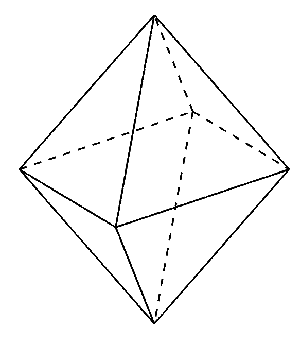 That's (assuming I'm not mistaken) an example of a Laguerre plane with an infinite number of points, but we can make a finite Laguerre plane. In fact, an example of the smallest kind of Laguerre plane can start with an octahedron. The points are the vertices, and the "circles" are the faces. Points are parallel if they are not joined by an edge. Here we have only six points, and eight circles.
The parallel classes in this example are the three pairs of opposing points of the octahedron (for instance, the topmost and bottommost points in this picture make up a parallel class). You can see that each circle (i.e., face of the octahedron) touches exactly one of each pair of opposing points.
I really enjoy the elegance of this, especially the finite example (stolen directly from A Geometrical Picture Book).
Sources
B. Polster and G. F. Steinke, "Criteria for Two-Dimensional Circle Planes", Contributions to Algebra and Geometry, Volume 35, 1994.
B. Polster, A Geometrical Picture Book. Springer-Verlag, 1998.
A lot of projective geometry is about incidence, that is, what points are collinear, which lines intersect, and that kind of thing. We don't really seem to talk about the normal things you talk about in Euclidean geometry - things like lengths, angles, areas, or in other words, the particulars of shapes. It's just about which points are in which lines, really.
So, a Laguerre plane is a type of circle plane (also called a Benz plane in one source). A circle plane has points, and the circles are made up of points. Points can be considered parallel to each other by some kind of equivalence relation*. If you make up a system like this, then it's a circle plane if it satisfies these axioms:
- Any three different points, no two of which are parallel to each other, determine a unique circle. (Note: In Euclidean space, any three different points determine a unique circle.)
- Given a point P on a circle C, and another point Q that is not parallel to P, there is a unique circle that contains both P and Q and either touches C at exactly one point, or else is C.
- Every circle contains exactly one point from every parallel class. (For instance, if A, B, and C are all parallel, and no other point is parallel to them, then every circle contains exactly one of A, B, or C. A, B, and C would be a "parallel class.")
- If you have different parallel relations - that is, completely different standards about what makes points parallel or not - then if you choose two parallel classes, each from a different relation, they'll have exactly one point in common. (You're allowed to have up to 2 parallel relations.)
- A circle has at least three points.
Now, Laguerre planes are a subset of these circle planes - specifically, the subset that has only one parallel relation, or way of determining whether points are parallel.
 An example of a Laguerre plane could start with the points that make up a vertically-oriented cylinder. We'll call points "parallel" if they are on the same vertical line on the cylinder. The circles will be non-vertical cross-sections of the cylinder, which can be straight across or at an angle (making them what we'd usually call ovals).
Does this satisfy the axioms?
- Given three points around the cylinder, no two of which are straight up or down from each other, can we make a cut of the cylinder that contains these points? Since three points determine a unique plane, and the intersection of that plane with the cylinder will be a circle or oval, yes, we can.
- Given a point on a circle, and another point that isn't vertical from the first point, can we find exactly one circle that contains both and touches the first circle at exactly one point? I think we can.
- It's pretty clear that any non-vertical cut across the cylinder crosses every vertical line exactly once.
- This axiom doesn't apply since we only have one parallel relation (the one about the vertical lines).
- Does every circle have at least three points? Yeah - we're doing this in the reals, so every circle has an infinite number of points.
That's (assuming I'm not mistaken) an example of a Laguerre plane with an infinite number of points, but we can make a finite Laguerre plane. In fact, an example of the smallest kind of Laguerre plane can start with an octahedron. The points are the vertices, and the "circles" are the faces. Points are parallel if they are not joined by an edge. Here we have only six points, and eight circles.The parallel classes in this example are the three pairs of opposing points of the octahedron (for instance, the topmost and bottommost points in this picture make up a parallel class). You can see that each circle (i.e., face of the octahedron) touches exactly one of each pair of opposing points.
I really enjoy the elegance of this, especially the finite example (stolen directly from A Geometrical Picture Book).
Sources
B. Polster and G. F. Steinke, "Criteria for Two-Dimensional Circle Planes", Contributions to Algebra and Geometry, Volume 35, 1994.
B. Polster, A Geometrical Picture Book. Springer-Verlag, 1998.
The Adventure of the Large Cat
 There is a very large tortoiseshell cat that I often see around my apartment complex. He (I think it is a he, though I could be mistaken) isn't fat at all - just tall and lanky, almost the size of a fox. I admire him often.
Well, yesterday as I was coming up the stairs to my apartment, he was coming down the stairs, which was mysterious - I'm fairly certain he doesn't live in any of the apartments on that stairway. So, naturally, I spoke to him, and he turned out to be quite friendly, and followed me up.
I intended to give him some food outside of the door, but when I opened my front door, he went right in! And showed no signs of wanting to do anything other than explore my entire apartment.
Sammy immediately backed away near the hall, but Tigerlily (!) went over to investigate this strange, large cat. Soon her tail puffed out to a gigantic size, and she and the other cat talked at each other a little bit as she cornered him behind the two armchairs. I was standing nearby and keeping them separated by walking towards Tigerlily when she got too close.
When Ed came out, he asked, "Are you sure that cat is safe?" I feel, honestly, that most cats are "safe" and I wasn't particularly worried about this big friendly fellow. He wasn't showing any signs of wanting to attack Tigerlily or anything, but I decided to go ahead and herd my two cats down the hall into my bedroom so that we wouldn't have too much ruckus.
Tigerlily hissed at Sammy the whole way down the hall! Every time she saw him she was freaked out! And Sammy was sidling sideways, scrunched low to the ground, clearly worried. I did pretty easily herd them both into my room, and then shut my door.
A couple of minutes later I shut Ed's door, because the big cat was exploring everywhere and I really didn't want him to stay too too long. He checked out the cat box and returned to the living room, where he was quite comfortable jumping up on tables and furniture for some pets.
It's always hard to know if a cat will tolerate being picked up, but after a few nice strokes I decided to try it. I let him know that I was going to pick him up, but not to worry, that if he didn't like it he should just let me know and I would stop right away. I gingerly picked him up, and he seemed slightly nervous but not too distressed. I set him down outside the door (where I had already put some food, hoping to lure him out; he never did eat the food), said, "Thanks for visiting. Stop by any time!" and closed the door behind him.
The cats came back out once I opened my bedroom door. Tigerlily went looking all over for signs of the big cat, but Sammy was crouchy and nervous for a while and hoped that the big cat would NOT reappear.
I think I am going to call him "Lopez" in honor of his interloper status.
Anne of Green Gables
 Anne of Green Gables (by Lucy Maud Montgomery) was first published around 1908. It is the story of an orphan girl who comes to live with a middle-aged brother and sister in rural Prince Edward Island. Anne is 11 at the beginning of the book, and 16 at the end of it, and there are several sequels that follow her through the various stages of life.
I'd read the first book before, but lately I've been reading the whole series on my Kindle, and reflecting on how remarkable it is.
The books are kind of simple - this isn't Dickens, but more like children's literature. Anne is feisty and quite imaginative, but she's a very good girl despite all of the scrapes she gets into. The books assume and promote a very basic Protestant morality. To the extent that there is moral conflict in the books, it's between a sort of fuddy-duddy outlook and a more free-spirited one.
But I find two things fairly remarkable. One is that the setting and the way the books progress is kind of historically amazing. There are no slaves, no serfs, and very little in the way of class differences, and Anne is free to pursue her education, vocation, and romantic aspirations as best she can in a friendly world full of opportunities. Oh, people still die of consumption, and ride in horse buggies, but otherwise it's kind of amazingly modern in some sense.
It's also rather astonishing how feminist the books are on a kind of basic level. The patriarchal features of the day are assumed, of course, but so is the idea that women can be intellectuals and academics. When Anne seeks her B.A., some of the adult women of her town disapprove of women going to college, but the surrounding culture is supportive of her doing so, and her years at college are filled with the kind of witty intellectual repartee that I remember from, well, my years at college.
The way that Anne's romantic life is worked out is also pretty cool. If you have any experience reading older novels at all, you'll have a guess within the first 50 pages of the first book about who Anne might end up with, but the way that it works out - the motivations and learning processes of the characters - is a bit interesting and, well, somewhat modern.
Watching Anne mature through the books is really fun. She starts off as a sort of comically exaggerated version of a girl you might imagine reading the book, but becomes really recognizably a person, a young woman, and an adult, as she ages.
All in all, if you're in the mood for some rather wholesome light reading, I can recommend these books heartily.
Thursday, April 02, 2009
Homogeneous Coordinates in the Extended Euclidean Plane
I've discussed the Extended Euclidean Plane ("EEP") before. Now I want to talk about homogeneous coordinates, because they are just very cool and convenient. They are used in all field planes, but the EEP works well as something to blog about without having to go into a whole bunch of other "stuff." (But in particular, we use them in a lot of finite field planes - that is, planes defined over a field that has a finite number of members rather than a field like the real numbers.)
So, the main distinguishing feature of the EEP is that there are no parallel lines. Lines that are parallel in the Euclidean plane meet at a "point at infinity" associated with their slope. These different points at infinity (one for each possible slope of line) make up the "line at infinity."
Normally, when we talk about coordinates in the Euclidean Plane, we use two numbers, so for instance, (2,3) might be the coordinates of a point. But for homogeneous coordinates, we are going to use three numbers - a 3-dimensional vector. What makes them "homogeneous" is that every scalar multiple of this vector refers to the same point, so that, for instance,
and
refer to the same point.
As a convention, we will make these coordinates from the usual Euclidean coordinates by making using the x and y values unchanged, and using 1 as the third coordinate. So the point formerly referred to as (2, 3) is now (2, 3, 1). It can also be called any scalar multiple of that, like (4, 6, 2) or (2/3, 1, 1/3), but there is no reason not to reduce any of those to (2, 3, 1).
Lines will also have three coordinates, which will come from the usual definition of a line:
is the same as
and gives rise to homogeneous coordinates: [2, -1, 4]
A point is on a line iff the dot product of the vectors of the point and line is 0. So let's say we have the line y = 2x + 4, and the point (1, 6). The homogeneous coordinates for the line are [2, -1, 4] and for the point we have (1, 6, 1).
so the point is on the line as we expect. Note that this is the same thing as saying that a line with coordinates [a, b, c] has the equation
and a point with coordinates (x, y, z) is on the line iff it satisfies that equation.
But what's with the three dimensions, yo? That doesn't make any sense.
The deal here is that we're kind of analogizing points (which usually have two coordinates) to lines (which usually have three), and lines to planes. Specifically, points become lines through the origin, and lines become planes through the origin. A point is on a line if the corresponding line is in the corresponding plane. Since two distinct lines through the origin determine a unique plane through the origin, and two distinct planes through the origin intersect in a unique line through the origin, this corresponds to our desired relationship between points and lines.
Now then. I've said that two parallel lines intersect at a point at infinity. How does that work? Well, let's look at these two parallel lines:
and, using the homogeneous coordinates, see them as a system of equations:
Using a bit of linear algebra (or regular algebra, if you prefer), we find that in order to solve these equations, a point (x, y, z) has to have the form (t, 2t, 0) for some t. So we can say that the homogeneous coordinates for this point are (1, 2, 0).
Using coordinates this way, in the EEP we will always get 0 as the final coordinate of a point on the line at infinity. The line at infinity, meanwhile, has homogeneous coordinates [0, 0, 1], as you can confirm if you like.
The linear algebraic qualities of this sytem mean that solving for the point of intersection of two lines, and for the line determined by two points, are exactly the same operation. In fact, given two line or point coordinates (a, b, c) and (d, e, f) we can solve for the point of intersection or the common line, respectively, by solving this determinant:
i.e.,
so the coordinates of the desired point or line are
So that's what I've been up to lately...
So, the main distinguishing feature of the EEP is that there are no parallel lines. Lines that are parallel in the Euclidean plane meet at a "point at infinity" associated with their slope. These different points at infinity (one for each possible slope of line) make up the "line at infinity."
Normally, when we talk about coordinates in the Euclidean Plane, we use two numbers, so for instance, (2,3) might be the coordinates of a point. But for homogeneous coordinates, we are going to use three numbers - a 3-dimensional vector. What makes them "homogeneous" is that every scalar multiple of this vector refers to the same point, so that, for instance,
(1, 1, 1)and
(2, 2, 2)refer to the same point.
As a convention, we will make these coordinates from the usual Euclidean coordinates by making using the x and y values unchanged, and using 1 as the third coordinate. So the point formerly referred to as (2, 3) is now (2, 3, 1). It can also be called any scalar multiple of that, like (4, 6, 2) or (2/3, 1, 1/3), but there is no reason not to reduce any of those to (2, 3, 1).
Lines will also have three coordinates, which will come from the usual definition of a line:
y = 2x + 4is the same as
2x - y + 4 = 0and gives rise to homogeneous coordinates: [2, -1, 4]
A point is on a line iff the dot product of the vectors of the point and line is 0. So let's say we have the line y = 2x + 4, and the point (1, 6). The homogeneous coordinates for the line are [2, -1, 4] and for the point we have (1, 6, 1).
(1, 6, 1) (dot) [2, -1, 4] = 1 * 2 + 6 * -1 + 1 * 4 = 0so the point is on the line as we expect. Note that this is the same thing as saying that a line with coordinates [a, b, c] has the equation
ax + by + cz = 0and a point with coordinates (x, y, z) is on the line iff it satisfies that equation.
But what's with the three dimensions, yo? That doesn't make any sense.
The deal here is that we're kind of analogizing points (which usually have two coordinates) to lines (which usually have three), and lines to planes. Specifically, points become lines through the origin, and lines become planes through the origin. A point is on a line if the corresponding line is in the corresponding plane. Since two distinct lines through the origin determine a unique plane through the origin, and two distinct planes through the origin intersect in a unique line through the origin, this corresponds to our desired relationship between points and lines.
Now then. I've said that two parallel lines intersect at a point at infinity. How does that work? Well, let's look at these two parallel lines:
y = 2x + 1
y = 2x + 3
and, using the homogeneous coordinates, see them as a system of equations:
2x - y + z = 0
2x - y + 3z = 0
Using a bit of linear algebra (or regular algebra, if you prefer), we find that in order to solve these equations, a point (x, y, z) has to have the form (t, 2t, 0) for some t. So we can say that the homogeneous coordinates for this point are (1, 2, 0).
Using coordinates this way, in the EEP we will always get 0 as the final coordinate of a point on the line at infinity. The line at infinity, meanwhile, has homogeneous coordinates [0, 0, 1], as you can confirm if you like.
The linear algebraic qualities of this sytem mean that solving for the point of intersection of two lines, and for the line determined by two points, are exactly the same operation. In fact, given two line or point coordinates (a, b, c) and (d, e, f) we can solve for the point of intersection or the common line, respectively, by solving this determinant:
| x  y  z |
| a  b  c |  = 0
| d  e  f |
i.e.,
(bf - ce)x - (af - cd)y + (ae -bd)z = 0so the coordinates of the desired point or line are
(bf - ce, cd - af, ae - bd).So that's what I've been up to lately...
Saturday, March 28, 2009
La Sourdine
I'm sure you've noticed how Spanish or French versions of things often come out longer. A case in point: my computer speaker has a big round button, which underneath says
PUSH TO MUTE
and also
APPLIYER POUR ACTIVER LA SOURDINE
Hee.
PUSH TO MUTE
and also
APPLIYER POUR ACTIVER LA SOURDINE
Hee.
Thursday, March 26, 2009
Wednesday, March 25, 2009
Notes

Lately I've noticed how very helpful notes are - not just notes I've already taken, but the writing of notes itself. Here are situations, some more common than others, in which writing notes helps me:
- To-do lists. I don't write large or ongoing to-do lists and keep them for weeks, but I find them helpful for a few tasks I need to do within a couple of days.
- Breaking down a task. Sometimes when I'm not sure how to tackle something, or just can't quite get myself started, I can write it down in tiny steps and get kick-started that way.
- Handling confusion. When I get confused about a problem - at school or work - writing out my questions and concerns (neatly, in complete sentences, slowly) is often surprisingly helpful. I will either get an answer to my problems or great insights about how to approach them. (The picture with this post is an example of some of this type of note-taking; I took these notes a few minutes ago and they have jump-started a task I had completely stalled at.)
- Reading difficult material. Recently, I've been trying to read some math journal articles. I decided that since I write down things like axioms and theorems when I take notes in class, I might as well directly copy them from journal articles as well. And guess what? It helps! A lot! I think the process of slowing down and being methodical makes me a lot more likely to understand material. I have also found this works wonders for reading math textbooks. It feels silly to copy out the exact lines of an example worked in the book, but it aids understanding immensely.
Wednesday, March 18, 2009
Cooking Experiment
 For the past few months, Ed and I have been trying to make and eat dinner together more. We've stuck pretty well to our original goal of having me cook for us twice a week and him once a week. A meal is typically weekday dinner or weekend brunch, and we try (and have so far managed) to include protein, vegetables (and/or fruits), and some kind of starch. I often include a whole grain when it is my turn. (I did not make the meal in this picture, but it looks like my type of thing.)
Last night, for instance, I made boneless pork chops (broiled in the oven), brown basmati rice (plain, but cooked with salt and butter), and asparagus (sauteed in a pan with olive oil, crushed red pepper, and garlic). It made a very pretty meal, actually, and the asparagus was pleasingly spicy.
Here is what I have learned so far:
- I much prefer cooking for the two of us to making my own dinner, even though when I cook for just myself it is much easier (because I don't make such elaborate things).
- I actually really enjoy making dinner for us.
- I prefer cooking several things to making a one-pot dish. I am especially fond of the protein/starch/vegetable trio, often with a very plain vegetable.
- Any kind of fish can be cooked with oil and butter in a pan and come out delicious.
- Excluding (bizarrely) restaurant food, I view food cooked by other people with suspicion and distrust.
- I like to control what we have for dinner.
Tuesday, March 17, 2009
Once He Was
I've owned this album for years, but lately (perhaps because Pandora has been playing it for me) I've gotten obsessed with "King of Spain" by Moxy Früvous. I think the whole thing is quite clever, but I especially like the policy details mixed in with the silliness, as here:
Royalty, lord it looked good on meHere is the song (along with a video someone made up to go with it):
Buried in silk in the royal boudoir or going nuclear free
Or playing Crokinole with the Princess of Monaco
Telling my jokes to the OPEC leaders, getting it all on video.
Sunday, March 15, 2009
Passive-Aggressive Tendencies
It's important to me to keep getting better in whatever ways I can. Of course, I start out with a basic package of assets and flaws, and my relative strengths and weaknesses may not change all that much over time. But I do work on many of the things about me that are troublesome.
Something I've worked on a lot in my relationship with Ed is passive aggressiveness. I've never thought of myself as particularly passive-aggressive, and I don't think most people would characterize me that way (in the spectrum of humanity), but I definitely have tendencies. Ed is particularly sensitive to it, and that has...helped.
When I get angry with someone, my first impulse is to be silent at them. Once I reject that option, the next few that come up on the list are also passive-aggressive. I could make a snide remark to let them know I'm angry. I could say something sarcastic. Or I could just go somewhere else and wait for them to figure out that I'm avoiding them on purpose.
These days, I try to first think and determine whether the anger seems justified or not. If it isn't, or if I can't tell, I'll say something like, "This may not be fair. But I'm feeling kind of angry [about X]." Otherwise I'll just say the angry part.
Even at this point (and Ed is amazing supportive of this type of communication), it's hard for me not to follow up with passive-aggressive remarks like, "I guess I just thought you would have known how that would make me feel," or, "I guess I just trusted that you knew how to cook a steak," or, "Never mind - I shouldn't have thought you'd get it."
It's not that being passive-aggressive is generally so very awful. There are definitely worse ways to handle anger. But I think my tendency to be this way comes from feeling essentially powerless whenever I am angry. I see no hope of remediation, and that's what makes me want to just snub the other person. I feel contemptuous or fundamentally angry towards them, as though whatever has happened changes the underlying reality of the whole relationship.
I am actually getting a lot better at this through practice, this thing of just saying, "I am angry. Here is why," and listening to the response and working through it. For me, right now, in this relationship, even when it turns out that my anger is unfair I seem to be better off expressing it.
Friday, March 13, 2009
Spoiler-Free Review of Watchmen
 Ed and I saw Watchmen tonight, in IMAX glory. And I promise this (brief) review will be completely spoiler-free, so read without fear.
I either read or started to read Watchmen years ago while dating Robin. At any rate, I didn't remember anything about the plot at all, though the opening sequence of the film was very familiar and I think it was shot a lot like you'd expect from the beginning of the book. I was glad not to know the plot going in.
I should preface this by saying that I have a hard time getting into any kind of plot-based action movies, especially superhero movies. I saw Iron Man. Watched The Dark Knight. They didn't really do anything for me even when I could recognize the artistry. I wasn't really drawn in at all, and they felt tedious to watch and I waited for the plots to resolve. Honestly, I feel similarly about the more recent three Star Wars movies and about The Lord of the Rings and the Harry Potter movies. I can modestly enjoy them but I wouldn't go see them if they weren't blockbuster spectaculars that one should see. (And I saw a lot of those with Mosch, who always wants to have seen those movies.) Oh, and Pirates of the Caribbean and the sequels. Same deal.
But Watchmen I liked. I mean, I really, really liked it. I was aware while I was watching it that I was just having a fantastic time.
I'm trying to think why that was. I think that, unlike with most other action movies, I was actually into the characters. Other than perhaps the romantic female lead (if you can call her that), any time a character was on screen I was watching in a mesmerized fashion. I found every one of the men attractive in some unusual way. I just wanted to look at them all day. And somehow that really helps.
The movie is gory in parts - more gory than I prefer. It is probably what Robin would call "cartoon-like violence," but for me it was mostly just violence. But I was willing to tolerate it in order to see the rest of the movie, and only one part really disturbed me.
It has a lot of fighting, but as best I can recall no high-speed chasing types of sequences, which was good since those usually bore me. There was interesting machinery and structures. And beauty.
So, if you're at all inclined to see it, go. You'll probably like it.

Wednesday, March 11, 2009
Ed's New Job
 Ed starts his first post-college job next week - a regular corporate office job. It will actually be a 3-month internship, at the close of which he will hopefully be hired as a permanent employee.
It's kind of an exciting time. He's never had a corporate job before and I'm looking forward to him having a working experience similar to mine. I feel like he doesn't really understand what working in this type of job is like, though all types of work have their ups and downs, and I certainly don't know what trying to write a thesis is like (though I think I would suck at it).
It'll also be challenging for us. Our relationship goes more smoothly when I'm not in school, when Ed is not stressed, when things are...easy. And having your first full-time office job is not easy. Being unemployed is stressful but also easy in terms of having plenty of time for rest and recreation.
But overall it's exciting. I hope Ed has a great time doing a kind of work where, when you come home at night, you're done. I don't think he's ever had that luxury. And just...all the various aspects of working life. (Oh. And they pay you. That's good too.)
Bring it on!
Tuesday, March 10, 2009
The One We Left Blank
Last week, I had a test in Principles of Programming Languages. I knew I wasn't fully prepared, but I had gone through my notes and looked for ways to review the things I would have to do on the test. (The whole test was "do this" types of questions - no factual questions at all. It was nice, actually. And it was open notes.)
 The last question on the test was about recursive descent parsing. We were supposed to write some code to go with some existing code to do a little piece of it, and I just...couldn't. I couldn't figure out how to access the variables I would have needed from the code block I was to write, and I wasn't sure how it was supposed to work anyway. I wrote a couple of lines and then gave up, essentially leaving it blank. Time was up anyway - I had spent most of the two-hour class period doing the first 7 problems.
So I was expecting a B.
Last night, when I got the test back, I had scored 55/56, or 98%.
"I didn't grade Question 8," the professor said. "By the time I got there I was just like ... eh. This is enough. No, not really. It's just, I looked, and most of the answers were blank. And the rest were...varying degrees of pseudocode that...yeah. So I decided not to grade it."
It seems fair. Our class has no textbook or any other kind of outside material. If basically nobody can make a decent attempt at answering a test question, it seems likely that you didn't actually teach the material.
And, of course, I was personally pleased to be one of many fuck-ups rather than an individual unique fuck-up.
The last question on the test was about recursive descent parsing. We were supposed to write some code to go with some existing code to do a little piece of it, and I just...couldn't. I couldn't figure out how to access the variables I would have needed from the code block I was to write, and I wasn't sure how it was supposed to work anyway. I wrote a couple of lines and then gave up, essentially leaving it blank. Time was up anyway - I had spent most of the two-hour class period doing the first 7 problems.So I was expecting a B.
Last night, when I got the test back, I had scored 55/56, or 98%.
"I didn't grade Question 8," the professor said. "By the time I got there I was just like ... eh. This is enough. No, not really. It's just, I looked, and most of the answers were blank. And the rest were...varying degrees of pseudocode that...yeah. So I decided not to grade it."
It seems fair. Our class has no textbook or any other kind of outside material. If basically nobody can make a decent attempt at answering a test question, it seems likely that you didn't actually teach the material.
And, of course, I was personally pleased to be one of many fuck-ups rather than an individual unique fuck-up.
Thursday, March 05, 2009
Desargues' Theorem
My geometry class this semester seems to revolve around Desargues' Theorem (pronounced dezargs), which is a slightly complicated theorem that doesn't hold in the Euclidean plane, but holds in a lot of projective spaces. It took me a long time to be really comfortable with it, but it now seems quite simple to me, probably because of the dozens of times that I have drawn and explained it.
Desargues' says, simply, that if two triangles are perspective from a point, they are also perspective from a line.
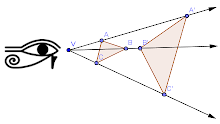
"Perspective from a point" is relatively simple, though it took me a while to learn what motivated calling it that.
 In this picture, the two triangles ABC and A'B'C' are perspective from V because if you were looking from V (hint: like the giant eye), the corresponding points of the triangles would be on the same lines. (Here, "triangle" actually refers to the points, not the line segments or the interior, though it's not very important in this case.)
"Perspective from a line," alas, doesn't allow quite such a simple explanation. What it means is that the intersections of the corresponding sides (e.g., where AB crosses A'B', if you extend the line segments) are collinear, or all on the same line. Let's expand the drawing above to include those points and their (possible) line of perspective. (Note: I've also moved the points around slightly to make the intersections show up.)

Here, I've colored the corresponding sides the same color, so AB and A'B' are blue, AC and A'C' are red, and BC and B'C' are green. Where each pair intersects, you get the purple points L, M, and N, and the big purple line goes through all of them. So, in this case, Desargues' Theorem does hold: ABC and A'B'C' are perspective from both V and the the purple line.
The only reason Desargues' doesn't always hold in a Euclidean plane (the kind of geometry we're used to) is that some of the lines might be parallel. For instance, if AC and A'C' were parallel, N (their intersection) wouldn't exist. Projective geometry basically does away with parallel lines, so it doesn't have that limitation.
Subscribe to:
Posts (Atom)