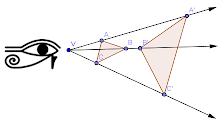
Since my new classes started yesterday, here is a brief overview.
Higher Geometry II
This course covers affine and projective geometry. Last night we went over groups, abelian groups, and fields, which are abstract algebra concepts. (A field, which is the highest level of this particular hierarchy, is something like the real numbers - a set with two operators comparable to addition and multiplication, with associativity, commutativity, distributivity, identities, and reciprocals.) The prof (a grad student) told us not to worry if we felt like we were drinking from a firehose. He called this "Abstract Algebra in an hour."
15% of our class grade will be based on problems that we individually present in class, 15% on problems that we turn in, 25% on a paper that we have to write (15% for the paper, 10% for a presentation based on the paper), and the remainder on the three exams (no cumulative final). For the exams, we have a choice of take-home (several new problems) or oral (problems from the book or handed out in class), and we have to choose an oral exam for at least one of them.
Oral exams and all of the presentations are graded as Perfect (100%), Good (95%), Fair (75%), or Poor (35%). He suggested that he will not be very harsh with the grading and if you do a decent job you will probably get the 95%.
Principles of Programming Languages
This is an upper-division CS course, pretty standard at most schools, that discusses the different paradigms of programming languages, their features, and something about their implementation. The professor was funny and charming.
There will be 7 coding assignments that will take about 2 weeks each. These are graded pass/fail, and at the deadline we must have turned in a "serious effort." He'll give it back and if he requests additional work or fixes on it, we have a week to turn it back in with the fixes. These coding assignments are worth 7 points each for the total course grade. The remainder of the points come from 3 exams (again no cumulative final) that are worth 17 points each.
Apparently the professor used to let people turn in their assignments whenever, but he discovered (unsurprisingly) that this just encouraged students to prioritize classes that did have deadlines. So now, barring "both of your grandparents dying in a horrible blimp accident [and if anyone's grandparents have died in a horrible blimp accident I'm sorry, didn't mean to be insensitive]" he'll only accept one assignment up to a week late per student.
There is no textbook for this class. He's used several, including (many times) the most popular one, by Sebesta, but he finds that he uses them mostly to make fun of how bad and wrong they are. Also, he said that for us having a textbook just means thinking, "Oh, there's this thing I should be reading, but I don't." And that sounds about right; I haven't actually read a CS textbook yet. He plans to attempt to produce whatever materials he wants us to read, which will be necessarily brief given that he has to produce them.
It's going to be a fun but difficult, I think, semester.
Thursday, January 22, 2009


Wednesday, January 21, 2009
Rocks and Sand
When I was in middle school, I saw a demonstration by a Christian group that, though I'm sure it is completely cliched, stuck with me. The leader had a something like a pitcher (your life), some large rocks (god, i.e., the important stuff), and a lot of sand (the unimportant stuff). She proceeded to demonstrate that, if you put the sand in first, the rocks would not fit, but if you put in the rocks first, the sand would still fit. You can get what you want if you put the important things first.
In middle school, that metaphor didn't fit my life particularly well (though I continued to ponder it), but these days it really does. I have found in particular that absolutely nothing happens unless I make a specific plan to do it. And this is true of hobbies as well, especially the ones that I share with Ed.
Having sex. Doing some math together. Watching a movie. Cleaning the house. Exercising. Eating dinner together. None of it will occur if we don't say, "We can do this tonight," or, "Tomorrow let's do that."
Even though I find this phenomenon a little frustrating, it also means that one of the central problems of life (not doing the things I want to do) is largely solvable through this very simple tactic of asking myself, "What do I want to accomplish today?" It doesn't really require a To Do list, because the things I'm talking about are regular things that you don't tend to forget. I know the house needs cleaning on a regular basis. I know I want to spend time with Ed doing math. I just have to be planful so that these things actually occur.
In middle school, that metaphor didn't fit my life particularly well (though I continued to ponder it), but these days it really does. I have found in particular that absolutely nothing happens unless I make a specific plan to do it. And this is true of hobbies as well, especially the ones that I share with Ed.
Having sex. Doing some math together. Watching a movie. Cleaning the house. Exercising. Eating dinner together. None of it will occur if we don't say, "We can do this tonight," or, "Tomorrow let's do that."
Even though I find this phenomenon a little frustrating, it also means that one of the central problems of life (not doing the things I want to do) is largely solvable through this very simple tactic of asking myself, "What do I want to accomplish today?" It doesn't really require a To Do list, because the things I'm talking about are regular things that you don't tend to forget. I know the house needs cleaning on a regular basis. I know I want to spend time with Ed doing math. I just have to be planful so that these things actually occur.
Tuesday, January 20, 2009
Rhapsody
Some people swear by Rhapsody, which is a subscription music service. Rather than (or in addition to) buying specific songs, you can listen to any of their entire (giant) catalog for a flat monthly fee. You can play the songs on your computer or Tivo, or put them on your portable music player (though not an iPod).
I was curious what that was like, so I signed up for a free 14-day trial. Afterwards, two buttons appeared - one to allow me to download the Rhapsody music player, and one that promised I could listen to music on Rhapsody's website. I was at work, so I went to try the website.
The interface is junked up with a million things, including ads (which, I'm subscribing, why should I have to see ads?), but I was able to find where you could look up artists or albums you might want to hear. The songs have buttons next to them - one that allows you to play them, and one that allows you to add them to your playlist.
The play button did nothing. The bottom edge of my browser said it was downloading data, but no sound ever happened. (Pandora is playing just fine, so there's no sound problem on my end.) I tried the playlist button, and then I went to where I could view my playlists. But I have no playlists. I guess that button only works if you start a playlist first?
Honestly I just can't be bothered with this. I was already skeptical once I found out that Rhapsody was related to Real because I remember what a nightmare the Real Player was when I had it installed on my computer in the past. But I just thought it would be a nice, clean service - something like Pandora except with options to listen to exactly what you want - and instead it's, well, like I described.
So before I forgot, I figured I would go cancel my 14-day free trial before I get charged. I went to the page to manage my account, and clicked on "Cancel Membership." Here is a screenshot of where that took me:
 So now I'm just fucking pissed. There is absolutely no technical reason that you shouldn't be able to cancel a membership online. They're just purposely making it difficult by requiring me to talk to a real-life human who will probably try to sell me some of the many packages and services that I had to un-check on my way to getting the free trial already. (I also had to un-check the box for "send me a bunch of spam email with crap offers all the time" more than once on different pages.)
So between the non-working interface, the ads, the constant upsells, the opt-out spam bullshit, and now the intentionally difficult membership-cancelling process, I am well and truly done with Rhapsody.
Fuck you, Rhapsody.
I was curious what that was like, so I signed up for a free 14-day trial. Afterwards, two buttons appeared - one to allow me to download the Rhapsody music player, and one that promised I could listen to music on Rhapsody's website. I was at work, so I went to try the website.
The interface is junked up with a million things, including ads (which, I'm subscribing, why should I have to see ads?), but I was able to find where you could look up artists or albums you might want to hear. The songs have buttons next to them - one that allows you to play them, and one that allows you to add them to your playlist.
The play button did nothing. The bottom edge of my browser said it was downloading data, but no sound ever happened. (Pandora is playing just fine, so there's no sound problem on my end.) I tried the playlist button, and then I went to where I could view my playlists. But I have no playlists. I guess that button only works if you start a playlist first?
Honestly I just can't be bothered with this. I was already skeptical once I found out that Rhapsody was related to Real because I remember what a nightmare the Real Player was when I had it installed on my computer in the past. But I just thought it would be a nice, clean service - something like Pandora except with options to listen to exactly what you want - and instead it's, well, like I described.
So before I forgot, I figured I would go cancel my 14-day free trial before I get charged. I went to the page to manage my account, and clicked on "Cancel Membership." Here is a screenshot of where that took me:
 So now I'm just fucking pissed. There is absolutely no technical reason that you shouldn't be able to cancel a membership online. They're just purposely making it difficult by requiring me to talk to a real-life human who will probably try to sell me some of the many packages and services that I had to un-check on my way to getting the free trial already. (I also had to un-check the box for "send me a bunch of spam email with crap offers all the time" more than once on different pages.)
So between the non-working interface, the ads, the constant upsells, the opt-out spam bullshit, and now the intentionally difficult membership-cancelling process, I am well and truly done with Rhapsody.
Fuck you, Rhapsody.
Saturday, January 17, 2009
Spring 2009
My semester begins Tuesday, and originally I was only scheduled to take one class - Principles of Programming Languages, the last computer science class in my degree plan. It is on Mondays and Wednesdays at 7 PM, and I just couldn't find another class before it to fill in the gap, at least among classes that I need or would like to take. (I only have three classes left after this semester, but I would have been happy to have taken another math.)
Last night, I decided to do a search through the online schedule for all classes that are around 5 on M/W. And I found that UCD (University of Colorado at Denver) has a cross-listed math class at 5:30. This one:
I am excited about this on several levels. One: math! Two: scary geometry! Three: it's at UCD, where I want to get my master's, so it's possible it could help me. Four: it's another 400-level math class, which I could use.
I was looking forward to a kind of laid-back semester with only the one class, but now I'm very excited about the geometry addition. It will make my semester difficult but enjoyable and rewarding. I can't wait.
Last night, I decided to do a search through the online schedule for all classes that are around 5 on M/W. And I found that UCD (University of Colorado at Denver) has a cross-listed math class at 5:30. This one:
MATH 4220-3. Higher Geometry II. Studies affine and projective geometries. Coordinates are introduced in this framework. Planes and higher dimensional spaces are examined. Prereq:MATH3191.The prereq is for linear algebra, which I started but didn't finish (and will retake next year). I feel relatively confident that I can remember and/or pick up whatever linear algebra it will require. I have also taken the Metro class that is equivalent to their Higher Geometry I, although that is not a prereq.
I am excited about this on several levels. One: math! Two: scary geometry! Three: it's at UCD, where I want to get my master's, so it's possible it could help me. Four: it's another 400-level math class, which I could use.
I was looking forward to a kind of laid-back semester with only the one class, but now I'm very excited about the geometry addition. It will make my semester difficult but enjoyable and rewarding. I can't wait.
Monday, January 12, 2009
Digital Piracy
I have a friend who as far as I know is a capitalist/libertarian, yet who believes that digital piracy is ethically all right if not outright desirable. I find this position somewhat bizarre, and I personally try to avoid copyright-violating theft.
I am not at all opposed to open source. I think it's great to make your work available for free if you can and wish to, and I see a lot of benefits (in software and elsewhere) to doing so.
But, subject to certain limitations (the time limits of patents, fair use, etc.), I think that if you make something, you own it, and have the right to control its use. If I make a CD of the most awesome music ever and I am only willing to sell it for $10,000 per copy, that's my right, even if the price is outrageous.
But what if the record companies are screwing over the musicians such that the musicians hardly see a dime of record sales anyway? Well, frankly, that's not my problem. If Walmart negotiated an unfair deal with a Chinese manufacturer, that doesn't give me the right to steal cheap Chineses goods at Walmart, and I don't see this situation as being any different. Somehow or other, the musicians decided that signing with the label was a good move for them, and until I see evidence that they were coerced or that, for instance, the record labels have some means of preventing you from publishing your own music, it's all kosher as far as property rights go, and I can either buy the CD or do without.
I'm not an absolutist on this issue. I think comp CDs distributed between friends are great and mostly fall within fair use. And I don't have a huge ethical problem with someone copying something they could never afford, like a college student having an illegal copy of Windows. (It's technically wrong in my book, but causes minimal, if any, harm and is completely understandable.)
There is a difference between digital data and physical products, in that the former can be reproduced without cost. If I would never buy a Shania Twain CD but want to pirate one, then I'm not actually costing anyone anything - I'm unfairly using other people's labor, but at no cost to them. If I would never buy an axe but steal one from Home Depot instead, then I am costing them - they have one fewer axe. That difference is why I feel fairly lenient towards small, mild piracy. But it's not enough to make me decide that people who produce digital products shouldn't have the right to charge for their work.
I am not at all opposed to open source. I think it's great to make your work available for free if you can and wish to, and I see a lot of benefits (in software and elsewhere) to doing so.
But, subject to certain limitations (the time limits of patents, fair use, etc.), I think that if you make something, you own it, and have the right to control its use. If I make a CD of the most awesome music ever and I am only willing to sell it for $10,000 per copy, that's my right, even if the price is outrageous.
But what if the record companies are screwing over the musicians such that the musicians hardly see a dime of record sales anyway? Well, frankly, that's not my problem. If Walmart negotiated an unfair deal with a Chinese manufacturer, that doesn't give me the right to steal cheap Chineses goods at Walmart, and I don't see this situation as being any different. Somehow or other, the musicians decided that signing with the label was a good move for them, and until I see evidence that they were coerced or that, for instance, the record labels have some means of preventing you from publishing your own music, it's all kosher as far as property rights go, and I can either buy the CD or do without.
I'm not an absolutist on this issue. I think comp CDs distributed between friends are great and mostly fall within fair use. And I don't have a huge ethical problem with someone copying something they could never afford, like a college student having an illegal copy of Windows. (It's technically wrong in my book, but causes minimal, if any, harm and is completely understandable.)
There is a difference between digital data and physical products, in that the former can be reproduced without cost. If I would never buy a Shania Twain CD but want to pirate one, then I'm not actually costing anyone anything - I'm unfairly using other people's labor, but at no cost to them. If I would never buy an axe but steal one from Home Depot instead, then I am costing them - they have one fewer axe. That difference is why I feel fairly lenient towards small, mild piracy. But it's not enough to make me decide that people who produce digital products shouldn't have the right to charge for their work.
NFL Playoffs
 I didn't watch much football this season, but I've been following the playoffs fairly avidly. And although there are a few NFL teams that I tend to really like (the Broncos of course, the Colts, the Eagles), it's not usually obvious to me who I will root for in a particular game. I didn't go into the playoffs this year with any particular favorites. Nevertheless, I have rooted for the winning team in 7 out of 8 playoff games so far, and more often than not I was rooting for the underdog, so it's been an interesting season.
In the first ("Wildcard") round, the games (with winners in bold) were
Chargers at Colts:
I rooted for the Chargers because I was honestly impressed by how they came back in their season and eventually won over Denver in the final game of the regular season to make the playoffs (after Denver led the division all season).
Ravens at Dolphins:
I rooted for the Ravens even though defense-heavy teams are not my style just because ravens are one of my very favorite birds and I like the purple uniforms. Also, Sally hates Florida teams.
Falcons at Cardinals:
I hate all Atlanta teams, so it was Cards for me all the way.
Eagles at Vikings:
I didn't watch this one, but would have gone for the Eagles because I love them.
In the second ("Divisional") round, we had (again with winners in bold):
Chargers at Steelers:
I rooted for the Chargers, but it was evident pretty early on that the Steelers were going to kick them all up and down the field.
Ravens at Titans:
I was still a Ravens fan.
Cardinals at Panthers:
I like both of these teams, but by now I'd noticed that I was picking all of the bird teams, and indeed I found myself continuing to root for the Cards.
Eagles at Giants:
I was still Eagles all the way.
So it's been a pretty good run, and I've supported a bird team every time I got the chance. I don't know if that's a general pattern or just happenstance. (I wouldn't have supported the Atlanta Falcons against anyone.)
Next week are the AFC and NFC champions, with Steelers at Ravens and Eagles at Cardinals, respectively. I'll be rooting for the Ravens and the Eagles, and, if things go according to plan, for the Eagles in the Superbowl. Not that anyone should care.
Sunday, January 11, 2009
Finances
My money situation is pretty good lately, so it seems like a nice time for another update.
If you look at my last debt snowball (from November '07), you will see that I should have owed about $9000 by this month. In truth, I've not done as well at paying off debts as I should have. I've spent money pretty profligately this year, partly because of dating Ed. (Ed isn't expensive or anything; it's mostly just that dating him has kind of made me loose and happy and carefree in a way that isn't helpful for budgeting, healthy eating, or other discipline-requiring endeavors.)
However, in May I changed jobs. As a result of doing so, instead of working for a company that is going out of business any day now, I'm working for a company that is doing very well. And although I have the same salary as before, I got a large bonus last month, nearly all of which I applied to debts.
As a result, my total debt this month is about $5,000. This is wonderful and unexpected and I should be completely out of debt by May. The only money I owe now is on my car, which is worth more than I owe on it. So I am feeling really good about that.
Meanwhile, the delightful Mosch moved out in May, and the differently delightful Ed moved in in September. Unlike Mosch, Ed pays me rent, so I have more money on a monthly basis. Ed has also graduated and is now looking for a job; when he gets one, he'll start paying half of the rent and utilities instead of the slightly smaller amount he pays now.
I recently became eligible for my company's 401K, and I am now putting in 15% of my income. I believe there is some matching or company donations of some kind, though I haven't been able to figure it out exactly.
In addition, I am now once again covered by a health insurance plan with a high deductible and associated HSA account. Unlike some people's flexible spending accounts, mine keeps the money in it forever; you can always use the money for medical expenses (including eyeglasses, OTC drugs, vitamins used to treat a condition, etc.), and at retirement age you can withdraw it freely. My current health plan is even more excellent in that regular preventive care is not subject to the deductible, and my company pays half of it every year - the first half! They just put that money directly into my HSA account, so I don't really need to fund it myself at all.
Anyway, things are looking good all the way around.
If you look at my last debt snowball (from November '07), you will see that I should have owed about $9000 by this month. In truth, I've not done as well at paying off debts as I should have. I've spent money pretty profligately this year, partly because of dating Ed. (Ed isn't expensive or anything; it's mostly just that dating him has kind of made me loose and happy and carefree in a way that isn't helpful for budgeting, healthy eating, or other discipline-requiring endeavors.)
However, in May I changed jobs. As a result of doing so, instead of working for a company that is going out of business any day now, I'm working for a company that is doing very well. And although I have the same salary as before, I got a large bonus last month, nearly all of which I applied to debts.
As a result, my total debt this month is about $5,000. This is wonderful and unexpected and I should be completely out of debt by May. The only money I owe now is on my car, which is worth more than I owe on it. So I am feeling really good about that.
Meanwhile, the delightful Mosch moved out in May, and the differently delightful Ed moved in in September. Unlike Mosch, Ed pays me rent, so I have more money on a monthly basis. Ed has also graduated and is now looking for a job; when he gets one, he'll start paying half of the rent and utilities instead of the slightly smaller amount he pays now.
I recently became eligible for my company's 401K, and I am now putting in 15% of my income. I believe there is some matching or company donations of some kind, though I haven't been able to figure it out exactly.
In addition, I am now once again covered by a health insurance plan with a high deductible and associated HSA account. Unlike some people's flexible spending accounts, mine keeps the money in it forever; you can always use the money for medical expenses (including eyeglasses, OTC drugs, vitamins used to treat a condition, etc.), and at retirement age you can withdraw it freely. My current health plan is even more excellent in that regular preventive care is not subject to the deductible, and my company pays half of it every year - the first half! They just put that money directly into my HSA account, so I don't really need to fund it myself at all.
Anyway, things are looking good all the way around.
Thursday, January 08, 2009
Food Attitude
I've been doing some thinking about my relationship to food, particularly in reference to this "let's eat dinner together" initiative that Ed and I have been working on. One of my reasons for trying this is that I did not come into adulthood with the basic skill of going home and eating dinner that someone makes.
It's not that I can't make food, nor that I am a picky eater. I was a pretty easy kid in terms of eating and I like even more things as an adult, including most vegetables. (Even the ones I don't particularly like, like carrots or squashes, I will eat.) I am not one of those people who will only eat hamburgers or whatever.
But I do have an aversion to feeling out of control about what I'm eating, to eating at a table, and to eating food at home. I visited my aunt and cousins for Christmas, and we ate many communal meals at my aunt's table. The meals were homemade, varied, and generally very good, but after a few days I found it difficult and started to feel whiny, with a feeling of a lack of indulgence and control in my eating. And I got tired of the rhythm of having these meals at a table.
My childhood was somewhat strange in terms of food. When I was young, my mom cooked for us (of course), but around middle school, she became a vegetarian and started on an arduous diet and I think after that we mostly ate separately - I would make meals and freeze them for myself, or eat frozen dinners or prepared foods like soups. After age 10 or so, I have almost no memories of sitting down at a table at home to eat together.
Our household also had no snacks - no chips, pretzels, crackers, cookies, candy, or things like that in the pantry. There was food in the house, but generally it was healthy food available in limited (though adequate) quantities. We usually only had the specific foods that we normally ate. I didn't snack very much in the ordinary course of events, though I could have eaten fruit or cereal or something like that.
Relatively frequently, my mom would bring home a snack like chips or malted milk balls. We would then consume the entire package of whatever it was. It would have been bought for that purpose - things were almost never partly eaten and then stored for later use. (There were exceptions, like girl scout cookies - you just can't eat a whole box of thin mints in one sitting.) Sometimes we would have restaurant food or fast food for dinner (as people do), but the "normal" food at home was never decadent at all. (Desserts were the same way as snacks - purchased and consumed immediately, never bought in advance and served later in small quantities like I think many people do.)
I think my feeling of deprivation when I contemplate eating food that is already in the house comes from this high contrast, in my childhood, between food that we had at home (healthy, limited quantities, no obvious snacks) and the food that was bought on impulse (restaurant food, fast food, or snacks to be consumed immediately in their entirety). This jibes with the pattern of my eating - I am more likely to be willing to consume even something healthy if I've bought it that very day with the express purpose of preparing it immediately.
When I shop for groceries, I am always torn between wanting to buy things that are healthy, so that I have a healthy diet, but wanting to make sure I will eat the things that I buy later. If I buy things that are not appealing enough, I will simply never, ever eat them (whether they are perishable or not). Even a food that I'd eat if someone served it to me, like a pretty good soup, can be something I will never choose to eat at a particular time. Yet I don't want to buy only total crap and subsist on a diet of nachos and pizza either. (I don't see much point in buying that type of stuff as "groceries" when you can just eat out if you want.) So I try to get a middle ground.
I've cooked twice this week and Ed has cooked once. On both of my nights, I went to the store that night and got ingredients for dinner, and then went home and made it. By doing that I ensured that I had energy towards the foods I was going to make, so that I found it easy to go ahead and carry through with making them. Shopping for meals in advance is a whole different challenge that I will have to tackle.
I want to develop a more wholesome and "normal" relationship to food. It's not so much that I want to become a super-healthy eater as that I want to become a person who can shop in advance for normal, reasonably healthy foods, and then later, even days later, cook and eat that food without feeling like I'm being deprived. I have already become (since college) a person who can keep snacks in the house without compulsively eating them, and I just want to keep moving along this path towards relative normalcy.
It's not that I can't make food, nor that I am a picky eater. I was a pretty easy kid in terms of eating and I like even more things as an adult, including most vegetables. (Even the ones I don't particularly like, like carrots or squashes, I will eat.) I am not one of those people who will only eat hamburgers or whatever.
But I do have an aversion to feeling out of control about what I'm eating, to eating at a table, and to eating food at home. I visited my aunt and cousins for Christmas, and we ate many communal meals at my aunt's table. The meals were homemade, varied, and generally very good, but after a few days I found it difficult and started to feel whiny, with a feeling of a lack of indulgence and control in my eating. And I got tired of the rhythm of having these meals at a table.
My childhood was somewhat strange in terms of food. When I was young, my mom cooked for us (of course), but around middle school, she became a vegetarian and started on an arduous diet and I think after that we mostly ate separately - I would make meals and freeze them for myself, or eat frozen dinners or prepared foods like soups. After age 10 or so, I have almost no memories of sitting down at a table at home to eat together.
Our household also had no snacks - no chips, pretzels, crackers, cookies, candy, or things like that in the pantry. There was food in the house, but generally it was healthy food available in limited (though adequate) quantities. We usually only had the specific foods that we normally ate. I didn't snack very much in the ordinary course of events, though I could have eaten fruit or cereal or something like that.
Relatively frequently, my mom would bring home a snack like chips or malted milk balls. We would then consume the entire package of whatever it was. It would have been bought for that purpose - things were almost never partly eaten and then stored for later use. (There were exceptions, like girl scout cookies - you just can't eat a whole box of thin mints in one sitting.) Sometimes we would have restaurant food or fast food for dinner (as people do), but the "normal" food at home was never decadent at all. (Desserts were the same way as snacks - purchased and consumed immediately, never bought in advance and served later in small quantities like I think many people do.)
I think my feeling of deprivation when I contemplate eating food that is already in the house comes from this high contrast, in my childhood, between food that we had at home (healthy, limited quantities, no obvious snacks) and the food that was bought on impulse (restaurant food, fast food, or snacks to be consumed immediately in their entirety). This jibes with the pattern of my eating - I am more likely to be willing to consume even something healthy if I've bought it that very day with the express purpose of preparing it immediately.
When I shop for groceries, I am always torn between wanting to buy things that are healthy, so that I have a healthy diet, but wanting to make sure I will eat the things that I buy later. If I buy things that are not appealing enough, I will simply never, ever eat them (whether they are perishable or not). Even a food that I'd eat if someone served it to me, like a pretty good soup, can be something I will never choose to eat at a particular time. Yet I don't want to buy only total crap and subsist on a diet of nachos and pizza either. (I don't see much point in buying that type of stuff as "groceries" when you can just eat out if you want.) So I try to get a middle ground.
I've cooked twice this week and Ed has cooked once. On both of my nights, I went to the store that night and got ingredients for dinner, and then went home and made it. By doing that I ensured that I had energy towards the foods I was going to make, so that I found it easy to go ahead and carry through with making them. Shopping for meals in advance is a whole different challenge that I will have to tackle.
I want to develop a more wholesome and "normal" relationship to food. It's not so much that I want to become a super-healthy eater as that I want to become a person who can shop in advance for normal, reasonably healthy foods, and then later, even days later, cook and eat that food without feeling like I'm being deprived. I have already become (since college) a person who can keep snacks in the house without compulsively eating them, and I just want to keep moving along this path towards relative normalcy.
Wednesday, January 07, 2009
All You Can Eat Pancakes?

I recently saw a TV ad proclaiming that all-you-can-eat pancakes are back at IHOP. Apparently this is a promotion they occasionally have, and now is one of those times.
But what I'm wondering is, are there people who really like that many pancakes? When I go to IHOP and get something that comes with the usual short stack, that is plenty for me - usually more than plenty.
I guess I can see how this might work as a promotion, reminding people of their love of pancakes and making them go to IHOP. But I seriously wonder if very many people at all - even people attracted to the idea of all-you-can-eat pancakes - actually want more than a normal-sized order.
Anyone?
The author of this post is not responsible for any pancake cravings you may experience after reading it.
Tuesday, January 06, 2009
Must. Have. Tivo.
A few months ago, I cancelled my home phone service, transferring the number to my (far cheaper) cell phone service. At the same time, I cancelled Tivo. I figured I could up my Netflix allowance to make up for the difference, and who needs Tivo, and anyway it uses the phone line.
Months later, it turns out I really do miss Tivo. Even though my Tivo box can still be used to record and pause television (you can pause live TV for up to half an hour, or program it to record manually like a very nice VCR), I really miss having the live program listings and the ability to just say, "Record every episode of The Amazing Race this season."
So I got an adapter so that the Tivo can use the wireless network, and it is now set up, and I restarted my account. For $12.95/month it is extremely worth it.
Long live Tivo.
Months later, it turns out I really do miss Tivo. Even though my Tivo box can still be used to record and pause television (you can pause live TV for up to half an hour, or program it to record manually like a very nice VCR), I really miss having the live program listings and the ability to just say, "Record every episode of The Amazing Race this season."
So I got an adapter so that the Tivo can use the wireless network, and it is now set up, and I restarted my account. For $12.95/month it is extremely worth it.
Long live Tivo.
Date Confusion
A conversation from yesterday:
Me: [talking about an economic run we did for a client] The capital costs didn't show up in 2009 because the well was scheduled for January '09 and the cap costs happen a month before that.
Joan: Well, they just completed the well yesterday, so the costs should be in 2009.
Me: How can the costs be next year if they just completed the well?!?
Joan: It's January already.
Me: Oh.
Me: [talking about an economic run we did for a client] The capital costs didn't show up in 2009 because the well was scheduled for January '09 and the cap costs happen a month before that.
Joan: Well, they just completed the well yesterday, so the costs should be in 2009.
Me: How can the costs be next year if they just completed the well?!?
Joan: It's January already.
Me: Oh.
Monday, January 05, 2009
Apple Thing
As part of cooking, I'm trying to work more fruit into our diets. Ed tends to be wary of fruit (has never really enjoyed it) and, while I like fruit, I don't tend to snack, and it's just never convenient to eat somehow.
A few nights ago, I made swordfish steaks, brussels sprouts, and brown rice with sauteed onions and shiitake mushrooms. It was all great, and for dessert we had blackberries. Well, to be more precise, I had picked up the berries for dessert, and ended up serving them with some ice cream, which made them extra delicious, of course.
Tonight for dinner I made tilapia, hobo-style potatoes*, broccoli and carrots. While at the store, I picked up a couple of apples for dessert. I was hoping to make some kind of baked apple "thing" that would be tastier than raw apples but not as unhealthy as an apple pie or crumble (which I don't know how to make in any case, though no doubt one can find recipes or something).
I ended up doing this. I sliced the apples up and put them into a small square casserole (like a brownie dish). Then I mixed oatmeal, cinnamon, brown sugar, and melted butter and put that on top of the apples. (I don't know a recipe like this, but it seemed like it would work.) It wasn't enough to completely make a top layer, so it was kind of just mixed in with the apples, but mostly on top. And then I baked that in the oven for about half an hour.
I didn't have anything to cover the casserole with (we were out of foil and I had already used my lidded dish for the potatoes), so some of the apples came out a bit dry. When the dish came out I wasn't sure that it would be good at all, but it was awesome. It definitely met my intention of being halfway between plain apples and something like a pie or crumble. And it was by far the tastiest part of the meal (which I had remarked, earlier, met the "dinner at home" criteria of "I would only eat this if someone told me 'here's dinner, now eat' - I wouldn't seek it out").
So that worked out well!
(* Hobo potatoes is where you cut up potatoes and onions and stick them in a foil pouch with some butter, and then cook them in the oven - or over your campfire. I was, as previously mentioned, unexpectedly out of foil, so in fact we had pseudo-hobo potatoes that were baked in a casserole dish.)
A few nights ago, I made swordfish steaks, brussels sprouts, and brown rice with sauteed onions and shiitake mushrooms. It was all great, and for dessert we had blackberries. Well, to be more precise, I had picked up the berries for dessert, and ended up serving them with some ice cream, which made them extra delicious, of course.
Tonight for dinner I made tilapia, hobo-style potatoes*, broccoli and carrots. While at the store, I picked up a couple of apples for dessert. I was hoping to make some kind of baked apple "thing" that would be tastier than raw apples but not as unhealthy as an apple pie or crumble (which I don't know how to make in any case, though no doubt one can find recipes or something).
I ended up doing this. I sliced the apples up and put them into a small square casserole (like a brownie dish). Then I mixed oatmeal, cinnamon, brown sugar, and melted butter and put that on top of the apples. (I don't know a recipe like this, but it seemed like it would work.) It wasn't enough to completely make a top layer, so it was kind of just mixed in with the apples, but mostly on top. And then I baked that in the oven for about half an hour.
I didn't have anything to cover the casserole with (we were out of foil and I had already used my lidded dish for the potatoes), so some of the apples came out a bit dry. When the dish came out I wasn't sure that it would be good at all, but it was awesome. It definitely met my intention of being halfway between plain apples and something like a pie or crumble. And it was by far the tastiest part of the meal (which I had remarked, earlier, met the "dinner at home" criteria of "I would only eat this if someone told me 'here's dinner, now eat' - I wouldn't seek it out").
So that worked out well!
(* Hobo potatoes is where you cut up potatoes and onions and stick them in a foil pouch with some butter, and then cook them in the oven - or over your campfire. I was, as previously mentioned, unexpectedly out of foil, so in fact we had pseudo-hobo potatoes that were baked in a casserole dish.)
Home Cookin'
Ed and I rarely eat dinner together at home. We either eat out together, or we eat separately. Given that neither of us is a very good "everyday" cook and the usual difficulties of managing schedules and so on, we eat homemade meals together about once a month or so, usually at my whim.
Since exercising together is going so well, I've proposed a new plan for eating together. Starting this week, the plan is for us to eat a home-cooked meal together three times a week. I'm planning to cook twice and have him cook once. I hope to move up to four and possibly even five times a week once we get the basics down.
"Home-cooked" is a bit loosely defined, but I basically mean for us to make a balanced meal (at least a protein and some kind of vegetable, and enough food overall to constitute dinner, which would generally mean some kind of starch or grain would be included) out of grocery store ingredients. A box of macaroni and cheese would thus count as a reasonable side, but a giant bowl of it is not dinner by itself. So, you know, just dinner the way most people would think of it - no fanciness or gourmet preparations required.
I think this will be fun and beneficial.
Since exercising together is going so well, I've proposed a new plan for eating together. Starting this week, the plan is for us to eat a home-cooked meal together three times a week. I'm planning to cook twice and have him cook once. I hope to move up to four and possibly even five times a week once we get the basics down.
"Home-cooked" is a bit loosely defined, but I basically mean for us to make a balanced meal (at least a protein and some kind of vegetable, and enough food overall to constitute dinner, which would generally mean some kind of starch or grain would be included) out of grocery store ingredients. A box of macaroni and cheese would thus count as a reasonable side, but a giant bowl of it is not dinner by itself. So, you know, just dinner the way most people would think of it - no fanciness or gourmet preparations required.
I think this will be fun and beneficial.
Friday, January 02, 2009
Once, in middle school, I went to a speech tournament with two other kids who were mildly friends of mine - Gretchen and Doug. Gretchen read the Emily Dickinson poem "I'm Nobody! Who Are You?" Her reading was oddly compelling, as though she really was like Dickinson. I was convinced utterly. And I remembered it for years.
So, I'm on Facebook. And I recently clicked on the "people you may know" application, and Gretchen showed up. I recognized the name instantly and she looked just the same as in middle school (it's uncanny how many people do) and I friended her and told her about the speech tournament. She was amazed, saying that she often recites that poem, but had totally forgotten that she'd originally memorized it for that purpose.
There are so many people I thought lost from my life forever with whom I've reconnected, at least in these shallow ways, on Facebook. I may never meet up with them again, or really have a conversation, but I know that they have a couple of young kids, or that they live in China, or that they had an excellent hot dog for lunch.
Sometimes I remember people and they don't remember me as clearly, as with Gretchen. Other times, people friend me and I barely remember their names, and I can't think of a single thing I ever knew about them. It is strange having all of these very light connections to so many people - in a way it is just like a snapshot of the tapestry of my life.
Before I left New Orleans when I was 9, I had a best friend at my school, named Burke. I've remembered her name for years and as a kid I passionately wished to know her again, but we never kept in touch. I didn't have her address or anything like that, and I'm sure I wouldn't really have written to her anyway. But the other day, I found her on Facebook. Same (unusual) name, still living in New Orleans. Unlike the middle school and high school kids, I couldn't recognize the picture, but I friended her anyway, with a message asking if she was the one I knew.
It was satisfying, but I realized I have no reason to really want to know her again. All I remember of her - and I mean all - is her name and that she had a gray jacket with a wooly white lining. I can't even say anything like "Do you remember that time we...?" because I have absolutely no memories of doing anything with her.
I had another friend, this one in high school, who came out to me as a lesbian back then and then, last I heard, was marrying a man. She just showed up on Facebook recently. She has three kids that are nearly grown, but a picture of herself with a woman who is clearly her partner, and a picture of a tattoo she has that is a rainbow with two female symbols. I guess that worked out all right.
I'm friended with my first boyfriend, Michael. He has a little boy.
I've never been to a reunion, but I guess for me Facebook is kind of like that, if you had a college and high school and junior high and current life reunion all at once, ongoing, for days and days, alongside your normal life. Some of it is meaningful and some is curiousity-satisfying and nearly all of it is nostalgic. Funny life.
So, I'm on Facebook. And I recently clicked on the "people you may know" application, and Gretchen showed up. I recognized the name instantly and she looked just the same as in middle school (it's uncanny how many people do) and I friended her and told her about the speech tournament. She was amazed, saying that she often recites that poem, but had totally forgotten that she'd originally memorized it for that purpose.
There are so many people I thought lost from my life forever with whom I've reconnected, at least in these shallow ways, on Facebook. I may never meet up with them again, or really have a conversation, but I know that they have a couple of young kids, or that they live in China, or that they had an excellent hot dog for lunch.
Sometimes I remember people and they don't remember me as clearly, as with Gretchen. Other times, people friend me and I barely remember their names, and I can't think of a single thing I ever knew about them. It is strange having all of these very light connections to so many people - in a way it is just like a snapshot of the tapestry of my life.
Before I left New Orleans when I was 9, I had a best friend at my school, named Burke. I've remembered her name for years and as a kid I passionately wished to know her again, but we never kept in touch. I didn't have her address or anything like that, and I'm sure I wouldn't really have written to her anyway. But the other day, I found her on Facebook. Same (unusual) name, still living in New Orleans. Unlike the middle school and high school kids, I couldn't recognize the picture, but I friended her anyway, with a message asking if she was the one I knew.
It was satisfying, but I realized I have no reason to really want to know her again. All I remember of her - and I mean all - is her name and that she had a gray jacket with a wooly white lining. I can't even say anything like "Do you remember that time we...?" because I have absolutely no memories of doing anything with her.
I had another friend, this one in high school, who came out to me as a lesbian back then and then, last I heard, was marrying a man. She just showed up on Facebook recently. She has three kids that are nearly grown, but a picture of herself with a woman who is clearly her partner, and a picture of a tattoo she has that is a rainbow with two female symbols. I guess that worked out all right.
I'm friended with my first boyfriend, Michael. He has a little boy.
I've never been to a reunion, but I guess for me Facebook is kind of like that, if you had a college and high school and junior high and current life reunion all at once, ongoing, for days and days, alongside your normal life. Some of it is meaningful and some is curiousity-satisfying and nearly all of it is nostalgic. Funny life.
Tuesday, December 23, 2008
An Early Memory
I had my first half of kindergarten in Houston, in a wonderful classroom with a kind teacher, who later gave me a copy of the complete Peter Rabbit series, which she wrote a note in, and which I still have. For my second half of kindergarten, we lived in New Orleans, and I had a terrible teacher.
 I remember arriving for my first day of kindergarten in New Orleans. There was a large jungle gym in the playground, and many children (big kids) were hanging from it all over. And they were singing the Pink Floyd song "We don't need no education." All of them. I thought, wow, these are tough kids at this school.
I remember this clearly, and yet it is entirely implausible to me that it actually occurred as I've described it here. That song isn't anachronistic for 1980, but I still can't imagine that there was actually a group of elementary school kids on a jungle gym, mostly hanging upside down, belting out this song in unison. It just can't be. (The fact that the song contains a chorus of children anyway makes it extra-suspicious.)
It's an interesting memory, though. Think how tough those big kids looked to me.
I remember arriving for my first day of kindergarten in New Orleans. There was a large jungle gym in the playground, and many children (big kids) were hanging from it all over. And they were singing the Pink Floyd song "We don't need no education." All of them. I thought, wow, these are tough kids at this school.I remember this clearly, and yet it is entirely implausible to me that it actually occurred as I've described it here. That song isn't anachronistic for 1980, but I still can't imagine that there was actually a group of elementary school kids on a jungle gym, mostly hanging upside down, belting out this song in unison. It just can't be. (The fact that the song contains a chorus of children anyway makes it extra-suspicious.)
It's an interesting memory, though. Think how tough those big kids looked to me.
Monday, December 22, 2008
Waterfall vs. Iterative Models
Most people only know one way to run a project; they use a structure that in software development is called a "waterfall model." In a waterfall model, each stage of the project is finished in order, and the results enable the next stage, until you are finished.
For instance, in writing a term paper for school, you might choose a topic, gather some references about the topic, read them while taking notes or making notecards, produce an outline for your intended paper, write a first draft, and then produce a final paper. I think this is the basic process we were all taught in school, and sometimes teachers would even make you turn in intermediate steps just to make sure you were using the process.
An "iterative" model is a different way of doing things, and I think for some types of projects it is superior. In an iterative model, rather than finishing an entire stage before moving onto the next, you divide your project into iterations. At the finish of each iteration, you will have done some of all of the appropriate kinds of work, and ideally you will have some kind of product.
If you applied an iterative model to writing a term paper, your first iteration might result in a very rudimentary draft. You would have gathered only a few sources and skimmed them, produced a very sketchy outline, and put together the bare bones of the paper. The goal should be to end up with a crappy paper at the end of this first iteration. From having done the work so far, you should now know what kind of sources you need and want, and have a good idea where the paper is going. The next cycle will incorporate more sources and be much more complete, and will result in the next draft. You can continue this process of refinement indefinitely (or until the paper is due).
I'm only sketching this out in a very basic way, but there are a few obvious advantages of using an iterative model. First, as soon as you've finished the first iteration, you are always ready to turn in something. Even that horrible first draft can probably get you some grade. In software development, this makes even more sense - even a very "sketchy" program that runs allows people to see visible progress.
Second, you learn a lot during each iteration. When your users or clients see the sketchy program, they will be filled with ideas about what it should do, or you may learn that it wasn't what they wanted after all. Even writing an extremely rough draft of a paper often gives you a very good idea of how it should proceed.
Third, an iterative model prevents the major drawback of a waterfall model - that you may never finish a stage to your satisfaction. If you have to have the whole paper planned out before you begin, you might not get there. If you can't hammer out a complete set of requirements for your software project, you could lose weeks or months or even years that you could have been making progress on other fronts.
Ed taught a computer science class last semester, and many of his students turned in a final project that didn't run. I can't help but think some of them would have been helped by using an iterative model (as well as starting earlier and all of the other usual student tricks). It's better to turn in the 2nd generation code that runs than to turn in the niftier 3rd generation code that doesn't. Using an iterative model lets you hedge your bets this way - at nearly every stage you've produced something of value.
For instance, in writing a term paper for school, you might choose a topic, gather some references about the topic, read them while taking notes or making notecards, produce an outline for your intended paper, write a first draft, and then produce a final paper. I think this is the basic process we were all taught in school, and sometimes teachers would even make you turn in intermediate steps just to make sure you were using the process.
An "iterative" model is a different way of doing things, and I think for some types of projects it is superior. In an iterative model, rather than finishing an entire stage before moving onto the next, you divide your project into iterations. At the finish of each iteration, you will have done some of all of the appropriate kinds of work, and ideally you will have some kind of product.
If you applied an iterative model to writing a term paper, your first iteration might result in a very rudimentary draft. You would have gathered only a few sources and skimmed them, produced a very sketchy outline, and put together the bare bones of the paper. The goal should be to end up with a crappy paper at the end of this first iteration. From having done the work so far, you should now know what kind of sources you need and want, and have a good idea where the paper is going. The next cycle will incorporate more sources and be much more complete, and will result in the next draft. You can continue this process of refinement indefinitely (or until the paper is due).
I'm only sketching this out in a very basic way, but there are a few obvious advantages of using an iterative model. First, as soon as you've finished the first iteration, you are always ready to turn in something. Even that horrible first draft can probably get you some grade. In software development, this makes even more sense - even a very "sketchy" program that runs allows people to see visible progress.
Second, you learn a lot during each iteration. When your users or clients see the sketchy program, they will be filled with ideas about what it should do, or you may learn that it wasn't what they wanted after all. Even writing an extremely rough draft of a paper often gives you a very good idea of how it should proceed.
Third, an iterative model prevents the major drawback of a waterfall model - that you may never finish a stage to your satisfaction. If you have to have the whole paper planned out before you begin, you might not get there. If you can't hammer out a complete set of requirements for your software project, you could lose weeks or months or even years that you could have been making progress on other fronts.
Ed taught a computer science class last semester, and many of his students turned in a final project that didn't run. I can't help but think some of them would have been helped by using an iterative model (as well as starting earlier and all of the other usual student tricks). It's better to turn in the 2nd generation code that runs than to turn in the niftier 3rd generation code that doesn't. Using an iterative model lets you hedge your bets this way - at nearly every stage you've produced something of value.
Friday, December 19, 2008
A Feeling
Last night as I went to bed, I felt a strong feeling of not-rightness in my body. It was very similar to one component of being very sick, but it didn't have any actual symptoms - no pains, no fever, nothing physically wrong at all, except for a feeling of wrongness, of dis-ease. It made me want to moan and thrash around.
I've had this feeling before at bedtime, and I had it really strongly in the hospital the night of my surgery. I'd woken up from the surgery around noon or so, feeling actually pretty good and happy to be alive, and then I steadily deteriorated until I was an absolute wreck around bedtime, filled with crippling anxieties and such a strong feeling of something being wrong with my body that I wanted to die.
I wonder what that feeling is. It must be, at least in cases like last night, psychological. I doubt anything was actually wrong with me physically. I may have been overtired, but usually once you lie down and prepare to sleep, that doesn't feel so bad.
I don't know.
I've had this feeling before at bedtime, and I had it really strongly in the hospital the night of my surgery. I'd woken up from the surgery around noon or so, feeling actually pretty good and happy to be alive, and then I steadily deteriorated until I was an absolute wreck around bedtime, filled with crippling anxieties and such a strong feeling of something being wrong with my body that I wanted to die.
I wonder what that feeling is. It must be, at least in cases like last night, psychological. I doubt anything was actually wrong with me physically. I may have been overtired, but usually once you lie down and prepare to sleep, that doesn't feel so bad.
I don't know.
Thursday, December 18, 2008
Final Grades
I got an A in both of my classes. I am pleased. (My school does not have +/-, so a letter grade is all you get.)
I knew I would have an A in Prob/Stats given that I had an A on basically every single thing for the entire semester (except perhaps for getting a B on one homework sometime), and given that I felt I aced the final. The class was moderately easy and fairly boring.
Discrete Math I wasn't sure about. I felt that I aced the final. Other than that, there were two exams during the semester. I got a 64% on the first one and was given the opportunity to retake it for up to 80% credit, but this re-test was never graded and returned, and I did not ace it. I got 100% on the second test. There was one very small homework assignment, but I never turned it in. I did a small project and write-up on my own but did not ask for credit for it.
So that's that. Another successful semester in the bag.
I knew I would have an A in Prob/Stats given that I had an A on basically every single thing for the entire semester (except perhaps for getting a B on one homework sometime), and given that I felt I aced the final. The class was moderately easy and fairly boring.
Discrete Math I wasn't sure about. I felt that I aced the final. Other than that, there were two exams during the semester. I got a 64% on the first one and was given the opportunity to retake it for up to 80% credit, but this re-test was never graded and returned, and I did not ace it. I got 100% on the second test. There was one very small homework assignment, but I never turned it in. I did a small project and write-up on my own but did not ask for credit for it.
So that's that. Another successful semester in the bag.
Wednesday, December 17, 2008
The Gift of the Lazi
 Last night, I had to go to Walmart because we were out of cat food (such that the cats got a packet of for-human-consumption salmon for dinner instead, about which they did not complain) and because we have a gift exchange at work today and I needed a gift for it, and some kind of wrapping material, etc. Ed came with me, and as we were checking out, we were talking about the fact that neither of us has obtained, or even really thought about, a Christmas gift for the other.
Saturday, we're going to the mall. We need to buy gifts for the gift exchange we're having with my family at Christmas, and we need to buy gifts for Sunday night, when we hang out with his family. And I need to get something to wear that night, to my office Christmas party. Sunday around brunchtime is his sister's wedding shower (so I'm finally getting to meet her), and then of course Sunday night we hang out with his family and do their Christmas.
I like Christmas but I'm always remiss about the shopping (as so many people are; I'm sure the mall will be a joy on Saturday). So the idea that I also need to get something for Ed is...argh. And on his side, he used up all of his ideas getting my birthday present earlier this month.
Thus, by mutual consent, what we are getting each other for Christmas, at least for now, is the convenience of not having to get each other anything. It's just what I've always wanted!
Thursday, December 11, 2008
Crying, Eureka
Last night, I took the final for my Discrete Math class. It's been a wonderful, fun, and somewhat amazing class (amazing in that I had no idea what discrete math was when I started, and only registered for the class because the one I wanted to take was cancelled and it was in a convenient time slot).
It has also been a stressful class. Although I want to study math forever, I really have a love/hate relationship with it. In short, I love math that I already understand, and sort of hate the struggle to learn new math. But once I start to understand the new math I will love it as well. (I have a very similar experience with music; I almost always hate listening to anything new, but as soon as the newness wears off - usually around the 2nd or 3rd exposure - I'm all over it.) I have a low threshold for frustration, so if I don't understand new math right away I tend to get disproportionately upset.
Occasionally, I get to learn new math that I immediately understand. This tends to be things like definitions around functions (onto, one-to-one, etc.), propositional logic, set theory, probability, and so on. These are really exciting and wonderful experiences for me - all the joy of a new way of thinking, with none of the suffering.
Anyway, returning to my Discrete class. Some of it has been the easy, delicious stuff. Other parts were really hard. The hardest part for me was recursively defined relations. These are sequences like the Fibonacci numbers, where the most natural definition is how to get the "next" number. In class, we "solved" these by coming up with the closed-form rule: the rule that tells you how to get, for instance, the 1000th Fibonacci number without having to figure out the preceding 999. We used tricks. We used generating functions.
On the final exam, we were given a series that didn't respond to any of these methods. We were to solve it "by inspection", which means "look at it and figure it out." Looking back, this one seems simple to me, but I had a very hard time with it. Here it is:
a[1] = 1
a[k+1] = k^2 * a[k]
so the terms are
a[1] = 1 (given)
a[2] = 1^2 * a[1] = 1
a[3] = 2^2 * a[2] = 4
a[4] = 3^2 * a[3] = 36
a[5] = 4^2 * a[4] = 576
and so on
I won't give the solution here in case anyone wants to figure it out for themselves, but taking the test, I stared at this. I tried to reason through it. I drew a picture. I wrote out the first six terms.
And then I cried. I knew I needed to get an A on the test in order to have a good chance of an A in the class, and this question was 1/6 of the points. And solving recursively defined series by inspection is something I can "never" do. So I actually cried. And then I dried my eyes and tried to calm down. I started writing out the terms in terms of how they were calculated, and this got me to the solution (which I at first didn't recognize, until I noticed that it really did correspond to each term). Then I had to do a (very easy) proof by induction to show that my solution was correct, and I was done.
I've noticed that I often get a difficult math thing immediately after crying. I think crying is one way of frustration "breaking", in the way that sweating is the breaking of a fever. Once the frustration breaks, you're calm again, and ready to proceed a bit diligently (if hopelessly), and insight can make its way through your brain again.
I am getting much better all the time at figuring out what to try next, in math. It used to be that I'd get frustrated and give up, and then the next day it would occur to me what else I could have tried, and then I wouldn't bother. Now I can often think of the next thing to try right away, and just do it. I'm sure my tolerance for frustration is increasing too. And I am succeeding at my explicit goal of learning that I can get better at math through effort.
It's been a good semester.
It has also been a stressful class. Although I want to study math forever, I really have a love/hate relationship with it. In short, I love math that I already understand, and sort of hate the struggle to learn new math. But once I start to understand the new math I will love it as well. (I have a very similar experience with music; I almost always hate listening to anything new, but as soon as the newness wears off - usually around the 2nd or 3rd exposure - I'm all over it.) I have a low threshold for frustration, so if I don't understand new math right away I tend to get disproportionately upset.
Occasionally, I get to learn new math that I immediately understand. This tends to be things like definitions around functions (onto, one-to-one, etc.), propositional logic, set theory, probability, and so on. These are really exciting and wonderful experiences for me - all the joy of a new way of thinking, with none of the suffering.
Anyway, returning to my Discrete class. Some of it has been the easy, delicious stuff. Other parts were really hard. The hardest part for me was recursively defined relations. These are sequences like the Fibonacci numbers, where the most natural definition is how to get the "next" number. In class, we "solved" these by coming up with the closed-form rule: the rule that tells you how to get, for instance, the 1000th Fibonacci number without having to figure out the preceding 999. We used tricks. We used generating functions.
On the final exam, we were given a series that didn't respond to any of these methods. We were to solve it "by inspection", which means "look at it and figure it out." Looking back, this one seems simple to me, but I had a very hard time with it. Here it is:
a[1] = 1
a[k+1] = k^2 * a[k]
so the terms are
a[1] = 1 (given)
a[2] = 1^2 * a[1] = 1
a[3] = 2^2 * a[2] = 4
a[4] = 3^2 * a[3] = 36
a[5] = 4^2 * a[4] = 576
and so on
I won't give the solution here in case anyone wants to figure it out for themselves, but taking the test, I stared at this. I tried to reason through it. I drew a picture. I wrote out the first six terms.
And then I cried. I knew I needed to get an A on the test in order to have a good chance of an A in the class, and this question was 1/6 of the points. And solving recursively defined series by inspection is something I can "never" do. So I actually cried. And then I dried my eyes and tried to calm down. I started writing out the terms in terms of how they were calculated, and this got me to the solution (which I at first didn't recognize, until I noticed that it really did correspond to each term). Then I had to do a (very easy) proof by induction to show that my solution was correct, and I was done.
I've noticed that I often get a difficult math thing immediately after crying. I think crying is one way of frustration "breaking", in the way that sweating is the breaking of a fever. Once the frustration breaks, you're calm again, and ready to proceed a bit diligently (if hopelessly), and insight can make its way through your brain again.
I am getting much better all the time at figuring out what to try next, in math. It used to be that I'd get frustrated and give up, and then the next day it would occur to me what else I could have tried, and then I wouldn't bother. Now I can often think of the next thing to try right away, and just do it. I'm sure my tolerance for frustration is increasing too. And I am succeeding at my explicit goal of learning that I can get better at math through effort.
It's been a good semester.
Tuesday, December 09, 2008
Christmas Specials
By John Scalzi, The 10 Least Successful Holiday Specials of All Time, including
Ayn Rand’s A Selfish Christmas (1951)
In this hour-long radio drama, Santa struggles with the increasing demands of providing gifts for millions of spoiled, ungrateful brats across the world, until a single elf, in the engineering department of his workshop, convinces Santa to go on strike. The special ends with the entropic collapse of the civilization of takers and the spectacle of children trudging across the bitterly cold, dark tundra to offer Santa cash for his services, acknowledging at last that his genius makes the gifts — and therefore Christmas — possible...
Monday, December 08, 2008

Tuesday, December 02, 2008
Living Each Day
At lunch, I received a fortune cookie that said
LIVE EACH DAY AS THOUGH IT IS YOUR LAST
and when I thought about how I would live my last day, this seemed like absolutely terrible advice. If I knew I was dying tonight at bedtime, assuming I didn't spend the day moping or railing against the cruelty of my fate, I would surely live the day in a more or less hedonistic fashion. Between phone calls to tell people I loved them (which would surely get old if I did it every day), I would eat rich foods (no vegetables unless perhaps a creamed spinach came my way), blow off work and school, and just generally try to relax and have a good time.
So, how ought one to live each day? The sort of obvious answer is that you should live it in accordance with whatever you know about it. If it's your last day to file graduate school applications, you ought to file them. If it's your first day of law school, you should probably go to class. But the idea behind "live each day as though it is your last" is surely to cast some kind of extra perspective to help you do better than you might otherwise. So in that vein, what would the good advice be?
I think you ought to live each day as though you're going to live a long time. What will you see when you look back at this time in your life, and what do you want to see? Will you see yourself working hard to get what you want? Will you see yourself laboring futilely because you never thought about your actual priorities? Will the whole decade disappear in a blur of tv-watching and beer-drinking? Will this be the time you saw the first glimmers of the theorem that eventually won you the Fields Metal?
I remember something C.S. Lewis wrote. He said that since we are going to live eternally (a believe I don't share, obviously), we ought to mind our personality traits and trends. If you find yourself growing more irritable over time, then carried out to eternity, this would become hellish. So we ought to spend our time, at the very least, trying to improve our characters across the board. That's not a bad idea.
It depends on what you care about. Do you care how you are remembered? How do your actions today contribute to what you hope your obituary says? Or do you mostly care about having a good time, in which case, what are you doing today to either have a good time, or let you have a good time in the future? If you want to contribute to a field, are you working on your 10,000 hours?
One thing I care a lot about myself is memories. I try to choose activities that I remember later, that give my life some richness. Things that are relaxing and almost boring, like watching television, napping, or mindlessly surfing the Internet, do not have this property. Even if they are desirable in the moment, over time they blur together and add little to my life.
I find that difficulty is a good proxy for meaningfulness, for me. Learning new math, taking a long hike, reading a non-pulp (for once) book...these are things that stay with me. I look back at them and feel that something has really happened and I wasn't just taking up space or killing time. Even among similar activities, difficulty makes a difference. Eating a spicy rather than a bland food. Hiking uphill rather than flat. Strength training with low reps and heavy weights rather than light weights and high reps. Learning theoretical rather than practical math.
So for me, taking a more difficult path is somewhat key to feeling satisfied in life. Other people naturally work hard all the time, and may need to remember to relax and have a little fun. What works for you?
Saturday, November 29, 2008
Girly
 Ed and I were at Wal-Mart recently looking at tools. I forget what he wanted to buy - a wrench, maybe. And I pointed out that they had a whole little toolkit for women - a bright pink toolbox filled with pink-handled tools. We both laughed at the ridiculous application of girly aesthetics.
"But, you know," I said, "we make fun of this, but what is the rest of this aisle?"
Everything was black. The men's toolkits were black with fake chrome. Some things were dark green and black. Everywhere, things had obviously been aesthetically augmented to be manly.
Many aisles of the store are the same way. Razors. Women's are pink, with names like Venus, and soft wavy lines. Men's are "Mach 3" and "Turbo" and everything else that suggests lean, hard-edged machines full of power.
The pink disposable razors are not different from the navy blue ones. I see the navy ones as neutral and the pink ones as girl-coded, but that's because that's how gender is arranged in our culture: male is the default, girl is "special." Plenty of women would buy and use blue or black or silver razors without thinking twice, but few men would want the pink ones, or the wavy-handled Venus ones.
Girl things are for girls only.
Wednesday, November 26, 2008
Software Operator
One of the main components of my job as an engineering & geological tech in oil & gas is knowing how to operate a lot of different software packages. Currently I'd say I'm proficient with Petra, Aries, ArcView, HPDI, IHS, and R2V. I can make my way around Grid. I have used Petrel, though not often or well. And of course, I'm excellent with MS Excel and Access. It's critical that I know how to do these things.
However, it is not enough.
If you don't have the domain knowledge, you're a bit screwed even though you may be able to operate the software. It's like knowing how to use a statistics software package; you can create meaningless analyses all day long. (I do not, incidentally, know any statistics software packages, unless you count Excel. Which I'm sure you shouldn't.)
I do have a lot of domain knowledge - I've worked in this industry for over 10 years - but not always exactly what is applicable to the task at hand. As an example, John (an engineer) asked me yesterday to print some logs for a particular well. Well logs look something like this:

The vertical scale is depth in the well. The squiggly lines represent the values of different things. The turqoise filled-in areas on the right were selected to be filled in based on some cutoff. (I just pulled this one off the web, so I'm not sure of the details.)
I did have some log data for the well John was interested in, and I have software to turn that (digital) log data into an actual log like you see above. However, I had no idea which curves he wanted to see, or how they are typically arranged or displayed. The software also gives you approximately one million options about how to arrange and display the logs - think something like making a chart in Excel, and then increase it by an order of magnitude in terms of options and things you can change.
Here is a screenshot showing many of my log choices (they are the things like CAL2, CAL2_1, CALI, etc., in the list on the lower right side):
 I picked some of the ones that sounded familiar, like "Gamma Ray" and "Neut. Porosity" and (off screen) "SFL Resisitivity." And I put together some horrible log that probably wasn't at all standard. And then I called John in.
Now, John doesn't know in a formulaic way how a typical log should look, and he doesn't know how to operate Petra at all. But he was able to tell me, for instance, "OK, Gamma Ray and caliper should go on the same track" and "Put the porosities together and let's go from 0 to 80 but reverse it" and "The resistivity, let's use a log scale." So with him directing and me fiddling around with the software, we were able to put together a useful log for him. It ended up looking like this:
 With this experience, hopefully the next time someone asks me to print the logs for a well, I'll be able to put something together that is at least reasonable - something that allows them to come back and give me some directions about what they want instead of just writing me off as obviously clueless.
But this is the kind of thing you get an education for. This is why college classes are not dense and efficient like the kind of professional classes you might take in, say, Petra. No matter how whiz-bang you are at running a program, you have to know what you want to get out of it.
However, it is not enough.
If you don't have the domain knowledge, you're a bit screwed even though you may be able to operate the software. It's like knowing how to use a statistics software package; you can create meaningless analyses all day long. (I do not, incidentally, know any statistics software packages, unless you count Excel. Which I'm sure you shouldn't.)
I do have a lot of domain knowledge - I've worked in this industry for over 10 years - but not always exactly what is applicable to the task at hand. As an example, John (an engineer) asked me yesterday to print some logs for a particular well. Well logs look something like this:
The vertical scale is depth in the well. The squiggly lines represent the values of different things. The turqoise filled-in areas on the right were selected to be filled in based on some cutoff. (I just pulled this one off the web, so I'm not sure of the details.)
I did have some log data for the well John was interested in, and I have software to turn that (digital) log data into an actual log like you see above. However, I had no idea which curves he wanted to see, or how they are typically arranged or displayed. The software also gives you approximately one million options about how to arrange and display the logs - think something like making a chart in Excel, and then increase it by an order of magnitude in terms of options and things you can change.
Here is a screenshot showing many of my log choices (they are the things like CAL2, CAL2_1, CALI, etc., in the list on the lower right side):
 I picked some of the ones that sounded familiar, like "Gamma Ray" and "Neut. Porosity" and (off screen) "SFL Resisitivity." And I put together some horrible log that probably wasn't at all standard. And then I called John in.
Now, John doesn't know in a formulaic way how a typical log should look, and he doesn't know how to operate Petra at all. But he was able to tell me, for instance, "OK, Gamma Ray and caliper should go on the same track" and "Put the porosities together and let's go from 0 to 80 but reverse it" and "The resistivity, let's use a log scale." So with him directing and me fiddling around with the software, we were able to put together a useful log for him. It ended up looking like this:
 With this experience, hopefully the next time someone asks me to print the logs for a well, I'll be able to put something together that is at least reasonable - something that allows them to come back and give me some directions about what they want instead of just writing me off as obviously clueless.
But this is the kind of thing you get an education for. This is why college classes are not dense and efficient like the kind of professional classes you might take in, say, Petra. No matter how whiz-bang you are at running a program, you have to know what you want to get out of it.
Monday, November 24, 2008
Rationalization
I sometimes find it amusing how our minds readily supply "reasons" for our irrational feelings. I suppose I should pick on myself before others, so here is a good example from last night.
I went to the gym pretty late. I had done some laundry earlier, and had one load in the dryer (dry but growing wrinkly) and one in the washer. When I got home, Ed had taken the dry clothes and put them in a laundry basket in my closet, and had dried the wet clothes, because he'd needed to get his own load of whites done.
I was angry. The clothes in the basket in my closet would need to be put back into the dryer and fluffed prior to being put away, and he'd done the other load without a dryer sheet. My mind seized on reasons this was wrong.
Can't you let me just have the machines on the weekends [since you have so much more time during the week to do laundry]? I considered asking. But this is ridiculous and untrue.
Now my clothes are ruined and staticky. Also not true - I merely finished up their drying (they were still a bit damp anyway) with a dryer sheet, and they came out fine.
I never handle clothes if I don't handle them in the right order; the clothes in the basket in the closet are doomed now. Well, in fact, I did handle them, and it's not Ed's problem if I'm incapable of the normal process of life.
Finally, I settled on the truth: I am tired and finding my stuff not as I expected was hard on me, but it was totally reasonable to move my clothes around so that you could do laundry, and in fact having both loads dry is more helpful than not.
Fortunately, Ed just left me alone after my original outburst, so that I could go apologize a few minutes later without further incident. It's nice to be trusted to be reasonable even if you can't get there right away. ("I knew I hadn't done anything wrong," he said, "so I thought it was a good time to just chill out.")
So now can I pick on someone else?
The other day, Ed and I saw a DVD player in someone's minivan - the kind that is mounted on the ceiling for the benefit of the backseat passengers. And Ed told me that his dad hates those, and that he'd seen one when Ed was last visiting and said they were stupid because "children should entertain themselves."
"So I guess you weren't really allowed to watch TV as a kid?" I asked.
"What? No, we did," he said.
"Oh. But why didn't you just entertain yourselves instead?"
"Oh."
Yep, this is just me being snarky again. If kids don't need to "entertain themselves" at home (where there are a million things to do), why should they do so while strapped into a tiny space for possibly hours at a time? I also ascertained that Ed's dad watches television, quite often, so apparently he does not how to entertain himself either.
I would think if there was any time it would be all right to let your kids veg out with some mindless entertainment, it would be while traveling in a car. At least when I was a kid you could move around freely. Heck, we took a whole drive to Florida in my mom's station wagon with the back seats folded down so the whole back was a (blanketed, bepillowed) play area. But now that we have all of this safety-mindedness (which I support), car drives must be more boring than ever.
Anyway, I think this was an instance of Ed's dad rejecting something because it's new-fangled and frivolous (i.e., through an irrational prejudice), and then having his mind supply a convenient rationalization.
Good thing that never happens to me.
I went to the gym pretty late. I had done some laundry earlier, and had one load in the dryer (dry but growing wrinkly) and one in the washer. When I got home, Ed had taken the dry clothes and put them in a laundry basket in my closet, and had dried the wet clothes, because he'd needed to get his own load of whites done.
I was angry. The clothes in the basket in my closet would need to be put back into the dryer and fluffed prior to being put away, and he'd done the other load without a dryer sheet. My mind seized on reasons this was wrong.
Can't you let me just have the machines on the weekends [since you have so much more time during the week to do laundry]? I considered asking. But this is ridiculous and untrue.
Now my clothes are ruined and staticky. Also not true - I merely finished up their drying (they were still a bit damp anyway) with a dryer sheet, and they came out fine.
I never handle clothes if I don't handle them in the right order; the clothes in the basket in the closet are doomed now. Well, in fact, I did handle them, and it's not Ed's problem if I'm incapable of the normal process of life.
Finally, I settled on the truth: I am tired and finding my stuff not as I expected was hard on me, but it was totally reasonable to move my clothes around so that you could do laundry, and in fact having both loads dry is more helpful than not.
Fortunately, Ed just left me alone after my original outburst, so that I could go apologize a few minutes later without further incident. It's nice to be trusted to be reasonable even if you can't get there right away. ("I knew I hadn't done anything wrong," he said, "so I thought it was a good time to just chill out.")
So now can I pick on someone else?
The other day, Ed and I saw a DVD player in someone's minivan - the kind that is mounted on the ceiling for the benefit of the backseat passengers. And Ed told me that his dad hates those, and that he'd seen one when Ed was last visiting and said they were stupid because "children should entertain themselves."
"So I guess you weren't really allowed to watch TV as a kid?" I asked.
"What? No, we did," he said.
"Oh. But why didn't you just entertain yourselves instead?"
"Oh."
Yep, this is just me being snarky again. If kids don't need to "entertain themselves" at home (where there are a million things to do), why should they do so while strapped into a tiny space for possibly hours at a time? I also ascertained that Ed's dad watches television, quite often, so apparently he does not how to entertain himself either.
I would think if there was any time it would be all right to let your kids veg out with some mindless entertainment, it would be while traveling in a car. At least when I was a kid you could move around freely. Heck, we took a whole drive to Florida in my mom's station wagon with the back seats folded down so the whole back was a (blanketed, bepillowed) play area. But now that we have all of this safety-mindedness (which I support), car drives must be more boring than ever.
Anyway, I think this was an instance of Ed's dad rejecting something because it's new-fangled and frivolous (i.e., through an irrational prejudice), and then having his mind supply a convenient rationalization.
Good thing that never happens to me.
Thursday, November 20, 2008
Lucky in Work
I have been lucky in a lot of ways in my life, but especially lucky in how my career has gone. Despite not having a degree, I make a good salary doing exactly the kind of work I am best suited to, and that I enjoy the most. ("The most" is a strong statement, but I think there are very few actually existing jobs that I would enjoy more.)
I got my first performance evaluation here yesterday afternoon. I've been working here since May, so I was curious (and anxious) to hear what they would say. I met with the President (and we're a small company - about 20 people - so that's not unusual or anything) and she gave me a page of feedback that included her thoughts and the thoughts of the other engineers & geologists who have worked with me.
Aside from a (legitimate) question about why my billable hours aren't better, I got only positive feedback. That is somewhat of an understatement. I don't want to be too specific here in case my coworkers might read this blog, but it seems that the people here have found me quick, smart, competent, and creative about finding ways to solve their problems. Under "weaknesses" my form says "none." (One person even described me as unflappable, which is untrue, but still nice.)
One of my coworkers told me once, at lunch, that she would like to be a dental hygienist. She'd get to interact with people all day long, and when the office wasn't busy, she could chat with the other employees. She would enjoy doing skilled work with her hands.
Now this person is pretty young, and I can't help but hope that she seriously considers pursuing that career. She doesn't really like what she does here. She doesn't feel very confident about it, and she doesn't really enjoy working with computers. The "format" of the job (working with computers all day by yourself) doesn't suit her very well.
It suits me perfectly.
I got my first performance evaluation here yesterday afternoon. I've been working here since May, so I was curious (and anxious) to hear what they would say. I met with the President (and we're a small company - about 20 people - so that's not unusual or anything) and she gave me a page of feedback that included her thoughts and the thoughts of the other engineers & geologists who have worked with me.
Aside from a (legitimate) question about why my billable hours aren't better, I got only positive feedback. That is somewhat of an understatement. I don't want to be too specific here in case my coworkers might read this blog, but it seems that the people here have found me quick, smart, competent, and creative about finding ways to solve their problems. Under "weaknesses" my form says "none." (One person even described me as unflappable, which is untrue, but still nice.)
One of my coworkers told me once, at lunch, that she would like to be a dental hygienist. She'd get to interact with people all day long, and when the office wasn't busy, she could chat with the other employees. She would enjoy doing skilled work with her hands.
Now this person is pretty young, and I can't help but hope that she seriously considers pursuing that career. She doesn't really like what she does here. She doesn't feel very confident about it, and she doesn't really enjoy working with computers. The "format" of the job (working with computers all day by yourself) doesn't suit her very well.
It suits me perfectly.
Benford's Law
I'd never heard of Benford's Law before, but this is pretty cool:
For those who can't or don't watch the video, Benford's Law states that, for most natural data (e.g., population sizes, but not something like social security numbers), the most common first digit is 1, then 2, on down to 9, in a specific pattern.
I was curious if this law would apply to the data I worked with, and pretty sure that it would. I opened up the well production database for a random client I'm working on and put the monthly oil production values into a spreadsheet. There were over 16,000 non-zero values. I got the first digit and then did a scatterplot, shown below. The red curve is the values predicted by Benford's Law, and the blue curve is the values I actually obtained. Click for a larger image:
 That's a pretty close fit, so I was pleased.
Benford's Law works because most real data is evenly distributed on a log scale, and the numbers on a log scale are farther apart the lower they are (i.e., 1 is further from 2 than 2 is from 3), so that more numbers fall into the lower end of any given order of magnitude, so that more of them will start with 1, and very few will start with 9. That's my understanding from Wikipedia, at least.
For those who can't or don't watch the video, Benford's Law states that, for most natural data (e.g., population sizes, but not something like social security numbers), the most common first digit is 1, then 2, on down to 9, in a specific pattern.
I was curious if this law would apply to the data I worked with, and pretty sure that it would. I opened up the well production database for a random client I'm working on and put the monthly oil production values into a spreadsheet. There were over 16,000 non-zero values. I got the first digit and then did a scatterplot, shown below. The red curve is the values predicted by Benford's Law, and the blue curve is the values I actually obtained. Click for a larger image:
 That's a pretty close fit, so I was pleased.
Benford's Law works because most real data is evenly distributed on a log scale, and the numbers on a log scale are farther apart the lower they are (i.e., 1 is further from 2 than 2 is from 3), so that more numbers fall into the lower end of any given order of magnitude, so that more of them will start with 1, and very few will start with 9. That's my understanding from Wikipedia, at least.
Tuesday, November 18, 2008
Iced Tea
 Iced tea is by far my favorite beverage, especially at a restaurant. I like it plain, heavily iced, and not too strong, which is usually how it is served.
Today I ate lunch at Wahoo's Fish Tacos, and noticed something I've wondered at before. Next to the usual soft drink station, they have two iced tea machines. I believe the brand is Shangri-La. And these have writing on them that looks something like this:
100% Natural Iced Tea
Freshly Brewed * No Sugar * No Calories
No Preservatives * No Bitterness
Freshly Brewed * No Sugar * No Calories
No Preservatives * No Bitterness
When I first saw it, it gave me pause. Since you don't normally expect to find sugar or calories in iced tea, it took me a minute to confirm to my satisfaction that it wasn't artificially sweetened. No preservatives is fine, though, again, one doesn't normally find preservatives in freshly brewed iced tea, so it's not all that reassuring.
And what of "no bitterness"? That part is confusing to me. Iced tea is somewhat bitter - are they saying theirs is less bitter? Are they trying to reach people who may have disliked iced tea in the past on account of its bitterness, and convince them to try this less-bitter tea?
Having had the tea on many occasions, I can state firmly that it is no more or less bitter than other freshly brewed iced tea. And if you like iced tea, I imagine you either like the bitterness, or are happy to mitigate it with lemon and/or sugar. If anything, the "no bitterness" might make you wonder if this is some kind of modified tea, not like a regular tea.
I freely admit to knowing nothing about the marketing of iced tea in this type of environment, but this signage does not strike me as very useful. Had the tea been unadorned, I would have assumed that it is exactly what it is - very standard, good, freshly-brewed iced tea. The words only made me question these assumptions.
Monday, November 17, 2008
Saturday, November 15, 2008
Manic Pixie Dream Girl
You've probably heard of this movie archetype - the manic pixie dream girl. She's that young (generally) woman with a whimsical view of life, a tendency to overshare, a lot of energy and light, and eccentric hobbies. In a movie she is typically drawn to a sullen, depressed, repressed, or otherwise drudge-like man. She rescues this man by awakening his interest in life. As with the magical negro, it's not always clear what the MPDG is actually getting out of the relationship. Garden State was a particularly egregious MPDG movie I saw recently.
I've been thinking about this character because Ed and I are in the middle of watching Eternal Sunshine of the Spotless Mind, which is an unusual MPDG movie in that it shows the consequences of actually having a long-term relationship with one of these women. You might eventually get tired of dealing with someone who is continually impulsive and has no purpose in life.
I have a few trains of thought about this archetype. First, I wonder if the MPDG is primarily a male or female fantasy. Is it that men dream of having some light-filled girl-creature enter and brighten their dull existences? Or is it that women dream that they can immediately let a man in on all of their eccentricities and, instead of being weirded out or disturbed, he'll find them adorable and entrancing? It seems to me that it could go either way. I don't think you often see a Manic Pixie Dream Man, though the love interest in The Family Stone comes close for me (and the woman is definitely a classic Drudge).
The second set of thoughts I've been having is a bit more serious. It strikes me that the MPDG and the Drudge that she rescues both have something in common - neither is applying energy to anything meaningful. The Drudge has a meaningless job (which can be high-powered or not) and basically no meaning in life, and he's generally low-energy. The MPDG has plenty of energy flying in all directions, but she's applying it only to meaningless things like her inevitable eccentric hobbies (making figurines out of potatoes, collecting kitschy trinkets, or whatever).
One vision of the "good life" would be applying energy and creativity to something that matters. I guess in movies, most of these characters are Crazed Artists; the guy in Pi comes to mind. Of course, in real life, such people exist and many are not crazed. In movies, you're either crazed, or you're famous and the movie is a biography. (Or both, of course.)
Ed reports that his high school girlfriend was a Manic Pixie Dream Girl. I had Mosch as my Magical Negro stand-in (I used to call him my "magical Jewish friend"). I don't think I fit any of these archetypes particularly well. I have some eccentric qualities and overshare, but overall I am a plodding rather than a flitting creature; my life has drudgelike aspects, but I also pursue meaning. Ed is clearly a Crazed Artist type.
Do you bear resemblance to a movie archetype? Are you someone's magical friend, manic pixie dream, drudge suitable for rescuing, or a crazed artist? Are there people in your life who fit these categories? (Do you wish there were?)
I've been thinking about this character because Ed and I are in the middle of watching Eternal Sunshine of the Spotless Mind, which is an unusual MPDG movie in that it shows the consequences of actually having a long-term relationship with one of these women. You might eventually get tired of dealing with someone who is continually impulsive and has no purpose in life.
I have a few trains of thought about this archetype. First, I wonder if the MPDG is primarily a male or female fantasy. Is it that men dream of having some light-filled girl-creature enter and brighten their dull existences? Or is it that women dream that they can immediately let a man in on all of their eccentricities and, instead of being weirded out or disturbed, he'll find them adorable and entrancing? It seems to me that it could go either way. I don't think you often see a Manic Pixie Dream Man, though the love interest in The Family Stone comes close for me (and the woman is definitely a classic Drudge).
The second set of thoughts I've been having is a bit more serious. It strikes me that the MPDG and the Drudge that she rescues both have something in common - neither is applying energy to anything meaningful. The Drudge has a meaningless job (which can be high-powered or not) and basically no meaning in life, and he's generally low-energy. The MPDG has plenty of energy flying in all directions, but she's applying it only to meaningless things like her inevitable eccentric hobbies (making figurines out of potatoes, collecting kitschy trinkets, or whatever).
One vision of the "good life" would be applying energy and creativity to something that matters. I guess in movies, most of these characters are Crazed Artists; the guy in Pi comes to mind. Of course, in real life, such people exist and many are not crazed. In movies, you're either crazed, or you're famous and the movie is a biography. (Or both, of course.)
Ed reports that his high school girlfriend was a Manic Pixie Dream Girl. I had Mosch as my Magical Negro stand-in (I used to call him my "magical Jewish friend"). I don't think I fit any of these archetypes particularly well. I have some eccentric qualities and overshare, but overall I am a plodding rather than a flitting creature; my life has drudgelike aspects, but I also pursue meaning. Ed is clearly a Crazed Artist type.
Do you bear resemblance to a movie archetype? Are you someone's magical friend, manic pixie dream, drudge suitable for rescuing, or a crazed artist? Are there people in your life who fit these categories? (Do you wish there were?)
Friday, November 14, 2008
Academic Fields
The other night in Prob/Stats, before class, some of the students were discussing graduate school. Specifically, they were talking about whether master's programs in math and/or stats involve writing a thesis. I commented that some do and some do not, from what I've seen, and it partly depends on the purpose of the master's.
"Why would you ever write a thesis in math?" asked one woman. "That's weird."
It made me think about how math isn't what people think it is. When I repeated her question to Ed, he asked, "What, does she think math is a solved problem?" But I don't think it's so much that she thinks everything in math is already known as that her conception of math is probably that it is about learning how to solve different kinds of problems.
A lot of fields are not about what you naively think when you have barely any knowledge of them. Psychology is not, as Sally mentioned, all about why people are crazy (or, alternately, about how to make people like you and do what you want by understanding the inner workings of the mind). History is not about learning the timeline of events. English Lit is, for all I know, probably not about writing papers about how the three rooms in the house in a novel represent the holy trinity or whatever. Computer science is not about learning programming languages (much less, as a coworker once asked me, learning how to use Power Point). Even GIS, which was my major at one point, is not about using software to make maps.
However, I'm pretty sure anthropology is about squatting in the dirt with some unknown natives and keeping a diary about their ways, and paleontology is about carefully excavating big dinosaur fossiles, and archaeology is about looking for ancient cities like Troy. Must be.
"Why would you ever write a thesis in math?" asked one woman. "That's weird."
It made me think about how math isn't what people think it is. When I repeated her question to Ed, he asked, "What, does she think math is a solved problem?" But I don't think it's so much that she thinks everything in math is already known as that her conception of math is probably that it is about learning how to solve different kinds of problems.
A lot of fields are not about what you naively think when you have barely any knowledge of them. Psychology is not, as Sally mentioned, all about why people are crazy (or, alternately, about how to make people like you and do what you want by understanding the inner workings of the mind). History is not about learning the timeline of events. English Lit is, for all I know, probably not about writing papers about how the three rooms in the house in a novel represent the holy trinity or whatever. Computer science is not about learning programming languages (much less, as a coworker once asked me, learning how to use Power Point). Even GIS, which was my major at one point, is not about using software to make maps.
However, I'm pretty sure anthropology is about squatting in the dirt with some unknown natives and keeping a diary about their ways, and paleontology is about carefully excavating big dinosaur fossiles, and archaeology is about looking for ancient cities like Troy. Must be.
Wednesday, November 12, 2008
Mad Greens
 Today I ate lunch at Mad Greens, which is one of those new chains that mostly does giant salads. (They also have paninis, soups, chips, and the usual brownies & cookies if you want dessert.) I had never eaten at one of these before, so I wanted to check it out. Even though I don't usually prefer the Giant Salad Meal, it seemed like there might be some good quantity of vegetables involved. So I went.
You can order any salad you want from the ingredients they have, and they also have set combinations that you can order by name. All salads start with a base of either romaine, baby greens, or spinach. I ordered the "Ty Cobb Salad", which has (by default) romaine, tomatoes, bacon, avocado, red onions, and boiled egg. I asked for baby greens instead of the romaine (which looked a bit pallid) - substitutions are no problem. I chose not to pay extra to add a protein (they have a lot of options including tofu, salmon, chicken, and steak of various types), and I chose ranch as my dressing (the recommended one for my salad was spicy bleu cheese).
They make your salad in a giant metal bowl and, if you are eating in, serve it to you in a smaller metal bowl. The salads come in two sizes and I had ordered the larger size. It was pretty big - probably larger than you'd ever make a salad at home, even if you meant it to be your whole meal.
The ingredients in my salad were very good, especially the bacon, which was thick and very bacony. The avocados, bacon, and eggs came in somewhat smaller amounts than you might normally expect in a cobb salad of that size, I thought, but when I ate the salad there seemed to be plenty of all of them. The dressing was good and came in the right amount. (The guy who made it asked me if I wanted a small, medium, or large amount. I asked for medium and he mixed it all into the salad for me. I assume you could also get it on the side if you wished.)
The salad plus iced tea came to about $9. Had I added a protein it would have been $11-14 depending on which one I'd chosen. So those places are definitely not cheap.
Ultimately I did not feel very satisfied by my meal. It was a great salad, but I am not really used to having a giant salad as my whole meal, and either the fact that it wasn't hot food or the lack of protein made it not feel like I had really eaten. (I guess if you consider that salad greens have almost no calories - though they have lots of nice nutrients - my lunch really consisted of a medium-large quantity of ranch dressing and about 1/4 cup each of bacon, boiled egg, and avocado.)
If you like to eat a giant salad and paying $12 or so (which is, after all, what you'd pay for the same thing in a restaurant once you include tip) doesn't bother you, then I'd recommend Mad Greens. I enjoyed the quality and convenience of the food. I probably won't go back there myself, though.
Iron
Ed and I have new arrangement whereby we travel to our local 24 Hour Fitness three times a week. We spend about 25 minutes lifting weights (we are actually using the same chart, designed by me, though naturally we have our own copies and are using different amounts of weight), and then 20-25 minutes doing some kind of cardio.
It makes me so high.
I usually don't really want to go. "Those weights are heavy!" as Mosch used to say. And the 20 minutes on the treadmill afterwards is somewhat torturous. But when I'm finished, I am often filled with a really strong feeling of well-being, and I find that later the same day, or the next day even, I am extra in love with Ed too. We had this conversation a few days ago:
Me: I just realized why I'm so in love with you right now!
Him: You pumped iron.
Me: Yeah. Is that weird?
Him: Nope. I'm all hopped up on endorphins too.
I joked the other day that we don't need to have sex anymore now that we have this instead.
I've gone through periods of doing strength training before, and I remember that I've always really liked it, despite how easy it is to get out of the habit (and despite the ways that it sucks). But I really hope I can remember how directly good this makes me feel, independent of it being good for you or whatever. I swear I fell asleep last night with a smile on my face.
It makes me so high.
I usually don't really want to go. "Those weights are heavy!" as Mosch used to say. And the 20 minutes on the treadmill afterwards is somewhat torturous. But when I'm finished, I am often filled with a really strong feeling of well-being, and I find that later the same day, or the next day even, I am extra in love with Ed too. We had this conversation a few days ago:
Me: I just realized why I'm so in love with you right now!
Him: You pumped iron.
Me: Yeah. Is that weird?
Him: Nope. I'm all hopped up on endorphins too.
I joked the other day that we don't need to have sex anymore now that we have this instead.
I've gone through periods of doing strength training before, and I remember that I've always really liked it, despite how easy it is to get out of the habit (and despite the ways that it sucks). But I really hope I can remember how directly good this makes me feel, independent of it being good for you or whatever. I swear I fell asleep last night with a smile on my face.
Tuesday, November 11, 2008
Dogville
 Ed and I watched Dogville recently. I'd seen (and enjoyed) the movie before, and was keen to have him see it. I remember Sally said something to me before the first time I saw it, which I'd never managed to reply to after I saw it (I think). Specifically, she wrote,
...the majority of reviews I read indicated that the reviewers did not understand what the movie was about even after having seen the whole thing...and when I saw it, I totally agreed. The rest of this post will have Dogville spoilers, so if you haven't seen it and intend to and don't want it spoiled, please stop reading now.
So, the basic plot of the movie is that Kidman's character (Grace) shows up in this mountain town during the Great Depression; she's on the run from some gangsters. The townsfolk decide to let her stay for 2 weeks, and she sets out to prove herself useful by helping everyone. They resist at first, but come to appreciate her help, and all is well for a while.
At some point, though, things start to go bad. Wanted posters appear and the townsfolk use them as an excuse to demand more labor from Grace. She attempts to escape at one point but is thwarted, and after that is more literally enslaved, with a collar and chain connecting her to a bell (so she can be heard) and a giant wheel that she has to drag around. And she's raped by most of the men in the town. (This is a terrible plot summary, but hopefully you've already seen the movie and I'm just refreshing your memory.)
Eventually, her boyfriend in the town calls the number on the card one of the gangsters gave him in the very beginning, hoping that she'll be taken away because she represents a threat to his image of himself as a moral person. When the gangsters show up, we find out that the head gangster is her father. Grace and her dad have a long talk in the car. She starts out on the side of the townsfolk, despite how they've treated her, but after thinking on it some more, decides that the world would be better off without them, and has them all murdered (including their children) and the town burned down.
Now, this is what Roger Ebert (who gave the movie 2 stars out of 4) wrote:
In [director Lars von Trier's] town, which I fear works as a parable of America, the citizens are xenophobic, vindictive, jealous, suspicious and capable of rape and murder. His dislike of the United States (which he has never visited, since he is afraid of airplanes) is so palpable that it flies beyond criticism into the realm of derangement.and
What von Trier is determined to show is that Americans are not friendly, we are suspicious of outsiders, we cave in to authority, we are inherently violent, etc. All of these things are true, and all of these things are untrue. It's a big country, and it has a lot of different kinds of people. Without stepping too far out on a limb, however, I doubt that we have any villages where the helpless visitor would eventually be chained to a bed and raped by every man in town.You can also go see David Edelstein's review for Slate here.
Now I know nothing of von Trier, so for all I know this could have been his exact intention and maybe he really does hate Americans and think we're all assholes. But since I'm looking at the movie and not the director, I don't really care what his intention was; I feel free to judge the movie on its own terms.
Some review I read (which I can't easily locate now, years later) thought that the ending just showed the utter bleakness of human nature, as inevitable crime is inevitably followed by excessive retribution. And I didn't see it that way at all.
Grace offers herself up, Christlike, and she maintains that mien right through the conversation with her father. In that conversation, her father calls her arrogant for refusing to apply the same high standards to others that she does to herself. He calls that the ultimate arrogance. And she rejects this idea, but leaves the car to wander around the town.
The turning point in her thoughts (which the narrator helpfully illuminates for us), and the point that I found really thrilling, is when she shifts from the question "Wouldn't I do the same as them in their place?" to the question "If I acted as they have, would I have any defense for myself? Would I not deserve whatever came upon me?" (These are paraphrases.) It is after this realization that she orders the town destroyed and the occupants killed.
I don't, of course, condone the murder of whole families, whatever crimes the parents might have committed. And the ending is a bit too horrifying in execution to be satisfying, at least to me. But I actually do love the moral reasoning. It's not about whether you're really any better than others; there's an actual standard to which everyone should be held, whether you yourself meet it or not. (There's some Kant for you.) And I like the turning on its head of the Christ idea. It changes from "Forgive them, for they know not what they do" to "Ah shit, the world would just be better off without these assholes, and they deserve it." It's like Noah's flood without, well, Noah. (I guess the dog, the only member of the town who is spared, is Noah, but I don't want to take this analogy too far.)
Also, contrary to Ebert's assertion that hardly anyone will enjoy the movie once, and nobody twice, I did enjoy it thoroughly both times. I find it rather captivating.
Monday, November 10, 2008
Tests Update
I don't usually post test results, but since Sally did I thought I'd go along.
I got my prob/stats test back tonight, and I got a 94%. I thought I had missed up to two questions - one that I just didn't know how to do, and one that I knew how to do except that I got "infinity" as the answer (for an expected value) and that seemed wrong, so I worked on it some more and finally gave up. But infinity was the correct answer, and he gave me credit for it even though I never quite said it was the answer. (I wrote something like "I don't know how to solve this since ln(infinity) -> (infinity)".) The other one I did miss.
Also tonight, I took my test in Discrete. It was probability plus the binomial theorem, and I had all of the material down cold. But the prof put six multi-part questions on the test, many along the lines of, "Explain why xyz," so there was a lot of writing and drawing and solving. And there is one technique that I always, always have problems with (related to generating functions) so that I couldn't solve part of one problem within the time allotted, even though I knew the answer (and wrote it down).
However, only one person had finished on time (and he had finished way early, so perhaps bombed it), so our prof speculated that he had made the test too long and promised to grade the best 5 problems, so I went ahead and left. I didn't, however, have time to full check the rest of my work, and the one question I did check had an obvious error. (No, Tam, 2^4 is not 8. That's 2 times 4.) So I am not as confident as I'd like that my other problems will be all right.
It was kind of an amazing test - it seemed to me that he put together the hardest possible test over the given material. I will probably have an A (if the universe is just), but it was difficult.
I got my prob/stats test back tonight, and I got a 94%. I thought I had missed up to two questions - one that I just didn't know how to do, and one that I knew how to do except that I got "infinity" as the answer (for an expected value) and that seemed wrong, so I worked on it some more and finally gave up. But infinity was the correct answer, and he gave me credit for it even though I never quite said it was the answer. (I wrote something like "I don't know how to solve this since ln(infinity) -> (infinity)".) The other one I did miss.
Also tonight, I took my test in Discrete. It was probability plus the binomial theorem, and I had all of the material down cold. But the prof put six multi-part questions on the test, many along the lines of, "Explain why xyz," so there was a lot of writing and drawing and solving. And there is one technique that I always, always have problems with (related to generating functions) so that I couldn't solve part of one problem within the time allotted, even though I knew the answer (and wrote it down).
However, only one person had finished on time (and he had finished way early, so perhaps bombed it), so our prof speculated that he had made the test too long and promised to grade the best 5 problems, so I went ahead and left. I didn't, however, have time to full check the rest of my work, and the one question I did check had an obvious error. (No, Tam, 2^4 is not 8. That's 2 times 4.) So I am not as confident as I'd like that my other problems will be all right.
It was kind of an amazing test - it seemed to me that he put together the hardest possible test over the given material. I will probably have an A (if the universe is just), but it was difficult.
Saturday, November 08, 2008
Primarily Plants
I wrote earlier about Linda Bacon's book Health at Every Size. I've now finished most of the book. Along with some details and a fair bit of encouragement, Bacon has some pretty simple eating advice:
There is one recipe in the book, for beets, but she does give a little bit of advice, like that if you find vegetables too bitter, roasting them often brings out their sweetness. (Apparently sour tastes like lemon juice also decrease the perception of bitterness. I hate sour and don't seem to taste bitter very strongly, so I'm going to promptly ignore that advice.)
The book has a lot of encouragement that you can change your tastes, and I have found this to be true when I've tried it. If you lay off processed, overly salty and sweet foods for a while, you do learn to appreciate "normal" food more. It's a slightly difficult road to go down, though, at least for me, and the road in the other direction is quite easy. (Taco Bell might taste like crap the first couple of times but then it's delicious! And so easy! And cheap!)
Along with her emphasis that diets don't work ("even if you don't call it a diet!"), Bacon doesn't suggest that you forbid yourself any particular foods. For things that are comparatively energy dense or unhealthy, she suggests monitoring yourself for the point at which pleasure starts to drop off, and listening to that signal, and seeing if you've maybe had enough at that point. And I have found (independent of reading this book) that while I could eat several Twix bars or something, I can also keep a large bar of really good chocolate in my living room and eat very small amounts of it.
The book argues, as I've seen argued elsewhere, that Americans' obsession with protein is misplaced - that we all get plenty and most of us get far more than is necessary. A vegetarian diet is definitely not necessary for health, but a normal vegetarian diet with a variety of foods (not one dominated by sweets) provides plenty of protein.
Honestly, I can never figure out who is right on this protein issue, possibly because I haven't done any real research myself. According to the standard (government-sanctioned?) information about how much protein I should get, it's not automatic that I would get that much from a healthy diet. But that number may be something like enough protein for 98% of people my size (a population that includes men my size who have a lot more muscle), and I don't know what the curve looks like. For that matter, I have no idea how "how much protein X person needs" is calculated in the first place. What are the signs of protein deficiency/sufficiency?
Bacon advises getting some protein and some fat in every meal, for satiety and because (she claims) fat increases nutrient absorption. (She cites studies to this effect, I just haven't looked at them.) She generally advocates not being afraid of fat and not worrying too much about it, but substituting plant for animal fats where possible.
And as I mentioned above, she really does advocate enjoying eating. Her suggestions include not eating while distracted by other things (hard for me; I have a seriously ingrained habit of watching TV while I eat), eating family dinners together, and eating foods that you enjoy (while hopefully training yourself to enjoy more natural, home-cooked foods).
I think that's about as good a summary as I can give about this aspect of the book. I still recommend reading it; it's a pretty easy read in any case.
Enjoy a variety of real food, primarily plants.Each word is important. She emphasizes enjoyment (taking time to savor your food and also learning to enjoy cooking as well as, e.g., shopping at the farmer's market), variety (not eating the same things over and over again), "realness" (staying away from processed foods), and a plant-based diet.
There is one recipe in the book, for beets, but she does give a little bit of advice, like that if you find vegetables too bitter, roasting them often brings out their sweetness. (Apparently sour tastes like lemon juice also decrease the perception of bitterness. I hate sour and don't seem to taste bitter very strongly, so I'm going to promptly ignore that advice.)
The book has a lot of encouragement that you can change your tastes, and I have found this to be true when I've tried it. If you lay off processed, overly salty and sweet foods for a while, you do learn to appreciate "normal" food more. It's a slightly difficult road to go down, though, at least for me, and the road in the other direction is quite easy. (Taco Bell might taste like crap the first couple of times but then it's delicious! And so easy! And cheap!)
Along with her emphasis that diets don't work ("even if you don't call it a diet!"), Bacon doesn't suggest that you forbid yourself any particular foods. For things that are comparatively energy dense or unhealthy, she suggests monitoring yourself for the point at which pleasure starts to drop off, and listening to that signal, and seeing if you've maybe had enough at that point. And I have found (independent of reading this book) that while I could eat several Twix bars or something, I can also keep a large bar of really good chocolate in my living room and eat very small amounts of it.
The book argues, as I've seen argued elsewhere, that Americans' obsession with protein is misplaced - that we all get plenty and most of us get far more than is necessary. A vegetarian diet is definitely not necessary for health, but a normal vegetarian diet with a variety of foods (not one dominated by sweets) provides plenty of protein.
Honestly, I can never figure out who is right on this protein issue, possibly because I haven't done any real research myself. According to the standard (government-sanctioned?) information about how much protein I should get, it's not automatic that I would get that much from a healthy diet. But that number may be something like enough protein for 98% of people my size (a population that includes men my size who have a lot more muscle), and I don't know what the curve looks like. For that matter, I have no idea how "how much protein X person needs" is calculated in the first place. What are the signs of protein deficiency/sufficiency?
Bacon advises getting some protein and some fat in every meal, for satiety and because (she claims) fat increases nutrient absorption. (She cites studies to this effect, I just haven't looked at them.) She generally advocates not being afraid of fat and not worrying too much about it, but substituting plant for animal fats where possible.
And as I mentioned above, she really does advocate enjoying eating. Her suggestions include not eating while distracted by other things (hard for me; I have a seriously ingrained habit of watching TV while I eat), eating family dinners together, and eating foods that you enjoy (while hopefully training yourself to enjoy more natural, home-cooked foods).
I think that's about as good a summary as I can give about this aspect of the book. I still recommend reading it; it's a pretty easy read in any case.
Friday, November 07, 2008
Stats Courses at Metro
For the benefit of anyone who might enjoy browsing course listings at various colleges and universities, I present the complete selection of statistics courses offered at my school, the Metropolitan State College of Denver:
MTH 1210-4 Introduction to Statistics (4 + 0)I am currently taking 3210, and I have also taken 1210 (required for my previous major). I would love to take Probability Theory (4210).
Prerequisites: two years of high school algebra or equivalent and an appropriate score on the mathematics preassessment test
This course is an introduction to the principles and techniques of descriptive statistics, probability, regression analysis, and statistical inference (estimation and tests of hypotheses). Students will work with data on problems related to their own interest or field of study. Credit will not be given for both MTH 1210 and MTH 1230. (General Studies—Level I, Mathematics) (GT—MA1)
MTH 1230-2 Introduction to Probability and Descriptive Statistics (2 + 0)
This course introduces the principles and techniques of probability, descriptive statistics and probability distributions. Students will learn collecting, analyzing, and drawing conclusions from data in their chosen field and using statistical software. This course will not count toward graduation if MTH 1210 is also taken.
MTH 3210-4 Probability and Statistics (4 + 0)
Prerequisites: MTH 2410 with a grade of “C” or better, or permission of instructor
This is a course in the application and theory of the principles of probability and statistics in the sciences and engineering. It includes random variables, probability distributions, sampling, estimation, tests of hypotheses, and regression analysis.
MTH 3220-4 Design of Experiments (4 + 0)
Prerequisites: MTH 3210 and either MTH 2140 or MTH 3140, all with grades of “C” or better, or permission of instructor
This is a course in the application and theory of statistical methods in the sciences and engineering. It includes analysis of variance, factorial experiments, and regression analysis.
MTH 3240-4 Environmental Statistics(4 + 0)
Prerequisites: MTH 1110 and MTH 1210 with grades of “C” or better, or permission of instructor
This is a course in inferential statistics, sampling techniques, and quality control as they relate to environmental issues. Students will work with data and problems related to the environmental science field of study. This course does not count towards a major or minor in mathematics.
MTH 4210-4 Probability Theory (4 + 0)
Prerequisites: MTH 3210 with a grade of “C” or better and senior standing, or permission of instructor
This is a course in the theory of discrete and continuous probability with applications in the sciences and engineering. It includes sample spaces, combinatorial probability, random variables, sets of random variables and random sequences, conditional probability, expectation, and special distributions. It also includes beginning analysis of Markov chains. (Senior Experience)
MTH 4220-4 Stochastic Processes (4 + 0)
Prerequisites: MTH 4210 with a grade of “C” or better, or permission of instructor
This course is an introduction to random processes with applications in the sciences and engineering. It includes examples and properties of stochastic processes, specifically, it includes discrete and continuous Markov processes, the exponential distribution and Poisson process, and other processes including queuing theory.
MTH 4230-4 Applied and Computational Statistics (4 + 0)
Prerequisites: MTH 3220 with a grade of “C” or better, or permission of instructor
This course will cover advanced methods in statistics, including regression and multivariate analysis. Additional topics will be chosen from time series, survival analysis, sampling, bootstrap methods, Taguchi designs, or others chosen by the instructor. The students will use statistical computer packages.
MTH 4290-1 Senior Statistics Project (1 + 0)
Prerequisites: MTH 3210, MTH 3220, MTH 4210, and permission of instructor
In this course, students will apply the statistical techniques covered in previous course work to a real-world situation. The students will write a report containing a description of the problem, statistical tools used, design of experiments, analysis, and results of the study.
Strange Conclusion
Today, BPS Research Digest discusses a finding that people's happiness is more readily increased by small, repeated events like going to the gym than by large, one-time events like winning the lottery. I enjoyed the article, but it did end on an odd note:
So what are the policy implications for this new research. The researchers said single-shot events such as a tax cut will probably have little impact on people's happiness. By contrast, "policies that lead to small but repeated gains are likely to succeed."Talk about shoehorning a study into liberal talking points! Unless we're talking about a tax rebate where the government sends you a big (or, generally, not so big) check, a tax cut is not a large, single-shot event. I mean, the news of a tax cut having been passed might be a single event, but actually keeping more money from each paycheck seems to be an exact example of a "small but repeated gain." No?
Names
In the shower this morning, I was pondering names. I imagined naming a baby girl after one of Obama's daughters. And then I wondered if the name "Barack" will get popular now.
My mind wandered, and I thought about Abraham Lincoln, about how those old testment names like Abraham were popular back then. I wondered how his name affected the election, if at all. Did it sound totally everyday?
Then I thought, "Abraham Lincoln - how could you not elect someone named Abraham Lincoln??" feeling how presidential and good the name sounded.
Because of Abraham Lincoln, of course. Heh.
My mind wandered, and I thought about Abraham Lincoln, about how those old testment names like Abraham were popular back then. I wondered how his name affected the election, if at all. Did it sound totally everyday?
Then I thought, "Abraham Lincoln - how could you not elect someone named Abraham Lincoln??" feeling how presidential and good the name sounded.
Because of Abraham Lincoln, of course. Heh.
Thursday, November 06, 2008
Probability
One thing I've learned a lot about in my Discrete Math class, somewhat inadvertently, is how my fellow students learn and the ways they struggle. There are only twelve of us in the class, and our prof typically does only a little bit of lecturing before having us work on problems and lecture each other. Quite frequently we get sent to the board with markers to write out solutions and, more importantly and unusually, explain things to each other. He will often have several of us explain the same concept for the benefit of the class.
There is, of course, a range of ability within the class, and each person's ability also changes from task to task. Sometimes I have seen other people pick things up more quickly than I do, and at other times I've been stunned as the rest of the class has seemed to turn into morons.
One of the topics my class has really struggled with has been probability. I also had some probability this semester in my Prob & Stats class (as you'd expect), and people seemed to struggle with it there too, though it's not as obvious in a large and non-interactive classroom. But I've heard from some people that, when they took that class, they had no problem with the statistics part, but did badly with probability.
I am no expert at probability and I have learned new things in both of these classes, but probability has always come somewhat easily to me. There seem to be a very small number of principles, and then you just have to figure out how to apply them to the situations in the problems. The principles themselves seem to make logical sense. Because there is a not a lot of fiddly algebra and everything makes logical sense (rather than seeming arbitrary), I do very well with it.
I have guesses about why other people struggle with it. I think one problem is that all the problems are word problems. A couple of students in my prob & stats class were talking once about not being able to figure out what the questions were asking - questions like "What is the probability that no more than 4 valves fail?" And in Discrete, even my professor has struggled to understand the questions sometimes, though he's obviously quite smart.
I think the other problem in probability is that, because it's about applying a few rules to diverse situations, it's not a field of math where you are given extremely specific question types and shown how to solve them. In calculus, for instance, you typically have a section of very similar questions and you are shown methods that always yield the correct results. In probability you really have to analyze the situation and think of equivalences between disparate types of events.
These are just guesses. There have been times when I've really wanted to tear my hair out at the struggles my classmates were having with things that seemed very straightforward to me, and I've had to remind myself that they haven't seemed dumb or underprepared on all topics, but that there is apparently something specifically difficult about probability.
What have your experiences been like?
There is, of course, a range of ability within the class, and each person's ability also changes from task to task. Sometimes I have seen other people pick things up more quickly than I do, and at other times I've been stunned as the rest of the class has seemed to turn into morons.
One of the topics my class has really struggled with has been probability. I also had some probability this semester in my Prob & Stats class (as you'd expect), and people seemed to struggle with it there too, though it's not as obvious in a large and non-interactive classroom. But I've heard from some people that, when they took that class, they had no problem with the statistics part, but did badly with probability.
I am no expert at probability and I have learned new things in both of these classes, but probability has always come somewhat easily to me. There seem to be a very small number of principles, and then you just have to figure out how to apply them to the situations in the problems. The principles themselves seem to make logical sense. Because there is a not a lot of fiddly algebra and everything makes logical sense (rather than seeming arbitrary), I do very well with it.
I have guesses about why other people struggle with it. I think one problem is that all the problems are word problems. A couple of students in my prob & stats class were talking once about not being able to figure out what the questions were asking - questions like "What is the probability that no more than 4 valves fail?" And in Discrete, even my professor has struggled to understand the questions sometimes, though he's obviously quite smart.
I think the other problem in probability is that, because it's about applying a few rules to diverse situations, it's not a field of math where you are given extremely specific question types and shown how to solve them. In calculus, for instance, you typically have a section of very similar questions and you are shown methods that always yield the correct results. In probability you really have to analyze the situation and think of equivalences between disparate types of events.
These are just guesses. There have been times when I've really wanted to tear my hair out at the struggles my classmates were having with things that seemed very straightforward to me, and I've had to remind myself that they haven't seemed dumb or underprepared on all topics, but that there is apparently something specifically difficult about probability.
What have your experiences been like?
Subscribe to:
Posts (Atom)